- 272 pages
- English
- ePUB (mobile friendly)
- Available on iOS & Android
eBook - ePub
About this book
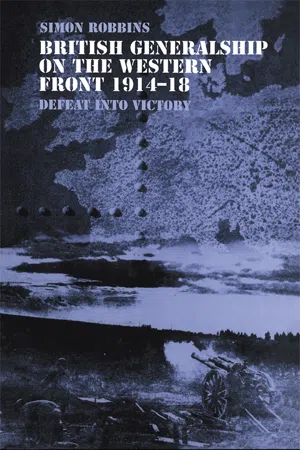
This book explores the British Army's response on the Western Front to a period of seminal change in warfare. In particular it examines the impact of the pre-war emphasis on worldwide garrison, occupation and policing duties for the Empire's defence of the mindset of the Army's leadership and its lack of preparation for a continental war involving a massive, unplanned increase in men and material.
The reasons for the poor performance in the early years of the war, notably professionalism within the British Army, including poor staff work, 'trade unionism', careerism within the high command, and the tendency of an overconfident hierarchy to ignore the need for reform to tackle the tactical stalemate prior to 1916, are analysed. The high command rapidly learnt from the defeats of 1915-16 and performed much better in 1916-18, an especially formative period resulting in the promotion of a younger, more professional leadership and the development of the first truly modern system of tactics which has dominated wars ever since.
During 1917-18 the Army's commanders and staff evolved and improved these new methods; developing a doctrine of combined arms to overcome the tactical stalemate bedevilling Allied offensives.
1 The army’s ethos and culture
We are too near the events of the Great War to see them as our descendants will see them, without prejudice and with fuller knowledge of the facts as a whole.
(Lieutenant-General Sir Noel Birch, 1920)1
History has given the British high command, during the First World War a bad reputation and the public has a deep-seated belief that many of the British offensives made between 1914 and 1918 led to needlessly heavy casualties for negligible military gain. Since the guns stopped firing over eight decades ago, the Great War has resulted in a large volume of literature of varied quality and objectivity. The conventional image of that war is one of a senseless bloodbath – a stark war of attrition conducted by unimaginative and incompetent generals and lacking any tactical innovation. There is an almost indelible image of futility produced by the heavy losses sustained on the Somme and at Passchendaele in 1916 and 1917, which puts the blame for the slaughter of British soldiers on the Western Front directly at the feet of the British Expeditionary Force’s (BEF) commanders.
British generals are still caricatured as being incompetent, mistake-prone and callous Victorians who did nothing to rectify their colossal errors. There remains a tendency, when discussing the British Army’s performance in 1914–18, to stress internal factors, usually the incompetence of Haig, General Headquarters (GHQ), and senior military commanders, devoting far more attention to the failures of 1915–17, notably the Somme and Passchendaele, than to the successes of 1917–18. The fighting on the Western Front of the Last Hundred Days in 1918, culminating with the German request for an armistice, the period on which Haig’s claim to greatness must rest, is still almost completely ignored.
In fact, technology and mechanisation, which led to improved tactics and strategy, had unlocked the German defences and from August 1918 the British Armies had triumphed in some of the greatest victories of British history. Analysis of the British Army’s internal failures does not explain the reasons for the successes of 1918. The army’s role as a colonial police force has often been regarded as a source of institutional weakness, producing an army, which fought in ‘penny packets’, lacked operational doctrine, was weak in staff work and under-gunned in heavy artillery, and in particular unable to adapt at all, even slowly and inadequately, to the challenge of defeating the German Army on the Western Front.
The true story of the First World War and its tactics is not quite so mindless or simplistic as the critics would have us believe. The wars of empire in fact produced an officer corps with vast combat and active service experience. The intensity and range of professional opportunity offered by the pre-war British Army was enormous. It is difficult to reconcile the fit, adaptable, energetic, resourceful men who served as battalion, battery, brigade and divisional commanders in 1918 with the dogma-ridden and unprofessional commanders depicted by their critics. Indeed, in the second half of 1918, the BEF finally succeeded in integrating and combining infantry, artillery, armour, and aircraft to defeat the German Army.
It is now possible to provide a more balanced understanding of the war, replacing the cherished stereotype of a futile and blundering BEF with the perception that the British Army was tactically innovative during the second half of the Great War and able to learn from past mistakes as was clearly shown by its performance and the transformation of British fortunes in 1917 and 1918. How impressive developments in tactics, staff work, training, operational planning and all-arms co-operation were introduced, codified, and implemented and at what levels the British Army progressed along the ‘learning curve’ are some of the important questions which have to be considered and answered. By examining how strategic and technical innovation, effective co-ordination and planning were handled, it is possible to evaluate the performance of the British Armies in France.
For the most part, the commanders of the British Army have remained faceless, devoid of personality or character. The British military leadership is characterised as being led by unthinking automatons, part of a ‘monolithic’ war machine. This faceless and colourless portrayal of British commanders gives little recognition to individual military prowess, and, in the end, extends oversimplified caricatures of generals as Colonel Blimps. The results are a grossly stereotyped image of British commanders. A more balanced assessment of these men both as personalities and leaders is long overdue. Undoubtedly the war saw the emergence of a tougher and younger group of leaders during the war.
Haig had good reason to be proud of his triumph in November 1918 but British victories and defeats were fundamentally the accomplishments of a specific group of men. In many ways, Haig’s subordinates are the forgotten men of the twentieth century. Haig’s subordinates are far less well known than, say, Montgomery’s lieutenants, because of Haig’s dominating personality. While the battlefield commanders of the Second World War such as Montgomery and Slim became familiar names to the British people, Birdwood, Byng, Horne, Plumer, and Rawlinson remain relatively unknown. Increasingly, as the war progressed Haig’s subordinates, resisting interference, played a major, and largely positive, role in winning the war on the Western Front but they have received little recognition or serious study.
To understand the British Army in 1914, one must comprehend something of the character and mentality of the officer corps, which was shaped by the ethos and culture of the Army’s hierarchy. In this opening chapter, the British military leadership on the Western Front is examined as a group and ‘social institution’. Every institution has a culture, the integrated pattern of behaviour that transmits knowledge and learning to succeeding generations, which can be observed in its distinctive behaviour. The Regular Army, largely cut off from British civilian society by the demands of foreign service and the distaste often displayed for army life by the middle and working classes alike, had its own unique style and identity. Who were the Army’s leaders and what were their backgrounds, ethos and culture?
In an attempt to evaluate the breadth of background, education and experience of the men who formed the High Command of the British Army biographical data has been collected on a sample of 700 senior commanders and staff officers (SOs), who served on the Western Front at divisional level and above between 1914 and 1918. The overwhelming majority (89 per cent) were British Army officers, mostly serving officers (82 per cent) but also including a small number of retired officers (7 per cent), with the rest (11 per cent) being made up of a motley mixture of officers from the Indian Army, the Territorials, the Dominions, civilian life, and even the Royal Navy (RN)!2
These war managers were born between 1854 and 1894, with 311 (44.5 per cent) being born in the 1870s; drawn from an Anglo-Saxon, Protestant, upper class or professional background. The British Army’s elite shared an Establishment and Victorian upbringing, which provided a common social background and elaborate family ties. The leadership of the BEF were members of a privileged class enjoying social prestige based on family origin and service to the state, which supplied a strong group and cohesive morale. They were a cohesive group recruited from either an aristocratic and landed-gentry background (34.5 per cent) or respectable middle-class service families (35 per cent) and a significant minority (8.5 per cent),3 such as Field-Marshals Lord Byng and Lord Cavan, Brigadier-General Hon A.M. Henley, and Major-General Hon W. Lambton, were members of the nobility. Others had aristocratic wives or family connections. A number of generals were close to the Royal Family, notably Lieutenant-General Sir William Pulteney (III Corps), who was a personal friend of the King,4 and Field-Marshal Earl Haig, whose marriage to the Queen’s lady-in-waiting took place in the private chapel of Buckingham Palace.5
The landed influence on the officer corps was still strong, with the gentry representing over a quarter (26 per cent) of the sample. The typical officer had the conventional upbringing of an upper-class Victorian gentleman. General Sir Walter Kirke, an SO throughout the war, had a typical background. The Kirkes had been the squires of Mirfield Hall, East Markham, Nottinghamshire, for several centuries but, unfortunately, the wealth associated with such an illustrious lineage had, as for many other gentry families, almost entirely evaporated by the time Walter Kirke was born.6 The second son of a Colonel, Kirke went to Haileybury, leaving at sixteen to attend a crammer to pass into Woolwich where he won the riding prize. He took up polo and racing when in the Army.7
All the available biographical and autobiographical evidence underlines the continuing influence of old established families with a tradition of military service.
This elite was traditionally drawn from gentry with a military tradition and such families continued to serve King and Country as officers in the armed services. Major-General Sir Hereward Wake was one of the Wakes of Northamptonshire, who when they were not defending the Empire, resided at the family seat, Courteenhall. General Sir Walter Congreve came from an old Staffordshire family with a tradition of service in the army and a notable ancestor in the inventor of the rocket. The County families of Tyrone and Fermanagh in Ulster produced six Field-Marshals.8
It was a narrow world whose ethos and values remained those of the landed gentlemen, who moved in ‘county’ circles. Brigadier-General Sir James Edmonds noted that ‘in 1914 the army was still very feudal in its status, and great personages, even great ladies, exercised the higher patronage’.9 Personality and connections, rather than professional expertise, continued to exert a big influence in the Army. Many officers believed, as a result, that ‘influential backing is more important than the possession of brains and professional ability’.10 For example, Haig was accused of flaunting his royal connections,11 and his rapid rise attributed partly by contemporaries to his links with the Royal family.12 A number of generals, including Allenby, Hunter-Weston, Rawlinson, Robertson, and Smith-Dorrien, kept up a long correspondence from France with the King through his private secretaries. At lower levels, aristocratic officers such as Major-Generals Lord Loch and Hon W. Lambton also had contacts with the King and were reporting on operations.
The Army’s values still espoused the traditional and leisurely lifestyle of the gentry and an officer was still expected to be a ‘Gentleman’, in an era when it was de rigueur for a ‘Gentleman’ to always carry a walking stick, which had replaced the sword as the symbol of belonging to the gentry.13 Service served to confirm one’s social status. Allenby, who looked like ‘a typical young English fox-hunting squire’,14 joined the Army because ‘other openings were limited, for commercial business was not in those days considered a suitable occupation for a gentleman’.15 In Scottish society of the mid-nineteenth century, Douglas Haig’s mother was regarded as having married beneath her class by marrying into trade (his father owned the Whiskey Distillers) and as a result he went to school in England and into an English cavalry regiment, the 7th Hussars, rather than into the Scots Greys,16 and was referred to disparagingly as ‘the opulent whiskey distiller’.17
General Sir John Burnett-Stuart, from the landed gentry in Scotland, was ‘an awful snob’ at Staff College, who allegedly socialised only with officers of the Rifle Brigade and Guardsmen.18 If a person had the proper background as a gentleman, it could be assumed that he would have the proper abilities as an officer. Major-General Sir Robert Rice, ‘a fine type of a loyal and determined English gentleman, ready to do his duty whatever required and regardless of his rank’,19 was the ideal officer. In 1914 Major-General Sir Frederic Glubb reminded his son ‘that you are also a gentleman, a simple honest English gentleman – you cannot be anything better whatever you are’.20
Officers were ‘expected to have more sense of chivalry and honour’21 and conduct themselves in accordance with a code of behaviour based upon ‘standards of morality, manners, and honesty, qualities we have been taught to regard as sacrosanct, and a peculiar heritage of our race’.22 The Army’s code was largely implicit and unwritten. A gentleman knew when he...
Table of contents
- Cover Page
- Title Page
- Copyright Page
- Acknowledgements
- Abbreviations
- Sources
- 1: The army’s ethos and culture
- 2: The decline and fall of an army
- 3: The brain of an army
- 4: Developing a professional leadership
- 5: The army’s over-ambitious decision-making
- 6: Training for victory
- 7: Tactical innovation
- 8: A strategy for victory
- Conclusion
- Notes
- Appendices
- Bibliography
Trusted by 375,005 students
Access to over 1.5 million titles for a fair monthly price.
Study more efficiently using our study tools.
Frequently asked questions
Yes, you can cancel anytime from the Subscription tab in your account settings on the Perlego website. Your subscription will stay active until the end of your current billing period. Learn how to cancel your subscription
No, books cannot be downloaded as external files, such as PDFs, for use outside of Perlego. However, you can download books within the Perlego app for offline reading on mobile or tablet. Learn how to download books offline
Perlego offers two plans: Essential and Complete
- Essential is ideal for learners and professionals who enjoy exploring a wide range of subjects. Access the Essential Library with 800,000+ trusted titles and best-sellers across business, personal growth, and the humanities. Includes unlimited reading time and Standard Read Aloud voice.
- Complete: Perfect for advanced learners and researchers needing full, unrestricted access. Unlock 1.5M+ books across hundreds of subjects, including academic and specialized titles. The Complete Plan also includes advanced features like Premium Read Aloud and Research Assistant.
We are an online textbook subscription service, where you can get access to an entire online library for less than the price of a single book per month. With over 1.5 million books across 990+ topics, we’ve got you covered! Learn about our mission
Look out for the read-aloud symbol on your next book to see if you can listen to it. The read-aloud tool reads text aloud for you, highlighting the text as it is being read. You can pause it, speed it up and slow it down. Learn more about Read Aloud
Yes! You can use the Perlego app on both iOS and Android devices to read anytime, anywhere — even offline. Perfect for commutes or when you’re on the go.
Please note we cannot support devices running on iOS 13 and Android 7 or earlier. Learn more about using the app
Please note we cannot support devices running on iOS 13 and Android 7 or earlier. Learn more about using the app
Yes, you can access British Generalship on the Western Front 1914-1918 by Simon Robbins in PDF and/or ePUB format, as well as other popular books in History & Military & Maritime History. We have over 1.5 million books available in our catalogue for you to explore.