Young black women bear all the hallmarks of a fundamentally unequal society. They do well at school, contribute to society, are good efficient workers yet, as a group they consistently fail to secure the economic status and occupational prestige they deserve.
This book presents a serious challenge to the widely held myth that young black women consistently underachieve both at school and in the labour market. In a comparative study of research and writig from America, Britain and the Caribbean Young, Female and Black re-examines our present understanding of what is meant by educational underachievement, the black family and, in particular, black womanhood in Britain.
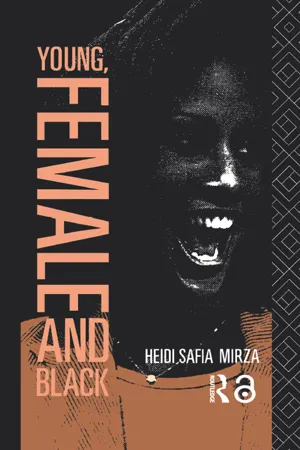
- 248 pages
- English
- ePUB (mobile friendly)
- Available on iOS & Android
eBook - ePub
Young, Female and Black
About this book
Information
Topic
EducationSubtopic
Education GeneralChapter 1
Introduction
Universal education—that is, compulsory, free schooling for all—is an essential and valued aspect of liberal democratic society. Its promise of social mobility through the acquisition of academic credentials offers each individual, regardless of social origin, the dream of equality. However, in spite of this meritocratic ideal, inequality among certain groups has remained endemic. One such group is African Caribbean women. This book, an investigation into the factors that influence the job choices of young black female school leavers, is an attempt to understand the process of inequality which so clearly structures their lives.
In the late seventies the work of the cultural reproductionists dominated the analysis of social inequality in Britain. During this time Paul Willis, an influential scholar within this tradition, asked the question, ‘How is it that working-class kids come to get working-class jobs?’ His answer was very perceptive; he put forward the notion of the ‘counter-school culture’. The counter-school culture was a culture of resistance to school and the authority it imposes. Willis suggested that young white men, through their own activity and ideological development, reproduce themselves as a working class. It was a radical and challenging observation.
In the eighties the notion of ‘subcultures of resistance’, the legacy of the cultural reproductionist school of thought, became the perceived wisdom for not only explaining the persistence of working-class inequality, but also sexual and racial inequality. But what if some ‘kids’ identify with school, do relatively well, but still fail to attain the jobs they have aspired to? If such an anomaly exists it calls into question the operation of the counter-school culture and other cultures of resistance.
However, it is exactly this phenomenon, positive educational orientation in the context of persistent labour market inequality, that is the collective experience of young black British women. Despite this contrary evidence, subcultural analysis has become, and remains, the major influence on the small but distinct body of scholarship which examines the experiences of young black women in Britain.
This preoccupation with subculture has had far-reaching consequences for the study of black women in Britain. Romantic notions of black female subcultures of resistance prevail in both our commonsense and academic discussions. At the core of these representations has been the belief that black females are motivated primarily through identification with their ‘strong black mothers’. The matriarchal family structure, in which motherhood takes on a special meaning, is seen as a resource. It is implied that the maternal role model provides black women with special powers of endurance which especially equip them in their struggle against racism and sexism at home, in school and the work place.
While black women clearly do have strong cultural traditions that are historically distinct, such a celebratory emphasis is analytically naïve for several reasons. Firstly, it marginalises men, who, in many ways, have a part to play in the lives of the majority of black women. Secondly, it confuses the issue of external structural economic inequality with an analysis of internal cultural traits. The effect of both these oversights has been, ultimately, to turn our attention away from looking at the importance of racial and sexual discrimination, in favour of focusing on cultural determinants to economic success or failure, and in particular has been responsible for reifying black motherhood.
This book, in which I follow the experiences of a group of young black British women as they leave school to enter the world of work, is an attempt to move away from the established emphasis on sub-cultural identity, towards a more structural understanding of the process of inequality. Such an account turns our attention towards the central role of the educational system in maintaining social and economic disadvantage. Chapters 3, 4 and 5, which examine the schooling experiences of young black women, focus on the institutional constraints to equality of opportunity.
To accommodate this shift towards a more structural emphasis in analysis it is necessary to re-appraise our present understanding of what is meant by educational underachievement, the black family and, in particular, black womanhood in Britain. In the context of research and writing from America and the Caribbean, a comparative consideration of the central arguments within social and educational research, race relations and feminist thought is undertaken in Chapters 2, 6, 7 and 8.
THE STUDY
This study attempted to combine a longitudinal survey approach, with what can be described as essentially a school-based ethnographic study. Despite the difficulty of combining these two distinct methodological perspectives into what may be called a ‘multidimensional framework’, it did offer a satisfactory means of studying the complex influences that affect the career aspirations and expectations of young black women.
The 62 young black women in this study, who were aged between 15 and 19 years, attended two comprehensive schools in south London. The girls and their black and white male and female peers, who numbered 198 in all, and who could be objectively identified as coming from working-class homes, answered questionnaires, and were interviewed and observed in their homes and classrooms over a period of 18 months.
In each school a random sample was drawn from the fifth- and the sixth-form pupils. From St Hilda's, a co-educational Catholic school, 128 (65 per cent) black and white male and female pupils were taken, whereas 70 (35 per cent) were taken from St Theresa's, a single-sex, Church of England school. Of these 62 (31 per cent) were African Caribbean young women; 13 (7 per cent) were African Caribbean young men; 77 (39 per cent) were ‘other’ young women; and 46 (23 per cent) were ‘other’ young men.
This sample, it must be stressed, was an ‘observed’ sample (that is, specific in its location) and therefore is not necessarily representative of the ‘accessible’ target population. Inferences drawn from these data therefore relate only to the population at hand and are not meant to lead to generalisations about the population as a whole.
In terms of their age, ability ranges, gender and ethnic groupings, this subpopulation of the fifth and sixth years did, however, reflect the various characteristics of the general school populations. Thus the sample had not only large numbers of girls (one school was an all-female school), but also few black males (St Hilda's, the co-educational school, was situated in an area of lower ethnic concentration).
The sample included a wide range of ethnic and racial groups not of African Caribbean origin. Because the place of birth of 94 per cent of the sample was the UK (99 per cent of black girls were British born), the ethnic origin of pupils was gauged by looking at the mothers' place of birth. Using this method 38 per cent of the sample were second-generation West Indian, 25 per cent were of Irish descent and only 27 per cent were of British parentage.
It is recognised that ethnic differences are substantial and distinctions between groups are important to make. Other secondgeneration, non-white pupils, though small in number, were therefore broadly classified as Asian, African, Southern European and Far Eastern. Of these 2 per cent were of Asian origin (from India and Pakistan); 3 per cent African (Nigeria and Sierra Leone), 4 per cent Southern European (Italy, Spain, Greece); and 1 per cent Far Eastern (Hong Kong and Vietnam).
Establishing the social class background of the sample was complex. The conventional procedure is to take the social class of the male head of household as representative of the social class of the family. However, for my purposes this was not an acceptable precedent as it offered no accurate way of measuring the social class of many West Indian families which were often headed by a female, even when a male was present.
It could be argued that because West Indian women so often fulfil the criteria established by conventional stratification analysts, being consistent and sustained contributors to the family income, they qualify as being eligible to define the social-class status of their families.
It was assumed, therefore, in this study that either the mother or the father, whoever could most appropriately fulfil this criterion, should define the social class of the family according to the classification system used by the Registrar General (OPCS 1980). If both the male and the female contributions were assessed as ‘equal’ by this criterion (that is, both worked full-time; travelled to work and so on), then the earner with the higher social class was taken to be the indicator of the family's social class, be they male or female.
Rather than introducing bias into the study, this method offers a more accurate reflection of the social and economic experience of the West Indian family. What appeared to be a completely working-class West Indian cohort if measured in terms of paternal social class, is by a culturally valid redefinition, now no longer ‘objectively’ classified as such. With many mothers located in social class 1 and 2 occupations these West Indian families are upwardly placed in the occupational hierarchy. It should be noted that within a redefinition of social class the family background of the white male and female pupils remains almost unchanged.
However, the working and living conditions of West Indian women in these professional occupations do not imply that they enjoy the same standards of living as whites, and in particular as white men, who are classified in similar occupational groupings (that is, qualified and well-educated nurses are in social class 2 yet paid very poorly). However, by other social-class criteria the West Indians did show differences from their white working-class counterparts; for example, they tended towards home ownership.
Using this method, 44 per cent of the black females in this study were from homes where the head of household held a professional, intermediate or managerial position; 48 per cent came from skilled manual and semi-skilled/unskilled backgrounds. Figures more accurately reflecting the dichotomy of job levels known to exist for black women in the British economy since the 1950s to the present day (Employment Gazette 1991).
In contrast, only 13 per cent of their female white counterparts came from professional households. The majority, 64 per cent, came from a working-class, skilled manual or semi-skilled/unskilled family background.
The sample also reflected the various ability ranges that were present in the schools. Applying the categories of the official ILEA banding system the African Caribbean pupils were, as other studies also show, disproportionately represented in the lower streams.
Among the black females 23 per cent were to be found in the high stream while 53 per cent were classified to be of low ability. No young black men were in the top stream but 77 per cent were in the lowest stream. In contrast, 44 per cent of the white female sample were high ability and 30 per cent low ability.
Other characteristics of the sample, such as family size, numbers of brothers and sisters, place of residence, male/female guardian, type of house, and experience at primary school were also investigated.
There was also a smaller random subsample of 27 younger pupils, aged 13–14 years who were in their third year of schooling. They contributed to the study by participating in informal discussions and answering ‘spot’ questionnaires regarding their subject and job choices.
In addition 30 young women from a school in Trinidad aged between 16 and 18 years participated in semi-structured interviews concerning their career choices and attitudes to marriage and relationships.
In youth clubs and community centres 16 young women also participated in the study. Informal discussions and exchanges with these women, aged 18+, provided additional information on the African Caribbean, British, female post-school-leaver attitudes to and experience of the labour market.
Schoolteachers, headteachers, careers officers and college staff from several institutions also contributed to the study. Interviews with them were carried out in the formal setting of their respective offices and classrooms. However, these interviews, though in formal surroundings, were not structured but focused on matters of interest.
Parents of several of the pupils also participated in the study. In-depth informal interviews were undertaken within their own homes and at meetings held in the schools.
It was a coincidence that both schools in the study had a recent history of being involved in educational research projects. As a consequence the staff in particular were familiar and at ease with the presence of a researcher and the research situation. Because of their positive relationship in the past with outside educational researchers, when approached by the ILEA, the headteachers of both schools felt uninhibited about giving me permission to carry out my research project in their respective schools.
The two schools were studied simultaneously; that is, I spent one day in one school and then the next day in the other. Depending on the time-table, some days I would spend half a day in one and the other half in the other. On other occasions I might spend several days at one school only.
General observations were made about the school, the daily regime, the headteacher's role, and so on. General staffroom observation was also undertaken, and school meetings were attended. Classroom observation constituted a major part of my time spent in the field. I attended many classes and lessons, in which my interest was not only to observe teacher-pupil interaction but other classroom situations. In particular I was interested in curriculum content and teaching effectiveness.
The observations in the school were recorded by a system of daily diary-keeping. I used short-term recall and wrote down observations, if possible at the time, but if not soon after the event, during recreation or lunch, after school, or in the privacy of the staffroom. I dated diaries and subsequently indexed them.
The questionnaire was designed primarily to obtain details of school experience and home background (including the social class of the respondent), in order to establish the factors that influence occupational aspirations and expectations of black and white, male and female pupils. It was administered to all 198 pupils in the study during their class time, and in particular their careers lessons.
The questionnaire endeavoured to place the ‘objective’ criteria affecting career choice, such as social and family background, culture and economic status, in the context of individual, ‘subjective’ preferences being made with regard to future occupations.
A postal follow-up questionnaire was sent to 72 of the young black men and women in the study four years after the initial survey. This questionnaire was designed to find out the subsequent educational and/or labour market destinations of the pupils and was only sent to the black leavers.
Formal and semi-formal interviews were conducted at the several different sites of the study. Formal interview situations were set up in the two schools. Different groups of pupils were asked questions guided by a detailed, structured interview schedule. Each group was selected from among the pupils in the study according to their race, gender and school ability allocation. For example, some groups were all female, others just black female, while others were mixed in terms of gender and race. The interviews, undertaken with different groups of pupils, provided good ‘control’ conditions for interviewing. Formal interview data were taped and later transcribed.
During the year spent in the schools, informal interviews were conducted among the fifth- and sixth-year pupils contributing data of a less ‘controlled’ nature. Less formal interviews were also conducted elsewhere in the study. For recording informal interviews, and in an effort to maximise reliable reporting, I used both short recall and more often, note-taking, done as unobtrusively as possible if the situation allowed.
Additional data on the pupils were available in the schools from records and reports. In both schools data were also available on mock and final examinations results. Details about the pupils, such as verbal reasoning scores, punctuality, attendance, conduct and teachers' comments, were available in individual pupil records and provided an invaluable source of information.
A useful source of information on the third-year pupils came from quick, one-word, written responses to seven short questions regarding their career choices and social background. It was a simple and easy way to get structured information without administering the long, detailed and fairly complicated questionn...
Table of contents
- Front Cover
- Young, female and black
- Title Page
- Copyright
- Dedication
- Contents
- Acknowledgements
- 1 Introduction
- 2 The myth of underachievement
- 3 Do schools make a difference?
- 4 Life in the classroom
- 5 Entering the world of work
- 6 Strategic careers
- 7 Redefining black womanhood
- 8 Family matters
- 9 Conclusion: understanding inequality
- Notes
- Bibliography
- Name index
- Subject index
Trusted by 375,005 students
Access to over 1.5 million titles for a fair monthly price.
Study more efficiently using our study tools.
Frequently asked questions
Yes, you can cancel anytime from the Subscription tab in your account settings on the Perlego website. Your subscription will stay active until the end of your current billing period. Learn how to cancel your subscription
No, books cannot be downloaded as external files, such as PDFs, for use outside of Perlego. However, you can download books within the Perlego app for offline reading on mobile or tablet. Learn how to download books offline
Perlego offers two plans: Essential and Complete
- Essential is ideal for learners and professionals who enjoy exploring a wide range of subjects. Access the Essential Library with 800,000+ trusted titles and best-sellers across business, personal growth, and the humanities. Includes unlimited reading time and Standard Read Aloud voice.
- Complete: Perfect for advanced learners and researchers needing full, unrestricted access. Unlock 1.5M+ books across hundreds of subjects, including academic and specialized titles. The Complete Plan also includes advanced features like Premium Read Aloud and Research Assistant.
We are an online textbook subscription service, where you can get access to an entire online library for less than the price of a single book per month. With over 1.5 million books across 990+ topics, we’ve got you covered! Learn about our mission
Look out for the read-aloud symbol on your next book to see if you can listen to it. The read-aloud tool reads text aloud for you, highlighting the text as it is being read. You can pause it, speed it up and slow it down. Learn more about Read Aloud
Yes! You can use the Perlego app on both iOS and Android devices to read anytime, anywhere — even offline. Perfect for commutes or when you’re on the go.
Please note we cannot support devices running on iOS 13 and Android 7 or earlier. Learn more about using the app
Please note we cannot support devices running on iOS 13 and Android 7 or earlier. Learn more about using the app
Yes, you can access Young, Female and Black by Heidi Safia Mirza in PDF and/or ePUB format, as well as other popular books in Education & Education General. We have over 1.5 million books available in our catalogue for you to explore.