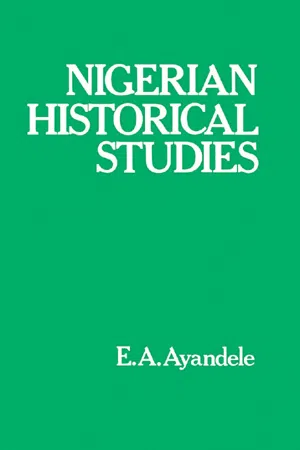
First Published in 1979. The collection of writings brought together in this book was written within the last ten
years in different circumstances and for different purposes. However, they have one thing
in common: they were intended to shed new light, or strike new depths, or widen scope of
knowledge on some aspects of Nigerian history in the context of the author's researches.
- 305 pages
- English
- ePUB (mobile friendly)
- Available on iOS & Android
eBook - ePub
Nigerian Historical Studies
About this book
1
How Truly Nigerian is our Nigerian History?
Although the conscious application of the academic mind to the study of the African past has been going on for less than a quarter of a century, sufficient progress has been achieved to justify a number of searching questions. Up to date, and quite rightly, such questions have been mainly historiographic, underlining the peculiar methodological challenges and problems confronting the historian of Africa. They have been concerned with the variety of sources the historian may have to tap, the care he must take to winnow European activity per se from the documents, the avid interest he should take in other disciplines, and so on.
In this chapter, I shall take the availability and fruitfulness of sources for granted, and deal rather with questions of interpretation and approach. More specifically, I shall deal with five kinds of imbalance in current historical writing about Nigeria. First, there is the tendency of historians to allow relations between the peoples of the Atlantic seaboard and the European intruders to dominate, if not monopolize, their writings—a tendency which gives the impression that the history of these peoples is made up entirely of such relations. Second, there is the serious error of interpreting the external relations of the seaboard peoples against the background and interests of the European intruders. Third, there is the over-emphasis on factors making for disunity and the neglect of factors making for unity which characterizes much writing on the pre-colonial period. Fourth, there is the fact that the large ethnic groups receive a great deal of attention from historians whilst smaller groups receive practically none. Fifth, and most important of all, there is the tendency to write the history of the cream of society rather than of the people.
With the singular exception of the Yoruba peoples, whose nineteenth century warfare and urban development have been studied in their own right,1 internal developments among the seaboard peoples have so far been relegated to the background. The emphasis has been on the relations of the Edo, the Ijaw, and the Efik with the world of Europeans. Even the historical writings on the Yoruba cannot be entirely absolved from criticism on this count, for writings on the Ẹgba and on the Ijẹbu nineteenth century pertain far too strongly to the relations of these peoples with the British. And what evidence have we that relations with the European intruders provided the most important events in the nineteenth century experience of the peoples of Southern Nigeria? Were there not exclusively internal happenings during the period which weighed as heavily, if not more so, on the minds of these peoples?
The two scholarly studies of the Ẹgba and the Ijẹbu in the nineteenth century may be used to illustrate this point. In his excellent pioneering work on the Ẹgba,2 Dr Biobaku finds it difficult to discuss their politics, economics, and social life except in relation to British influence. And yet there is ample evidence to show that relations with the British in Lagos provided no more than some out of the many events which the Ẹgba regarded as crucial features of their experience in the second half of the nineteenth century, and that there were political, social, and economic events, by no means determined by the British presence in Lagos, which constituted the real core of Ẹgba history during this period. One may mention the constitutional experimentation between 1845 and 1891 on which there is ample material; the internal bickering among the innumerable chiefs, which resulted in the weakening of solidarity after the abortive Dahomian attack of 1864; the economic relations with Ẹgbado and Ijẹbu which made Ketu, Ibẹrẹkodo, and Ipẹru important markets for the Ẹgba; the frequent smallpox epidemics and the annual destruction of houses by fire; the implacable adherence of the Ẹgba to their traditional religion.3 Similar comments are applicable to Dr Ayantuga’s work on nineteenth century Ijẹbu history.4 Despite the title of Dr Ayantuga’s thesis on this subject, the substance of his achievement is his analysis of Anglo-Ijẹbu relations. And yet a perusal of the historical names of Ijẹbu Ode age-grades up to the eve of the 1892 expedition gives us one among many indications that during this period it was events inside Ijẹbuland that engaged the thoughts of the people—not the diplomatic negotiations between their rulers and the British, and not the ideas about Ijẹbuland entertained by the British and by the Ijẹbu Saro5 based on Lagos.6
No less serious is the infection of historical thinking by overweighting of the alien economic and political interests of the Europeans—interests which obviously inspired the despatches of consuls, governors, and traders to the Colonial or Foreign Office. Thus the matter-of-life-and-death attitude of these intruders to trade-routes—an attitude determined by their metropolitan economic milieux—has pervaded historical writing on Southern Nigeria.7 The African attitude, determined by consideration of the political implications of open routes, has been largely ignored. When the Ẹgba and the Ijẹbu persistently closed their routes to the British in Lagos, these peoples were conveying the message that they did not look upon routes in predominantly economic terms, that they would not have economic relations with the intruders at the expense of their sovereignty and territorial integrity, and that European presence on the coast was not a sine qua non for their existence and wellbeing.8 The same argument holds for the Enyong, Akunakuna, and Umon peoples of the Cross River. These peoples did not regard the palm oil trade with the British, through the Efik, in the way that British industrialists and traders looked at it. For these peoples sovereignty came first; and since their sovereignty was threatened by the British desire for unrestricted and direct movement along the river, they preferred to withhold oil from the British rather than allow the intruders to violate their frontiers.9
Emphasis on factors making for disunity at the expense of factors making for unity has been a striking feature of writing on the pre-colonial era. In our generation this approach has been particularly encouraged by writers of local histories who seek to project presentday political animosities into the past by emphasizing ethnic or sub-ethnic exclusiveness and denying the existence of excellent neighbourliness, co-operation, community of feelings, and sense of identification. Such a wholly negative approach obviously contributes to present-day political difficulties. More important in the context of the present discussion, it is almost certainly unhistorical.
Much as we are entitled to draw attention to the precolonial wars between the Fulani and the Nupe, the Sura and the Angass, the Ifẹ and the Ondo, the Ibani and the Kalabari, we are not telling the whole story unless we also stress the factors for unity and cooperation that existed before the advent of the white man. And these factors were many. Consider for example the mosaic of inter-state routes that linked the south and the north; and think not only of the economic role the routes played but also of the diffusion along them of religious, social, and political ideas. Few people realize that in the eighteenth century the natron used by the Efik came largely from the Chad basin; that in the same century the Ijẹbu were the specialist makers of a coarse type of cloth used by slaves and poor people in Northern Nigeria; that up to 1830 the larger part of what is now Nigeria regularly patronized the market of Kulfu, near present-day Kontagora; that for a long time the Edo trafficked with the Nupe and bartered their camwood for manufactured articles of northern origin;10 that as late as the second half of the nineteenth century, the Nupe were the most excellent weavers in the textile establishments of the cities of the far north; that Ijaw men from Nembe were trading directly as far north as the Nupe kingdom before 1841; that the Yoruba obtained their horses from Tripoli through Kanuri middlemen long before the nineteenth century; that, as slaves, a large number of Hausa were an economic asset to the Yoruba. Even Igboland was not completely closed to the rest of Nigeria before the advent of the British; trade went on between the Igbo and their neighbours, and many Igbo went to the north as slaves.11
Historical writing should also accord due recognition to the large political units and empires which embraced diverse peoples and, for varying periods, achieved stability and commanded the loyalty of their component groups. Of these, the Kororofa Empire, the Edo Kingdom, and the Old Ọyọ Empire are examples that readily come to mind. In terms of vision, the jihadists of the nineteenth century deserve some credit for the capacity at least to dream of a Caliphate that would embrace all the areas that lay between the Hausa States and the sea.
A final point worth considering in any discussion of factors making for unity is the fact of the harmonious relations which existed between rulers on the inter-state level. The commonest way in which rulers got in touch with each other involved correspondence by symbolic messages. I have come across evidence that in December 1842 messengers of the Sultan of Sokoto were with Ṣodẹkẹ in Abẹokuta;12 that the Sultan of Sokoto made some effort to pursuade the Yoruba to end their civil war,13 that Balogun Ogundipẹ, the uncrowned king of the Ẹgba for nearly a quarter of a century, offered advice to the Etsu of Nupe in 1870.14
In a multi-ethnic nation like Nigeria, the question arises: which ethnic groups should have their activities given preference to and treated as representing historically crucial episodes? Perhaps the biggest danger here is the tendency to see the history of Nigeria as the history of its three largest ethnic groups.
This danger scarcely arises for periods before the twentieth century. For such periods, evidence of all kinds is relatively thin, and people are forced to write about those groups which are represented in it and neglect those groups which are not represented. To date, historians of Nigeria have depended very heavily on written documents; and for periods before the nineteenth century such documents seem, if anything, to favour the study of the smaller ethnic groups. Thus many smaller groups such as the Edo, Ijaw, and Efik feature prominently in them, whilst major ethnic units such as the Yoruba and Igbo scarcely appear. For the nineteenth century, the balance is somewhat different. Several additional smaller units turn up in the documents, but so do the Yoruba and the Hausa- Fulani. However, several middle-sized groups such as the Ibibio, the Borgawa, and the Maguzawa Hausa still remain off-stage, and so too do the Igbo. Though an increasing expertise in the use of oral tradition may swell the bulk of the evidence and partially change the existing balance of emphasis, it seems unlikely that these early periods will ever lend themselves to the ‘big group only’ treatment.
It is in the present century that the danger becomes real. So far as the last seventy years are concerned, there is a mass of written documentation and rich oral tradition to exploit for almost every ethnic group in the country—large or small. Inevitably, this embarrassment of riches brings with it a very real problem of selection. And if the present tendency to write the history of one’s own ethnic group continues, selection is bound to favour the three giant ethnic units at the expense of the remaining five hundred-odd minor groups. Selection on such a basis is bound to be detrimental to Nigerian historiography. First of all, we have no justification for assuming that economic, political, and social developments among the major ethnic groups provide valid models for developments among the minor groups. Second, the intrinsic interest of social and cultural institutions is frequently out of all proportion to the number of people who support them. One has only to reflect on the intricacies of secret society government among the Ekoi, the rich complexity of music among the Igede, the development of an art practised entirely for its own sake in the masquerade ballet of the Kalabari, the evolution of a unique and austerely beautiful sculptural style among the Afo, to realize the truth of this proposition. Third, even in terms of their impact on the broader cultural and political scene, the importance of small ethnic groups is frequently out of all proportion to their numbers. Here again, Ekoi secret societies provide an apt example, for these institutions, with their awe-inspiring cult-houses and their apparatus of masked executives, have been borrowed and sometimes re-fashioned by a great diversity of neighbouring peoples. Thus we find their offspring in many of the States of the central Cameroons, among the Efik and some of the Ibibio, and among a number of the more easterly Igbo groups. To take a more radically contemporary example, the importance of the Bachama people in the Federal Army is out of all proportion to the size of the ethnic group they hail from. And so too is the importance of the Ijaw in the naval and amphibious operations of the Federal forces.15
I now come to the fifth and most important kind of imbal-ance in historical writing about Nigeria: the tendency to write the history of the cream of society rather than of the people.
With regard to Africa generally, it is questionable how far historical writing to date can claim that its accounts are more of the people than of a section of the people. There has been a tendency among historians to study the past of peoples—the Fon, the Ijaw, the Ndebele, the Funj, and the Arab-Berbers, to name but a few—through the spectacles of their kings. It can of course be argued that in certain respects, for example in their resistance to imperialist European intruders in the nineteenth century, Mzilikazi of the Ndebele, Ademiyẹwo Fidipotẹ of the Ijẹbu, Jaja of Opobo, Mohammed Ali of Egypt, and Moulay Abdel Rahman of the Sherifian Empire were authentic spokesmen for their peoples. But this does not justify the inclination of historians to give almost exclusive attention to the rulers and to assume that all important events in the experience of their peoples revolved around them.
Historical writing on Nigeria is no exception to the general trend. Many professional historians of this country, in writing about the last century and a half, have given us, albeit unwittingly, what amounts to a history of the aristocracy. This aristocracy may be subdivided into two categories. On the one hand, there are the traditional patricians—e.g. kings, emirs, chiefs, and nobility (the latter being exemplified by the Aro and the Fulani). On the other, there are the parvenu patricians conventionally referred to as the ‘educated elite’. It was members of this numerically insignificant aristocracy who were presented over Radio Nigeria on the eve of independence as ‘eminent’ and ‘Nigerian’.16 It is through the biographies of members of this class—Shehu dan Fodio, Nana Olumu, Jaja, Bishop Samuel Ajayi Crowther, and James Johnson—that what are regarded as the salient developments in Nigeria over the past one hundred and fifty years are being portrayed. This way of looking at the Nigerian past raises a crucial point in the philosophy of history; and it is a matter over which we should begin to have second thoughts.
In the first place, it is clear that our selection of individual members of this class for the honorifics ‘eminent’ and ‘Nigerian’ is based more on values and aspirations derived from the modernized sector of the country’s present day life than on the opinions of the masses in the society which these individuals inhabited. This is particularly obvious in the case of the Saro, who made up the greater part of the parvenu patrician class in the nineteenth century. Not only were the mental, cultural, social, and political aspirations of these expatriates at variance with those of the vast, unlettered majority. Most of this majority did not even see them as a part of their own society, let alone as makers of its history. Thus the Saro were actually disowned in Lagos, where in 1855–6 the indigenes wished to expel them,17 and in Abẹokuta, where in 1891 the authorities begged them to leave.18 In Ibadan, where they were few and far between, they were looked upon with undisguised contempt. In the Niger Delta and Lower Niger areas, they were looked upon, in the words of a CMS secretary, as ‘Black Englishmen’.
Despite these facts, historical writing on Nigeria has focused its attention on the largely unaccepted Christian religion paraded by the parvenu aristocracy,19 on their aversion to the all-essential institution of slavery, on their ill-digested, alien-orientated, political and constitutional aspirations,20 on their infinite hope in the triumph of ...
Table of contents
- Cover Page
- Title Page
- Copyright Page
- Acknowledgments
- Preface
- 1 How Truly Nigerian is our Nigerian History?
- 2 Britain and Yorubaland in the Nineteenth Century
- 3 The Yoruba Civil Wars and the Dahomian Confrontation
- 4 Observations on Some Social and Economic Aspects of Slavery in Pre-Colonial Northern Nigeria
- 5 Background to the ‘Duel’ between Crowther and Goldie on the Lower Niger, 1857–85
- 6 The Relations between the Church Missionary Society and the Royal Niger Company, 1886–1900
- 7 The Missionary Factor in Northern Nigeria, 1870–1918
- 8 The Collapse of ‘Pagandom’ in Igboland
- 9 The Missionary Factor in Brass, 1875–1900: A Study in Advance and Recession
- 10 The Phenomenon of Visionary Nationalists in Pre-Colonial Nigeria
- 11 The Colonial Church Question in Lagos Politics, 1905–1911
- 12 Lugard and Education in Nigeria, 1900–18
- 13 The Ideological Ferment in Ijẹbuland, 1892–1943
Trusted by 375,005 students
Access to over 1.5 million titles for a fair monthly price.
Study more efficiently using our study tools.
Frequently asked questions
Yes, you can cancel anytime from the Subscription tab in your account settings on the Perlego website. Your subscription will stay active until the end of your current billing period. Learn how to cancel your subscription
No, books cannot be downloaded as external files, such as PDFs, for use outside of Perlego. However, you can download books within the Perlego app for offline reading on mobile or tablet. Learn how to download books offline
Perlego offers two plans: Essential and Complete
- Essential is ideal for learners and professionals who enjoy exploring a wide range of subjects. Access the Essential Library with 800,000+ trusted titles and best-sellers across business, personal growth, and the humanities. Includes unlimited reading time and Standard Read Aloud voice.
- Complete: Perfect for advanced learners and researchers needing full, unrestricted access. Unlock 1.5M+ books across hundreds of subjects, including academic and specialized titles. The Complete Plan also includes advanced features like Premium Read Aloud and Research Assistant.
We are an online textbook subscription service, where you can get access to an entire online library for less than the price of a single book per month. With over 1.5 million books across 990+ topics, we’ve got you covered! Learn about our mission
Look out for the read-aloud symbol on your next book to see if you can listen to it. The read-aloud tool reads text aloud for you, highlighting the text as it is being read. You can pause it, speed it up and slow it down. Learn more about Read Aloud
Yes! You can use the Perlego app on both iOS and Android devices to read anytime, anywhere — even offline. Perfect for commutes or when you’re on the go.
Please note we cannot support devices running on iOS 13 and Android 7 or earlier. Learn more about using the app
Please note we cannot support devices running on iOS 13 and Android 7 or earlier. Learn more about using the app
Yes, you can access Nigerian Historical Studies by E.A. Ayandele in PDF and/or ePUB format, as well as other popular books in History & World History. We have over 1.5 million books available in our catalogue for you to explore.