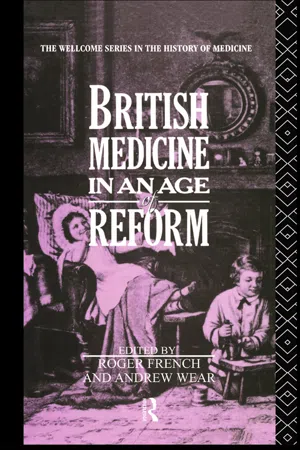
British Medicine in an Age of Reform, charts the nature and dynamics of the radical changes which occurred between 1780 and 1850 - a great turning point in British medicine. Medicine was reformed just as politics was being reformed. It became a recognizable profession, and at the same time there was an impetus from within to base the subject upon science. By the end of the 1850's medicine had become perceptibly `modern'.
Contributions by acknowledged experts cover subjects from Apothecaries' Act of 1815 to froensic medicine, and the effect of scientific medicine on the doctor-patient relationship. Fascinating and detailed, British Medicine in an Age of Reform provides a rich source of information for students of social history, the history of medicine and science, and for those working in the medical profession.
- 272 pages
- English
- ePUB (mobile friendly)
- Available on iOS & Android
eBook - ePub
British Medicine in an Age of Reform
About this book
1
Reforming the patient in the age of reform: Thomas Beddoes and medical practice
Roy Porter
In the age of reform, one of the institutions thought ripest for reformation was medicine. Endless meetings were addressed and pamphlets published promoting that cause, and the ensuing modernization of medicine has generally been seen as a self-evidently good thing.1 After all, was not the old order vitiated by closed, oligarchic corporations, the decay of medical education, whether at Oxbridge or in the antiquated apprenticeship system for training common practitioners, by a paucity of qualified doctors, and certainly by a lack of skill— while all the time the toadstool millionaires were left to multiply unchecked? By contrast, the new order the reformers eventually succeeded in building was graced by more meritocratic colleges, the emergence of the family doctor, the parliamentary enforcement of minimum entry requirements, the marginalization of the unqualified, the establishment of the Medical Register and the General Medical Council, and the brisk new professionalism of the British Medical Association, the British Medical Journal, and the Lancet: improvement all round.
Just how far—or, better, perhaps, how little—today’s historians can accept this traditional tableau of reform triumphant is a crucial question for this book as a whole—one which will not, however, be further explored here.2 My aim, rather, is to examine a particular neglected facet of the reformist agenda.
Thanks to the researches of Sidney Holloway, Ivan Waddington, Irvine Loudon, and others, we are now better informed about the aims and claims of ordinary provincial practitioners in the decades from the 1790s, and about the activities of their central spokesmen, such as Thomas Wakley, founder of the Lancet.3 They wanted to change medicine from above and below. At its head, the medical colleges formed one target: their portals must be opened or their teeth must be drawn. At its foot, cowboy practice had to be ended, quackery outlawed, or, at least, empirics regularized. In this recent historiography of medical modernization, which sheds new light upon the aspirations and interests of the practitioners themselves, one reformist drive has, however, remained ignored: the desire to reform the patient.
Medical historians long neglected the dynamics of bedside practice. Then, in the 1970s, our understanding of the history of patient/doctor relations was significantly advanced by the sociologist Nicholas Jewson, who contended for the influential role of the (wealthy) patient in pre-1800 clinical medicine.4 Drawing upon Jewson’s pioneer, if rather abstract, articles, empirical investigations have subsequently been laying bare the micro-politics of common-or-garden practice, seen ‘from below’ or ‘from the patient’s point of view’. We now have a richer grasp of a traditional, client-orientated system, in which attention was granted to the sick person’s own ‘history’, diagnostic hunches, and even therapeutic preferences.5 These were the tacit norms —professional, cognitive, and commercial —within which practitioners typically had to operate, like it or not. But what did doctors think about such terms of service? How did they regard their clients? And how, and how far, did they want clinical relations to change?
Obviously, those campaigning to curb quacks and correct the colleges pledged heartfelt concern for the welfare of the sick as their motive. But, aside from noting such ideological anodynes, doctors’ attitudes towards patients have been little studied. Or, more precisely, a certain rather general viewpoint has recently been gaining ground. Teasing out the implications of Jewson’s hypothesis of the ‘disappearance of the sick man from medical cosmology’, and extending Foucault’s insights about the enhanced cognitive authority of hospital medicine from around 1800,6 it is now often suggested that the sick person, like the Cheshire cat, faded from the doctor’s vision. The ailing human being, with his ‘complaints’, was replaced by a new Gestalt, that of a body suffering from various lesions, whose signs the practitioner would investigate, increasingly as the century wore on, using diagnostic technology, and thus setting less store by the patient’s own story. Mary Fissell’s contribution to this volume, ‘The disappearance of the patient’s narrative and the invention of hospital medicine’, offers a convincing demonstration of this very process at work, in context of the ‘clinic’.7
There is a truth in this, yet it is far from the whole story, and it would be a shame if the Jewson-Foucault interpretation became an excuse for renewed scholarly indifference to the sick person, or rather to the clinical duo. The sympathies and loyalties of reforming doctors in respect of their patients were often complex. If they frequently resented them as ignoramuses or tiresome busybodies, they could also feel common cause with common people in combating oppression, privilege, and corruption. The modern doctor, the reforming doctor, did not solely want his patients to shut up, lie back, and submit to the medical gaze. So what did practitioners think of their patients, actual and idealized, past, present, and future? In this chapter I shall focus upon the views of one single physician, Thomas Beddoes.
Thomas Beddoes
Beddoes was an outspoken, no-nonsense maverick, a radical facing the future with more than a tinge of nostalgia for the plain and simple past. His career was unconventional and somewhat chequered. Born in 1760, this Shropshire lad took his BA at Oxford and then pursued medicine at Edinburgh, before becoming a pioneer of chemistry teaching at his alma mater. Vilified for his outspoken pro-French Revolution and anti-Pitt politics, Beddoes quit Oxford, removing to practise in the Bristol suburb of Clifton, where he opened his Pneumatic Institute in 1799. Initially established to further scientific therapeutics, the Institute dwindled into a more general receptacle for the ‘sick and drooping poor’. Beddoes meantime earned his living by treating a fashionable clientele. He thus acquired extensive face-to-face experience with a broad band of sufferers.8
For a decade and a half from the early 1790s, Beddoes produced a stream of works addressed to reforming medicine.9 Unlike many of his contemporaries, he was not primarily concerned with reorganizing the superstructure of the profession and its statutory basis. He principally wanted to improve the politics of health at the contact point of doctor-patient relations and, more broadly, to set health care and medical practice on more fruitful footings.
Beddoes’s directives towards the poor, such as The History of Isaac Jenkins, and of the Sickness of Sarah his Wife, and Their Three Children (1792), are the staple admonitory pabulum of the times. Be thrifty, be frugal, be industrious, be regular, be clean, be hardy, be continent, be temperate, and, above all else, be sober. Beddoes instructed the labouring classes in a prose which narrowly escapes Hannah More’s egregiously patronizing incantations. Beddoes’s priority was to teach the indigent habits which would strengthen their health and so minimize the need for doctoring. I shall not explore these writings further here.10
By contrast, Beddoes wrote with zest, originality, and umbrage about medicine among the polite and propertied in a series of wordy works, above all Hygeia,11 first published in eleven monthly instalments from 1802 to 1803 and running to some 1500 pages, and the Manual of Health (1807),12 a mere five hundred pages. Both were targeted at the ‘middle and more opulent classes’,13 for they alone, Beddoes observed, had the ‘necessary degree of intelligence’.14 His professed aim in these works and elsewhere was to expose defects in the daily practice of doctoring—the covetousness of practitioners,15 the cozenings of quacks,16 and, above all, the follies of the affluent classes themselves, in health and in sickness—in the hope that readers, suitably chastened, would mend their ways.
Civilization and its sicknesses
Improvement was in the air.17 The bracing breezes of freedom, inquiry, and criticism (so ran a familiar Enlightenment rhetoric) were fanning the advancement of useful and practical knowledge. Medicine itself, Beddoes believed, had been transformed by the Scientific Revolution. He He personally played some part in the ‘chemical revolution’, and at one exhilarating stage in his career proffered positively millennial hopes of curing all manner of fatal diseases through the use of laboratory-produced gases, announcing ‘a great revolution in this art is at hand’. Did Beddoes then think that the progress of enlightenment and science were bearing fruit in tangible health improvements, affording still more rosy prospects for the future? Far from it.18
Beddoes’s writings for the intelligent layman present a uniformly bleak picture of sufferings and setbacks. Such traditional illnesses as scarlatina and other fevers continued unabated, endangering even the wealthy. Other fatal diseases were newly rampant, above all, tuberculosis. And a host of chronic conditions, perhaps not lethal but disabling none the less, were also growing worse: gout, nervous maladies, scrofula, mental derangement, hysteria, hypochond...
Table of contents
- Cover Page
- Title Page
- Copyright Page
- List of Tables and figures
- List of Editors and contributors
- Acknowledgements
- Introduction
- 1 Reforming the patient in the age of reform: Thomas Beddoes and medical practice
- 2 Private enterprise and public interests: medical education and the Apothecaries’ Act, 1780–18251
- 3 ‘Trading assassins’ and the licensing of anatomy
- 4 The disappearance of the patient’s narrative and the invention of hospital medicine
- 5 Robert Carswell and William Thomson at the Hôtel-Dieu of Lyons: Scottish views of French medicine
- 6 The idea of science in English medicine: the ‘decline of science’ and the rhetoric of reform, 1815–45
- 7 Why were most medical heretics at their most confident around the 1840s? (The other side of mid-Victorian medicine)
- 8 William Brande and the chemical education of medical students
- 9 A scientific profession: medical reform and forensic medicine in British periodicals of the early nineteenth century
- 10 Religion, respectability and the origins of the modern nurse
Trusted by 375,005 students
Access to over 1.5 million titles for a fair monthly price.
Study more efficiently using our study tools.
Frequently asked questions
Yes, you can cancel anytime from the Subscription tab in your account settings on the Perlego website. Your subscription will stay active until the end of your current billing period. Learn how to cancel your subscription
No, books cannot be downloaded as external files, such as PDFs, for use outside of Perlego. However, you can download books within the Perlego app for offline reading on mobile or tablet. Learn how to download books offline
Perlego offers two plans: Essential and Complete
- Essential is ideal for learners and professionals who enjoy exploring a wide range of subjects. Access the Essential Library with 800,000+ trusted titles and best-sellers across business, personal growth, and the humanities. Includes unlimited reading time and Standard Read Aloud voice.
- Complete: Perfect for advanced learners and researchers needing full, unrestricted access. Unlock 1.5M+ books across hundreds of subjects, including academic and specialized titles. The Complete Plan also includes advanced features like Premium Read Aloud and Research Assistant.
We are an online textbook subscription service, where you can get access to an entire online library for less than the price of a single book per month. With over 1.5 million books across 990+ topics, we’ve got you covered! Learn about our mission
Look out for the read-aloud symbol on your next book to see if you can listen to it. The read-aloud tool reads text aloud for you, highlighting the text as it is being read. You can pause it, speed it up and slow it down. Learn more about Read Aloud
Yes! You can use the Perlego app on both iOS and Android devices to read anytime, anywhere — even offline. Perfect for commutes or when you’re on the go.
Please note we cannot support devices running on iOS 13 and Android 7 or earlier. Learn more about using the app
Please note we cannot support devices running on iOS 13 and Android 7 or earlier. Learn more about using the app
Yes, you can access British Medicine in an Age of Reform by Roger French,Andrew Wear in PDF and/or ePUB format, as well as other popular books in History & World History. We have over 1.5 million books available in our catalogue for you to explore.