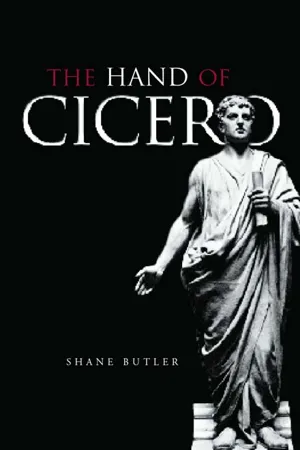
Hundreds perished in Rome's Second Proscription, but one victim is remembered above all others. Cicero stands out, however, not only because of his fame, but also because his murder included a unique addition to the customary decapitation. For his corpse was deprived not only of its head, but also of its right hand. Plutarch tells us why Mark Antony wanted the hand that wrote the Philippics. But how did it come to pass that Rome's greatest orator could be so hated for the speeches he had written?
Charting a course through Cicero's celebrated career, Shane Butler examines two principal relationships between speech and writing in Roman oratory: the use of documentary evidence by orators and the 'publication' of both delivered and undelivered speeches. He presents this fascinating theory that the success of Rome's greatest orator depended as much on writing as speaking; he also argues against the conventional wisdom that Rome was an 'oral society', in which writing was rare and served only practical, secondary purposes.
- 176 pages
- English
- ePUB (mobile friendly)
- Available on iOS & Android
eBook - ePub
The Hand of Cicero
About this book
1
THE YOUNG CICERO, READING
The sole surviving fragment of frescoes executed in the 1460s by Vincenzo Foppa for the Palazzo Mediceo of Milan shows a rosy-cheeked fair-haired fanciullo seated on a bench, absorbed in the book he balances with a delicate hand against his chest, which is draped in a pink fur-trimmed smock that matches his slippers.1 To his right another book lies open on a table, while others wait to be fetched from two cubby-holes, one of which holds the lectern the boy has abandoned in favor of the more intimate relationship to his book allowed by his pose. To his back, on the bench, could be read (until it was slightly garbled by a bungling restorer) an inscription: M. T. CICERO. The name was taken to refer to the author of the book the boy is reading until 1950, when Ellis Waterhouse made what he freely admitted was “a suggestion so obvious that it seems never to have been made,” viz., that it is not the book but the boy who is Cicero, and that Foppa has offered us a fancy of the bibliophilic beginnings of the consul-to-be.2
Waterhouse connects the scene to a statement in Plutarch about fame already acquired by the very young Cicero for his quickness in school and thus makes the bench a school bench.3 But the decor makes us think rather more of the studioli of Renaissance scholars, “among the elegant wooden shelves and benches where they spent so many hours leaning over heavy, odiferous books, writing in margins, and using the skills, and sometimes breaking the rules, they had learned from influential teachers.”4 In the painting, of course, both book and scholar have been shrunk, and the only hint as yet that the young Cicero might one day “break the rules” is, perhaps, his foot on the bench. But there seems little doubt that the painting represents a quite understandable desire to see the young Cicero reading in the same sort of environment in which the humanists themselves read Cicero. This probably is what led nineteenth-century commentators on the painting to overlook the “obvious” and identify the boy as Pico della Mirandola or as a young Sforza prince.
Classicists might fuss about details of clothing and architecture in the scene and would hastily paint over the anachronistic codices with book-rolls and wax tablets. But the most important problem with Foppa's picture is not so much the room or the books as it is the expression on the boy's face. Downstairs in the cantina, we must imagine Cicero's mother sealing “even the empty wine flasks” to guard against pilfering – the only detail of the domestic life of the Tullii Cicerones that has been preserved for us.5 In such an efficient household, time and space for pleasure must have been taken on the sly. The sole exception may have been Cicero's father, who, Cicero himself tells us, suffered from bad health and devoted his time to literary pursuits.6 But there is no evidence that the son was encouraged to follow his father's example; rather, the family's investment in the education of Marcus and his brother Quintus was calculated to serve ambitious ends. Perhaps it was Cicero's mother, of senatorial family, who first pushed the boys toward politics. In any case, by the time he left Arpinum, Cicero had made his family's ambition for his future his own.
Yet we search in vain the face of Foppa's tranquil prince for signs of the fear of idleness that should already be drawing young Cicero's face into the restless adult expression preserved in a handful of ancient busts.7 The thoughts of the boy in the painting carry him into the literary selva oscura that waits beyond an open window, but the young Cicero must have had no time either for fairy tales or for aristocratic otium. The journey which he charted was a real one, for he must have known even from an early age that his books and notebooks were paving his way to the capital city, distant – once one joined the Via Latina – some seventy Roman miles.
The Renaissance picture of Cicero celebrates reading and writing as humanistic pursuits, while perhaps obscuring the textual experiences most relevant to Cicero and his age. In this chapter we will attempt a reconstruction of the young Cicero reading that will be quite different from that offered by Foppa. In the first place, we will focus on a period in Cicero's life – that of his debut as an orator – for which we know more about his reading habits. Second, we will break with the scholarly fantasy of Cicero, reader of books, to attempt a more complex picture of Cicero reading a wide variety of written texts. Indeed, in this chapter, as in the several that follow, our study of Cicero's relationship to the written word will have, for some, surprisingly little to do with books or literature.
In a moment, we will turn to the evidence provided by Cicero's earliest surviving speeches. But first, let us sketch a counterpoint to Foppa's idyll. Picture Cicero in his mid-twenties, already in Rome, and place him not in a secluded study but in the midst of the Roman crowd, where he is as yet just a face like countless others. On this particular day, the din of the crowd is of an uncustomary character, but Cicero no longer notices: he, like the others shoving their way forward to see, is busy reading. Before him is a text that could not be more different from the book held by the boy in Foppa's painting. This text is not a book, but a book will help us to imagine it.
The first proscription
François Hinard's Les Proscriptions de la Rome républicaine ends with two catalogues of the proscribed, one for the Sullan proscription of 82 BCE, another for that of the triumvirs in 43 BCE.8 The lists are culled from stray mentions in various later sources, and each list is arranged alphabetically, with what is known of each name (some are fragmentary) given after a sequential number. For some of the victims, a name is all that remains; where shreds of evidence for a life survive, Hinard had pieced together a brief biography; in a few exceptional cases, the victims were famous and we know a great deal about them. In the end, there are 75 entries for the first proscription and 160 for the second – a fraction of the actual number proscribed, but still an impressive reconstruction. In the case of the first proscription, most of the proscribed eventually were killed or committed suicide; for every victim whose name survives, perhaps six dead remain anonymous.
Hinard's twin prosopographical lists form a curiously moving monument to the dead. The litany of names goes on for 200 pages, while the discussion below each entry constantly reminds that to each of the names was once attached a life. It is sometimes said that the proscriptions were numerically mild compared to other atrocities of their day, but Hinard's book helps us to see why counting heads misses the point: the terror produced by the proscriptions was not a matter so much of quantity, or even of quality, though the rich and powerful figure prominently in the lists, but rather one of form. This began with the formal characteristics of the proscription list itself, of which we already catch a glimpse in Hinard's catalogue, especially in the names, printed in capitals that stand out bold and black against the white of the page.
In legal terms, the proscriptio proper was loosely fit by ancient writers into the category of the edictum, the decree of a high Roman magistrate – in this case, Sulla in the capacity of dictator.9 Formally, the list itself was in generic terms a tabula and more specifically an album, a whitened board bearing a painted inscription, usually set up in a public place. Alba were used to record not only edicta but also other texts, including, most famously, official annals of magistrates and prodigies; the proscription shared with all of these a schematic and repetitive format. After a preamble and the condemnation itself, including the price to be paid per head – 12,000 denarii in the case of the first proscription – came a list of names. On the first day of Sulla's proscription there were 80 names; on the second day were added 220; on the third as many again, for a total of 520.10 Anyone who wished was free to present one of the heads listed and claim the published prize.
Sulla himself seems to have invented this novel form of mass execution. A tradition recorded by Plutarch makes the idea the product of a discussion with the dictator in the senate. With Sulla's retribution against his enemies already well under way, and “murders without number or limit filling the city,” a young Gaius Metellus beseeched the dictator for clarity:
“We do not petition you,” he said, “to spare from vengeance those whom you have decided to do away with, but to relieve from doubt those whom you have decided to save.” When Sulla answered that he had not yet decided whom to spare, Metellus responded, “Very well, then, show us clearly whom you propose to punish.”11
The story makes the proscription a grim improvement over disordered slaughter, and whether or not the ancedote is true, it probably reflects the real way in which the list itself gave the massacre the appearance of law. For even if the proscription of persons originated with Sulla, proscription in its general sense had a long legal history in the form of the proscriptio or publkatio bonorum, the confiscation of an individual's property, announced through the posting of a public notice.12 Since the terms of Sulla's proscription also included the confiscation of the property of the victims, he might be said to have built on an established legal precedent, expanding the goods included under proscription to include the head of the proscribed. Such a justification doubtless seemed as specious to contemporaries as it does to us, but it may also have seemed ironically appropriate: many of those proscribed were said to die not so much for their politics as for their wealth. Plutarch records the story of a certain Quintus Aurelius, unassuming but well-off, who, unexpectedly finding his own name on the list, exclaimed, “Ah! woe is me! my Alban estate is prosecuting me.”13
Few of the proscribed will have had time for similar ironic reflection. The reading public of the list, however, was larger than just those whose names appeared. There were, of course, the percussores who chose to carry out the sentence and collect the reward. (Among them was Catiline, the later conspirator.) But to the extent that it was an act of terror, the proscription bore a message addressed neither to its victims nor to its agents. Most Romans escaped death but not fear during the proscriptions; the more philosophical among these had both time and reason to contemplate carefully the list's broader meaning. They are unlikely to have been reassured by the proscription's apparent legality; rather, its legal form had precisely the opposite effect. The list's beguiling familiarity, its formal order and ordinariness, stood in uncanny contrast to the violence it commanded. Was it really possible to kill a man simply by writing his name? Here was something else uncanny, for the Romans were used to the association of death with proper names in the guise of the epitaph – what made the proscription different was that it announced a death that had yet to occur. But perhaps the most striking feature of the proscription was the way in which it displaced and diffused responsibility for the slaughter. Who was the real murderer? Sulla? The state? The law? The informants? The percussores? Was even the sign-painter in some way responsible? For a few days at least, it was the list itself that ruled Rome.
Several centuries later, Dio Cassius described the scene of the reading of the proscription list thus:
The tablets were set up like a register of senators or list of conscripted soldiers. Everyone who would pass by pushed forward eagerly with the crowd, as if the tablets bore some useful announcement. Many found relations – and some, indeed, found themselves – there written, whereby the fate which overtook them was made more terrible, in as much as misfortune came without warning. Many of these identified themselves by their reaction and were destroyed. No one outside Sulla's coterie was safe. Anyone who approached the alba was accused of being a busybody; anyone who did not approach was seen as expressing disgust. The man who read through the list or asked what was written there fell under suspicion of inquiring about himself and his friends; the man who did not read or ask questions was suspected of grieving over it and was for this reason hated. Tears or laughter became instantly fatal, and thus many were destroyed not because they had said or done anything forbidden, but because they had frowned or smiled.14
Dio created this imaginative reconstruction long after the fact. A similar picture, however, emerges from an anecdote recorded by Diodorus Siculus, who had ample opportunity to hear of the proscription from first-hand witnesses. In the story, a reader of the list stands mocking and insulting the names of the proscribed, only to find unexpectedly his own name at the very end of the list. Attempting to steal away unnoticed, he is recognized and killed – eliciting the satisfied approval of bystanders.15
We may record here one final ancient tale of the reading of the proscription. In his epic Pharsalia, drenched with the blood of a later calamity, the poet Lucan recalls the events of Sulla's reign of terror, including the proscription, in a lengthy aside.16 The list itself does not appear in the narrative, but the poet inserts an echo of it into the scene of relat...
Table of contents
- Front Cover
- Half Title
- Title Page
- Copyright
- Dedication
- CONTENTS
- Acknowledgments
- Abbreviations
- Introduction: the hand (or hands) of Cicero
- 1 The young Cicero, reading
- 2 Cicero takes a bath: an introduction to the prosecution of Verres
- 3 Multitudo litter arum: a catalogue of the written evidence against Verres
- 4 The trial of Verres
- 5 Litterae manent: the publication of the Verrines
- 6 December 3, 63 BCE: convincing Rome of a conspiracy
- 7 The hand of a secretary: writing after the Ides of March
- Notes
- Selected bibliography
- Index locorum
- Index
Trusted by 375,005 students
Access to over 1.5 million titles for a fair monthly price.
Study more efficiently using our study tools.
Frequently asked questions
Yes, you can cancel anytime from the Subscription tab in your account settings on the Perlego website. Your subscription will stay active until the end of your current billing period. Learn how to cancel your subscription
No, books cannot be downloaded as external files, such as PDFs, for use outside of Perlego. However, you can download books within the Perlego app for offline reading on mobile or tablet. Learn how to download books offline
Perlego offers two plans: Essential and Complete
- Essential is ideal for learners and professionals who enjoy exploring a wide range of subjects. Access the Essential Library with 800,000+ trusted titles and best-sellers across business, personal growth, and the humanities. Includes unlimited reading time and Standard Read Aloud voice.
- Complete: Perfect for advanced learners and researchers needing full, unrestricted access. Unlock 1.5M+ books across hundreds of subjects, including academic and specialized titles. The Complete Plan also includes advanced features like Premium Read Aloud and Research Assistant.
We are an online textbook subscription service, where you can get access to an entire online library for less than the price of a single book per month. With over 1.5 million books across 990+ topics, we’ve got you covered! Learn about our mission
Look out for the read-aloud symbol on your next book to see if you can listen to it. The read-aloud tool reads text aloud for you, highlighting the text as it is being read. You can pause it, speed it up and slow it down. Learn more about Read Aloud
Yes! You can use the Perlego app on both iOS and Android devices to read anytime, anywhere — even offline. Perfect for commutes or when you’re on the go.
Please note we cannot support devices running on iOS 13 and Android 7 or earlier. Learn more about using the app
Please note we cannot support devices running on iOS 13 and Android 7 or earlier. Learn more about using the app
Yes, you can access The Hand of Cicero by Shane Butler in PDF and/or ePUB format, as well as other popular books in History & Ancient History. We have over 1.5 million books available in our catalogue for you to explore.