eBook - ePub
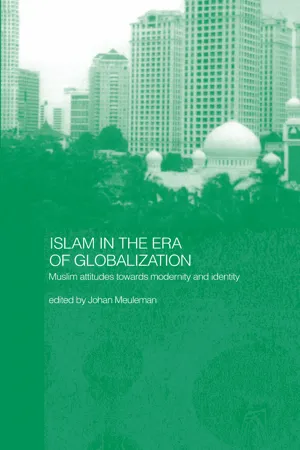
Islam in the Era of Globalization
Muslim Attitudes towards Modernity and Identity
- 432 pages
- English
- ePUB (mobile friendly)
- Available on iOS & Android
eBook - ePub
About this book
Globalization, modernity and identity are fundamental issues in contemporary Islam and Islamic Studies. This collection of essays reflects the wide diversity that characterises contemporary Islamic Studies. The case studies cover regions stretching from China and Southeast Asia to diaspora communities in the Caribbean and Tajikistan. There is significant participation of intellectual voices from all areas concerned, providing a real contribution to the academic exchange between the Muslim and the Euro-American worlds.
Information
Part One
Globalization
South-East Asian Islam and the Globalization Process
Johan Meuleman
Introduction: Discourse on Globalization as a Global Fashion
Over the past few years, discourse on “globalization” has become trendy. Many consider globalization one of the fundamental processes of the present and of the near future. The rapid and comprehensive spread of this idea itself appears to be a clear indication of its truth. A person who has been living in South-East Asia for the last decade or so might at first suppose that the fashion of speaking about globalization is particular to a certain group of semi-intellectuals and popular writers, who happen to have read one or two American publications on “megatrends” or similar concepts that attempt to explain the history and future of mankind in a few catchwords. A simple search for titles containing the word globalisasi in the on-line catalogue of the National Library in Jakarta yields fifty-two works, globalisation one—by a foreign author—and globalization twentyone— of which three are by Indonesian authors. However, a similar search in the Nederlandse Centrale Catalogus (Dutch Central Catalogue) yields fifty-four for globalisasi, of which a large part relate to publications by Indonesian authors available at the library of the Royal Institute for Linguistics and Anthropology (KITLV) in Leiden, ninety-one for globalisation, 263 for globalization and two and thirty-four for the Dutch equivalents globalisatie and globalisering respectively.1 Furthermore, during a recent visit to France I discovered that the term mondialisation—not globalisation—had become widely mentioned in newspapers. Still more recently, at a seminar on Islamic Studies held two weeks before the original version of this text was presented in Pattani, Thailand, I learnt a new term: ‘awlamah, being the Arabic equivalent of “globalization”.2 And we could go on for a long time in a similar vein.
Globalization and the History of Islam
If we define globalization as the process towards an increasingly strong interdependence between increasingly large parts of the world, resulting in the phenomenon that events and developments in one region influence most other regions, we may argue that it is notsomething as new as this recent discourse might have us believe. Islam, for instance, has played a prominent role in globalization processes since its very origin. This role was not accidental to Islam, but was instead one of its fundamental attributes. It affected political, economic, and cultural life.
This is thrown into particularly sharp relief when we look at the expansion of Islam to South-East Asia. Many historians emphasize the role of an international commercial network, stretching from North Africa to East Asia, in this expansion. At a time when commerce within Europe and the role of the Mediterranean as a bridge between Europe, Africa, and Asia declined,3 the Indian Ocean became the centre of a new trade network, dominated by Muslim traders. The South-East Asian islands acquired a prominent position within this new “global system”. This theory, which has already achieved classical status, has recently received further support from André Wink, Denys Lombard, and Anthony Reid, Wink draws our attention to the Indian Ocean as the axis of a world system and goes on to analyse “al-Hind” —understood as South and South-East Asia— as a world in itself.4 Lombard studies the island of Java as a crossroads in an international economic and cultural system.5 Reid relates the Islamization and Christianization—two processes he regards as fundamentally variants of the same phenomenon—of large parts of South-East Asia during the “Age of Commerce” (1450–1680, most intensely 1570– 1630) to integration of their areas into larger commercial and cultural systems.6
Convincing though these arguments may be, we should not conclude that the development of an international trade network was the only factor in the Islamization of South-East Asia. This has been underscored by Jacobus Cornelis van Leur in his dissertation on pre-colonial and early colonial Asian trade. He argues that a particular combination of commercial and political factors coincided to bring about the Islamization of South-East Asia.7 In this framework, he is most insistent that these factors were not purely external, internal transformations also certainly contributed to this process.
Lombard confirms the role of internal changes.8 Given these data, it is plausible to maintain that, at least at this stage of “globalization”, South-East Asia did not only play a passive role and that the process was the result of interaction between the centre and the periphery of a developing global system.
After commercial relations had played an important role in the expansion of Islam and the unification of the various parts of the Muslim world at an early stage, the way was paved for the development of a network of scholarly relations and mystical organizations which served to strengthen this unity. Anthony H.Johns has emphasized the role of this network in the further development of Islam in South-East Asia.9 After the Muslim world disintegrated politically and its commercial power had been broken by Portugal, Holland, France, and England, this spiritual network continued to function unimpaired. The fear of Dutch and other colonial authorities about contacts between their Muslim subjects and their co-religionists in the Holy Land is well known. Recent research has confirmed the importance of this type of network between the Hijaz and South-East Asia.10
These facts abstracted from the history of Islam, especially in South-East Asia, militate against considering globalization to be a totally new phenomenon.
Modern Western Expansion and Its Limits
In spite of the development and continued existence of this spiritual network, from about the fifteenth or sixteenth century AD the centre of the world economy moved towards Europe. The Muslim world had previously attained a high level of scientific development, a refined civilization, wealth, and even the formation of a capitalist sector and a bourgeois class.11 However, despite these advantages it was Europe that experienced the technological and social leap that indirectly transformed it into the centre of an ever wider and stronger new global system.
Instead of the Muslim system which preceded it, it is this “modern world system”, as it is often called after the title of Immanuel Wallerstein’s influential study of it,12 that is frequently cited as evidence that globalization is not a recent phenomenon.13 Wallerstein writes that since the sixteenth century the world has progressively become one integrated system. West”—, a secondary zone depending on the centre, and a periphery in which only limited influence was exerted by the centre.
European and later also Western progress and expansion led to the formation of a vision that all societies and states were located somewhere on the way towards the same, Western pattern of life, be this in the political, He emphasizes that the basis of this unification was economic and that economic integration has been faster than its counterpart in other fields. He is quick to point out that this unification has not been accompanied by equality. On the contrary, the “modern world system” was characterised by the contrast between a centre—Europe, later “the cultural, social, or economic field. This view had its origins during Enlightenment and later appeared in various forms in the works of otherwise such disparate authors as Auguste Comte, Karl Marx, and Max Weber. Its influence was strong on colonial policy and on orientalism, including Western analyses of Islam. Finally, it was reflected in the ideas of many political, social, and economic scientists as well as in the development policies of a large number of countries during the period after the Second World War.14 In this respect the similarity between liberal politicians and scholars and their Marxist adversaries was striking.
From about the middle of the 1960s, and even more markedly since the 1970s, this broad tendency to link Western expansion—or the expansion of communism—to a process towards uniformity on the Western or communist model began to be abandoned. The prime target for attack was the idea of Western uniformity. This was criticized because of a number of related factors: the failure of development policy for the Third World based on this vision; the political and military failure of the West, in particular the USA, in Vietnam;15 new developments in Western philosophy that stressed the differences and ruptures between various paradigms, epistemes, and discourses, or which were critical of Western “logocentrism”;16 and a renewed interest in particular, non- Western values and a stress of specificity in the non-Western world, most clearly in the Muslim world.17
Not only has the vision that the whole world is on the way towards a uniform pattern of life become the object of criticism, but also the idea that the West would forever occupy the centre of the expanding global system has recently come under fire. The latter criticism has been supported by a number of specialists on Western expansion. Among them was the prominent French historian, Fernand Braudel. He had been influenced by Wallerstein and was greatly interested in long-term transformations in international mechanisms of dependency and interdependency. On the basis of historical research, he concluded that economic and political systems and their centres have always been in a state of flux, changing slowly but inexorably. At the time of (Western) classical civilization, its centre was located around the Mediterranean, then it moved to the Middle East, and from the end of the European Middle Ages it moved back again to—Southern then Western— Europe and finally crossed the Atlantic Ocean to North America. At a seminar held in Leiden, the Netherlands in 1975, he predicted that the centre might switch back to Rotterdam.18 Another prediction that was very popular until the recent economic crisis hit South-East Asia and Japan was that the centre would switch to the Pacific Rim or the Asia-Pacific region. Today there seems to be less evidence to support such an assumption.
At the same seminar, an Israeli political scientist, Samuel Eisenstadt, emphasized that modernization—a concept often associated with globalization and uniformization—was not necessarily identical to Westernization. He argued that the modernization process, which started several centuries ago with European expansion, has not consisted only of the export of European or Western civilization to other regions, but that this Western expansion has also induced a series of reactions in the non-Western world that combine various Western and local elements in the symbolic, political, economic and still other fields.19
In this context, it is interesting to indicate the view of the British social anthropologist, the late Ernest Gellner, who agreed with Eisenstadt that modernity is not equivalent to “Westernity”. More precisely, he argues that Islam, more than other religions, is very compatible with modernity.20 As is often the case with Gellner’s theories, this one is as fascinating as it is open to question. On this occasion we cannot go into a critical discussion of his underlying theory that, until the modern era, Islam is in continuous state of oscillation between a “scripturalist” and a “pastoralist” pattern.21 It should be remembered that to define “modernity” or to determine compatibility with the modern era, Gellner exclusively uses criteria that are borrowed from modern Western civilization rather than from the Muslim world: universalism, scripturalism, participation in the holy community by all on equal footing, and rational systematisation of social life.22 In other words, Gellner has only gone halfway in his criticism of the view that modernity equals “Westernity”. Another widespread assumption related to the concepts of globalization and modernization was that these processes would ultimately everywhere lead to a reduction in the role of ethnicity and religion in public life so that these would no longer be dividing factors in societies and states. This prediction too has seemed highly debatable in the light of recent developments in various regions. The clearest and bestknown case is that of the Balkan region. Here, ethnicity and religion have quite suddenly emerged as the ultimate forces determining the relations between people and this in a negative rather than a positive way. However, deeper analysis shows that reaction against excessive centralization and unequal positions between various groups and regions lie at the bottom of what are superficially ethnic and religious phenomena.
Turning more specifically to South-East Asian Islam, similar developments have manifested themselves in Southern Thailand and the Southern Philippines. The Malaysian scholar, Wan Kadir Che Man, has shown that theories on economic and political development or state formation, especially these from the 1960s and 1970s, which predicted the end of ethnicity as a factor in public life, have been proved wrong in these regions. He considers analytical models based on the notions of internal colonialism, cultural division of labour and ecological competition—all within a single state—to be more useful and closer to reality.23 He also thinks that religion is a source of inspiration and political ideology and a basis for social mobilization, and not a basic cause of the conflicts between the central authorities and the Muslim minorities in these regions.24 Another interesting conclusion drawn by this author is that, at least in these cases, modernization, in the form of increases in social mobilization, indeed intensifies—not reduces—ethnic tension.25
The Contemporary Globalization Process
So far we have seen that several viewpoints relating to earlier processes of globalization and associated concepts su...
Table of contents
- Cover Page
- Title Page
- Copyright Page
- Acknowledgements
- Note on References
- The Contributors
- Introduction
- Part One: Globalization
- Part Two: Modernization
- Part Three: Identity
- Glossary
- Bibliography
Trusted by 375,005 students
Access to over 1.5 million titles for a fair monthly price.
Study more efficiently using our study tools.
Frequently asked questions
Yes, you can cancel anytime from the Subscription tab in your account settings on the Perlego website. Your subscription will stay active until the end of your current billing period. Learn how to cancel your subscription
No, books cannot be downloaded as external files, such as PDFs, for use outside of Perlego. However, you can download books within the Perlego app for offline reading on mobile or tablet. Learn how to download books offline
Perlego offers two plans: Essential and Complete
- Essential is ideal for learners and professionals who enjoy exploring a wide range of subjects. Access the Essential Library with 800,000+ trusted titles and best-sellers across business, personal growth, and the humanities. Includes unlimited reading time and Standard Read Aloud voice.
- Complete: Perfect for advanced learners and researchers needing full, unrestricted access. Unlock 1.5M+ books across hundreds of subjects, including academic and specialized titles. The Complete Plan also includes advanced features like Premium Read Aloud and Research Assistant.
We are an online textbook subscription service, where you can get access to an entire online library for less than the price of a single book per month. With over 1.5 million books across 990+ topics, we’ve got you covered! Learn about our mission
Look out for the read-aloud symbol on your next book to see if you can listen to it. The read-aloud tool reads text aloud for you, highlighting the text as it is being read. You can pause it, speed it up and slow it down. Learn more about Read Aloud
Yes! You can use the Perlego app on both iOS and Android devices to read anytime, anywhere — even offline. Perfect for commutes or when you’re on the go.
Please note we cannot support devices running on iOS 13 and Android 7 or earlier. Learn more about using the app
Please note we cannot support devices running on iOS 13 and Android 7 or earlier. Learn more about using the app
Yes, you can access Islam in the Era of Globalization by Johan Meuleman in PDF and/or ePUB format, as well as other popular books in Theology & Religion & Islamic Theology. We have over 1.5 million books available in our catalogue for you to explore.