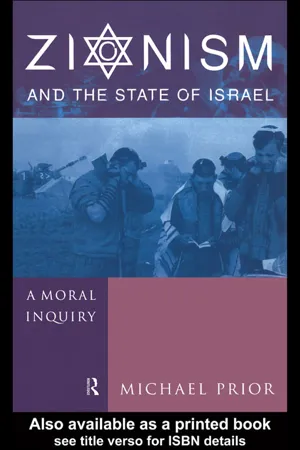
Zionism and the State of Israel provides a topical and controversial analysis of the development of Zionism and the recent history and politics of Israel.
This thought-provoking study examines the ways in which the Bible has been used to legitimize the implementation of the ideological and political programme of Zionism, and the consequences this has had.
eBook - ePub
Zionism and the State of Israel
A Moral Inquiry
- 312 pages
- English
- ePUB (mobile friendly)
- Available on iOS & Android
eBook - ePub
About this book
Information
Part I
The achievement of Zionism
1
From Zionism to the establishment of the State of Israel
As will become clear, several streams converge to issue in the broad and complex ideology of ‘Zionism’, a term used in its modern sense for the first time by Nathan Birnbaum in 1890 (Bein 1961:33). Whether one approaches the question from a strictly secular perspective, or from one which takes account of religious considerations, the role of the biblical narrative is a critical element in any discussion of Zionism.1 However, overt appeal to the Bible and its interpretation in underpinning Zionist nationalism was not prominent in the beginning, and only assumed a critical role when the religious settler movement collaborated with the new phase of Zionist expansionism which was inaugurated by the conquests of the 1967 War.
Since theological discourse should aspire to familiarity with unfolding realities, it is desirable to situate the Zionist movement within the social and political contexts in which it arose and progressed. I divide the history of the movement into five phases, beginning with Herzl’s programmatic statement calling for the establishment of a state for Jews, and bringing the discussion up to the present day. I trust that this survey will be illuminating for those not familiar with the aspirations of the Zionist movement and its planned programme to realise its ideal to establish a state for Jews. Antecedents of Herzl’s vision, and the sacralisation of the Zionist project will be examined in succeeding chapters.
The early phase of Zionism (1896–1917)
While Theodor Herzl (1860–1904) was not the first to suggest the establishment of a state for Jews, he was the one who most systematically planned the elevation of his vision into a programme of action. He interested himself in the Jewish Question as early as 1881–82, and while in Vienna had considered mass Jewish conversion to Catholicism as a solution to the problem of being a Jew in European society. By 1895 he judged the efforts to combat antisemitism to be futile (Herzl 1960, vol. 1:4–7).2 He composed the first draft of his pamphlet, Der Judenstaat, between June and July 1895.3
On 17 January 1896 the editor of the London Jewish Chronicle, although decidedly unsympathetic to Zionism, invited Herzl to summarise his scheme, and published his article, ‘A Solution of the Jewish Question’. Herzl called for the establishment of a model and tolerant, civil, Jewish state, which, while not a theocracy, would ‘rebuild the Temple in glorious remembrance of the faith of our fathers’. He summed up, ‘We shall live at last as free men, on our own soil, and die peacefully in our own home’. The editorial was sceptical: ‘We hardly anticipate a great future for a scheme which is the outcome of despair’. The response to the article was lukewarm, and for several more years, despite the Jewish Chronicle giving lavish space to Zionist activities, its editor continued to view Zionism as ‘ill-considered, retrogressive, impracticable, even dangerous’. Matters changed in 1906, when Leopold J.Greenberg, a leading figure in English Zionism bought the paper (in Finklestone 1997:xiii–xiv). In February 1896, Herzl published the full statement of his programmer
It is commonly held that the public degradation of Captain Alfred Dreyfus, an Alsatian Jew on the French General Staff, wrongly convicted of selling military secrets to the Germans (5 January 1896), signalled for Herzl the impossibility of Jews ever assimilating into European society, and confirmed him as a Zionist. Nevertheless, Herzl’s journalistic dispatches from Paris were by no means ‘Zionist’. It was only after the second guilty verdict of September 1899 that he publicly declared that Dreyfus’ fate was essentially that of the Jew in modern society, and he suggested for the first time, in an article for the North American Review (1899), that the original Dreyfus trial had made him into a Zionist (Wistrich 1995:17). There is no word about the Dreyfus affair in the early part of his diaries, and nothing in Der Judenstaat.
Herzl’s vision and its underpinning
Herzl insisted that Jews constituted one people (Herzl [1896] 1988:76, 79), and spoke of ‘the distinctive nationality of Jews’ (p. 79).4 Wherever they were, they were destined to be persecuted (pp. 75–78). Antisemitism was a national question, more than a social, civil rights or religious issue, and could be solved only by making it a political world-question (p. 76). The solution to the Jewish Question could be achieved only through ‘the restoration of the Jewish State’ (p. 69), in which sovereignty would be granted over a portion of the globe large enough to satisfy the rightful requirements of a nation (p. 92). Jews could rely on the governments of all countries scourged by antisemitism to assist them obtain that sovereignty (p. 93), and on the Powers to admit Jewish sovereignty over a neutral piece of land. The creation of a Jewish state would be beneficial to both the present possessors of the land and to adjacent countries (p. 95). Concerning whether the state should be established in Argentina or Palestine, he said, ‘Palestine is our ever-memorable historic home. The very name Palestine would attract our people with a force of marvellous potency’ (p. 96).
Reflecting typical nineteenth-century European colonialist attitudes, Herzl presented the proposed Jewish state as ‘a portion of the rampart of Europe against Asia, an outpost of civilisation [Herzl’s term was ‘Kultur’] opposed to barbarism’ (p. 96). Elsewhere he reflects the world-view of European racist superiority. He assured the Grand Duke of Baden that Jews returning to their ‘historic fatherland’ would do so as representatives of Western civilisation, bringing ‘cleanliness, order and the well-established customs of the Occident to this plague-ridden, blighted corner of the Orient’ (Herzl 1960, vol. 1:343).
On the religious aspect, ‘The Temple will be visible from long distances, for it is only our ancient faith that has kept us together’ (Herzl [1896] 1988: 102). He appealed for the support of the rabbis (p. 129), and asserted, ‘Our community of race is peculiar and unique, for we are bound together only by the faith of our fathers’ (p. 146). But the Jewish state would not be a theocracy: ‘We shall keep our priests within the confines of their temples in the same way as we keep our professional army within the confines of their barracks’ (p. 146). Herzl’s final words were:
A wondrous generation of Jews will spring into existence. The Maccabeans will rise again…. The Jews who wish for a state will have it. We shall live at last as free men on our own soil, and die peacefully in our own homes. The world will be freed by our liberty, enriched by our wealth, magnified by our greatness. And whatever we attempt there to accomplish for our own welfare, will react powerfully and beneficially for the good of humanity.
(pp. 156–57)
Herzl’s proposal met with considerable opposition, not least from Chief Rabbi Moritz Güdemann of Vienna, who maintained that the Jews were not a nation, and that Zionism was incompatible with the teachings of Judaism.5
Herzl acknowledged that the notions of ‘Chosen People’, and ‘return’ to the ‘Promised Land’ would be potent factors in mobilising Jewish opinion, despite the fact that the leading Zionists were either non-religious, atheists or agnostics. However, Rabbis representing all shades of opinion denounced Zionism as a fanaticism and contrary to the Jewish scriptures, and affirmed their loyalty to Germany. On 6 March 1897 the Zionsverein decided upon a Zionist Congress in Munich for August, but the Munich Jews refused to host it. Moreover, the executive committee of the German Rabbinical Council ‘formally and publicly condemned the “efforts of the so-called Zionists to create a Jewish national state in Palestine” as contrary to Holy Writ’ (Vital 1975:336). On the Zionist side, Herzl’s critics found little specifically Jewish about the state he envisaged.
In addition to the challenge his programme proposed to traditional Orthodox Messianic eschatology—the Almighty alone would bring about the Jewish ‘return’—Herzl’s insistence on unredeemable antisemitism was a source of considerable annoyance to the Jewish leadership in several Western countries. In England, for example, Chief Rabbi Herman Adler judged Herzlian Zionism to be radically divergent from the main core of Judaism, which it would undermine. He regarded the First Zionist Congress as an ‘egregious blunder’ and an ‘absolutely mischievous project’. No less seriously, where the Jewish leadership of the Rothschilds, Montagus, Cohens, Montefiores and others had honours bestowed on them by government and crown, there was no enthusiasm for the Herzlian dogma that life in the diaspora was inherently unnatural (see Finklestone 1997:xi–xxi).
Herzl convened the First Zionist Congress (29–31 August 1897) in Basle. On the day before the Congress, though non-religious, he attended a synagogue service, having been prepared for the reading of the Law (Vital 1975:355). The purpose of the Congress was, in three days, to lay the foundation stone of the house to shelter the Jewish nation, and advance the interests of civilisation. The civilised nations would appreciate the value of establishing a cultural station, Palestine, on the shortest road to Asia, a task Jews were ready to undertake as the bearers of culture. Zionism, he summarised, seeks to secure for the Jewish people a publicly recognised, legally secured (öffentlich-rechtlich) home in Palestine for the Jewish people.6
The Congress also founded the World Zionist Organisation, and adopted the motion to establish a fund to acquire Jewish territory, which ‘shall be inalienable and cannot be sold even to individual Jews; it can only be leased for periods of forty-nine years maximum’ (in Lehn 1988:18), the forty-nine years reflecting the divine provenance of land-possession (Lev 25).7 Herzl envisaged that the European powers would endorse Zionism for imperialist self-interest, to rid themselves of Jews and antisemitism, and to use organised Jewish influence to combat revolutionary movements. After the Congress, Herzl wrote in his diary (3 September),
If I were to sum up the congress in a word—which I shall guard against pronouncing publicly—it would be this: At Basle I founded the Jewish state. If I said this out loudly today, I would be greeted by universal laughter. Perhaps in five years, and certainly in fifty, everyone will know it.
(Herzl 1960, vol. 2:581)
Herzl’s tactics would combine mobilising the Jews with negotiating with the imperial powers, and colonisation. Realising that intensive diplomatic negotiations at the highest level, and propaganda on the largest scale would be necessary (11 May 1896, Herzl 1983–96, vol. 2:340–41), he obtained audiences with key international figures, including the Sultan, the Kaiser, the Pope, King Victor Emmanuel, Chamberlain and prominent Tsarists. During his first visit to Palestine (1898) he was received by the German emperor, Wilhelm II, at his headquarters outside Jerusalem (2 November) after which he realised that the Zionist goal would not be achieved under German protection. Jerusalem, with its musty deposits of two thousand years of inhumanity, intolerance and uncleanness lying in the foul-smelling little streets, made a terrible impression on Herzl (31 October, 1983–96, vol. 2:680). In a series of meetings with Sultan Abdul Hamid (May 1901 to July 1902), Herzl promised that Jews would help him pay his foreign debt, and promote the country s industrialisation. The Sultan promised lasting protection if the Jews would seek refuge in Turkey as citizens. However, Herzl, unable to raise a fraction of the money, decided to open negotiations with Britain. As we shall see, Britain would have its own interests in supporting the Zionist enterprise.
Herzl explained to Joseph Chamberlain, Britain’s Colonial Secretary, that in patronising the Zionist endeavour the British Empire would have ten million agents for her greatness and her influence all over the world, bringing political and economic benefits (October 1902, 1983–96, vol. 3:469). In this quid pro quo, England would undertake to protect its client Jewish state, and world Jewry would advance British interests. In August 1903, Herzl discussed with the Tsarist government the speeding up of the emigration of Russian Jews, and argued that the European powers would support Jewish colonisation in Palestine not only because of the historic right guaranteed in the Bible, but because of the European inclination to let Jews go.
Chamberlain had raised already the option of Jews settling in Uganda, rather than Palestine, which was hotly debated, and finally carried at the Sixth Zionist Congress at Basle (22–28 August 1903), with 295 for, 175 against and 90 abstentions. Herzl emphasised that Uganda would only be a staging post to the ultimate goal of Palestine, but fearing that the issue might split the Zionist movement, lifting his right hand, he cried out, ‘Im Yeshkakhekh Yerushalayim…’ (‘If I forget you, O Jerusalem, may my right hand wither’), quoting Psalm 137.5 (Laqueur 1972:129). The Seventh Congress, at which Herzl was not present, officially buried the Uganda scheme.
With failing health, Herzl visited Rome on 23 January 1904, and met King Victor Emmanuel III and Pope Pius X. To Herzl’s request for a Jewish state in Tripoli, the king replied, ‘Ma è ancora casa di altri’ (‘But it is already the home of other people’) (Herzl 1983–96, vol. 3:653). Neither Pius X nor the Secretary of State, Cardinal Merri del Val, considered it proper to support the Zionist intentions in any way (Herzl 1960, 4:1602–1603), opposing it on religious grounds. Herzl made the last entry in his Diaries on 16 May 1904, and died in Edlach on 3 July. On the day of his burial Israel Zangwill, the Anglo-Jewish writer and propagandist, compared him with Moses, who had been vouchsafed only a sight of the Promised Land. But like Moses, Herzl ‘has laid his hands upon the head of more than one Joshua, and filled them with the spirit of his wisdom to carry on his work’ (Zangwill 1937: 131–32).
Evaluation of Herzl
That Herzl provided the inspiration, the leadership and the organisation of the Zionist movement is reflected in David Ben-Gurion’s proclamation of the State of Israel (14 May 1948) under his portrait, and in the transfer of his remains to Jerusalem in 1949. His genius lay in elevating his vision and plan into action, through remarkable organisational and diplomatic skills. While others who advocated the establishment of a Jewish state hoped that someone else would lead the march, Herzl organised practical means to advance it, most significantly the convening of the First Zionist Congress in 1897. He was very much a man of action, a ‘Tatmensch’, as Martin Buber put it. To have dealt with the Kaiser, the Sultan, a king and the Pope, as though he were the leader of a state was no mean achievement. Moreover, his early death ensured that he could be embraced by all factions within the broad Zionist and Israeli camp:
This iconisation of Herzl has been a useful and unifying force for Zionism, transcending the gulf between Right and Left, liberals and conservatives, secular and religious Jews. There is potentially something for everybody in Herzl’s rhetoric of unity, in his visionary ‘third way’ between capitalism and socialism, in his enlightened, optimistic liberalism.
(Wistrich 1995:3)
Although Herzl’s motivation was not dictated by a religious longing for the ancient homeland, nor by appeal to biblical injunctions, e.g. to go to the Promised Land in order to observe the Torah, at various times people referred to him as the Messiah, or King of Israel, and as the fulfilment of the prophecies of the Jewish Scriptures. At his graveside, Buber did not hide the fact that Herzl had no sense of Jewish national culture, and no inward relationship to Judaism or to his own Jewishness. Moreover, he had the soul of a dictator (in Wistrich 1995: 30–31). Indeed, Herzl’s Zionism had much in common with ‘Pan-Germanism’, with its emphasis on das Volk: all persons of German race, blood or descent, wherever they lived, owed their primary loyalty to Germany, the Heimat. Jews, wherever they lived, constituted a distinct nation, whose success could be advanced only by establishing a Jewish nation-state.
Moreover, Herzl’s claim to construct a separate state ‘like every other nation’ amounted to special pleading. The basic assumption of European nat...
Table of contents
- Cover Page
- Title Page
- Copyright Page
- Contents
- Preface
- Part I: The achievement of Zionism
- Part II: An assessment of Zionism
- Part III: The biblical justification for Zionism
- Part IV: The mythological justification for Zionism
- PART V: Critique of Zionism
- Epilogue
- Bibliography
- Index
Trusted by 375,005 students
Access to over 1.5 million titles for a fair monthly price.
Study more efficiently using our study tools.
Frequently asked questions
Yes, you can cancel anytime from the Subscription tab in your account settings on the Perlego website. Your subscription will stay active until the end of your current billing period. Learn how to cancel your subscription
No, books cannot be downloaded as external files, such as PDFs, for use outside of Perlego. However, you can download books within the Perlego app for offline reading on mobile or tablet. Learn how to download books offline
We are an online textbook subscription service, where you can get access to an entire online library for less than the price of a single book per month. With over 1.5 million books across 990+ topics, we’ve got you covered! Learn about our mission
Look out for the read-aloud symbol on your next book to see if you can listen to it. The read-aloud tool reads text aloud for you, highlighting the text as it is being read. You can pause it, speed it up and slow it down. Learn more about Read Aloud
Yes! You can use the Perlego app on both iOS and Android devices to read anytime, anywhere — even offline. Perfect for commutes or when you’re on the go.
Please note we cannot support devices running on iOS 13 and Android 7 or earlier. Learn more about using the app
Please note we cannot support devices running on iOS 13 and Android 7 or earlier. Learn more about using the app
Yes, you can access Zionism and the State of Israel by The Rev Dr Michael Prior Cm,Michael Prior in PDF and/or ePUB format, as well as other popular books in Theology & Religion & Religion. We have over 1.5 million books available in our catalogue for you to explore.