Beowulf is the oldest and most complete epic poem in any non-Classical European language. Our only manuscript, written in Old English, dates from close to the year 1000. However, the poem remained effectively unknown even to scholars until the year 1815, when it was first published in Copenhagen.
This impressive volume selects over one hundred works of critical commentary from the vast body of scholarship on Beowulf - including English translations from German, Danish, Latin and Spanish - from the poem's first mention in 1705 to the Anglophone scholarship of the early twentieth century. Tom Shippey provides both a contextual introduction and a guide to the eighteenth- and nineteenth-century scholarship which generated these Beowulf commentaries.
The book is a vital document for the study of one of the major texts of 'the Northern renaissance', in which completely unknown poems and even languages were brought to the attention first of the learned world and then of popular culture. It also acts as a valuable guide to the development of nationalist and racist sentiment, beginning romantically and ending with World War and attempted genocide.
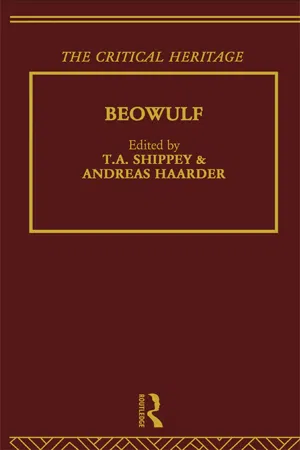
eBook - ePub
Beowulf
The Critical Heritage
- 594 pages
- English
- ePUB (mobile friendly)
- Available on iOS & Android
eBook - ePub
Beowulf
The Critical Heritage
About this book
Information
1
Humfrey Wanley 1705
As one can see from several of the items below (2, 6, 10, 11, etc.), many scholars were misled as to the parts played by George Hickes and Humfrey Wanley in their joint publication of 1705. The first title-page of this gives Hickes alone as the author of the Linguarum Vett. Septentrionalium Thesaurus Grammatico-Criticus et Archæologicus. The second more scrupulously announces Antiquæ Literaturæ Septentrionalis Libri Duo, of which the first is the Thesaurus by Hickes (and Sir Andrew Fountaine), the second being Wanley’s Librorum Vett. Septen trionalium, qui in Angliæ Bibliothecis extant… Catalogus Historico-Criticus (both Oxford 1705). For a fuller account of the Thesaurus/Catalogus (reprinted in facsimile by Scolar Press, Menston 1971), see Bennett 1948; for Wanley’s life (1672–1725) and career, see Bennett 1938: ch. 4; Sisam 1953; Wright 1960. Wanley’s Latin description remained the sole source of knowledge of Beowulf for almost a century (see Introduction, pp. 3–6). Pp. 218–19.
Vitellius A. XV
[Wanley lists the contents of this codex under ten headings, of which nos VI, VII and VIII are respectively ‘The Legend of St. Christopher’, ‘Fabulous description of the East, and the monsters who are born there’ and ‘The fabulous letter of Alexander to Aristotle’. He adds brief descriptions, comments and opening citations. He then continues:]
IX.fol.130. A most noble treatise written in poetry. This is the beginning of the preface,
[transcribes lines 1–19, with some five minor errors (gefrumon for gefrunon (line 2), ðreatum for þreatum (4), mægðum for mægþum (6), wæs for þæs (7), hwilc for hwile (16), and some added capitalisation.]
However the beginning of the first Chapter goes like this,
[transcribes lines 53–73, with two further slight errors (ðrage for þrage, line 54, gefrumon for gefrunon, line 70) and added capitalisation and minor expansion again. Wanley reads line 62 as hyrde ic þ[æt] helan cwen.]
In this book, which is an outstanding example of Anglo-Saxon poetry, seem to be described the wars which Beowulf, a certain Dane, sprung from the royal stock of the Scyldings, waged against the petty kings of Sweden.
Wanley concludes by listing X, ‘Poetic fragment of the History of Judith and Holofernes’. The Index to the Catalogus also includes under ‘B’ the entry, still in Latin: ‘The history of Beowlf [sic] king of the Danes, in Dano-Saxon verse.’
2
Jacob Langebek 1772
Jacob Langebek (1710–75) held the post of Danish National Archivist, and began the project of editing the Scriptores Rerum Danicarum Medii Ævi, eventually to appear in nine volumes 1772–1834. Although he had not seen Beowulf, he read Wanley’s catalogue entry, item 1 above, carefully enough to draw some original conclusions even from its short citations. In Scriptores: I, 9 (Copenhagen 1772), he comments on the various forms of the Anglo-Saxon royal genealogies so far printed, and remarks that while Sceaf is not mentioned by Asser or the author of the Anglo-Saxon Chronicle, a strange story is told of him by Ethelweard, William of Malmesbury and Simeon of Durham. He then cites the account of the sleeping boy in an oarless boat from William of Malmesbury, adding Ethelweard’s version, the boy in a boat ‘surrounded by weapons’, in footnote p; his versions are virtually identical with those in the footnotes to Chambers 1959:70–1, except that Langebek takes William’s story to refer to Sceaf, not. Sceldius. He then gives what appear to be two conflated versions of the West Saxon royal genealogy from Sceldvea Heremoding to ‘Sceaf who was born in Noah’s ark’ (see Chambers 1959:200–3), and adds the following as a note to Sceldvea in footnote r:
Ethelweard…names this Scyld as the son of Scef. Unless I am mistaken, this is the same Scyld Scefing, of whose posterity was Beowulf a Dane, who made wars against the kings of Sweden, of whom we have an old Anglo-Saxon poem in the Cotton library [cites Hickes, i.e. Wanley, p. 219.]
[On p. 44, footnote e, commenting on ch. 1 of Sven Aggesen’s Historia Regum Danorum, Langebek cites Wanley more fully, including the phrase ex Regia Scyldingorum stirpe ortus, and adds, still in Latin:]
I am surprised that none of the scholars of England has taken the trouble to edit a work of such antiquity, which would infinitely gratify both his own people on account of its poetry, and ours on account of its history.
3
Sharon Turner 1803
Sharon Turner’s four-volume History of the Anglo-Saxons began to appear in 1799. Turner was, however, accused of ‘gross credulity’ for accepting the evidence of Welsh poetry in reconstructing that history, and replied with A Vindication of the Genuineness of the Ancient British Poems of Aneurin, Taliesin, Llywarchhen, and Merdhin, London 1803. His first incidental reference to Beowulf appears as part of this argument on pp. 110–12, as pointed out by Stanley 1975a.
It would not be very easy to prove the existence of any individual poet of these distant periods. There were both Frankish and Saxon poets, but their names have not appeared in history, and cannot now be recovered. How many of the poets and minstrels of Europe are known only by some lays having been transmitted to us under their names; but of their existence what external evidence can be brought?
There is a very long and curious Saxon poem in existence, which of course must have had an author, and have been written in the Saxon times; and yet the poem is mentioned in no writing that has survived to us, nor is the name of its parent known. It is a poem in forty sections, and occupying 140 MS. pages. It describes the wars which Beowulf, a Dane of the Scyldinga race, waged against the Reguli of Sweden. It is in the Cotton library, Vitellius, A. 15. Wanley calls it a tractatus nobilissimus—an egregium exemplum of the Anglo-Saxon poetry; and so it is. But if any one should take it into his head to pronounce it to be a forgery, and should call upon its advocates to prove its genuineness, how could this be done by any external evidence? How could it be defended by facts taken from other authors, when no other writing mentions it? It could only be supported by some arguments from the antiquity of the writing; from its internal evidence, and the improbability of any person having had sufficient inducements to commit the fraud.
I put these observations, merely to shew the difficulty of proving even those compositions to be genuine, which no one will dispute.—Greater proofs, in favour of the Welsh bards, must not be expected, than such as the nature of the case will admit us to obtain.
4
Sharon Turner 1805
By 1805 Turner was ready to give a longer account of Beowulf than he had ventured on in 1803, and accordingly devoted to it pp. 398–408 of vol. 4 of his The History of the Manners, Landed Property, Laws, Poetry, Literature, Religion, and Language of the Anglo-Saxons, 4 vols, London 1799–1805. The pioneering quality of this work may be seen by the fact that Turner uses only one footnote in his eleven pages, to ‘Wanley Catal.’, i.e. item 1 above. For the problems of the ‘misplaced leaf’ etc., see Introduction, pp. 7–9.
The most interesting remains of the Anglo-Saxon poetry which time has suffered to reach us, are contained in the Anglo-Saxon poem in the Cotton library, Vitellius, A. 15. Wanley mentions it as a poem in which ‘seem to be described the wars which one Beowulf, a Dane of the royal race of the Scyldingi waged against the reguli of Sweden’. But this account of the contents of the MS. is incorrect. It is a composition more curious and important. It is a narration of the attempt of Beowulf to wreck the fæhthe or deadly feud on Hrothgar, for a homicide which he had committed. It may be called an Anglo-Saxon epic poem. It abounds with speeches which Beowulf and Hrothgar and their partisans make to each other, with much occasional description and sentiment.
It begins with a proemium, which introduces its hero Beowulf to our notice:
| Beowulf... |
Table of contents
- Cover Page
- Title Page
- Copyright Page
- The Critical Heritage Series
- General Editor’s Preface
- Acknowledgements
- Abbreviations
- Editorial Preface
- Introduction
- 1: Humfrey Wanley 1705
- 2: Jacob Langebek 1772
- 3: Sharon Turner 1803
- 4: Sharon Turner 1805
- 5: Sharon Turner 1807
- 6: Grímur Jónsson Thorkelín 1815
- 7: Anon. [Peter Erasmus Müller] 1815
- 8: Nikolai Frederik Severin Grundtvig 1815
- 9: Grímur Thorkelín 1815
- 10: Anon. [Abraham Jacob Penzel] 1816
- 11: Nicholaus Outzen (and Friedrich Christoph Dahlmann) 1816
- 12: Anon. [William Taylor] 1816
- 13: Anon. [Gustaf Wilhelm Gumælius] 1817
- 14: N.F.S.Grundtvig 1817
- 15: Anon. [Friedrich Ludewig Bouterwek] 1818
- 16: Ebenezer Henderson 1818
- 17: N.F.S.Grundtvig 1820
- 18: Sharon Turner 1820
- 19: F.C.Dahlmann 1822
- 20: Thomas Silver 1822
- 21: Jacob Ludwig Karl Grimm 1823
- 22: Richard Price 1824
- 23: Sir Walter Scott 1824
- 24: John Josias Conybeare 1826
- 25: Wilhelm Karl Grimm 1829
- 26: Joast Hiddes Halbertsma 1829
- 27: N.F.S.Grundtvig 1831
- 28: Henry Wheaton 1831
- 29: John Mitchell Kemble 1832–4
- 30: J.M.Kemble 1833
- 31: J.M.Kemble (and anonymous others) 1834
- 32: Jacob Grimm 1835
- 33: Thomas Wright 1835
- 34: J.M.Kemble 1836
- 35: Jacob Grimm 1836
- 36: Franz Joseph Mone 1836
- 37: J.M.Kemble 1837
- 38: Henry Wadsworth Longfellow 1838
- 39: Heinrich Leo 1839
- 40: Ernst Moritz Ludwig Ettmüller 1840
- 41: Jacob Grimm 1840
- 42: Isaac Disraeli 1841
- 43: N.F.S.Grundtvig 1841
- 44: Johannes Pieter Arend 1842
- 45: Wilhelm Grimm 1842[?]
- 46: Thomas Wright 1842
- 47: Jacob Grimm 1844
- 48: Karl Victor Müllenhoff (and Gregor Wilhelm Nitzsch) 1844
- 49: Thomas Dale 1845
- 50: Anon. [Johann Martin Lappenberg?] 1845
- 51: Karl Müllenhoff 1845
- 52: Thomas Wright 1846
- 53: Ludwig Ettmüller 1847
- 54: Johann Paul Ernst Greverus 1848
- 55: Joseph Bachlechner 1849
- 56: Moriz Haupt 1849
- 57: J.M.Kemble 1849
- 58: Karl Müllenhoff 1849
- 59: Karl Müllenhoff 1849
- 60: Gísli Brynjúlfsson 1852
- 61: Benjamin Thorpe 1855
- 62: Joseph Bachlechner 1856
- 63: Karl Wilhelm Bouterwek 1856
- 64: Karl Joseph Simrock 1859
- 65 Daniel Henry Haigh 1861
- 66: Christian Wilhelm Michael Grein 1862
- 67: Adolf Holtzmann 1863
- 68: Hippolyte Adolphe Taine 1863
- 69: Henry Morley 1864
- 70: Karl Müllenhoff 1865
- 71: Karl Müllenhoff (and Wilhelm Scherer) 1868
- 72: Karl Müllenhoff 1869
- 73: Wilhelm Scherer 1869
- 74: Artur Köhler 1870
- 75: Artur Köhler 1870
- 76: Henry Sweet 1871
- 77: Sophus Bugge 1872
- 78: Ludvig Schrøder 1875
- 79: Thomas Arnold Jr 1876
- 80: Bernhard Konrad Aegidius ten Brink 1877
- 81: John Richard Green 1877
- 82: Hermann Dederich 1877
- 83: Walter William Skeat 1877
- 84: George Stephens 1878
- 85: Guthbrandur Vigfússon 1878
- 86: Ludwig Laistner 1879
- 87: Henry Sweet 1879
- 88: Thomas Northcote Toller 1880
- 89: J.R.Green 1882
- 90: Martin Thomas Hermann Möller 1883
- 91: Frederik Rönning 1883
- 92: Guthbrandur Vigfússon and F.York Powell 1883
- 93: John Earle 1884
- 94: Thomas Krüger 1884
- 95: John Earle 1884–5
- 96: Gregor Ignatz Sarrazin 1886
- 97: Eduard Sievers 1886
- 98: Walter W.Skeat 1886
- 99: Sophus Bugge 1887
- 100: Johan Hendrik Gallée 1887
- 101: Henry Morley 1887
- 102: Bernhard ten Brink 1888
- 103: Richard Heinzel 1889
- 104: Max Hermann Jellinek and Carl Kraus 1891
- 105: Stopford Augustus Brooke 1892
- 106: John Earle 1892
- 107: Anon. [Henry Bradley?] 1892
- 108: Rudolf Kögel 1893
- 109: Rudolf Kögel 1894
- 110: Thomas Miller 1894
- 111: William John Courthope 1895
- 112: William Paton Ker 1897
- 113: Stopford Brooke 1898
- 114: Gregor Sarrazin 1898
- 115: Pieter Johann Cosijn 1899
- 116: Axel Olrik 1903
- 117: W.P.Ker 1904
- 118: Andreas Heusler 1905
- 119: Levin Ludwig Schücking 1905
- 120: Alois Brandl 1908
- 121: Friedrich Wilhelm Panzer 1910
- 122: M.G.Clarke 1911
- 123: W.P.Ker 1912
- 124: Walter Benary 1913
- 125: Walter Arthur Berendsohn 1915
- 126: Levin Schücking 1917
- 127: Walter Berendsohn 1935
- Appendix A: Key to references to Thorkelin’s edition
- Appendix B: A note on line numbers
- Bibliography
- The Critical Heritage Series
Trusted by 375,005 students
Access to over 1.5 million titles for a fair monthly price.
Study more efficiently using our study tools.
Frequently asked questions
Yes, you can cancel anytime from the Subscription tab in your account settings on the Perlego website. Your subscription will stay active until the end of your current billing period. Learn how to cancel your subscription
No, books cannot be downloaded as external files, such as PDFs, for use outside of Perlego. However, you can download books within the Perlego app for offline reading on mobile or tablet. Learn how to download books offline
Perlego offers two plans: Essential and Complete
- Essential is ideal for learners and professionals who enjoy exploring a wide range of subjects. Access the Essential Library with 800,000+ trusted titles and best-sellers across business, personal growth, and the humanities. Includes unlimited reading time and Standard Read Aloud voice.
- Complete: Perfect for advanced learners and researchers needing full, unrestricted access. Unlock 1.5M+ books across hundreds of subjects, including academic and specialized titles. The Complete Plan also includes advanced features like Premium Read Aloud and Research Assistant.
We are an online textbook subscription service, where you can get access to an entire online library for less than the price of a single book per month. With over 1.5 million books across 990+ topics, we’ve got you covered! Learn about our mission
Look out for the read-aloud symbol on your next book to see if you can listen to it. The read-aloud tool reads text aloud for you, highlighting the text as it is being read. You can pause it, speed it up and slow it down. Learn more about Read Aloud
Yes! You can use the Perlego app on both iOS and Android devices to read anytime, anywhere — even offline. Perfect for commutes or when you’re on the go.
Please note we cannot support devices running on iOS 13 and Android 7 or earlier. Learn more about using the app
Please note we cannot support devices running on iOS 13 and Android 7 or earlier. Learn more about using the app
Yes, you can access Beowulf by Andreas Haarder, T A Shippey, T. A. Shippey, Andreas Haarder,T A Shippey,T. A. Shippey in PDF and/or ePUB format, as well as other popular books in Literature & Literary Criticism. We have over 1.5 million books available in our catalogue for you to explore.