eBook - ePub
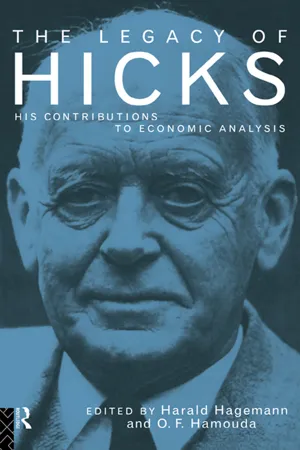
The Legacy of Sir John Hicks
His Contributions to Economic Analysis
- 304 pages
- English
- ePUB (mobile friendly)
- Available on iOS & Android
eBook - ePub
About this book
Sir John Hicks made a major contribution to almost every aspect of modern economic theory. His diverse and inventive work has left a huge impression on the discipline.
Contributors: Christopher Bliss, Oxford University; John S. Chipman, University of Minnesota; Nicholas Georgescu-Roegen, Vanderbilt University; Richard Goodwin, University of Siena; Frank H. Hahn, Cambridge University; John D. Hey, University of York; Charles M. Kennedy, University of Kent; David Laidler, University of Western Ontario; Axel Leijonhufvud, University of California, Los Angeles; Robin C.O. Matthews, Cambridge University; Michio Morishima, London School of Economics; Kurt W. Rothschild, Vienna; Robin Rowley, McGill University; Roberto Scazzieri, University of Bologna.
1
IN MEMORIAM
It is not in doubt that Hicks was the most distinguished British economist of his generation, many would say the most distinguished in the world. Yet it is more difficult to convey in a few words the nature of his greatness and his contribution than it would be for others of comparable stature. His fame did not come from some strong policy recommendations, like those derived from Keynes; nor from some strong empirical finding. And subtle though much of his writing is, he is not remembered mainly for sharp and startling deductive theorems, achieved through complex chains of reasoning.
His chief contribution, rather, was as a conceptualizer. He was one who showed new methods of analysing economic problems, methods that might sometimes be used for one purpose, sometimes for another. This is not the place to enumerate these concepts. They were wide ranging, but related. They run from income and substitution effects in his early days, to others which he was continuing to develop even in his extreme old age. Hicks gave to economics a conceptual apparatus which is now taken for granted as part of the grammar of the discipline.
John Hicks was born in 1904. His father was a journalist–editor and part-proprietor of the Warwick and Leamington Spa Courier. There were intellectual traditions on both sides of his family, which had a connexion with Graham Wallas. A strong intellectual impulse was given to Hicks also by the Headmaster of his Prep school, to whom he felt he owed more than he did to Clifton or (alas!) to Balliol, where he was not well taught, at least on the economics side of the new PPE school. His undergraduate contemporaries, like Denis Brogan, recognized him as something out of the ordinary; but they knew too, even before the results were announced, that something had gone seriously wrong with his performance in the schools. His failure to get a First was a severe setback, and after doing a B.Litt. he actually tried for some months following his father’s profession as a journalist, on the Manchester Guardian. Balliol, through the person of its Master, Lindsay, then made restitution by helping him in 1926 towards the job in the London School of Economics (LSE) that turned out to be so decisive for his career.
Those nine years at the LSE were tremendously productive. They included contributions to value theory, to welfare economics, to the portfolio theory of money and to general equilibrium theory. Any one of these contributions the average economist would be proud to have as his chief life’s achievement. Hicks signalized the debt he felt to the LSE by giving for their new library the proceeds of his Nobel Prize – the first Nobel Prize in economics to be given to a British economist.
It was at the LSE, too, of course, that he met Ursula Webb, who became his wife. For the rest of his life, until her death a few years ago, they were seldom parted even for a few days. Their marriage was a marriage of opposites. He was shy, she was outgoing; she was direct, he was subtle. She protected him and organized their lives. Their loyalty to each other was unswerving.
The LSE years were the only important phase in his career when Hicks worked in close association with others of his own age and standing in his own field. Even then he was something of a loner, working things out on his own in his own way. Later, he talked a good deal to some selected younger economists; and throughout his life he saw much of his near contemporary who came to be a neighbour in Blockley, the economic historian T. S. Ashton, a pre-eminent scholar in a field which Hicks did not regard as his own, but in which he was deeply interested. The close intellectual contacts of the LSE days with his peers in his own field were not repeated. On the other hand, he gave encouragement and discerning help to an army of graduate students now spread over the globe. Many of them came from Ursula’s college, Linacre, where he was an Honorary Fellow and a frequent visitor.
Chance plays a part in the development of even the greatest thinkers. I suspect that the near tabula rasa that Hicks brought to the LSE as a result of his lack of economic education in Oxford had a permanent effect on his approach to the subject. He felt he had to work out his own way of thinking, in part almost from first principles, and this habit persisted throughout his life. He had to chew things through and make them part of his own system of thought.
Had chance taken him as an undergraduate to Cambridge instead of Balliol, his intellectual starting point would have been quite different: he would have become deeply imbued in a single tradition, ready-made, the tradition of Marshall; and his initial task would have been to add or else to escape, rather than, as it was, to construct afresh. This desire to construct an edifice is witnessed by the remarkable breadth of his work. It shows also in his practice, almost unique among modern economic theorists, of making most of his main contributions not in journal articles but in books (or at least developed into books) – over a dozen of them.
This is not to say that in his process of construction he was uninfluenced by other thinkers. Indeed, the evolution of economic thought became a central preoccupation of his. He returned again and again to the great classical authors. As an undergraduate, I had the good fortune to be sent to him for tutorials in economic theory in 1946–7, soon after he came to be a Fellow of Nuffield after his sojourns in Cambridge and in Manchester. I was struck instantly by the complete difference between his approach and the approach of the other economics tutors I had had – and by the difference too from what I had expected (hard work on Value and Capital). With my other tutors, I had studied topics, using textbooks and other convenient but usually undistinguished sources. With Hicks I studied, not the instability of the price level, but Wicksell on the cumulative process; not discriminating monopoly, but Pigou’s theory of it and his chapter on railway rates.
Chance played a part too, in determining which earlier thinkers initially influenced him the most. Hugh Dalton, of all people, still on the LSE staff when Hicks went there, said to him, ‘You can read Italian, you should read Pareto’. So he did. And from Pareto it was natural that he should proceed to Walras and to general equilibrium theory. Hence, and also from Hayek’s presence in the LSE, came the paradox that Hicks, English of the English in his personal character, was of the great British economists of our times the least English in his intellectual antecedents.
Hicks was conscious of his own place in the development of economic thought, and took a justified pride in it. There was one aspect of his influence that aroused mixed feelings in him. At school and in his first year at Oxford, he had become a proficient mathematician, without, I think, ever falling in love with mathematics. His own most influential book, Value and Capital, published in 1939, contained more mathematics than was usual in those days (as it had to, given its concern with the interaction of multiple markets). Together with the much further elaboration by American economists after the war of the lines of thought he had opened up, it had some responsibility for the present-day mathematization of economic theory. That process went much further than in Hicks’s view was appropriate to the nature of the real-life problems that economics should address. That to him was the decisive criterion for economic theory. He was deeply academic in his outlook, but never scholastic.
There was also a matter of temperament in this. ‘My home lies in the humanities’, he said, with increasing emphasis as he grew older. That was one of the reasons why All Souls was so congenial to him. Here was a community of distinguished scholars, spanning the humanities – a community of which he could be proud to be a member, but a community in which privacy was respected. The honour that the College conferred on him by having his portrait painted was something that he appreciated with an intensity that surprised economists who knew of his renown in their own world. He was a Fellow of the College for 35 years. The rather parliamentary style of its governing body meetings suited him. He was a man for the single well-considered contribution, not a man for the cut and thrust of debate, whether in a College meeting or in an academic seminar. He did not relish the role of academic entrepreneur – hence his move at the age of 61 from the Drummond chair to a Research Fellowship. Still less was he attracted by the corridors of political power. He did have views on current economic policy issues; and sometimes they were strongly held. But his style was to state the argument, with his characteristic clarity, very likely also showing the issue in some larger context, and leave persuasion to others.
The breadth of Hicks’s intellectual interests was apparent to all who knew him. It was given more rein in his later writings than earlier. It embraced architecture and music, as well as literature and above all history, which linked with his lifelong preoccupation with the treatment of time in economic theory. This wide range of interests in the humanities was one of the reasons why he so enjoyed being a Delegate of the University Press. Less widely known, perhaps because of his reticence, was the range of his emotional sympathies. He was interested in children; in his old age he took much pleasure from the company of his great-nieces. Poetry was important to him. He held no strict religious faith and he was unsympathetic to organized religion or to religion tainted with sentimentalism. But Dante, that most Christian of poets, was the poet most loved. And these lines by a poet of very different temper, from Kim, moved him to tears when he recited them:
My brother kneels (so saith Kabir)
To stone and brass in heathenwise,
But in my brother’s voice I hear
My own unanswered agonies.
His God is as his Fates assign –
His prayer is all the world’s – and mine.
To stone and brass in heathenwise,
But in my brother’s voice I hear
My own unanswered agonies.
His God is as his Fates assign –
His prayer is all the world’s – and mine.
2
JOHN HICKS THE THEORIST
Hicks’s contribution to economic theory deserves and surely will receive serious and extended scholarly assessment. The present essay written so soon after his death, which, characteristically, came to him while completing a new book, does not provide this. It is written to evoke for the many for whom Hicks was a decisive influence the Hicksian spirit and approach. It will of course discuss some, but by no means all, of his contributions but these discussions will, in the nature of the case, not be exhaustive. The main aim is to remind us of what we owe to his work.
I
We live in an age of American economics. (Hicks (1963b) regarded 1946 as the ‘eve of a great moment in American economics’ and the start of its preeminence.) When he began his career as a theorist (he started economics in a very practical vein (Hicks 1963b: 305–6)) it was still very much a British subject with a recognizable British tradition. The latter is hard to pin down precisely but it had certain distinctive characteristics: (1) The study of economics is not to be regarded as an end in itself. It lacks the beauty of mathematics or art or the possibilities for precision and prediction of physics. The main motive for its study must be the improvement of the condition of mankind ‘The complicated analysis which economists endeavour to carry through are not mere gymnastic. They are instruments for bettering human life’ (Pigou 1928: vii). (2) While certain aspects of the subject require precision and rigour it does not lend itself to the formulation of a general ‘system’. A good economist is a pragmatic economist. (3) Economic phenomena are only one part of the phenomena of importance to the study of society. While ceteris paribus concerning all the non-economic variables may often be legitimate, explanation and understanding is often impossible without a knowledge of the history, mores and social norms of the society concerned. It is the duty of the theorist who has arrived at a formal result to consider whether it is robust when applied to different societies and particularly when it is applied to his own society. (4) It is pretentious to use mathematics when words will do and it is equally pretentious to use ‘highbrow’ mathematics when more elementary methods will do almost as well. (5) As far as possible (given (1)) the economist should attempt to communicate with the educated non-expert.
It seems to me that, except in one important particular, Hicks belongs to this tradition and that he was conscious of it. The exception is point (1). He no doubt was interested in the amelioration of the ‘human condition’ but he seems to have felt strongly that the condition must be understood. Indeed it is this departure from the tradition which appeals to many of us now. Reading Hicks always renews one’s faith in the importance of economic theory as a means of understanding (and not necessarily of prediction). No one can doubt that he took this enterprise seriously. He returned to the same problems over and over again over many years because he brooded on them and became dissatisfied with his earlier answers.
On the other hand it must be admitted that other aspects of the tradition exacted a certain cost (as well as conferring benefits). Amongst the costs I would put Hicks’s relatively small box of mathematical tools. He plainly had considerable mathematical ability but he seemed disinclined to learn ‘new tricks’. To some extent this cut him off from some new developments to which he could otherwise have contributed. Again he wrote A Revision of Demand Theory (1956a) of which he says: ‘Those who rely on mathematical methods will not get much from the present approach which they could not get from the mathematical appendix to Value and Capital (p. v.).’ It is thus an example of point (5) of the tradition. However, it must be doubted that the non-mathematical reader would get very far with the ‘translation’ which is offered. The tradition also made him reluctant to read widely in the new technocratic literature. He read the ‘greats’ like Samuelson, but judging by his references missed much that was relevant to him from the pen of the ‘smaller fry’. These are genuine costs but they are happily vastly outweighed by the benefits of his work.
II
Although it was not his first book it seems clear that reflections on Hicks’s work should start with Value and Capital (1939a). There can be few books which have had as much influence on the course of economic theory not only in the years which immediately followed its publication but to this day.
Although there were distinguished predecessors (e.g. Slutsky) and no doubt Hicks gained much from Roy Allen’s early co-operation (Allen and Hicks 1934), the exposition of consumer’s choice in the first part of Value and Capital is a tour de force. Of course much work has followed and many refinements are now available, but in its essentials it stands like a rock. The argument is always clear and decisive. Hicks’s forte of coining new terms plays an important expository role as one moves from income and substitution effects to the compensating and equivalent variations. Later this yielded new insights into consumer’s surplus and the economic theory of index numbers (Hicks 1956a). Even when he falters, as he does in his discussion of the convexity of indifference curves, the reader is learning. Of course there is nothing yet on duality and revealed preference. But one guesses that there are many economists who are not specialists in the theory of household choice for whom the Value and Capital account is all they know and all that they need to know.
But the real delight is the appendix. We no longer need bordered Hessians but to come across the analysis here presented in the 1940s was an exhilarating eye-opener. Most importantly is this the case for those sections of the appendix where Hicks used the theory of the individual agent to discuss certain problems of the interaction of these agents. We learned for the first time the rôle of income effects and substitution effects in the analysis of the economy as a whole. It is true that Hicks’s notion of stability was both stilted and, in the end, unsatisfactory. But it was not as flawed as Samuelson (1941/2) supposed (see McFadden 1968; Hahn 1991). It remains true that now it was possible to see how the Walrasian enterprise could be started from the ‘bottom up’, i.e. from a well-articulated micro-theory.
But of course Value and Capital contained much more than this. Perhaps the most lasting and important part is that on sequence analysis and the accompanying discussion of expectations. Even if we somehow convince ourselves that an economy is typically approximately in steady state with correct or rational expectations, it is hard to see that we can rest content before explaining why that should be so. Indeed it has been a central question since Adam Smith how rational greedy agents could lead an economy to a coherent disposition of resources. On this matter we have not been served well by many American economists who often seem to take the evident need to simplify as an injunction not to ask awkward questions. They thus leave out of consideration a large part of the subject matter of economics. In any event Hicks knew what he was about here and indeed, over the years, repeatedly returned to the subject (see Hicks 1965a, 1973d, 1974b, 1985a). He had well-known Swedish predecessors (in particular Lindahl) and he has had distinguished successors who adopt a period approach (e.g. Radner 1972; Grandmont 1982). His period analysis in Value and Capital was the beginning of Hicksian dynamics but it was only in later writings that it emerged as a recognizable theory of a process. In Value and Capital the story stops at short period equilibrium. ‘The ...
Table of contents
- Cover
- Halftitle
- Title
- Copyright
- Contents
- List of Contributors
- Introduction
- 1 In Memoriam
- 2 John Hicks the Theorist
- 3 Capital and Growth
- 4 Capital Theory
- 5 The Theory of Wages Revisited
- 6 A Reformulation and Extension of Hicksian Dynamics
- 7 Hicks on General Equilibrium and Stability
- 8 Hicksian Welfare Economics
- 9 Hicks, Keynes and Marshall
- 10 Hicks’s Later Monetary Thought
- 11 In Time with Hicks: Probability
- 12 Risk and Uncertainty
- 13 Employment and Machinery
- 14 Economic Theory and Economic History: Perspectives on Hicksian Themes
- 15 Time in Economics
- Published Writings
- Name index
- Subject index
Trusted by 375,005 students
Access to over 1.5 million titles for a fair monthly price.
Study more efficiently using our study tools.
Frequently asked questions
Yes, you can cancel anytime from the Subscription tab in your account settings on the Perlego website. Your subscription will stay active until the end of your current billing period. Learn how to cancel your subscription
No, books cannot be downloaded as external files, such as PDFs, for use outside of Perlego. However, you can download books within the Perlego app for offline reading on mobile or tablet. Learn how to download books offline
Perlego offers two plans: Essential and Complete
- Essential is ideal for learners and professionals who enjoy exploring a wide range of subjects. Access the Essential Library with 800,000+ trusted titles and best-sellers across business, personal growth, and the humanities. Includes unlimited reading time and Standard Read Aloud voice.
- Complete: Perfect for advanced learners and researchers needing full, unrestricted access. Unlock 1.5M+ books across hundreds of subjects, including academic and specialized titles. The Complete Plan also includes advanced features like Premium Read Aloud and Research Assistant.
We are an online textbook subscription service, where you can get access to an entire online library for less than the price of a single book per month. With over 1.5 million books across 990+ topics, we’ve got you covered! Learn about our mission
Look out for the read-aloud symbol on your next book to see if you can listen to it. The read-aloud tool reads text aloud for you, highlighting the text as it is being read. You can pause it, speed it up and slow it down. Learn more about Read Aloud
Yes! You can use the Perlego app on both iOS and Android devices to read anytime, anywhere — even offline. Perfect for commutes or when you’re on the go.
Please note we cannot support devices running on iOS 13 and Android 7 or earlier. Learn more about using the app
Please note we cannot support devices running on iOS 13 and Android 7 or earlier. Learn more about using the app
Yes, you can access The Legacy of Sir John Hicks by Harald Hagemann,Omar Hamouda in PDF and/or ePUB format, as well as other popular books in Business & Business General. We have over 1.5 million books available in our catalogue for you to explore.