eBook - ePub
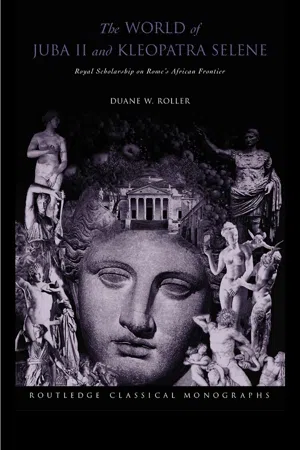
The World of Juba II and Kleopatra Selene
Royal Scholarship on Rome's African Frontier
- 352 pages
- English
- ePUB (mobile friendly)
- Available on iOS & Android
eBook - ePub
The World of Juba II and Kleopatra Selene
Royal Scholarship on Rome's African Frontier
About this book
Raised and educated in Rome, Juba II (48 BC- AD 23) was sent to uphold Roman interests in northwest Africa as ruler of the cliet kingdom of Mauretania. Together with his wife K'eopatra Selene, daughter of Marcus Anthonius and Kleopatra VII, he established a rich, multicultural environment at their capital, renamed Caesarea, where Egyptian, Hellenistic Greek and indigenous elements came together. Juba combined a reign of more than half a century with a career as a distinguished scholar and writer, producing an extensive collection of works and shaping Roman knowledge of the southern half of the known world, from the Atlantic coast of northwest Africa to India. This book explores the complex culture and legacy of the kingdom, with emphasis on Juba's scholarship and the world created by these two remarkable monarchs. This detailed and comprehensive study is not only the first examination in English of Juba's life and career, but the first critical analysis of the king both as an implementer of the Augustan political, artistic and intellectual programme and as a notable scholar.
1
JUBA’S NUMIDIAN ANCESTRY
Juba II was descended from a long line of distinguished ancestors who had been involved in Roman politics for nearly two hundred years prior to his accession to the throne of Mauretania. The family tree can be constructed for at least seven generations before Juba,1 starting with the tribal chieftain Zilalsan, born perhaps around 300 BC.2 The family was famous and talented, producing a variety of scholars and political and cultural leaders, attached first to Carthaginian interests and then to Roman, with an increasing amount of Hellenism. This impressive ancestry was certainly a factor in Caesar’s decision to save young Juba, and that of Augustus to make him king of Mauretania.
Juba’s ancestors were kings of Numidia, the territory south and west of Carthage. Originally nomadic herdsmen, by the fourth century BC they became identifiable as a number of tribal groups, which seem to have begun to coalesce into a single ethnic unit late in the following century.3 This process was said to have been largely due to the efforts of Massinissa, the first of the Numidian kings to appear prominently in the historical record. His grandfather Zilalsan (the first member of the dynasty whose name is known with certainty) held the title of suffete, indicating the Carthaginian influence existing by the early third century BC.4 His son, Gaia or Gala, was the first to carry the title “king,” but presumably was king only of his tribal group, the Maesyli.5 Gaia came to Roman notice during the Second Punic War because he opposed another Numidian chieftain, Syphax, who had revolted from the Carthaginians and sided with Rome, a crucial event of the latter years of the war.6 For the first time, the Romans began to incorporate the Numidian tribes into their strategic designs against Carthage. Gaia’s son Massinissa, who turned 20 the year the war began, fought at the side of his father for Carthage and against Syphax and Rome.
Gaia died in Spain near the end of the war,7 but Massinissa did not inherit the kingship because custom caused it to revert to his uncle Oezalces, brother-in-law of the famous Hannibal. Oezalces died shortly thereafter and was succeeded by his son Capussa, who was promptly killed by a relative, Mazaetullus, who had married Oezalces’ widow and thus had acquired the status appropriate for the brother-in-law of Hannibal. This Numidian civil war now involved three tribal groups, those of Syphax, the brothers Gaia and Oezalces, and Mazaetullus. Moreover, Roman and Carthaginian interests were already polarizing in their support of these families. The way was clear for the rise of Massinissa.
Massinissa was the most famous and notable of the ancestors of Juba II, his great-great-great-grandfather.8 During his long reign, which extended from the Second Punic War into the Third, he prospered despite being caught between Rome and Carthage, eventually siding with the former and playing a decisive role in the destruction of the latter. Learned and erudite, he presided over a court that attracted both Greeks and Romans, and thus became one of the best early examples of the king allied to Rome and an ideal role model for his descendant.

Figure 1 The Numidian marble quarries at Chemtou (Tunisia).
Photograph by Duane W. Roller.
The career of Massinissa was lengthy and complex. He was educated at Carthage and became a protégé of the great Carthaginian leader Hasdrubal.9 His youth and early maturity coincided with the Second Punic War and the internal power struggles within Numidia. He first fought for Carthage, his operations ranging far west to Tingis, disrupting the supplies from Syphax to the Romans, and eventually crossing to Spain and opposing the Scipio brothers: it was his cavalry that killed P. Cornelius Scipio the elder in 211 BC.10 But a few years later, when the fortunes of war began to turn in favor of Rome, Massinissa realized that Rome might be of use to him in asserting his position within Numidia. He sought out M. Junius Silanus, one of the Roman commanders11 – the details of the interview were not preserved by Livy but apparently the result was that he joined the Roman side – and then returned to Africa in order to bolster support among his countrymen for his change of allegiance. This was a wise move, since both Syphax and Mazaetullus had reverted to the Carthaginians.12 With Carthage and most of Numidia against him, Massinissa’s prospects were not good, and although initially successful he was eventually wounded and had to hide out in the mountains and await the Romans. Eventually, in 204 BC, the Romans under P. Cornelius Scipio Africanus landed in Africa and soon engaged the Carthaginians. Massinissa’s cavalry was decisive in the battle and he was said to have personally captured Syphax.13 He also eliminated the other claimant to Numidian power, Mazaetullus, so his victory over his countrymen was complete.14 Thus with Roman support Massinissa was able to claim the kingship of Numidia. Scipio formally addressed him as king and gave him insignia of office, telling him that he was the foreigner most respected by Rome;15 the Senate confirmed the title and gave him additional honors and gifts.16
It is probable that few foreigners had ever been so well treated by Rome. Massinissa was to rule as king of Numidia for the next fifty-five years, skillfully balancing his interests, precarious because he was geographically adjacent to Carthage but a client of Rome. He became famous for exploiting the agricultural bounty of his kingdom,17 which led to exports to Rome and the Greek world. He was probably the first Numidian to hellenize his court,18 which became a center of culture: among the visitors were the historian Polybios and King Ptolemaios VIII, who was impressed with its Greco- Roman character.19 Massinissa’s coinage shows Greek qualities in the bearded bust of the king, with royal diadem, and includes the elephant, an early numismatic representation of this ubiquitous symbol of North African royalty.20 It was perhaps also Massinissa who began to exploit the Numidian marble that was soon to be exported to Rome,21 and to build in Hellenistic fashion, especially the monumental funerary architecture still conspicuous today.22 He involved himself in the politics of the eastern Mediterranean, assisting Rome in the Makedonian Wars, and eventually sending his son Misagetes with a substantial force and supplies to Greece.23 Later he shipped grain to Delos and was honored by that island,24 and was on friendly terms with eastern royalty, especially Nikomedes II of Bithynia.25 His sons were sent to Greece, probably Athens, to be educated.26
Meanwhile, in order to insure his own survival at home, he initiated a series of territorial disputes with Carthage.27 A continuing series of confrontations ensued, warily watched by Rome, that lasted until the outbreak of the Third Punic War.28 In 151 BC the Carthaginians invaded Numidia (a violation of the terms of the end of the Second Punic War), and Massinissa, who was now 87, decisively defeated them, leading his forces personally on horseback.29 This Carthaginian incursion gave Rome the pretext for war, something probably already decided, but the Roman government was ambivalent about what role the elderly monarch should play. Eventually, in 148 BC, it was decided that he could be of use to Rome, but the envoys found him dead at the age of 90.30
When his great-great-great-grandson Juba II arrived in Rome a century later, Massinissa’s legend was well established.31 Contemporary Romans were fascinated with the tale of the witty and cultured barbarian king, who had lived so long and fathered the last of his forty-four sons at 86, and was noted for such ability and strength in extreme old age.32 He had been so impressed with Rome that he became its greatest friend, evolving, in the best barbarian tradition, from hostility to alliance.33 Particularly romantic, although doubtless elaborated, was the story of his relationship with Sophoniba, the elegant daughter of his mentor Hasdrubal. Sophoniba was the wife of his enemy Syphax, but Massinissa became enamored with her and sent her poison so that she would not be captured alive by the Romans – an episode as much from tragedy as history.34 Massinissa was a role model for Juba to adopt: the ancestor who embodied all the best qualities of barbarian integrity, Greco-Roman culture, and political astuteness, strongly attached to a particular Roman family, turning from enemy to friend, spending his life balancing the needs of his territory with those of Rome.35
Upon his death, Massinissa left his kingdom to three of his sons and made P. Cornelius Scipio Aemilianus the executor of his will,36 one of the earliest known cases of a royal inheritance involving Rome.37 Scipio had met the king’s heirs and was the adopted grandson of his patron Scipio Africanus. The will, whether oral or written, was executed in perilous times, during the middle of the Third Punic War, in the context of long-standing Carthaginian–Numidian animosity, when the Carthaginians might have been expected to meddle in the succession. Scipio, well known in Numidia and prestigious in Rome, was an obvious choice to supervise this touchy issue. How much the eventual settlement was the work of Scipio and how much was the testament of Massinissa is not certain: Appian, the primary source, is ambiguous, stating only that the sons were to obey (pe…qesqai) Scipio.38
Scipio’s decision – whether or not suggested by Massinissa – was to create a regal triumvirate of Massinissa’s three oldest sons, Micipsa, Gulussa, and Mastanabal.39 Yet this three-way rule did not last long, for Gulussa and Mas...
Table of contents
- COVER PAGE
- TITLE PAGE
- COPYRIGHT PAGE
- ILLUSTRATIONS
- PREFACE
- ACKNOWLEDGMENTS
- ABBREVIATIONS
- INTRODUCTION
- 1. JUBA’S NUMIDIAN ANCESTRY
- 2. MAURETANIA
- 3. JUBA’S YOUTH AND EDUCATION
- 4. KLEOPATRA SELENE
- 5. THE MAURETANIAN CLIENT KINGDOM: FOUNDATION, MILITARY HISTORY, AND ECONOMY
- 6. THE ARTISTIC AND CULTURAL PROGRAM OF JUBA AND KLEOPATRA SELENE
- 7. REX LITERATISSIMUS
- 8. LIBYKA
- 9. THE EASTERN EXPEDITION WITH GAIUS CAESAR
- 10. ON ARABIA
- 11. THE MAURETANIAN DYNASTY
- EPILOGUE
- APPENDIX 1: THE PUBLISHED WORKS OF JUBA II
- APPENDIX 2: STEMMATA
- APPENDIX 3: CLIENT KINGSHIP
- BIBLIOGRAPHY
- LIST OF PASSAGES CITED
Trusted by 375,005 students
Access to over 1.5 million titles for a fair monthly price.
Study more efficiently using our study tools.
Frequently asked questions
Yes, you can cancel anytime from the Subscription tab in your account settings on the Perlego website. Your subscription will stay active until the end of your current billing period. Learn how to cancel your subscription
No, books cannot be downloaded as external files, such as PDFs, for use outside of Perlego. However, you can download books within the Perlego app for offline reading on mobile or tablet. Learn how to download books offline
Perlego offers two plans: Essential and Complete
- Essential is ideal for learners and professionals who enjoy exploring a wide range of subjects. Access the Essential Library with 800,000+ trusted titles and best-sellers across business, personal growth, and the humanities. Includes unlimited reading time and Standard Read Aloud voice.
- Complete: Perfect for advanced learners and researchers needing full, unrestricted access. Unlock 1.5M+ books across hundreds of subjects, including academic and specialized titles. The Complete Plan also includes advanced features like Premium Read Aloud and Research Assistant.
We are an online textbook subscription service, where you can get access to an entire online library for less than the price of a single book per month. With over 1.5 million books across 990+ topics, we’ve got you covered! Learn about our mission
Look out for the read-aloud symbol on your next book to see if you can listen to it. The read-aloud tool reads text aloud for you, highlighting the text as it is being read. You can pause it, speed it up and slow it down. Learn more about Read Aloud
Yes! You can use the Perlego app on both iOS and Android devices to read anytime, anywhere — even offline. Perfect for commutes or when you’re on the go.
Please note we cannot support devices running on iOS 13 and Android 7 or earlier. Learn more about using the app
Please note we cannot support devices running on iOS 13 and Android 7 or earlier. Learn more about using the app
Yes, you can access The World of Juba II and Kleopatra Selene by Duane W Roller in PDF and/or ePUB format, as well as other popular books in History & Ancient History. We have over 1.5 million books available in our catalogue for you to explore.