eBook - ePub
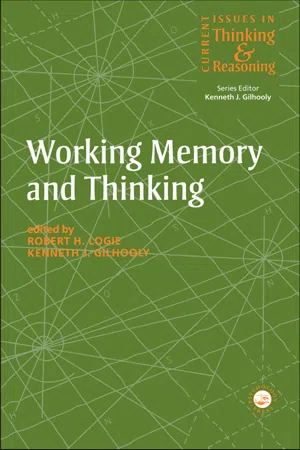
Working Memory and Thinking
Current Issues In Thinking And Reasoning
- 176 pages
- English
- ePUB (mobile friendly)
- Available on iOS & Android
eBook - ePub
Working Memory and Thinking
Current Issues In Thinking And Reasoning
About this book
Thinking and memory are inextricably linked. However, a "divide and rule" approach has led cognitive psychologists to study these two areas in relative isolation. With contributions from some of the leading international researchers on working memory and thinking, the present volume aims to break down the scientific divisions and foster scientific integration in the connections between these two core functions of cognition. Broadly defined, thinking comprises mentally driven change in current representations. The processes involved in such change include application of logical rules, heuristics, problem solving strategies, decision making, planning and comprehension of complex material. Memory involves the encoding, retention and retrieval of information, and the retention may be temporary or in a long-term knowledge base.; Thinking cannot occur in a vacuum; it relies on the long-term memory base and a temporary mental workspace. Despite the apparent limitations on mental workspace, humans can drive a car and hold a conversation, or store partial solutions while tackling other aspects of a problem. So too, some aspects of thinking are relatively resilient in the face of quite extensive brain damage, yet other aspects are remarkably vulnerable to neuroanatomical insults. Humans can solve complex problems with many alternative choice points and yet seem to be able to consider only a few hypotheses at any one time. These apparent paradoxes present significant scientific challenges as to how humans can be such successful thinkers despite their very limited working memory. The chapters herein represent a diversity of views as regards the nature or working memory and forms of human thinking. The links between working memory and thinking are directly addressed and made explicit, and in so doing this volume offers an increasingly integrated understanding of human thinking and memory.
Information
CHAPTER ONE
Thinking in Working Memory
Kenneth J.Gilhooly and Robert H.Logie
University of Aberdeen, Scotland, UK
Thinking and memory are inextricably linked. However a “divide-and-rule” approach has led cognitive psychologists to study these two areas in relative isolation. The present volume aims to break down the scientific divisions and foster scientific integration in the connections between these two core functions of cognition. We define thinking broadly as mentally driven change in current representations. The processes involved in such change would include application of logical rules, heuristics, strategies typically aimed at solving problems, making decisions, planning, and comprehension of complex material. Memory involves the encoding, retention, and retrieval of information, and the retention may be temporary or in a long-term knowledge base. Thinking cannot occur in a vacuum; it relies on the long-term knowledge base and a temporary workspace. Each chapter in this volume addresses different aspects of the interaction between thinking and differing conceptions of the mental temporary workspace known as working memory. The chapters by Gilhooly, Phillips and Forshaw, Della Sala and Logie, and Saariluoma espouse the multiple-component view of working memory in which different task demands are met by differing, specialised working-memory components (Baddeley, 1986). Each component then draws on relevant information in the long-term knowledge base. Engle sits astride the multiple-component view of working memory and the dominant North American “modal model” of a single flexible resource for differing forms of processing and storage. Both Halford, and Ericsson and Delaney focus on the development of knowledge structures. In the case of Halford these knowledge structures incorporate a form of “conceptual chunking”, which develops as children grow to maturity, and enhances the efficiency with which working memory can operate. Ericsson and Delaney discuss how the development of expert knowledge in adults permits ease of access to knowledge within the domains of expertise.
Thinking is constrained by the content, nature, and organisation of the knowledge base. It is also constrained by the ease with which information from the knowledge base and the environment can be retrieved, and then maintained and processed within working memory. The operation of working memory is constrained by its architecture, and the efficiency of operations within that architecture. A dramatic example of the interaction between thinking and the architecture of the temporary workspace is provided by the contrast between natural and artificial “thinkers”. At the time of writing (May 1997), the world champion human chess player Kasparov is locked in battle with “Deep Blue”, an artificial chess-playing opponent, which has essentially unlimited workspace. These opponents appear very closely matched in performance (although Deep Blue prevailed), yet the underlying architecture and concomitant strategies (or processes of “thinking”) are vastly different. Less dramatically, Broadbent (1993) has noted that artificial intelligence systems for problem-solving generally require manifestly larger workspace than that available to human problem-solvers. An equally striking feature of human thinking emerges from the ability to deal with more than one task demand at a time. Humans can drive a car and hold a conversation, or store partial solutions while tackling other aspects of a problem. Current trends in air-traffic volume place multiple processing and storage demands on air-traffic controllers, and yet air travel remains one of the safest forms of transportation. These apparent paradoxes, as to how humans can be such successful thinkers despite their very limited working memory, present significant scientific challenges.
Gilhooly addresses the role of working memory in reasoning tasks. A number of studies, using dualtask methodology, indicate that central executive and articulatory loop components are typically involved in reasoning tasks. It is noted that “reasoning tasks” are more often than not solved by heuristic strategies that differ from strict reasoning. It is argued that in order fully to understand how strategies for solving problems are implemented, the demands that the strategy implementations place on working-memory components must be specified. Examples are developed of the ways in which alternative implementations of the same strategy may place greater and lesser loads on working-memory components. From studies of response patterns and thinking-aloud records, for instance, it is possible to identify the broad strategy followed. From studies of working-memory component loadings, it is possible to gain information on how the major strategy is implemented.
The issue of strategies arises again in studies of working memory and ageing in reasoning tasks, as discussed in the chapter by Phillips and Forshaw. The difficulty in establishing clear links between measures of working-memory characteristics, age, and performance in a range of tasks may be caused by subjects adopting strategies that compensate for reduced working-memory capacities by minimising loads on working memory while still yielding a satisfactory level of performance. Phillips and Forshaw point out the many problems of reliability and validity that arise from attempts to measure individual differences in working-memory capacities and processing efficiency.
Phillips and Forshaw argue that although the link between working memory and ageing is not completely resolved, the age effects that have been reported might be attributable largely to changes in processing speed with age. The underlying neurological changes that occur in normal ageing are somewhat modest compared with those suffered by patients with brain damage as a result of injury, disease, stroke, tumour, or neurosurgery. Disorders of thinking ought to accompany neurological damage. However, in their chapter, Della Sala and Logie note that although gross cognitive impairments are observed in brain-damaged patients, disorders of thinking are not clearly understood. In large part, this stems from which functions of cognition might be considered to fall under the umbrella of “thinking”, with many researchers in neuropsychology preferring to refer to impairments in “executive functions”. The issue is further complicated by the reference in this literature to “frontal functions”, linking executive aspects of cognition with the functioning of the frontal lobes, a link that is by no means clear cut. Nevertheless, the area is ripe for exploration both with respect to the understanding of the effects of brain damage, and with respect to the implications that neuropsychological findings have for our understanding of thinking in the healthy brain.
The chapter by Engle and Conway incorporates some aspects of the multiple-component model of working memory, but largely consigns the “slave systems” of working memory (phonological loop and visuospatial sketch-pad) to relatively minor roles in language comprehension. Much of the focus of their chapter is on individual differences in working-memory span and its association with individual variability in comprehension. They conclude that the executive component of working memory probably contributes little to much of everyday skilled comprehension. Working memory, then, is only brought to bear when comprehension tasks involve complex syntax or ongoing interruptions.
Engle’s contribution to the literature has focused on the activation of stored knowledge of semantics and syntax in order to deal with compre hension tasks. Much of this access, then, is automated in skilled comprehension. This theme arises in the Ericsson and Delaney chapter in their discussion of “long-term working memory”. The issue here is that as expertise is acquired in particular domains, that expertise, in the form of stored knowledge, becomes readily available for performing tasks relevant to the expertise. Experts can then demonstrate on-line processing and storage capacity far in excess of the typically reported limits for working memory, particularly in thinking and problem-solving. The authors build on the proposal of Ericsson and Kintsch (1995) that experts develop efficient encoding and retrieval schemes that enable them rapidly to store relevant new information in long-term memory and retrieve it rapidly as needed in the course of solving problems. Effectively, expert solvers have an extended long-term working memory to supplement short-term working memory. Persuasive evidence is adduced from studies of expert chess players, mnemonists, medical diagnosticians, and skilled readers.
Saariluoma focuses on the role of working memory in the adversary problem domain of chess. Applying the multiple-component model of working memory, Saariluoma presents evidence that the visuospatial sketch-pad and central executive are crucially involved in chess play. Saariluoma also points to the role of long-term working memory as proposed by Ericsson and Delaney in their chapter. Long-term working memory has a role in normal chess play as a store for alternative move sequences (“episodes”), which are generated as the player explores possible moves and decides between the options generated. The ability of experts to engage successfully in simultaneous blindfold play of 10 or more games is a dramatic example of long-term working memory in action.
The effects of developing an expert knowledge base, discussed both by Ericsson and Delaney, and by Saariluoma, recur in a different form in the chapter by Halford. As children grow older, Halford argues, they develop conceptual knowledge, which allows them to simplify complex relations and associations. In a manner that echoes the development of expert skill in adults, children develop skills in conceptual chunking, thereby making better use of limited processing capacity. The apparent increase in processing capacity on the way to adulthood arises, then, from an ability to simplify.
The chapters herein represent a diversity of views as regards the nature of working memory. They also cover diverse forms of human thinking. In so doing, the links between working memory and thinking are directly addressed and made explicit. By bringing together a range of views and current research on the nature of the links, we hope that this volume will contribute to an increasingly integrated understanding of human thinking and memory.
REFERENCES
Baddeley, A.D. (1986). Working memory. Oxford: Oxford University Press.
Broadbent, D.E. (1993). Comparison with human experiments. In D.E.Broadbent (Ed.), The simulation of human intelligence (pp. 198–217). Oxford: Blackwell.
Ericsson, K.A., & Kintsch, W. (1995). Long term working memory. Psychological Review, 102, 211–245.
CHAPTER TWO
Working Memory, Strategies, and Reasoning Tasks
Kenneth J.Gilhooly
University of Aberdeen, Scotland, UK
1.
INTRODUCTION
In life, memory and thinking are inextricably intertwined. When tackling a problem, previously acquired concepts must be retrieved from long-term memory to represent the problem situation, previously acquired rules in long-term memory need to be activated to change the problem representation towards the goal state, intermediate results may need to be held briefly in working memory, and the results of thought may in turn change long-term memory contents. The present chapter will be focusing particularly on the interrelations between working memory and that form of thinking referred to as reasoning. The role of working memory in reasoning was a concern of the originating papers of the Baddeley-Hitch working-memory model (Baddeley & Hitch, 1974; Hitch & Baddeley, 1976) and this concern continues. In common with many of the chapters in this book, I will be discussing the issues within the framework of the Baddeley-Hitch model of working memory as a tripartite system consisting of central executive, phonological (or articulatory) loop, and visuo-spatial scratchpad (or sketch-pad). In the remainder of this section I will consider various questions of definition that gather around the notion of “reasoning” and its associate “rationality”, then, in the second section, I will outline salient empirical results, and in the last section, I will develop a theoretical discussion of how working memory and strategies for reasoning tasks could interact.
Firstly, how might “thinking” be defined? I propose that “thinking” is an internally driven process of changing the currently active mental representation. It is plausible to suppose that the currently active mental representation is maintained in working memory. So, thinking is a process of changing currently active mental representations held in working memory.
Second, how might “reasoning” be defined as a special type of thinking process? A recent definition of reasoning is: “When most psychologists talk about ‘reasoning’ they mean an explicit sequential thought process of some kind, consisting of propositional representations” (Evans & Over, 1996, p. 15). This definition is helpful in stressing that reasoning is an explicit rather than an implicit process and is sequential rather than parallel. However, this definition, as it stands, is possibly over-inclusive, and could apply to most cases of problem-directed thinking. For this chapter, I will limit “reasoning”, as a form of thinking, to explicit sequential thought processes that are effectively equivalent to the application of a sequence of rules of some formal system. Formal systems provide sets of general rules for reaching correct conclusions from given statements.
The principal formal systems are those of deductive logic, mathematics, statistics, probability, decision theory and, although less fully formalised, inductive and deontic logics. Such theories are couched in abstract terms and can apply to a wide variety of contents for which the appropriate relationships hold (such as set inclusion, exclusion, overlap, implication, negation, and so on). Thus, reasoning involves the application of very general rules to specific contents.
Reasoning tasks, then, can be defined as tasks that could be successfully tackled by the application of a formal theory and require no real-world knowledge of the objects being reasoned about. However, presentation of a reasoning task is no guarantee that reasoning will be evoked. Indeed, it is a recurrent theme in research on reasoning tasks that subjects generally do not actually reason! Instead, a wide variety of heuristic strategies have been postulated as underlying performance in reasoning tasks, and such strategies, although generally superior in results to guessing, are typically not equivalent to logical rule application. The hypothesis that subjects respond to syllogisms, for example, by reasoning correctly, is plainly wrong; the modal answer to most syllogisms is an error of some sort (Erickson, 1978). Indeed, the frequency of errors in reasoning tasks has been taken by some as having bleak implications for human rationality (Cohen, 1981; Sutherland, 1992). Because reasoning, in the sense defined above, is not modal even in response to reasoning tasks, this chapter would be rather brief if it focused solely on working memory and thinking that was equivalent to logical rule application. Instead, this chapter will address the role of working memory in reasoning tasks, and consider how that role may vary with different strategies and different tasks.
Finally, in this section, let us consider definitions of “rationality”. Because reasoning in the sense of logic-equivalent processes seems to be rare, it is tempting to conclude that humans are irrational. However, on the other hand humans are a very successful species and have constructed those very logical systems against which their own thinking can be assessed, as well as building enormously complex and highly effective physical systems, such as computers and space rockets; these achievements suggest rationality rather than irrationality. Alternative routes to reconcile the apparently conflicting evidence on human rationality have been espoused. Firstly, there is the idea of “bounded rationality” (Simon, 1978), which proposes that humans can apply rules of reasoning but only within capacity limits—and among these limits working-memory limits are very important. Because of capacity limits, certain heuristics, which sacrifice some accuracy in order to save mental overload, are followed. In terms of “optimality” (Anderson, 1991), use of such heuristics may maximise utility when cognitive-effort costs are included and so be “rational”, whereas use of correct reasoning rules may be suboptimal when effort costs are taken into account and so be “irrational”.
Another line of defence of human rationality is to argue that humans (and other species) may show “adaptive rationality” (Anderson, 1991; Evans & Over, 1996) and achieve important goals by means of implicit learning processes that fine-tune behaviour to match environmental regularities. The behaviour of bees, for example, may conform to the predictions of optimal search theories, but it seems safe to assume that bees do not actually work through these rules explicitly. Rather, through a combination of evolutionary pre-wiring and simple learning processes, their behaviour becomes adapted to their environment with good results. Adaptively, rational mechanisms do not involve explicit strategic processes and so would not be expected to load working memory. Evans and Over (1996) label explicit reasoning processes as showing rationality1, whereas implicitly rational processes are labelled as showing rationality2. They suggest that many “errors” in reasoning tasks are due to elicitation of implicit rational processes rather than explicit rational processes. Stevenson (in press) points out a third option, which is that heuristic strategies that are explicit may also be elicited (i.e. not all explicit processes will be strictly equivalent to reasoning with formal rules of logic). It is quite possible that tasks designed to evoke explicit reasoning will tend to evoke explicit heuristic strategies that perform below the level of correct reasoning (but load working memory) or implicit adaptive processes, which may deliver a fast response with no loading of working memory. The following sections of this chapter focus on the possible role of working memory and its components in tasks designed to evoke reasoning, with special reference to differences among strategies.
2.
WORKING MEMORY IN REASONING TASKS: EMPIRICAL RESULTS
2.1
The AB task
In Baddeley and Hitch’s (1974) seminal presentation on working memory, considerable emphasis is given to studies of the role of working memory in reasoning, and these studies were also reported in greater detail in Hitch and Baddeley (1976). The experiments in question involved the use of a task known as the AB task (Baddeley, 1968), in which the subject is presented with sentences that claim to describe the order of two letters at the end of each sentence and the subject must indicate as quickly as possible whether each sentence is true or false. For example, given “A does not precede B-AB”...
Table of contents
- Cover Page
- Title Page
- Copyright Page
- Contributors
- Chapter One: Thinking in Working Memory
- Chapter Two: Working Memory, Strategies, and Reasoning Tasks
- Chapter Three: The Role of Working Memory in Age Differences in Reasoning
- Chapter Four: Dualism Down the Drain: Thinking in the Brain
- Chapter Five: Working Memory and Comprehension
- Chapter Six: Working Memory and Expert Performance
- Chapter Seven: Adversary Problem-solving and Working Memory
- Chapter Eight: Development of Processing Capacity Entails Representing More Complex Relations: Implications for Cognitive Development
Trusted by 375,005 students
Access to over 1.5 million titles for a fair monthly price.
Study more efficiently using our study tools.
Frequently asked questions
Yes, you can cancel anytime from the Subscription tab in your account settings on the Perlego website. Your subscription will stay active until the end of your current billing period. Learn how to cancel your subscription
No, books cannot be downloaded as external files, such as PDFs, for use outside of Perlego. However, you can download books within the Perlego app for offline reading on mobile or tablet. Learn how to download books offline
Perlego offers two plans: Essential and Complete
- Essential is ideal for learners and professionals who enjoy exploring a wide range of subjects. Access the Essential Library with 800,000+ trusted titles and best-sellers across business, personal growth, and the humanities. Includes unlimited reading time and Standard Read Aloud voice.
- Complete: Perfect for advanced learners and researchers needing full, unrestricted access. Unlock 1.5M+ books across hundreds of subjects, including academic and specialized titles. The Complete Plan also includes advanced features like Premium Read Aloud and Research Assistant.
We are an online textbook subscription service, where you can get access to an entire online library for less than the price of a single book per month. With over 1.5 million books across 990+ topics, we’ve got you covered! Learn about our mission
Look out for the read-aloud symbol on your next book to see if you can listen to it. The read-aloud tool reads text aloud for you, highlighting the text as it is being read. You can pause it, speed it up and slow it down. Learn more about Read Aloud
Yes! You can use the Perlego app on both iOS and Android devices to read anytime, anywhere — even offline. Perfect for commutes or when you’re on the go.
Please note we cannot support devices running on iOS 13 and Android 7 or earlier. Learn more about using the app
Please note we cannot support devices running on iOS 13 and Android 7 or earlier. Learn more about using the app
Yes, you can access Working Memory and Thinking by Kenneth Gilhooly,Robert H. Logie in PDF and/or ePUB format, as well as other popular books in Psychology & History & Theory in Psychology. We have over 1.5 million books available in our catalogue for you to explore.