William James's The Varieties of Religious Experience was an intellectual landmark, paving the way for current study of psychology, philosophy and religious studies. In this new companion to the Varieties, key international experts provide contemporary responses to James's book, exploring its seminal historical importance and its modern significance. Locating the Varieties within the context of James's other works and exploring James's views on psychology, mysticism, religious experience, emotion and truth, the sixteen articles offer new analyses of the Varieties from the perspectives of postcolonial theory, history, social theory and philosophy. As the only critical work dedicated to the cross-disciplinary influence of The Varieties of Religious Experience, this book testifies to William James's genius and ongoing legacy.
eBook - ePub
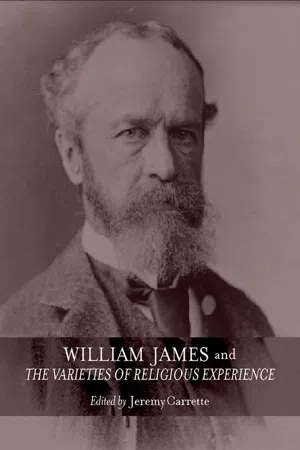
William James and The Varieties of Religious Experience
A Centenary Celebration
- 272 pages
- English
- ePUB (mobile friendly)
- Available on iOS & Android
eBook - ePub
About this book
Information
Part I
James and the history of psychology
Chapter 1
Metaphysics and consciousness in James's Varieties
A centenary lecture*
Eugene Taylor
Ladies and gentlemen. Standing here before you now, I feel the weight of history. We have come today to celebrate not only a great work, The Varieties of Religious Experience, but also a great man, the American philosopher-psychologist and physician, William James. His readers, his interpreters, and his admirers fill this room in a way that makes his presence palpable. To one degree or another, each one of us holds him in our hearts and our minds, which gives renewed meaning to the apt phrase, ‘To live on in the hearts of others is not to die.’
In this regard, I come before you today with what, I hope, will be the promise of a great task; something possibly as significant as the Varieties itself; a project larger than one person merely: I wish to invite you to participate with me in launching nothing less than a revolution in James scholarship. I call on you to help me bring the modern world up-to-date on William James, his work, and its implications, and I propose that we take this centenary celebration of the Varieties to do it.
We here are, to one degree or another, aware of the range of James's ideas, his international character, and his consummate skill as a writer. Indeed, and I hope you agree, as the psychologist Gordon Allport once said, ‘in verve he has no equal.’ But, in general, the world at large knows Henry, the novelist, first, and not William. Psychologists tend to ignore William after his Principles of Psychology in 1890, while religious scholars stay largely within the framework of his Varieties of 1902. Philosophers, meanwhile, cleave to his Pragmatism (1907) or his Will to Believe (1897), only sometimes considering his Pluralistic Universe (1909), The Meaning of Truth (1909), or Some Problems in Philosophy (1911) and rarely his Essays in Radical Empiricism (1912).1 Indeed, it seems each scholar writes what he believes is the magnum opus on James as if no other such books or articles had been written before.2
As a result, the large body of literature by James, as well as on James, is mostly ignored in favor of some new statement of what might actually be an old problem already dealt with, either by James himself, or by scholars of another generation or different discipline. It is a stark reality that, most often, only a certain point of view is stated because that is the one held by the author and a lineage of colleagues with whom the author most desires to be associated. Or the same old interpretations are recycled because scholars rely too heavily on the more readily available published literature and few rarely go back to check the original sources. And when those few do, there is frequently the question of priority, as well as arguments over interpretation that arise. Meanwhile, exactly the opposite is also the case. Because a significant amount of new information on William James remains to be brought to light, new facts are being presented all the time in various titrations, but they tend to appear in odd places and are neither readily acknowledged nor widely circulated.
All of this I now rather idealistically propose should come to an end. In its place, I propose that we take a great leap forward – here, now – and consolidate what we know from our various points of view. Out of such an endeavor, I hope that a new generation of scholars will emerge who are more familiar with the James corpus than their predecessors, both in-depth and across disciplines. Further, I propose we take as our starting point for this revolution, the text upon which we are now devoting most of our attention today, James's Varieties of Religious Experience,3 largely because I consider it the clearest expression of James's tripartite metaphysics of pragmatism, pluralism, and radical empiricism.
Much has been said about the point of this text, most of which we should consider to be more about the interpreter than the work itself.4
My own story begins in graduate school more than thirty years ago in a seminar on the history of psychology. I had elected to present a project on the analytical depth psychology of Carl Jung. The person next to me was doing this psychologist of whom I was only vaguely aware, William James. The quote that caught my attention was a descriptive line from a letter James had written to his wife, Alice, after seeing what was to become their summer home in Chacorua, New Hampshire: ‘it had fourteen doors and they all opened outwards.’ I took that to mean a statement about expanded consciousness, or at least that was the effect the statement had on me at the moment.
Several years later I was invited by a Yale professor and his student to contribute a chapter in a book entitled The Stream of Consciousness: Scientific Investigations into the Flow of Human Experience (1978), the only book written on such a topic since James's coining of that phrase in 1892. I contributed the only non-Western chapter, ‘Asian interpretations: Transcending the stream of consciousness,’ which later became the most frequently reprinted chapter of the book.5 The project took me to Harvard to read in the James papers, while at the same time I was applying to graduate school there at the Harvard Divinity School. Graduate students were not allowed to read in the James papers, however, but I had not been admitted yet, so I registered as just a visiting scholar with an MA and a book contract and was immediately granted access.
While reading in the James papers, I discovered 125 pages of handwritten lecture notes for a series of Lowell Lectures that James had delivered in 1896 but never published. The series was called ‘Exceptional Mental States.’ His individual lecture titles were: ‘Dreams and Hypnotism,’ ‘Automatism,’ ‘Hysteria,’ ‘Multiple Personality,’ ‘Demoniacal Possession,’ ‘Witchcraft,’ ‘Degeneration,’ and ‘Genius.’
At the same time, in a separate part of the reference room at Houghton Library, I found correspondence indicating that 1,000 volumes from James's personal library had been given to Harvard in 1923 on the death of James's wife, Alice. The books were given a special William James bookplate and at the time accessed into the open stacks of Harvard's nine million volume library system by subject. The correspondence I had discovered indicated that many of the books contained James's hand-pencilled annotations, and the general description of their content indicated that many of the volumes were on the subject of the 1896 Lowell Lectures and general topics in abnormal psychology, multiple personality, religious autobiography, and mysticism.
Later, in the Reading Room over in Widener, I was to find the original list of books that made up the gift. The immediate problem when I first discovered the lecture notes in 1977, however, was that, because I was not at first a member of the university, I could not get into the library stacks where these books were all housed. When I was admitted to the university through the Divinity School a few weeks later, to my great delight, I learned that a possible first effect of my presence on campus was to cause to have struck down one of their venerable old institutions – they dropped the graduate student restriction on the James papers. I presumed it was because I was already registered. It was a surprise moment in which one distinctly felt an ever-so-slight trembling of the foundations. Possibly, of course, it may also have had nothing to do with me.
At any rate, once I had found the original list of books given by the James family, a team of Divinity students helped me look up all their call numbers. William Rogers, Parkman Professor in the Divinity School, put me on his faculty library card so I was able to borrow more than 200 of the annotated volumes from the library for a two-year period to study the pattern of James's reading.6 We also systematically separated out those that contained annotations keyed to the 1896 lecture notes.
Then, I also discovered lists of all the books, called the Library Charging Records, that James checked out of the Harvard College Library during the course of his career as a student and a faculty member up to the late 1890s, when a different manner of recording books taken out of the library was adopted. Many of these latter entries were on the subject of the Exceptional Mental States lectures. The problem was that, while before the 1880s, the author and book title appeared, most of the numbers in the 1880s and 1890s appeared only in two different successive sets of cryptic notation devised by the librarians before the introduction of the Dewey Decimal System. Due to the efforts of Professor Tom Cadwallader, a visiting scholar from the University of Indiana, and two assistants from the Pusey Archives at Harvard, by correlating the accession records – when each book came into the library – with the shelf list – where each book was housed in the library – over a two-year period we were able to reconstruct the history of Harvard's early idiosyncratic library classification systems. We were then able to translate the cryptic notations into the modern shelf numbers, and locate many of these books. Many had been purchased with library funds at James's request. He had kept many of them out for several years at a time, numerous volumes contained his hand-pencilled notations, and many of these were also keyed to the Exceptional Mental States lectures. Also, many of our finds had not been checked out since James returned them.
With these resources, I went on to reconstruct the 1896 Lowell Lectures and to redeliver them at Harvard in 1980. Through the good offices of Professor Jacques Barzun, Emeritus professor and former Dean at Columbia University, who was then an editor for Charles Scribner's Sons, they were published as William James on Exceptional Mental States in 1982.7
It was widely acknowledged among James scholars that James's 1878 Lowell Lectures on ‘The Brain and Mind’ had found an important place in his Principles of Psychology in 1890, while his 1906 Lowell Lectures had been published as his Pragmatism (1907). Why, I asked, would not these 1896 lectures be of similar import? The problem was, it turned out, that they were on heretical topics rejected by psychology as a developing reductionistic science, religion as an exclusively Christian and theistic enterprise, and philosophy as primarily a logical and analytic endeavor. Within the field of James scholarship, it had already been the judgment of early biographers such as Ralph Barton Perry and later interpreters such as Gerald Myers that these lectures were of little consequence.
Nevertheless, my reconstruction of the series in its historical context suggested that the first four lectures appeared to be the outline of a dynamic psychology of the subconscious, such as that found in the modern depth psychologies, while the second four largely demonstrated the pathological working out of the subconscious in the social sphere. Given James's focus on a cognitive psychology of attention in The Principles and the primacy of mystical experience in the Varieties, and their isolation from each other by psychologists, philosophers, and religious scholars, respectively, it was immediately clear to me that, among other important implications, the 1896 Lowell Lectures represented a transitional text in James's psychology of consciousness between 1890 and 1902. The 1896 Lowell Lectures also coincided with the crystallization of James's philosophical metaphysics of radical empiricism, in what I believe was his search for a new metaphysical foundation underlying experimental science in psychology.8
Beyond this single project itself, the archival evidence from the Exceptional Mental States Lectures raised two new questions: first, what were the origins of James's ideas about consciousness leading up to the lectures of 1896? And what were the consequences afterwards on his evolving model of consciousness?
In this regard, reconstruction of the 1896 Lowell lectures served to re-orient my reading of all James's earlier published writings. It also led me to the archives of the former Swedenborg School of Religion in Newton, Massachusetts and the trunk containing Henry James Sr.'s annotated Swedenborg collection. This trunk turned out to be the only permanent piece of furniture the James family hauled around Europe during William's youth. Henry the novelist was to later claim it was so important that the day its contents went up on the mantelpiece they knew that, wherever they were, they were there to stay, and the day the volumes by Swedenborg disappeared back into the trunk, they knew it was time to pack up and move on.
Working in this trunk for the past twenty-three years for me has drawn Emerson into William's orbit in an entirely new way, and also implicated Emerson and Henry James Sr. a...
Table of contents
- Cover Page
- Title Page
- Copyright Page
- Contributors
- Acknowledgements
- Introduction: The centenary and the varieties of interpretation
- Part I: James and the history of psychology
- Part II: James, psychology and religion
- Part III: James and mysticism
- Part IV: James and philosophy
- Conclusion: Experience and the value of religion – Overview and Analysis1
- Also available from Routledge: The Varieties of Religious Experience a Study in Human Nature Centenary Edition
Trusted by 375,005 students
Access to over 1.5 million titles for a fair monthly price.
Study more efficiently using our study tools.
Frequently asked questions
Yes, you can cancel anytime from the Subscription tab in your account settings on the Perlego website. Your subscription will stay active until the end of your current billing period. Learn how to cancel your subscription
No, books cannot be downloaded as external files, such as PDFs, for use outside of Perlego. However, you can download books within the Perlego app for offline reading on mobile or tablet. Learn how to download books offline
Perlego offers two plans: Essential and Complete
- Essential is ideal for learners and professionals who enjoy exploring a wide range of subjects. Access the Essential Library with 800,000+ trusted titles and best-sellers across business, personal growth, and the humanities. Includes unlimited reading time and Standard Read Aloud voice.
- Complete: Perfect for advanced learners and researchers needing full, unrestricted access. Unlock 1.5M+ books across hundreds of subjects, including academic and specialized titles. The Complete Plan also includes advanced features like Premium Read Aloud and Research Assistant.
We are an online textbook subscription service, where you can get access to an entire online library for less than the price of a single book per month. With over 1.5 million books across 990+ topics, we’ve got you covered! Learn about our mission
Look out for the read-aloud symbol on your next book to see if you can listen to it. The read-aloud tool reads text aloud for you, highlighting the text as it is being read. You can pause it, speed it up and slow it down. Learn more about Read Aloud
Yes! You can use the Perlego app on both iOS and Android devices to read anytime, anywhere — even offline. Perfect for commutes or when you’re on the go.
Please note we cannot support devices running on iOS 13 and Android 7 or earlier. Learn more about using the app
Please note we cannot support devices running on iOS 13 and Android 7 or earlier. Learn more about using the app
Yes, you can access William James and The Varieties of Religious Experience by Jeremy Carrette in PDF and/or ePUB format, as well as other popular books in Teología y religión & Religión. We have over 1.5 million books available in our catalogue for you to explore.