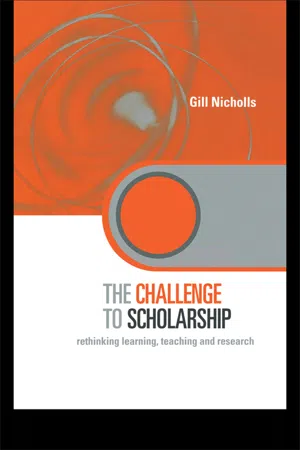
The Challenge to Scholarship is a lively and engaging investigation that seeks to establish what it means to be a scholar and the value of scholarship. It addresses current concerns and tensions including the scholarship of teaching and the relationship between teaching and research.
Gill Nicholls gets right to the heart of the debate over scholarship and declares that a reconceptualization of scholarship within universities is required, outlining the changes involved and the practical implications for higher education institutions of the future.
- 176 pages
- English
- ePUB (mobile friendly)
- Available on iOS & Android
eBook - ePub
About this book
Information
Part 1
Establishing the concept of scholarship
Chapter 1
Why challenge scholarship?
Every word has a meaning. This meaning is correlated with the word. It is the object for which the word stands.
(Wittgenstein)
Wittgenstein in his early writings believed that ‘Every word has a meaning. This meaning is correlated with the word. It is the object for which the word stands’ (Wittgenstein 1953:1). It is the application of the word that provides the meaning: the context that is given or associated with it. However, as John Locke suggested over three centuries ago, knowledge and understanding are often held back by words that have no fixed signification. As a result a term can appear beset with controversy and debate because of an unacknowledged ambiguity in how it is applied. Could this be the case with the general term ‘scholarship’ which no longer has a fixed significance? If so, we would expect the result to be controversy and ambiguity whenever it is applied.
Our understanding of a general term extends beyond one individual thing to those that share common attributes. For example, the word ‘car’ includes every car that has ever been or ever will be in the world. The intention of such a general term is that it suggests a set of features that are shared by everything it applies to—in the case of ‘car’, perhaps ‘a wheeled vehicle designed for transportation’. As a result, for Wittgenstein words are like tools in a toolbox. Their functions vary according to how the speaker wishes to use them. Their difference is what makes them useful and gives them authority in each particular situation. When an individual reports to another upon the meaning of ‘scholarship’ the goal is to inform that person of the accepted meaning of the term. This is a ‘lexical’ definition because it is a simple way of replicating how the term is already used. The definition becomes accurate depending upon how well it captures the usage of the term at that moment in time. The key element in meaning is the understanding of the word by those using and hearing it. But as Wittgenstein suggests, it is the circumstance that surrounds the use of the word that gives it the meaning each time. This suggests that meanings change and that the universality of language is fluid. This may provide us with clues as to the interpretation of the word ‘scholarship’ both over time and also within different environments. If scholarship as a concept is to have meaning to and for the academic community and the society that scholars serve, then it needs to be understood by how it relates within the world that is observed.
This book considers how the meaning associated with scholarship has altered over time and to do this examines the contexts in which it has changed. It considers the lexical definition, and how the general term ‘scholarship’ has been extended, to create an understanding of the common attributes that it denotes. From here it becomes clear that the context within which this definition gains its meaning has grown increasingly complex. It can be viewed from different perspectives: within an occupation, for instance, or within a particular location or language. This suggests that understanding of the term ‘scholarship’ within the academy in the USA, the UK and Australia (for example) will differ because of the qualifications used. As the postmodern state becomes an ever more complex set of overlapping structures and cultures, these qualifications become ever more diverse. For human beings attempting to predict outcomes this increased complexity is discomforting. The result is an attempt to set a common and accepted context within which meanings can be identified. In the case of scholarship this attempt was initially undertaken at a disciplinary level, where shared ‘professional’ values provided the basis and context. However, there is an increasing literature that suggests that the individual institution's context now prevails over the disciplinary and it is from this that the individuals now draw their shared values. If this is the case it clearly has implications for the conceptualization of scholarship, both as a term and for the definition of what this word actually means. As the original meaning of scholarship has changed or developed, the qualifications against which it becomes understood have increased so that a universal understanding becomes increasingly unlikely.
As the meaning of the general term ‘scholarship’ has become increasingly context driven, one response has been the adoption of a new, more specific, term that has not previously existed in the academic's language: ‘the scholarship of teaching’. The scholarship of teaching had no existing standards, and the goal since Boyer (1990) has been to propose the adoption of a shared use for this new term. Achieving agreement would significantly reduce the vagueness of the general term ‘scholarship’ by providing a clearer and sharper explanation of a related concept. This book attempts to provide a view on how the term ‘scholarship’ is already used within higher education and then considers whether or not the notion of the scholarship of teaching sharpens our understanding of this by removing the vagueness that has built up over time.
In an ideal world, academic scholarship would not need to be defined or encouraged.
It would arise naturally from the intellectual curiosity and energy of the academic community at its best. But in the real world scholarship has been subjected to an elaborate system of rewards and punishments created by the higher-education community The consequence has been that academics have been encouraged by the needs of these systems to find an aspect or interest within their disciplines, i.e. a scholarly niche, so that they can keep up with professional dialogue, and join in the scrutiny associated with their disciplinary community. The push towards the scholarly niche or specialism continues as the information available on disciplines increases and the authority of the academic becomes more overtly questioned. In addition to this the higher-education community expects that the scholarship produced will make a significant contribution to the field of knowledge engaged by academics, but the contribution must also be personally and professionally renewing. A large demand from a concept termed ‘scholarship’!
It would arise naturally from the intellectual curiosity and energy of the academic community at its best. But in the real world scholarship has been subjected to an elaborate system of rewards and punishments created by the higher-education community The consequence has been that academics have been encouraged by the needs of these systems to find an aspect or interest within their disciplines, i.e. a scholarly niche, so that they can keep up with professional dialogue, and join in the scrutiny associated with their disciplinary community. The push towards the scholarly niche or specialism continues as the information available on disciplines increases and the authority of the academic becomes more overtly questioned. In addition to this the higher-education community expects that the scholarship produced will make a significant contribution to the field of knowledge engaged by academics, but the contribution must also be personally and professionally renewing. A large demand from a concept termed ‘scholarship’!
The structure of the book
The main theme of this book is scholarship, its meaning and its place within the academic community, and the extent to which its meaning has changed and influenced the thinking that has occurred within higher education. Its aim is to challenge traditional thoughts, ideals and ideologies, as well as the epistemological grounds on which scholarship is discussed and used within the community. Each chapter deals with a specific issue, by identifying the central points of debate and linking them to possible ways forward. The book is divided into three parts, thus identifying the main areas of debate and influence.
The first part deals with setting the context and exploring the historical and philosophical aspects that have led higher education to conceive scholarship in the way that it is currently interpreted. Chapter 2 traces the historical development of the term ‘scholarship’ by focusing on the nature of the term and the contexts from which it has emerged. Aristotelian and Socratic philosophies, as well as the ideas and beliefs of John Henry Newman, offer theoretical underpinnings for the examination of the term. These are then taken further by considering how the emergence of research became a university goal and as a consequence of the changing objectives of the university the term ‘scholarship’ slowly but definitively took on alternative meanings within the academic community. The argument is further developed to show how, with the changing goals of the university, scholarship needs to be considered as a learning activity—but in reality became and continues to become more detached from learning—and the implications this has had for the student and the academic. At the heart of the discussion is the need to understand the epistemological grounds and underpinnings on which academics as individuals and institutions collectively base their assumptions of learning and understanding. The premise is that what academics think they believe is not always what they practise. Hence epistemological examination has become a key ground for discussion and a possible avenue for the redefinition of scholarship. However, for academics to understand why it is necessary to investigate epistemological frameworks also requires them to engage with what the purpose of scholarship is, could be or should be. This leads into a discussion of the ideas connected with scholarship and the scholar, and argues that the boundaries around the scholarly enterprise should be drawn more widely and allow for the development of knowledge in a more open way—one that creates interest rather than narrowing down the avenues of enquiry.
The final elements of Chapter 2 deal with scholarship and the ideals of education, considering the philosophical works of Socrates, Plato, Dewey and Kierkegaard. It suggests that these philosophies give us an insight into why the ideals of education focus on learning and rationality, and that universities need to consider learning as a core function for both students and academics. This last element is what has currently caused conflict in understanding scholarship within a fragmented framework of research versus teaching. The cause of the perceived conflict is examined from the perspective of promotion and tenure and the implication these have for scholarship and the role and behaviours of academics within higher education.
The second part of the book relates to the introduction of the term ‘the scholarship of teaching’ within an educational development framework. Chapter 3 concentrates on the policy and power relationships in the development of the term ‘scholarship’. Three aspects are given significant attention. The first relates to principles and reasons why policy initiatives aimed at enhancing teaching and learning in higher education should make reference to the concept of scholarship. Within this framework several key issues are raised, such as the importance of values in understanding and defining scholarship, the nature of policy in influencing such values, and the need to reconceptualize scholarship. In an attempt to expand the questions that should be asked of scholarship, the nature of excellence is considered and used to show that although it has gained currency within higher education it is not always a useful term when trying to define concepts. The final commentary relates to the urgent need within the community to collectively reconsider the term ‘scholarship’ and to take back control of the definition.
Chapter 4 argues that the term ‘the scholarship of teaching’ has become confused and misplaced within certain communities and used to sustain and enhance a particular type of credibility in activities related to the enhancement of learning and teaching in higher education. Bourdieu's concept of symbolic culture is used to construct the argument and shows how the use of the term ‘the scholarship of teaching’ needs to be re-examined and conceptualized. The argument is reinforced through a piece of empirical research that considers perceptions of the notions of scholarship and the scholarship of teaching among twenty-five academics from a variety of disciplines. These perceptions are examined in the light of disciplinary style and behaviours as well as generic elements of belonging to an academic community.
Chapter 5 relates to the nature and influence of the disciplines within scholarship. It concentrates on trying to understand why and from where the disciplines have gained their power in higher education and the reasons why they maintain such prominence.
Defining a discipline is a starting point for the discussion, as is the need to answer the question ‘why consider the disciplines in a debate on scholarship?’ The notion of specialization and territorial boundaries within and between the disciplines is also considered. These debates shed light on the role of the individual within the discipline and how this influences action taken by academics. Fear and risk are key notions within the arguments put forward. Particular attention is given to the work of Palmer. No discussion about scholarship within the disciplines would be complete without an exploration of disciplinary styles: ways of knowing within the disciplines, and the influence these may have on teaching and learning within the disciplines. Finally, issues around power and change are considered and are related to why disciplines remain such a firm institution within higher education.
Defining a discipline is a starting point for the discussion, as is the need to answer the question ‘why consider the disciplines in a debate on scholarship?’ The notion of specialization and territorial boundaries within and between the disciplines is also considered. These debates shed light on the role of the individual within the discipline and how this influences action taken by academics. Fear and risk are key notions within the arguments put forward. Particular attention is given to the work of Palmer. No discussion about scholarship within the disciplines would be complete without an exploration of disciplinary styles: ways of knowing within the disciplines, and the influence these may have on teaching and learning within the disciplines. Finally, issues around power and change are considered and are related to why disciplines remain such a firm institution within higher education.
The third and final part of the book concentrates on international perspectives and the challenges scholarship has to face in the future. The nature of international perspectives, and the influence these have had globally, cast an interesting light on the concept of scholarship. Although each continent has been researching and questioning the term ‘scholarship’, and in particular the scholarship of teaching, each has developed a different perspective and angle on the problem. We try to show that although it is essential that we share our findings, the findings cannot be assumed to be transferable. Each community has considered the scholarship of teaching within its social and cultural context, and as we have argued throughout the book, social and cultural aspects underpin the very nature and conceptualization of the status and positioning of scholarship within the respective higher-education communities.
Challenging the notion of scholarship is like any other academic challenge. There is a need to consider underlying theory, historical and sociological perspectives and alternative avenues that might shed light on the issues and questions related to the concept under investigation. Challenging the notion of scholarship has uncovered an array of perspectives including fear, risk, complexity and power which have proved both fascinating and in urgent need of attention from the education community. It is hoped that this book expands and increases the questions and the dialogues which will ensure that the challenge to scholarship proves worth while.
Chapter 2
Historical concepts of scholarship
Teaching is the highest form of understanding.
(Aristotle)
The concept of scholarship is often traced back to the Greeks, for whom scholarship and character went together. A proper patriotism and the worship of the gods were virtues esteemed in the ancient world. ‘We must’, said Plato, ‘assimilate ourselves to God, seeking to become like him, wise and just and holy.’ To mould the character of the young, he said, ‘teachers are enjoined to look at the child's manners even more than to his reading and music’, and the only education which truly deserves the name is ‘that education from the youth upward, which makes a man eagerly pursue the ideal perfection of citizenship’.
In his classic work The Idea of a University John Henry Newman set forth the notion that the purpose of the university is to promote and disseminate knowledge. Since that time, the concept of scholarship and the promotion of scholarship have belonged to academia. Scholarship can be said to be at the heart of the professions and higher education. There is little doubt that nothing brings greater honour to an academic than a reputation as a scholar. For most in higher education, the concept of the scholar and scholarship are nearly synonymous with the role of the academic. Thomson (1996) suggests a lexical definition of a scholar as ‘a learned person, especially in language, literature, etc.; an academic’ (p. 910). Similarly, scholarship refers to ‘the methods and standards characteristic of a good scholar’ (p. 911). Certainly there are scholars who do not teach, but scholarship is recognized as the fundamental qualification for most academic positions within universities.
Newman's definition of the university is important in relation to the discussions on scholarship, scholars and a community of scholars. Within this discourse Newman suggests the ideal of intellectual culture as a means to explain the nature of learning within a university. He argues that the best aid to professional and scientific study is for the
man who has learned to think and to reason and to compare and to discriminate and to analyse, who has refined his taste, and formed his judgement, and sharpened his mental vision, will not indeed at once be a lawyer…or an orator, or a statesman, or a physician, or a good landlord, or a man of business…but he will be placed in that state of intellect in which he can take up any one of these sciences or callings I have referred to…with an ease, a grace, a versatility, and a success to which another is a stranger.
(quoted from Cameron 1978:145)
Newman, a man who could be said to have ‘a high tolerance for restatement’, laid out an idea of a university that excluded research, locating discovery and the advancement of knowledge in separate academies and confining the university function to teaching. Newman's ‘idea’ of a university has significant associations with the past while simultaneously assimilating and expanding a collegiate ideal of his own. He described the purpose of the university as the diffusion and extension of knowledge rather than its advancement. If its objects were scientific and philosophical discovery, ‘I do not see why a University should have students’. ‘Lest the learned world become stagnant’ (Cameron 1978:1), he recommended that other bodies—institutes or academies—should be devoted to the creation rather than the dissemination of knowledge. Newman was content to leave research to research societies, what we might call institutes or think tanks. Newman firmly believed that ‘To discover and to teach are two distinct functions rarely found in the same person’. It is interesting here to note that George Orwell abandoned teaching because he later observed that, despite appearances, teaching and writing do not go together. Orwell described teaching as a semi-creative activity and one that siphoned off just enough energy and time to make serious writing virtually impossible. Orwell was not a university teacher, but was making the same point as Newman. This continuous distinction between teaching, research and scholarship defines Newman's work and consequent interest in his thinking surrounding teaching and the university.
Newman's pedagogical principles have been written about widely, but most contentious have been his views on research within the university context. Pelikan in The Idea of the University: A Re-examination (1992) considers Newman's ideas about university research. He expresses a deep admiration for nearly all of Newman's pedagogical principles except for this one issue. Pelikan states that the four legs of the university table are:
- the advancement of knowledge through research
- the transmission of knowledge through teaching
- the preservation of knowledge in scholarly collections
- the diffusion of knowledge through publication.
Pelikan argues that no one of these legs can stan...
Table of contents
- Cover Page
- Title Page
- Copyright Page
- The Challenge to Scholarship
- Key Issues in Higher Education series
- Preface
- Acknowledgements
- Part 1: Establishing the concept of scholarship
- Part 2: Policy and power: influences on scholarship
- Part 3: Challenging the future
- Bibliography
Trusted by 375,005 students
Access to over 1.5 million titles for a fair monthly price.
Study more efficiently using our study tools.
Frequently asked questions
Yes, you can cancel anytime from the Subscription tab in your account settings on the Perlego website. Your subscription will stay active until the end of your current billing period. Learn how to cancel your subscription
No, books cannot be downloaded as external files, such as PDFs, for use outside of Perlego. However, you can download books within the Perlego app for offline reading on mobile or tablet. Learn how to download books offline
Perlego offers two plans: Essential and Complete
- Essential is ideal for learners and professionals who enjoy exploring a wide range of subjects. Access the Essential Library with 800,000+ trusted titles and best-sellers across business, personal growth, and the humanities. Includes unlimited reading time and Standard Read Aloud voice.
- Complete: Perfect for advanced learners and researchers needing full, unrestricted access. Unlock 1.5M+ books across hundreds of subjects, including academic and specialized titles. The Complete Plan also includes advanced features like Premium Read Aloud and Research Assistant.
We are an online textbook subscription service, where you can get access to an entire online library for less than the price of a single book per month. With over 1.5 million books across 990+ topics, we’ve got you covered! Learn about our mission
Look out for the read-aloud symbol on your next book to see if you can listen to it. The read-aloud tool reads text aloud for you, highlighting the text as it is being read. You can pause it, speed it up and slow it down. Learn more about Read Aloud
Yes! You can use the Perlego app on both iOS and Android devices to read anytime, anywhere — even offline. Perfect for commutes or when you’re on the go.
Please note we cannot support devices running on iOS 13 and Android 7 or earlier. Learn more about using the app
Please note we cannot support devices running on iOS 13 and Android 7 or earlier. Learn more about using the app
Yes, you can access The Challenge to Scholarship by Gill Nicholls in PDF and/or ePUB format, as well as other popular books in Education & Education General. We have over 1.5 million books available in our catalogue for you to explore.