
eBook - ePub
History of the International Union of Psychological Science (IUPsyS)
- 306 pages
- English
- ePUB (mobile friendly)
- Available on iOS & Android
eBook - ePub
History of the International Union of Psychological Science (IUPsyS)
About this book
This book describes the present status and the history of the International Union of Psychological Science (IUPsyS) -- the most representative international psychological body. The IUPsyS includes national psychological associations from 66 countries, with more joining every year, and it has formal relations with the United Nations, UNESCO, the World Health Organization, the International Council for Science, and the International Social Science Council. Many well known psychologists have played important roles in this international organization, and the text and many photographs bring the story to life.
IUPsyS was organized formally at the 14th international Congress of Psychology at Stockholm in 1951, so the 27th International Congress of Psychology at Stockholm in 2000 marks a half-century of its existence. But the history of the IUPsyS goes back to the first International Congresses of Psychology, 1889, and to the International Congress Committee which foreshadowed the organization of the International Union.
After describing the present status of the IUPsyS in Chapter 1, the book traces briefly the early development of scientific societies and organizations. Chapter 3 tells how the first International Congress of Psychology was organized in Paris in 1889 and what it accomplished. Successive international congresses and the growth of psychology during the next sixty years are treated in chapters 4-6. The founding and development of the International Union in the last half of the 20th Century are described in the remaining chapters.
International Congresses organized by the IUPsyS have taken place regularly since 1951, and the IUPsyS has steadily gained in the scope and influence of its activities. The congresses, long restricted to western Europe and North America, became more representative geographically, moving to Moscow, Tokyo, Leipzig, Acapulco, and Sydney, with the 28th congress planned for Beijing in 2004. The history shows how the IUPsyS has become increasingly able to face the problems and opportunities of the 21st century.
Information
1
The International Union of Psychological Science today
FIGURE 1.1 Relations of the International Union of Psychological Science (IUPsyS) with other organizations
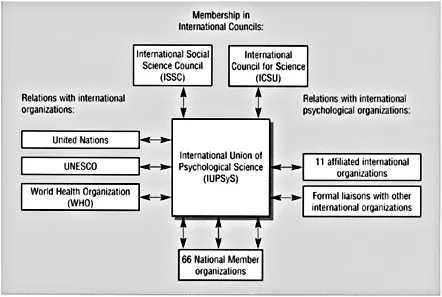
The International Union of Psychological Science (IUPsyS) is the main international body of psychology. As indicated in Figure 1.1, it groups together organizations that represent psychology in 66 countries (as of early 2000), and the memberships in these national organizations total more than 500,000 psychologists. The IUPsyS represents psychology in such organizations as the International Social Science Council (ISSC) and the International Council for Science (ICSU); it also has consultative relations with the Economic and Social Council and the Department of Public Inf ormation of the United Nations and with the World Health Organization (WHO). The IUPsyS aims to represent psychology in all the countries in which it is developed and to foster the development of psychology as a science and a profession around the world.
The Assembly of IUPsyS is its legislative body and final authority. The Assembly consists of the members of the Executive Committee and one or two delegates per national member. It meets every 2 years, at the site of an international congress of the IUPsyS or at the site of an international congress of the International Association for Applied Psychology (IAAP). As is the rule for most international scientific unions, the IUPsyS is composed of national member organizations, not more than one national member per country. Since 1951, IUPsyS has grown steadily to a membership of 66 national members (as of May 2000). A detailed history of the IUPsyS and of the international congresses of psychology is given in later chapters of this book.
Changes in name and acronym of the IUPsyS
Over its history, the Union has changed its name and its acronym. The original name, from 1951 to 1965, was the International Union of Scientific Psychology (IUSP). The name was changed to the International Union of Psychological Science (IUPS) in 1965. Most members of the Executive Committee preferred the change because they wanted to avoid the implication that some psychology is not scientific. French-speaking members, however, preferred to retain the original name, so the French name remained unchanged (Union Internationale de Psychologie Scientifique). The change of acronym to IUPsyS occurred in 1982, when IUPsyS assumed membership in the International Council for Science (ICSU). The International Union of Physiological Sciences, founded in 1952, had been a member of ICSU since 1955 and also used the acronym IUPS. When psychology posed its candidacy for full membership in ICSU, a condition required for the election was that the psychological union choose a different acronym from that already used in ICSU by the physiological union. Various alternatives were considered, including changing the name back to the International Union of Scientific Psychology. Finally it was agreed to use IUPsyS, and that acronym has now become familiar.
Participation of the IUPsyS in major international organizations
An important function of IUPsyS for the promotion and application of psychological science is participation in major international scientific organizations, especially the International Council for Science (ICSU), which is the major international scientific organization, and the International Social Science Council (ISSC), of which IUPsyS is a founding member. As a member of ICSU, IUPsyS receives grants for some research projects, and it collaborates with the ICSU Committee on Data for Science and Technology (CODATA). IUPsyS is also developing cooperative relations with other scientific unions in ICSU, such as the International Brain Research Organization (IBRO) and the International Geographical Union (IGU). IUPsyS and IBRO recently received a major grant from ICSU to organize a Brain Imaging Workshop in conjunction with the International Congress of Psychology in 2000 in Stockholm, and it will hold a joint symposium with IGU at the Stockholm Congress.
IUPsyS cooperates with ISSC and its member organizations in several research programs and International Issue Groups, in the program on Human Dimensions of Global Environmental Change, in Working Groups, and in a number of UNESCO-sponsored projects, particularly those involving developing countries. ISSC provides IUPsyS grants for certain projects. IUPsyS has also cooperated with UNESCO on several projects of mutual interest.
Organizations affilliated with the IUPsyS
The IUPsyS maintains relations with several other international or regional psychological organizations. Its affiliates include the following organizations: the International Association of Applied Psychology (IAAP), the Interamerican Society of Psychology/Sociedad Interamericana de Psicologia (SIP), Association de Psychologie Scientifique de Langue Française (APSLF), International Council of Psychologists (ICP), International Association for Cross-Cultural Psychology (IACCP), European Association of Experimental Social Psychology (EAESP), International Society of Comparative Psychology (ISCP), International Society for the Study of Behavioural Development (ISSBD), European Association of Personality Psychology (EAPA), European Association of Psychological Assessment (EAPP), and the International Neurological Society (INS). In addition to these affiliates, the IUPsyS maintains special liaison exchanges with the European Association of Professional Psychologists' Associations (EFPPA) and the International Test Commission (ITC).
Current activities of the IUPsyS
As well as assuring the regular succession of international congresses of psychology, representing psychology in international organizations, maintaining relations with other international or regional psychological organizations, publishing the International Journal of Psychology and sponsoring other publications, the IUPsyS engages in several other important current activities, some of which the following paragraphs will describe.
Regional conferences and congresses
The IUPsyS sponsors regional international congresses designed to assist and promote psychology within low-income countries (developing countries and countries in transition). This program addresses the problem that few psychologists from developing countries participate in the major international congresses. Even though the range of countries represented among registrants has increased with each international congress, the difficulties and costs of travel, accommodation, and congress registration fees pose significant obstacles to the attendance of psychologists from developing countries. To address these problems, the IUPsyS in 1995 creatively began the practice of sponsoring international regional congresses within developing countries. This IUPsyS initiative has become a joint venture with the IAAP. Both associations contribute to the support of each regional congress with the primary sponsorship alternating in successive odd-numbered years. IUPsyS sponsored the first regional congress in Guangzhou, China (1995) and the African regional congress held in Durban, South Africa (1999). The IAAP was the primary sponsor for the Latin American regional congress in Mexico City (1997).
Codes of ethics
Although the IUPsyS had long encouraged its national members to adopt codes of ethics, a survey by the Secretary-General in the 1970s revealed that only a small number of national members had actually adopted codes and were enforcing them. A special symposium on ethics at the 1976 International Congress in Paris gave further impetus to this effort. (For more on this, see Chapter 11.)
In 1993 the Union Executive Committee instructed the then Deputy Secretary-General, Bruce Overmier, to survey the membership once again, to see whether or not each country had adopted a set of ethical guidelines or code to govern activities by psychologists. The president or executive officer of each national member was contacted to determine whether or not a formal “ethics code” had been officially adopted in their country, and, if so, was asked to provide a copy to the Union. Twenty-four countries reported having such a code and submitted copies. Four Scandinavian countries shared a single code, yielding 20 different codes. Interestingly, many of the codes were submitted in English; those that were not were translated into English to allow comparisons among the codes. (It was recognized that such English translations performed without a backtranslation check may not be fully accurate representations of the original code.) Mark M.Leach and Judd J.Harbin of the University of Mississippi undertook a systematic comparison of these 20 codes for the Union. The result was published in the International Journal of Psychology (Leach & Harbin, 1997), highlighting similarities and differences. This paper also put their review into a context of prior smaller surveys of national codes of ethics for psychologists.
Advanced Research Training Seminars (ARTS)
Going back to the 1988 International Congress of Psychology in Australia, where the participation of psychologists from low-income countries was very poor, the idea emerged among some psychologists of the need for sponsored research/training seminars for psychologists from low-income countries that would also enable their participation in international congresses. This idea materialized in 1992 under the auspices of IUPsyS when the first Advanced Research Training Seminars (ARTS) were held in conjunction with the 25th International Congress of Psychology in Brussels. The coordinator was Ype Poortinga, and the two ARTS were organized in Tilburg and Berlin by Fons v.d.Vijver and Ute Schönpflug, respectively. The International Association for Cross-Cultural Psychology (IACCP) also collaborated in sponsoring ARTS.
Since then ARTS have been organized every 2 years in conjunction with the international congresses of psychology and of applied psychology under the auspices of IUPsyS, in collaboration with IAAP and IACCP For two terms, in 1994 and 1996, Cigdem Kagitcibasi was the ARTS coordinator. In 1994 two ARTS were organized in conjunction with the Madrid IAAP Congress, one in Saarbrucken by Lutz Eckensberger on “Eco-Ethical Thinking from a Cross-Cultural Perspective” and the other in Istanbul by Sevda Bekman, Banu Oney and Cigdem Kagitcibasi on “Human Development and Assessment.” In 1996 two more ARTS were organized in Canada, in conjunction with the 26th International Congress of Psychology, one in Ottawa by Alastair Ager, assisted by Martha Young, on “Qualitative Research Methods” and the other in Sherbrooke by Pnina Klein and Michael Boivin on “Early Intervention in Families and Other Settings for Infants and Young Children.” In 1998 John Adair served as the ARTS coordinator. In conjunction with the San Francisco IAAP Congress three ARTS were organized, by Robert Serpell and Abdeljalil Akkari in Baltimore on “Qualitative Approaches in Cultural Psychology,” by Martin Fishbein in Bellingham on “Developing Effective Health Behavior Interventions,” and by Peter Graf in San Francisco on “Advances in Cognitive Psychology.”
John Adair continues as the ARTS Coordinator for 2000. In conjunction with the 27th International Congress of Psychology in Stockholm, three ARTS are being planned by Jarl Risberg in Lund on “Imaging the Structure and Function of the Brain,” by Thomas Oakland and Walter Lonner in Stockholm on “Psychological Test Adaptations to Diverse Cultures and Measuring Personality Cross-Culturally,” and by Heidi Keller in Stockholm on “Pathways across Development: Cross-Cultural Perspectives.”
ARTS have been very successful in fulfilling their mission, that is, providing research/training to psychologists from developing countries and from Eastern Europe, as well as supporting their participation in international congresses. Greater participation of psychologists from low- income countries in international congresses is crucial for increased internationalization of psychology. ARTS is serving this worthwhile purpose.
Publications
The IUPsyS has developed an extensive program of publications to foster communication with and among psychologists around the world. Starting with the first International Congress of Psychology in 1889, the practice arose of publishing the proceedings of each congress, often including texts of some of the main papers and abstracts of the others. When the International Union was formally organized in 1951, its statutes included the provision that proceedings of the congresses be published in a uniform manner, and the practice has been maintained to a large extent. The proceedings of the 26th International Congress of Psychology, Montreal, 1996, and of the 25th Congress, Brussels, 1992, are available from Psychology Press, UK.
In 1966 the Union founded its journal, the International Journal of Psychology. The Journal publishes scientific and theoretical papers in all fields of psychological research. Most issues of th...
Table of contents
- Cover
- Half Title
- Full Title
- Copyright
- Contents
- Illustration credits
- Foreword
- Preface
- 1. The International Union of Psychological Science today
- 2. The origins of scientific organizations: Historical context
- 3. The 1st International Congress of Psychology: Assuring the continuity of congresses
- 4. The International Congresses of Psychology become regularized, 1892–1909
- 5. Problems and progress in the period between the two World Wars
- 6. Creation of the International Union of Scientific Psychology
- 7. The formative years of the Union
- 8. Expansion and international collaboration (1960–1965)
- 9. Consolidation of the Union's progress (1966–1971)
- 10. Psychology in Asia (1972): A first major step in the globalization of psychological science
- 11. The congresses return to Europe (1976–1982)
- 12. Continued initiatives in the globalization of psychology (1984–1988)
- 13. Strengthening linkages and international networks (1989–1992)
- 14. New initiatives and preparations for the Montreal congress (1993–1995)
- 15. Renewing historic strengths, initiating new ventures (1996–2000)
- Appendix A
- Appendix B
- Appendix C
- Appendix D
- Appendix E
- Index
Trusted by 375,005 students
Access to over 1.5 million titles for a fair monthly price.
Study more efficiently using our study tools.
Frequently asked questions
Yes, you can cancel anytime from the Subscription tab in your account settings on the Perlego website. Your subscription will stay active until the end of your current billing period. Learn how to cancel your subscription
No, books cannot be downloaded as external files, such as PDFs, for use outside of Perlego. However, you can download books within the Perlego app for offline reading on mobile or tablet. Learn how to download books offline
Perlego offers two plans: Essential and Complete
- Essential is ideal for learners and professionals who enjoy exploring a wide range of subjects. Access the Essential Library with 800,000+ trusted titles and best-sellers across business, personal growth, and the humanities. Includes unlimited reading time and Standard Read Aloud voice.
- Complete: Perfect for advanced learners and researchers needing full, unrestricted access. Unlock 1.5M+ books across hundreds of subjects, including academic and specialized titles. The Complete Plan also includes advanced features like Premium Read Aloud and Research Assistant.
We are an online textbook subscription service, where you can get access to an entire online library for less than the price of a single book per month. With over 1.5 million books across 990+ topics, we’ve got you covered! Learn about our mission
Look out for the read-aloud symbol on your next book to see if you can listen to it. The read-aloud tool reads text aloud for you, highlighting the text as it is being read. You can pause it, speed it up and slow it down. Learn more about Read Aloud
Yes! You can use the Perlego app on both iOS and Android devices to read anytime, anywhere — even offline. Perfect for commutes or when you’re on the go.
Please note we cannot support devices running on iOS 13 and Android 7 or earlier. Learn more about using the app
Please note we cannot support devices running on iOS 13 and Android 7 or earlier. Learn more about using the app
Yes, you can access History of the International Union of Psychological Science (IUPsyS) by Mark R. Rosenzweig,Wayne H. Holtzman,Michel Sabourin,David Belanger in PDF and/or ePUB format, as well as other popular books in Psicología & Historia y teoría en psicología. We have over 1.5 million books available in our catalogue for you to explore.