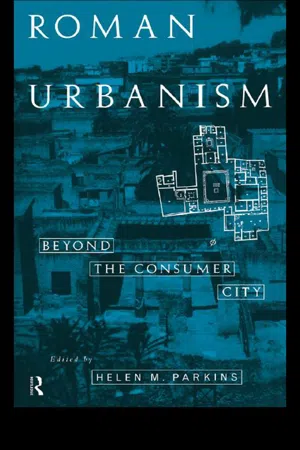
The contributors to this volume provide an accessible and jargon-free insight into the notion of the Roman city; what shaped it, and how it both structured and reflected Roman society. Roman Urbanism challenges the established economic model for the Roman city and instead offers original and diverse approaches for examining Roman urbanization, bringing the Roman city into the nineties. Roman Urbanism is a lively and informative volume, particularly valuable in an age dominated by urban development.
- 248 pages
- English
- ePUB (mobile friendly)
- Available on iOS & Android
eBook - ePub
1
Writing the Roman metropolis1
Ray Laurence
The city goes soft; it awaits the imprint of an identity. For better or worse, it invites you to remake it, to consolidate it into a shape you can live in. You, too. Decide who you are, and the city will again assume a fixed form round you.
(Raban 1974, 9)
Introduction
The classical city has often been seen as an ideal form of urbanism. The architectural forms have inspired both classical architects and modernists (Laurence 1993). The classical city continues to be viewed as a planned entity, and the appearance of urbanism in northwest Europe is often seen as an index of Romanization. In contrast, the city of Rome is presented as a metropolitan dystopia. The architectural forms of the public buildings at Rome are celebrated. However, when historians and archaeologists turn to the private sphere, they find little to comment upon. There is little archaeological evidence for dom estic housing in Rome. Therefore, authors are dependent upon literary perceptions of life in the metropolis. Much of this literary material has been assimilated, uncritically, into modern accounts. Indeed, source books continue to present Juvenal’s Satire 3 without any discussion of how the author represents the city (e.g. Shelton 1988, 63, 64, 69—71). Further, as we shall see, this literary material can be moulded according to our own viewpoint of what the city should be.
My concerns in this chapter are to examine how the city of Rome has been constructed to represent a metropolitan dystopia. This contrasts sharply with the historiography of the Roman city elsewhere, which sets the Roman city up as a utopia to be aimed for in the present (I do not intend to discuss this material here; see Laurence 1994a, b). I will argue that the theme of a metropolitan dystopia at Rome has its origins in the twentieth century, rather than in the ancient source material. It is at its most explicit in Lewis Mumford’s The City in History (1961) but it can also be traced in the classic works of Yavetz (1958) and Scobie (1986). First, I will examine the modern literature on the city that inspired these authors. There follows a detailed examination of the work of Lewis Mumford, who used the city of Rome as a vehicle for expressing his views on modern planning. Then I shall move on to the work of ancient historians and their efforts to represent an urban dystopia at Rome, and these are as much an ideological construct as Mumford’s work was. However, I do not believe ancient historians made a conscious decision to create a dystopia at Rome. Certainly, they did not have a vested interest in doing so. In fact, they hoped to establish an objective framework for viewing life in ancient Rome (Scobie 1986, 399—401). Finally I will discuss the ease with which the metropolis, ancient or modern, can be manipulated to create a dystopian vision of urban life. Therefore, I wish to examine the preconceptions behind our treatment of Roman urbanism to demonstrate an agenda in the history of the Roman city that filters through into other authors.
Metropolitan commentators
The dichotomy between Rome and the other Roman cities is at its strongest amongst English-speaking scholars, whether from Britain, the Americas or the Antipodes. This reflects these authors’ common tradition in their approach and experience of cities and city planning. German, French and Italian planning traditions are quite different (compare the different versions of city life at Rome by various European commentators: Friedlander 1907; Paoli 1940; Carcopino 1941; Grimal 1960; Balsdon 1969; Guillen 1977. Dupont 1993 updates these versions to form a politically correct 1990s’ version, which relies only on the literary source material). To understand the construction of Rome’s metropolitan dystopia, we need to examine the emergence of planning in Britain during the early decades of the twentieth century.
The nineteenth century had been preoccupied with conditions in the city, following the massive growth of the urban population of Britain. Mayhew, Engels, Hill, Kingsley, Gaskill, Dickens and the Hammonds—all provided commentaries on the subject of adversity in the city. Poverty was highlighted by the early statistical surveys of Booth and others. Following on from Thomas More, a number of authors suggested solutions to the urban situation in Britain. James Silk articulated an ideal urban utopia in National Evils and Practical Remedies, published in 1849—an ideal city of 10,000 inhabitants, with eight radial streets named Peace, Concord, Fortitude, Hope, Faith, Charity, Justice and Unity. This concept was replicated north of Bradford in 1850: Thomas Salt established Saltaire, his ideal community of 2,000 people, with a boating park, baths, wash houses, an institute, shops and a church, but no pubs or pawnbrokers. At the centre of this community was his alpaca mill, which replicated the dimensions of St Paul’s cathedral (Cherry 1988, 9). Similar communities to that of Saltaire were founded at Bourneville and Port Sunlight. These ideal communities existed in stark contrast to their neighbouring cities of Bradford, Birmingham and Liverpool, with their poverty documented by the statistical surveys. In spite of legislation with reference to the regulation of public health in towns, these towns continued to exhibit unacceptable levels of poverty. Some 16 per cent of the population of London lived in overcrowded conditions, and this figure rose to 30 per cent on Tyneside. Moreover, these overcrowded conditions were blamed for the ill health of the urban population in general. Some 50 per cent of all recruits for the Boer War in Manchester were rejected on the grounds of poor health. Moreover, the urban birth rate was seen to be declining (Cherry 1988, 56—7). Finally, the middle class’s moral crusade had failed in the slums of Britain (Searle 1976, 20). These glimpses of urban dystopia challenged those who believed in the progress of man.
In the face of this failure, the city was perceived as a form that was less than perfect and an alternative to the metropolis was sought along the lines of Saltaire. The end of the century saw two landmarks in the history of planning in Britain. The year 1899 saw not only the publication of Ebenezer Howard’s ToMorrow: A Peaceful Path to Real Reform, but also the foundation of the Garden City Association. This association attracted a wide variety of members: from radicals to conservatives, socialists and individualists, artists, lawyers, architects, medics, merchants, ministers, manufacturers, and cooperators. The aim of the association was to remedy the problems of the Victorian city and countryside by presenting an alternative, which combined the best of the city and countryside in a new urban form known as the Garden City (Hardy 1991, 19—20). This ideal form was physically created at Letchworth by Raymond Unwin from 1903 (Miller 1992). Further, the association successfully campaigned for legislation culminating in the passing of the first town planning Act in 1909. This was followed by a celebration of planning at the London Town Planning Conference in 1910. Some 1,200 delegates came from Europe, America, Africa, Australia and New Zealand. On the first day, a session on cities in the past emphasized how the cities of Greece and Rome were geometrically planned entities with relatively small populations. For the delegates, these were ideal formations similar to those they wished to create in the form of the Garden City. Ancient Rome was discussed, but dismissed (Laurence 1994a). As a whole, the conference rejected the over-crowded metropolis in favour of a lower density urbanism: the suburb or the Garden City.
The rejection of the ‘overcrowded’ metropolis continues to play a role in the discussion of the ancient Roman city. Many of these modern themes, so apparent in the nineteenth century, appear in the literature written on Roman urbanism. The emphasis on overcrowding in the metropolis is a theme pursued by ancient historians in their treatment of Rome. It characterizes urban dystopia and provides the ultimate condemnation of life in the city. The lower density settlements, for example Pompeii or Timgad, are always praised in contrast to Rome’s overcrowded conditions so easily identified from the texts of Juvenal or Martial. However, it should be recognized that this emphasis comes from our own planning tradition with its stress on low density suburbs. This partly accounts for the uniqueness of the English-speaking tradition that deals with Rome’s metropolitan dystopia. There is little or no writing upon this subject from France, Germany, Italy or Spain. (However the English-speaking examples might be seen to be writing in the tradition of Friedlander 1907, who throughout his four volumes on Roman life and manners makes cross-cultural comparisons.) In these countries, there is not such an emphasis upon low density suburban development; hence, the metropolitan dystopia literature hardly exists. Moreover, this literature should be seen as a product of modern urban conditions, rather than any form of objective truth gleaned from the study of ancient texts. Therefore, we find this historiographical theme at its most virulent among British, American and New Zealand scholars.
Lewis Mumford’s Rome2
Lewis Mumford’s The City in History (1961) became a best seller and in the three years after publication it sold 55,000 copies (Miller 1989, 461). Underlying the book is a belief in Patrick Geddes’ evolution of settlement types from the neolithic village to the metropolis. The book also contained the most damning indictment of Roman urban culture ever to have been written (Miller 1989, 469). The appearance of Mumford’s book in bibliographies of articles and books upon the Roman city is a tribute to his importance in twentieth-century culture.
Mumford had been closely associated with Patrick Geddes, a key actor in the foundation of town planning in Britain. Geddes was not only a town planner, but also a biologist, a peace campaigner and an educational commentator. In many of these roles he was self-appointed and highly opinionated. For example, he was ‘Wandering inspector-critic of Universities’ and concluded there were too many ‘portly word fog giants’ (teachers) and too much ‘cram-jaw-exam’ (Boardman 1978, 4). In many of his projects he failed, but in town planning he achieved an unrivalled status. His first volume on this subject—City Development, published in 1906—was an acclaimed volume detailing how to conduct a city survey: a book should be devoted to the city’s history and geography, a second book should be composed of a social survey of the present population and finally a third book should detail the city’s hope for the future (Boardman 1978, 200—1). This was to be the format for the 1910 Town Planning Conference with sessions on the past, present and future. His own survey of Edinburgh took pride of place at the exhibition held at the Royal Academy alongside the 1910 Conference. This formed the core of his 1911 Cities and Town Planning Exhibition, which was visited by thousands. In recognition of his unique contribution to town planning he was offered a knighthood in 1911, which he characteristically refused. His contribution to town planning added a sociological dimension to the sterile geometric planning of his contemporary architects (Meller 1990, 156). Moreover, he revealed the complexity of town planning and shifted the emphasis away from the beautiful and technologically efficient city to an ideal of the city as a community based upon social justice.
Geddes’ influence on Mumford cannot be underestimated. Geddes was the first person to equate the modern metropolis with that of ancient Rome. At the London Town Planning Conference, he stated that the modern metropolis was a ‘type of Caesarism’ (as reported in the recently founded journal Sociological Review, 4 (1911), 54) and this was later drawn out by Mumford, as we shall see. More importantly, Mumford subscribed to Geddes’ evolutionary schema for the city, as set out in Geddes’ Cities in Evolution published in 1915 (Mumford 1940, 294). The earliest form of city in this schema was the Eopolis, which was equated with the neolithic village. This evolved into the polis of Greece and Rome. Eventually, there followed the metropolis with its emphasis upon capitalism. This degenerated into megalopolis, which Mumford equated with Rome in the second century AD or Paris in the eighteenth century and New York in the early twentieth century. Potentially, this urban form could turn into tyrannopolis—the city of Mussolini or Hitler. Finally, there was necropolis—the ultimate fate of Rome (ibid., 284). Here we see a form of Darwinian evolution heading for disaster. Mumford also inherited Geddes’ preference for biological metaphors, for example:
The growth of a great city is amoeboid: failing to divide its chromosomes and split up into new cells, the big city continues to grow by breaking through its edges and accepting its sprawl and shapelessness as an inevitable by-product of its physical immensity.
(ibid., 233—4)
In The Culture of Cities, Mumford preserves many of the ideals of the early town planners, which were ultimately based upon the arts and craft movement of Morris and Ruskin. He attacks luxury and advertising. The desire for hot water in the home was seen by Mumford as a potential cause of higher density settlement due to the cost of bathrooms (ibid., 237). Moreover, morally the metropolis was sick, because its size allowed people to ignore the social pressures of a smaller community, which he saw leading to drunkenness and adultery—favourite themes of the nineteenth-century commentators (ibid., 265). Ultimately, for Mumford, the survival of the modern metropolis was dependent upon bread and circuses to negate the evils of daily life (ibid., 268—9). Naturally, the situation of ancient Rome was never far away—a metropolis that had disintegrated after greatness. Rome provided an important example of what could happen in the future. This is summed up by Mumford:
Imperialism, pretending to conquer the wilderness and civilize the natives of b...
Table of contents
- Cover Page
- Title Page
- Copyright Page
- Tables and Figures
- Contributors
- Preface
- Abbreviations
- 1. Writing the Roman Metropolis
- 2. The Idea of a City: Élite Ideology and the Evolution of Urban Form In Italy, 200 BC–AD 100
- 3. Cities In Context: Urban Systems In Roman Italy
- 4. Mobility and Social Change In Italian Towns During the Principate
- 5. The ‘Consumer City’ Domesticated? The Roman City In Élite Economic Strategies
- 6. Roman Households: An Archaeological Perspective
- 7. Ritual and Power In the Romano-Egyptian City
- 8. Ideology and Reception: Reading Symbols of Roman Cyrene
- 9. Beyond Belief? Drawing a Line Beneath the Consumer City
Frequently asked questions
Yes, you can cancel anytime from the Subscription tab in your account settings on the Perlego website. Your subscription will stay active until the end of your current billing period. Learn how to cancel your subscription
No, books cannot be downloaded as external files, such as PDFs, for use outside of Perlego. However, you can download books within the Perlego app for offline reading on mobile or tablet. Learn how to download books offline
Perlego offers two plans: Essential and Complete
- Essential is ideal for learners and professionals who enjoy exploring a wide range of subjects. Access the Essential Library with 800,000+ trusted titles and best-sellers across business, personal growth, and the humanities. Includes unlimited reading time and Standard Read Aloud voice.
- Complete: Perfect for advanced learners and researchers needing full, unrestricted access. Unlock 1.5M+ books across hundreds of subjects, including academic and specialized titles. The Complete Plan also includes advanced features like Premium Read Aloud and Research Assistant.
We are an online textbook subscription service, where you can get access to an entire online library for less than the price of a single book per month. With over 1.5 million books across 990+ topics, we’ve got you covered! Learn about our mission
Look out for the read-aloud symbol on your next book to see if you can listen to it. The read-aloud tool reads text aloud for you, highlighting the text as it is being read. You can pause it, speed it up and slow it down. Learn more about Read Aloud
Yes! You can use the Perlego app on both iOS and Android devices to read anytime, anywhere — even offline. Perfect for commutes or when you’re on the go.
Please note we cannot support devices running on iOS 13 and Android 7 or earlier. Learn more about using the app
Please note we cannot support devices running on iOS 13 and Android 7 or earlier. Learn more about using the app
Yes, you can access Roman Urbanism by Helen Parkins in PDF and/or ePUB format, as well as other popular books in History & Ancient History. We have over 1.5 million books available in our catalogue for you to explore.