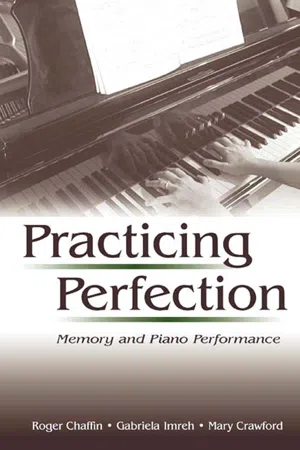
The memory feats of famous musicians seem almost superhuman. Can such extraordinary accomplishments be explained by the same principles that account for more ordinary, everyday memory abilities? To find out, a concert pianist videotaped her practice as she learned a new piece for performance, the third movement, Presto, of the Italian Concerto by J.S. Bach. The story of how the pianist went about learning, memorizing and polishing the piece is told from the viewpoints of the pianist (the second author) and of a cognitive psychologist (the first author) observing the practice. The counterpoint between these insider and outsider perspectives is framed by the observations of a social psychologist (the third author) about how the two viewpoints were reconciled. The CD that accompanies the book provides for yet another perspective, allowing the reader to hear the polished performance. Written for both psychologists and musicians, the book provides the first detailed description of how an experienced pianist organizes her practice, identifying stages of the learning process, characteristics of expert practice, and practice strategies. The main focus, however, is on memorization. An analysis of what prominent pianists of the past century have said about memorization reveals considerable disagreement and confusion. Using previous work on expert memory as a starting point, the authors show how principles of memory developed by cognitive psychologists apply to musical performance and uncover the intimate connection between memorization and interpretation.
eBook - ePub
Practicing Perfection
Memory and Piano Performance
- 320 pages
- English
- ePUB (mobile friendly)
- Available on iOS & Android
eBook - ePub
About this book
Information
Publisher
Psychology PressYear
2005Print ISBN
9780805826104
9780805826104
Edition
1eBook ISBN
9781135685454
ONE
In the Green Room
Take the deepest of breaths and watch for a tremble; the recital is about to begin.
—Noah Adams, Piano Lessons
The green room is a lonely place, however crowded it may be. In the green room—performing artists’ generic name for the place they wait before going on stage—the laser focus of a great performance must gather its intensity.
It is Sunday, October 12,1997, two-thirty in the afternoon, and I am in the green room with Gabriela Imreh. This particular green room, at Trinity Cathedral, Trenton, New Jersey, is less than luxurious. It seems to be a dressing room for clergy and a catchall for church equipment. The room is quite cold with a high ceiling. Vestment cupboards line the wall. Tables scattered around the room are crowded with flower vases, brass candlesticks, hymnals, and old programs from services.
Still it is better than some. Another time, I accompanied Gabriela to a recital at a well-known college of the performing arts, where the green room, a basement with dripping pipes, was also a thoroughfare for custodial staff. I improvised a screen from my coat while she slipped into her gown for the performance. Rather than be dripped on, she did her hair while standing in the wings. I remember watching her fasten the tiny clasp of a necklace, her hands steady and quick, minutes before stepping on stage to play the gigantic Bach-Busoni Chaconne.
When a live performance works—when the technical proficiency, the aesthetic sensibility, the rapport between the audience and performer come together—beauty is created. When it doesn't work—when there is memory failure, technical or aesthetic limitation, debilitating performance anxiety, or a mismatch between audience and performer—the result is painful to all. Live performance persists in an age of technically perfect recording precisely because of the tension, uncertainty, and excitement of real-time music making. Literally, anything can happen.
Gabriela, still in her street clothes, hangs her stage dress from a doorjamb and goes on stage to try the piano. Her program today is demanding:
Chromatic Fantasy and Fugue in D minor (BVW 903), J.S. Bach
Sonata No. 14 in C-sharp minor, Op. 27, No. 2 (Moonlight), L. van Beethoven
Etude, Op. 12, No. 12, “Revolutionary,” Frederic Chopin
Nocturne, Op. 27, No. 2 Preludes, Op. 28, Nos. 22, 23, 24, Frederic Chopin
Intermission
Two Valses-Caprices from “Soirées de Vienne,” Franz Liszt
Aprés une lecture de Dante “Dante Sonata,” Franz Liszt
We have an hour before the performance. The cathedral is empty, the Baldwin grand standing ready at the front outside the altar rail. Gabriela begins her warmup with the slow movement of the Moonlight Sonata, then runs through one of the waltzes from “Soirées de Vienne.” A big, powerful passage from the Dante Sonata is next, followed—incongruously—by “Flight of the Bumblebee,” a much played encore this season. Next she takes on some fast runs from the third movement of the Moonlight, more bits from the Dante Sonata, another waltz. After 20 minutes of concentrated work, she stands up, stretches, and returns to the piano to try a particularly difficult passage from the Dante Sonata. She fumbles, takes a wrong turn, and loses her direction. She plays it again and then a third time before getting through the passage without a mistake.
It is now after 3:00 p.m., less than half an hour before the performance. She has not played a single note of the difficult opening piece, the Chromatic Fantasy and Fugue. Unlike many pianists, who open recitals with a warmup piece that is not particularly difficult for them, Gabriela almost always chooses a big, demanding work. She says that she prefers to do the hardest thing first, rather than have it “hanging over” her throughout the first half of the performance. (Typically, she has chosen to make huge demands on herself at both ends of the performance, ending today's recital with the virtuoso Dante Sonata.) I know that the Bach fantasy and fugue, with its difficult polyphonic structure, has given her memory problems in the past. I am starting to get very nervous. My hands and feet are cold, and the muscles in my shoulders and back are tense. At 3:05, she stands again, stretches, and walks to the back of the cathedral. She talks about the piano. “It's good,” she says, though a bit “flimsy” in the touch. “It can run away from you if you're not careful.” Back at the instrument, she riffs through a few short passages from the Chromatic Fantasy. To me, they seem like random bits, her practice without focus. By now I can hardly write my notes; my hands are shaking and my movements clumsy. My breath is shallow, my chest constricted. Empathy—and memories of my days in music school—make the waiting and watching almost unbearable.
Much of Gabriela's practice in the hour before the performance seems aimed at getting to know the instrument. Only a few artists can afford to have their own piano shipped with them on tour. The rest are at the mercy of out-of-shape, unreliable instruments (not to mention equally out-of-shape and unreliable technicians and tuners). Gabriela often plays in small towns where the community's sole concert piano may not have been played or tuned for months at a time. Tales of performances sabotaged by the piano-from-Hell are a fixture of pianists’ lives. Perhaps none surpasses this one, seen through the eyes of a music critic:1
A Humid Recital Stirs Bangkok
A hush fell over the room as Mr. Kropp appeared from the right of the stage, bowed to the audience and placed himself upon the stool.
As I have mentioned on several occasions, the Baldwin Concert Grand, while basically a fine instrument, needs constant attention, particularly in a climate such as Bangkok.... In this humidity, the felts which separate the white keys from the black tend to swell, causing an occasional key to stick, which apparently was the case last evening with the D in the second octave.
During the “raging storm” section of the D minor Toccata and Fugue, Mr. Kropp must be complimented for putting up with the awkward D. However, by the time the “storm” was past and he had gotten into the Prelude and Fugue in D Major, in which the second octave D plays a major role, Mr. Kropp's patience was wearing thin.
Some who attended the performance later questioned whether the awkward key justified some of the language, which was heard coming from the stage during softer passages of the fugue.... [O]ne member of the audience had a valid point when he commented over the music and extemporaneous remarks of Mr. Kropp that the workman who had greased the stool might have done better to use some of the grease on the second octave D. Indeed, Mr. Kropp's stool had more than enough grease and during one passage in which the music and lyrics were both particularly violent, Mr. Kropp was turned completely around. Whereas before his remarks had been aimed largely at the piano and were therefore somewhat muted, to his surprise and that of those in the chamber music room he found himself addressing himself directly to the audience....
Mr. Kropp appeared somewhat shaken. Nevertheless, he swiveled himself back into position facing the piano, and leaving the D Major fugue unfinished, commenced on the Fantasia and Fugue in G Minor.
Why the concert grand piano's G key in the third octave chose that particular time to be sticking I hesitate to guess. However, it is certainly safe to say that Mr. Kropp himself did nothing to help matters when he began using his feet to kick the lower portion of the piano instead of operating the pedals as is generally done.
Possibly it was this jarring or un-Bach-like hammering to which the sticking keyboard was being subjected. Something caused the right front leg of the piano to buckle slightly inward; leaving the entire instrument listing at approximately a 35-degree angle from that which is normal. A gasp went up from the audience, for if the piano had actually fallen several of Mr. Kropp's toes, if not both his feet, would surely have been broken.
It was with a sigh of relief therefore, that the audience saw Mr. Kropp slowly rise from his stool and leave the stage. A few men in the back of the room began clapping and when Mr. Kropp reappeared a moment later it seemed he was responding to the ovation. Apparently, however, he had left to get a red-handled fire ax, which was hung back stage in case of fire, for that was what was in his hand.
My first reaction at seeing Mr. Kropp begin to chop at the left leg of the grand piano was that he was attempting to make it tilt at the same angle as the right leg and thereby correct the list. However, when the weakened legs finally collapsed altogether with a great crash and Mr. Kropp continued to chop, it became obvious to all that he had no intention of going on with the concert.
The ushers, who had heard the snapping of piano wires and splintering of sounding board from the dining room, came rushing in and, with the help of the hotel manager, two Indian watchmen, and a passing police corporal, finally succeeded in disarming Mr. Kropp and dragging him off the stage.
Perhaps pianists like to repeat tales like these because they deflect attention from the less tangible factors affecting their performance. Every soloist lives with the threat of performance anxiety and memory failure, which can disrupt and destroy the aesthetics of a musical moment as surely as a collapsing piano.
Mountain climbers say that altitude sickness is totally unpredictable: The same climb, under the same weather conditions, can be easy or impossible depending on the body's response. For pianists, the magnitude and effects of anxiety are unpredictable. Many pianists believe that a moderate level of tension before a performance makes it better. Gabriela has said that the worst recital she ever played, years earlier, was preceded by an unusual level of calm. Moreover, they do not believe that high anxiety necessarily leads to poor performance. Just last year, Gabriela says, she was “sick for a week” with anxiety before an important concert with the Hong Kong Philharmonic—a concert where her performance of the Rhapsody on a Theme of Paganini drew stellar reviews.
Performance anxiety feels terrible. Noah Adams, host of National Public Radio's All Things Considered, has described his first recital as an adult piano student. Adams played a short, easy piece for an audience of other beginners, a long way from the kinds of situations that professional pianists confront, but he well knows how fear feels and how it can affect one's playing:
There's a coppery taste in my mouth, and my hands are cold.... I can play the prelude pretty well, I don't know how to factor in the fear.... I walk around the backyard, telling myself that it's only a bit of piano playing in front of people I know and like and that I'm on the radio every evening talking to more than a million strangers. I make a cup of peppermint tea, mostly just to hold and keep my hands warmed. The recital starts.... And suddenly I'm at the piano.... The name of my piece has been announced, so there's really nothing for me to say. I adjust the knobs on the sides of the piano bench. I take off my glasses.... I push the wooden frame holding the music back two inches, place my foot on the right pedal, and push it down to feel the tension. My hands wait above the first notes. I hear the phrase in my mind ... and begin.
It's like skating very, very fast on dangerous ice, being pushed by the wind with no way to slow down. I don't feel over-the-top nervous, but as I begin the graceful eleven-note run up three octaves with my right hand, it starts to shake. Drastically. I'm still playing the correct keys, I think, but it's scary to see your hand shake like that. I miss a few notes, just leaving them behind.... The middle part's coming up; I could collapse right here. I slow down for it, but I can still hear the bad notes clanging like a pinball machine.... Then I'm thankfully into the last eight measures.... The soft ending chord comes up—I look at the keyboard, so I won't make a horrendous final mistake...
A half-hour later I'm standing in the kitchen, drinking a beer, accepting compliments. It's an athletic glow—an after race satisfaction. (Adams, 1996, pp. 197–201)
It is now 3:14 p.m. Audience members are approaching the cathedral, and Gabriela is still out front in her street clothes. We head to the green room. I realize that allowing herself only a few minutes to dress is a deliberate strategy. Keeping busy, she says, helps alleviate anxiety. Right now, my own empathic anxiety is reaching an extremely unpleasant peak. I wish this were all over and we could go home.
Many performing artists develop superstitious routines for the time leading up to performance. Gabriela has her own coping strategies for the entire day of a performance. When I arrived at her house at midmorning, she was busy practicing. Her practice piano, a Kawai grand, had several broken strings, the result of being used for 6 or more hours a day; it sounded tinny and sharp. Because Gabriela has perfect pitch, an out-of-tune piano is not only aesthetically painful, but can interfere with memory retrieval. However, she feels comfortable with her familiar Kawai, her dog Daisy at her station underneath.
She had practiced slowly, playing short sections from the day's program—from a few bars to perhaps 3 minutes in length. When I asked about her strategy, she said that it is aimed at avoiding becoming tired before the performance, “not giving yourself away too soon.” Yesterday she had done a “huge workout” on the D minor fugue; today she had “imagined it” instead of actually playing it. This strategy, she said, “works only if you really know it.”
Usually she does not eat before a performance, but today she insisted on fixing lunch for me. Quickly, she sliced cucumber, carrot, and a slippery-ripe avocado. Is she nervous, I wondered? Morbid thoughts of the danger to her hands came to mind. Gabriela does not allow herself to do any sports that might lead to hand or wrist injury—no skating, tennis, or racquetball for her. But she is a fearless, creative cook, with an armory of chopping and grinding gadgets and knives and an impatient energy to do complicated tasks presto.
After lunch, Gabriela volunteered that she had not been nervous about this recital until about 48 hours before. Her goal, she said, is to be “keyed up,” reaching a peak state of being “pleasantly nervous” about an hour before a performance. She confessed that she was more nervous than she should be. She thinks it is because this recital is on home territory; many friends have called to say they will be in the audience. (Afterward, when I asked her to review the course of anxiety and tension throughout the performance day, she remembered this time after lunch, about an hour and a half before the recital, as one of two unpleasant peaks. The other had been earlier, before my arrival, when she had walked Daisy and locked herself out of the house.)
We talk lightly, skipping from one thought to another. Gabriela, prompted by the flower arranging paraphernalia in the green room, instructs me on the best ways to dry flowers fr...
Table of contents
- Cover
- Half Title
- Title Page
- Copyright Page
- Dedication
- Table of Contents
- Series Editor's Foreword
- Preface
- 1 In the Green Room
- 2 Improvisations
- 3 In the Words or the Masters: Artists’ Accounts or Their Expertise
- 4 Expert Memory
- 5 The Way to Carnegie Hall
- 6 Lessons From J.S. Bach: Stages or Practice
- 7 In the Words of the Artist
- 8 Effects of Musical Complexity on Practice
- 9 Memory and Performance
- 10 Stages or Practice Revisited
- 11 CODA
- Appendix 1 Discography for Gabriela Imreh (pianist)
- Appendix 2 Score of the Italian Concerto (Presto)
- References
- Author Index
- Subject Index
Trusted by 375,005 students
Access to over 1.5 million titles for a fair monthly price.
Study more efficiently using our study tools.
Frequently asked questions
Yes, you can cancel anytime from the Subscription tab in your account settings on the Perlego website. Your subscription will stay active until the end of your current billing period. Learn how to cancel your subscription
No, books cannot be downloaded as external files, such as PDFs, for use outside of Perlego. However, you can download books within the Perlego app for offline reading on mobile or tablet. Learn how to download books offline
Perlego offers two plans: Essential and Complete
- Essential is ideal for learners and professionals who enjoy exploring a wide range of subjects. Access the Essential Library with 800,000+ trusted titles and best-sellers across business, personal growth, and the humanities. Includes unlimited reading time and Standard Read Aloud voice.
- Complete: Perfect for advanced learners and researchers needing full, unrestricted access. Unlock 1.5M+ books across hundreds of subjects, including academic and specialized titles. The Complete Plan also includes advanced features like Premium Read Aloud and Research Assistant.
We are an online textbook subscription service, where you can get access to an entire online library for less than the price of a single book per month. With over 1.5 million books across 990+ topics, we’ve got you covered! Learn about our mission
Look out for the read-aloud symbol on your next book to see if you can listen to it. The read-aloud tool reads text aloud for you, highlighting the text as it is being read. You can pause it, speed it up and slow it down. Learn more about Read Aloud
Yes! You can use the Perlego app on both iOS and Android devices to read anytime, anywhere — even offline. Perfect for commutes or when you’re on the go.
Please note we cannot support devices running on iOS 13 and Android 7 or earlier. Learn more about using the app
Please note we cannot support devices running on iOS 13 and Android 7 or earlier. Learn more about using the app
Yes, you can access Practicing Perfection by Roger Chaffin, Gabriela Imreh, Mary Crawford in PDF and/or ePUB format, as well as other popular books in Psychology & Cognitive Psychology & Cognition. We have over 1.5 million books available in our catalogue for you to explore.