- 492 pages
- English
- ePUB (mobile friendly)
- Available on iOS & Android
eBook - ePub
About this book
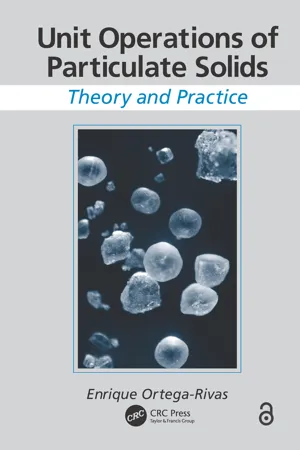
Suitable for practicing engineers and engineers in training, this book covers the most important operations involving particulate solids. Through clear explanations of theoretical principles and practical laboratory exercises, the text provides an understanding of the behavior of powders and pulverized systems. It also helps readers develop skills for operating, optimizing, and innovating particle processing technologies and machinery in order to carry out industrial operations. The author explores common bulk solids processing operations, including milling, agglomeration, fluidization, mixing, and solid-fluid separation.
Information
Part I
Characterization of Particulate Systems and Relation to Storage and Conveying
1.1 Definitions of Unit Operations
The term unit operation has been used to describe a physical and/or mechanical procedure occurring parallel to a chemical reaction known as unit process, which happens in diverse materials processing industries. In order to understand this term properly, one should bear in mind that modernly structured industries were shaped during the great industrial revolution that started in England in the eighteenth century. With the invention of the steam engine, some industries developed and grew in complexity as other energy sources, such as oil and electricity, were incorporated (Valiente and Stivalet, 1980). In modern economics, there are four main components in economic activities of a nation or region:
• Primary sector: extraction of natural resources (agriculture, fishing, mining, etc.)
• Secondary sector: transformation of primary products (industry)
• Tertiary sector: services (commerce, banking, transportation, etc.)
• Quaternary sector: technological exploitation (research, design, and development)
The industrial sector needs to be further classified, but that would be a difficult task. A broad general categorization could be considered, however, as follows:
• Manufacturing industry (assembled goods, automotive industry, etc.)
• Construction industry (building construction, industrial construction, etc.)
• Materials processing industry
The materials processing industry receives diverse raw materials to be transformed directly from the primary sector, either for direct consumption as finished products or for further transformation in some other types of industries. The materials processing industry may be divided into four categories:
• Chemical industry
• Pharmaceutical industry
• Food industry
• Metallurgy industry
In many industrial plants that process materials, a fundamental aspect of their operation is a chemical reaction known as unit process, such as oxygenation, hydrogenation, or polymerization. In order for a particular reaction to be carried out, a series of controlled steps to create optimal conditions are required. These steps or maneuvers are the physical and/or mechanical processes mentioned before (evaporation, distillation, pulverization, etc.) and are known as unit operations. The term unit operation arose from the need to standardize and systematize the teaching of chemical engineering as a discipline, due to the growth of the industry activity generated by the industrial revolution. A sort of tailor-made appropriate professional was required to operate chemical processing plants and promote a harmonic development of the materials processing industry. In 1887 George E. Davis proposed, in a famous series of 12 lectures at Manchester Technical School in England, the creation of a special career to cater for the growing chemical processing industry. Davis worked as an inspector for the Alkali Act of 1863, a very early piece of environmental legislation that required soda manufacturers to reduce emissions to the atmosphere. Davis also identified broad features common to all chemical factories, and he published his influential Handbook of Chemical Engineering (Davis, 1904) that roughly defined chemical engineering as a profession. His lectures were criticized for being common place know-how observed around operating practices used by British chemical industries at the time. Davis’ ideas were, however, fundamental in initiating new thinking in the US chemical industry and sparking, eventually, the launching of chemical engineering study programs at several US universities. Chemical engineering courses, organized by Lewis M. Norton, were taught by 1888 at the Massachusetts Institute of Technology (MIT). In 1891, the Department of Chemistry at MIT granted seven Bachelor’s degrees for Chemical Engineering, the first of their kind to be bestowed in the world. Almost at the same time, chemical engineering courses were offered at Pennsylvania State University in 1892, at Tulane University in 1894, and at Michigan University in 1898 (Valiente and Stivalet, 1980).
The pioneering courses of the chemical engineering degree programs consisted of deep knowledge of chemistry and physics complemented by courses of mechanical engineering and descriptive courses about equipment and important industry processes. As soon as the graduates began practicing, they realized about flaws and inconsistencies in their formation. The courses they received were descriptive but in practice they needed to make engineering. They needed to know how to design equipment, how to calculate the size of a new plant, and so on. This served to discuss the teaching of chemical engineering again in the schools. From these discussions, the concept of unit operation was originated, attributed to Arthur D. Little (Brown, 2005) who acted as president of the Inspecting Committee of the Department of Chemistry and Chemical Engineering at MIT. Such concepts may be defined textually as: “Any chemical process, at any scale, may be reduced to a coordinated series of what may be called unit operations, such as pulverize, dry, roast, crystallize, filter, evaporate, electrolyze, and so on. The number of these operations is not big and only a few of them is involved in a particular process” (Valiente and Stivalet, 1980, p. 35). Unit operations nowadays are diverse, since new types of industries have arisen, some consisting of very specific features. A classification of unit operations is not an easy task and some can be found in literature. The criteria used to categorize unit operations are varied and may include types of phases involved in a process, mass transfer or heat transfer possibility, governing force (e.g., physical or mechan-ical) in an operation, and so on.
In general terms, the book by Walker et al. (1937) could be recognized as the first formal text of chemical engineering and the original work of McCabe and Smith (1956) as the most widely recognized and used text for educational purposes. Also, Per...
Table of contents
- Cover
- Half Title
- Title Page
- Copyright Page
- Table of Contents
- Preface
- Author
- Part I Characterization of Particulate Systems and Relation to Storage and Conveying
- Part II Bulk Solids Processing
- Part III Separation Techniques for Particulate Solids
- Appendix 1: International (SI) System of Units
- Appendix 2: Density and Viscosity of Water at Different Temperatures and 101.325 kPa
- Appendix 3: Density and Viscosity of Air at Different Temperatures and 101.325 kPa
- Appendix 4: Dimensional Analysis
- Appendix 5: Standard Screen Scales
- Appendix 6: Guidelines for the Preparation of Laboratory Reports
- Appendix 7: Notation
- Index
Trusted by 375,005 students
Access to over 1.5 million titles for a fair monthly price.
Study more efficiently using our study tools.
Frequently asked questions
Yes, you can cancel anytime from the Subscription tab in your account settings on the Perlego website. Your subscription will stay active until the end of your current billing period. Learn how to cancel your subscription
No, books cannot be downloaded as external files, such as PDFs, for use outside of Perlego. However, you can download books within the Perlego app for offline reading on mobile or tablet. Learn how to download books offline
Perlego offers two plans: Essential and Complete
- Essential is ideal for learners and professionals who enjoy exploring a wide range of subjects. Access the Essential Library with 800,000+ trusted titles and best-sellers across business, personal growth, and the humanities. Includes unlimited reading time and Standard Read Aloud voice.
- Complete: Perfect for advanced learners and researchers needing full, unrestricted access. Unlock 1.5M+ books across hundreds of subjects, including academic and specialized titles. The Complete Plan also includes advanced features like Premium Read Aloud and Research Assistant.
We are an online textbook subscription service, where you can get access to an entire online library for less than the price of a single book per month. With over 1.5 million books across 990+ topics, we’ve got you covered! Learn about our mission
Look out for the read-aloud symbol on your next book to see if you can listen to it. The read-aloud tool reads text aloud for you, highlighting the text as it is being read. You can pause it, speed it up and slow it down. Learn more about Read Aloud
Yes! You can use the Perlego app on both iOS and Android devices to read anytime, anywhere — even offline. Perfect for commutes or when you’re on the go.
Please note we cannot support devices running on iOS 13 and Android 7 or earlier. Learn more about using the app
Please note we cannot support devices running on iOS 13 and Android 7 or earlier. Learn more about using the app
Yes, you can access Unit Operations of Particulate Solids by Enrique Ortega-Rivas in PDF and/or ePUB format, as well as other popular books in Politics & International Relations & Political History & Theory. We have over 1.5 million books available in our catalogue for you to explore.