- 520 pages
- English
- ePUB (mobile friendly)
- Available on iOS & Android
eBook - ePub
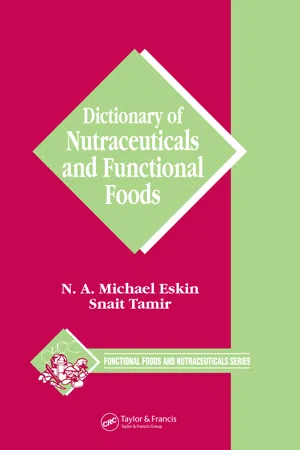
Dictionary of Nutraceuticals and Functional Foods
About this book
Health professionals are recognizing the major role that nutraceuticals play in health enhancement. As a result, there is a dramatic increase in research aimed at identifying new functional foods and nutraceuticals. There is not, however, a single source that presents this research in a thorough and accessible manner. Comprehensive and complete, th
Information
Z
Zeaxanthin
Zeaxanthin, a hydroxylated carotenoid, is an important plant food xanthophyll. Together with lutein, they are found in the macula pigment of the central retina of the eye responsible for the yellow coloration (Snodderly et al., 1986). Since the source of the macular pigment is solely dietary-based, studies have examined the possible relationship between the pigment and dietary intake. The majority of dietary zeaxanthin and lutein (78 percent) are obtained from such vegetables as spinach and orange pepper, although they are also found in egg yolk (Summerburg et al., 1998; USDA, 1998). The importance of the macula pigment is its protection against agerelated maculopathy, one of the major causes of blindness in Western countries (Klaver et al., 1998). Modified diets that are supplemented with zeaxanthin and lutein were shown to augment or enhance the macular pigment optical density (Hammond et al., 1997; Johnson et al., 2000). Both zeaxanthin and lutein are strong antioxidants, as age-related maculopathy is due to a combination of cumulative blue-light damage or oxidative stress (Beatty et al., 2000). Thus, oxidative stress appears to play a role in such neurodegenerative diseases as age-related macular degeneration (ARMD), the primary cause of blindness in seniors in developed countries (Leibowitz et al., 1980; Klein et al., 1992).
Wrona and coworkers (2004) examined the ability of zeaxanthin to protect the outer layer of the retina containing photoreceptor outer segments and retinal pigment epithelium (RPE), possible targets of oxidative damage. Using ARPE 19 cells from the globes of a 19-year-old male donor, they showed that zeaxanthin, in the presence of ascorbic acid and α-tocopherol, significantly enhanced resistance to photo-induced oxidative stress. Compared to cells without added antioxidants, these cells had enhanced cell viability and accumulated fewer lipid hydroperoxides. A synergism was evident between zeaxanthin and vitamin E or C, which could play a role in protecting the cell membranes from oxidative damage. The reduction in the decay of zeaxanthin in the presence of either vitamin C or E, following photo-sensitized oxidation of ARPE-19 cells, pointed to their protective effects. The synergism between these antioxidants was responsible for preventing the depletion of zeaxanthin by free-radical degradation and repair of the semioxidized zeaxanthin molecules. Chen et al. (2005) recently reported the successful use of high-speed, counter-current chromatography for isolating and purifying zeaxanthin from the microalga Microcystis aeruginosa. For a further review of the relationship between serum and dietary levels of zeaxanthin, lutein, and macular pigment optical density, the article...
Table of contents
- Cover Page
- Title Page
- Copyright Page
- Preface
- The Authors
- A
- B
- C
- D
- E
- F
- G
- H
- I
- J
- K
- L
- M
- N
- O
- P
- Q
- R
- S
- T
- U
- V
- W
- X
- Y
- Z
Trusted by 375,005 students
Access to over 1.5 million titles for a fair monthly price.
Study more efficiently using our study tools.
Frequently asked questions
Yes, you can cancel anytime from the Subscription tab in your account settings on the Perlego website. Your subscription will stay active until the end of your current billing period. Learn how to cancel your subscription
No, books cannot be downloaded as external files, such as PDFs, for use outside of Perlego. However, you can download books within the Perlego app for offline reading on mobile or tablet. Learn how to download books offline
Perlego offers two plans: Essential and Complete
- Essential is ideal for learners and professionals who enjoy exploring a wide range of subjects. Access the Essential Library with 800,000+ trusted titles and best-sellers across business, personal growth, and the humanities. Includes unlimited reading time and Standard Read Aloud voice.
- Complete: Perfect for advanced learners and researchers needing full, unrestricted access. Unlock 1.5M+ books across hundreds of subjects, including academic and specialized titles. The Complete Plan also includes advanced features like Premium Read Aloud and Research Assistant.
We are an online textbook subscription service, where you can get access to an entire online library for less than the price of a single book per month. With over 1.5 million books across 990+ topics, we’ve got you covered! Learn about our mission
Look out for the read-aloud symbol on your next book to see if you can listen to it. The read-aloud tool reads text aloud for you, highlighting the text as it is being read. You can pause it, speed it up and slow it down. Learn more about Read Aloud
Yes! You can use the Perlego app on both iOS and Android devices to read anytime, anywhere — even offline. Perfect for commutes or when you’re on the go.
Please note we cannot support devices running on iOS 13 and Android 7 or earlier. Learn more about using the app
Please note we cannot support devices running on iOS 13 and Android 7 or earlier. Learn more about using the app
Yes, you can access Dictionary of Nutraceuticals and Functional Foods by Michael Eskin,Snait Tamir in PDF and/or ePUB format, as well as other popular books in Biological Sciences & Nutrition, Dietics & Bariatrics. We have over 1.5 million books available in our catalogue for you to explore.