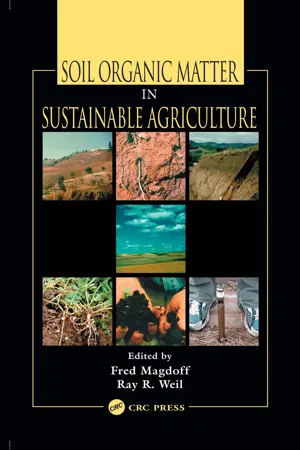
eBook - ePub
Soil Organic Matter in Sustainable Agriculture
- 412 pages
- English
- ePUB (mobile friendly)
- Available on iOS & Android
eBook - ePub
Soil Organic Matter in Sustainable Agriculture
About this book
Recognition of the importance of soil organic matter (SOM) in soil health and quality is a major part of fostering a holistic, preventive approach to agricultural management. Students in agronomy, horticulture, and soil science need a textbook that emphasizes strategies for using SOM management in the prevention of chemical, biological, and physic
Information
1
Significance of Soil Organic Matter to Soil Quality and Health
Ray R.Weil and Fred Magdoff
SOIL QUALITY, SOIL HEALTH, AND ECOSYSTEM FUNCTIONS
Soil scientists have developed the concept of soil quality (SQ) to describe the fitness of soils to perform particular ecosystem functions (Karlen et al., 2001). SQ is usually defined as the capacity of the soil to carry out ecological functions that support terrestrial communities (including agroecosystems and humans), resist erosion, and reduce negative impacts on associated air and water resources (Karlen et al., 1997). The soil quality concept addresses the associations among soil management practices, observable soil characteristics, soil processes, and the performance of soil ecosystem functions (Lewandowski et al., 1999). Soil quality can be influenced by many properties inherent to a particular soil and reflective of the environmental factors affecting long-term soil formation, such as steepness of slope, depth of solum, and soil texture. Soil quality can also reflect the condition of a soil resulting from the alteration of certain soil properties by management practices. Aggregate stability, infiltration capacity, nitrogen mineralization potential, and biodiversity of soil organisms are among the soil properties that are substantially altered by management. The term soil health is often used to describe those aspects of soil quality that reflect the condition of the soil as expressed by management-sensitive properties (Islam and Weil, 2000). The health of a soil refers not only to its lack of degradation or contamination, but also to its overall fitness for carrying out ecosystem functions and responding to environmental stresses (Lewandowski et al., 1999).
The many ecosystem processes mediated by soils can be grouped into five fundamental, though somewhat overlapping, functions (Brady and Weil, 2002): (1) promotion of plant growth; (2) biogeochemical cycling of elements (especially carbon and mineral nutrients elements); (3) provision of habitat for soil organisms; (4) partitioning, storage, translocation, and decontamination of water; and (5) support and protection of human structures and artifacts. Although soil organic matter (SOM) can be a negative factor with regard to the fitness of soil as a medium for constructing roads and buildings, it is usually a major positive factor in determining a soil’s capacity to perform most of the other functions listed.
Specific soil functions important in promoting plant growth include (1) provision of mineral nutrients available to plant roots in time, space, and form; (2) retention of water in sufficient quantities and with appropriate potential energy to be available for root uptake on an almost continuous basis; (3) provision of a network of interconnected pores sufficient to provide pathways of low physical resistance to root growth and meet plant root needs by supplying oxygen and removing carbon dioxide and toxic gases; (4) support of plant growth-promoting soil organisms; and (5) provision of sufficient rooting depth and physical support for optimal plant growth. These functions, with the possible exception of the last, are greatly influenced by the increase in organic matter content of soils. High levels of SOM are associated with reduced erosion and runoff; enhanced soil aggregation and nutrient cycling; and improved infiltration, movement, and retention of water (Greenland and Szabolcs, 1994; Woomer and Swift, 1994). Areas that need more research to elucidate the relationship between SOM and soil quality are (1) the role of organic compounds as chelating agents that control the availability and toxicity of micronutrients to plants and microorganisms; (2) the role of soluble or easily oxidizable C as fuel for microbial biomass; and (3) the passage of SOM and its chemical energy through the trophic levels of the soil food web that cycles C and nutrients.
SOIL QUALITY INDICATORS, PERCEPTIONS, AND INDICES
Many soil ecosystem functions are difficult to measure directly; therefore, SQ must often be inferred from easily measurable soil properties, the soil quality indicators (Acton and Padbury, 1993). Because of the multiple and complex functions associated with SQ, its assessment necessitates the integration of chemical, physical, and biological soil properties. Of particular interest are properties that can serve as early and sensitive indicators of ecosystem stress or changes in soil productivity. Given the pervasive role of organic matter in promoting soil ecosystem functions, it is not surprising that researchers have found SOM-related properties to be important indicators of SQ (Larson and Pierce, 1991; Arshad and Coen, 1992; Gregorich et al., 1994; Kennedy and Papendick, 1995; Wander and Bollero, 1999; Islam and Weil, 2000). Of the 13 SQ indicator properties suggested in 14 recent papers on SQ indices, the two most commonly included are pH (13 of 14) and SOM (12 of 14; Popp et al., 2002). Dumansky (1994) concluded that “soil organic matter is emerging as a key indicator for assessing sustainability” of land management systems.
Organic matter content and related soil properties can also largely account for farmers’ perception of SQ. For example, in the mid-Atlantic region of the U.S., in a study of pairs of similar soils with similar pedological characteristics but different management histories, 88% of the 32 farmers interviewed cited SOM as a soil property indicative of relative SQ (Gruver and Weil, 1997). Organic-matter-related soil properties, such as total organic carbon, microbial biomass C, extractable carbohydrates, and macroaggregate stability, exhibited significantly higher values in the soils perceived by the farmers as being in better condition or in a state of higher SQ. Similarly, in the highlands of Kenya (Murage et al., 2000), 12 smallholder farmers identified paired fields as either productive or nonproductive. Total organic C, various labile fractions of organic C, and microbial biomass C were significantly higher in the soils perceived to be more productive. In the Kenyan setting, the lower-quality unproductive soils were also more acidic and lower in available plant nutrients, because the resource-limited farmers had applied inadequate levels of fertilizers, organic amendments, and crops residues. In the U.S., application of mineral fertilizer and limestone is so routine that researchers studying farmer perceptions of SQ (Liebig and Doran, 1999; Gruver and Weil, 1997) have found that farmer-identified high-and low-quality soils differ little with regard to levels of pH or available nutrients, leaving SOM-related properties as the main differentiating factors. Traditional indigenous knowledge of subsistence farmers is also often a factor in perceived SOM content when classifying the fertility or potential productivity of different soils in their local landscapes (Corbeels et al., 2000)
To assess overall SQ from an agricultural viewpoint, researchers have attempted to integrate numerous SQ indicator properties into a single index by which SQ under various management systems can be compared (Karlen et al., 1997). Glover et al. (2000) tested a systematic method for rating SQ in a study of apple orchards in Washington managed by conventional, organic, and integrated approaches. Their system focused on the capacity of soils to perform four specific ecosystem functions: accommodate water entry, accommodate water movement and availability, resist surface structure degradation, and sustain fruit production and quality. Each of these functions was given an equal (0.25) weightage and was assessed by averaging scores given for two levels of indicator properties. The two properties most closely related to SOM [soil organic content (SOC) and aggregate stability] together accounted for 41% of the total SQ scores. However, despite progress in developing SQ indices useful for assessing agricultural management practices, Sojka and Upchurch (1999) warn that it will probably not be possible to develop a single SQ index that applies to all five basic soil functions.
NATURE AND COMPOSITION OF SOM
SOM is arguably the most complex and least understood component of soils. The content of organic matter in soils ranges from ca. 2 g/kg in some desert soils to more that 800 g/kg in some Histosols; however, cultivated mineral soils usually contain 10 to 40 g/kg in the A horizon. The major portion of SOM usually consists of a conglomeration of relatively recalcitrant organic molecules termed humus (see Chapter 4). Although the chemistry of humus is under active investigation and several phenolic-rich models of humus have been proposed (Schnitzer, 1995; Stevenson, 1994), the chemical nature of this large portion of SOM is highly variable and not yet well understood. However, advances in instrumentation in the 1980s and 1990s (Hatcher et al., 2001) h ave all owed identific and quantification of the major types of chemical groups present in a complex organic mixture. Solid-state CPMAAS 13C-NMR is at present routinely applied to quantify the alkyl, N-alkyl, O-alkyl, acetal, aromatic, phenolic, and carboxylic groups in various fractions of SOM (Oades, 1995; Guant et al., 2001).
A considerable advance in the chemical characterization of the recalcitrant portion of SOM came with the recent discovery of glomalin, a large (~90 kDa) iron-containing glycoprotein molecule synthesized by the hyphae of arbuscular mycorrhizal fungi (see Chapter 6). Glomalin, which appears to contain only 10 to 35% C, resists acids and enzymes and therefore accumulates to rather high levels in many soils (2 to 35 g/kg). Apparently, large amounts of glomalin are present in SOM fractions defined operationally as particulate organic matter, humic acid, fulvic acid, and humin. Other works have suggested that the charred plant material resulting from incomplete burning might constitute an important part of what is often considered humus. Ponomarenko and Anderson (2001) combined high-energy UV photooxidation with micromorphology and electron microscopy to define and estimate the char portion of SOM in the A horizons of black prairie soils. Char was found to be highly recalcitrant, high in aromatic groups, and a constituent of all particle sizes, from sand to clay size.
Litter and detritus, the dead, decaying remains of plants and animals, comprise a significant proportion of the organic matter in (or on) soils. The chemistry of the litter and detritus is usually closely related to that of the original tissues, the greatest portion being derived from lignin and polysaccharides. Kögel-Knabner (2002) has reviewed the structural chemistry of litter and some of the alterations that occur as it decomposes. Finally, a small but biologically active portion of SOM consists of easily oxidized, often relatively soluble compounds derived from litter, such as sugars and amino acids, as well as a wide array of biochemicals synthesized by microorganisms or contributed by plant roots. The chemistry of this microbially available bioactive fraction is complex and poorly understood. In addition to dead remains, soils contain myriads of living organisms. The microorganisms, constituting the soil microbial biomass, are especially significant.
Because SOM is nonhomogenous and not well defined chemically, it cannot be measured directly as a specific substance. Instead, methods used routinely for its analysis generally measure some proxy for SOM, such as total organic C, total C, or weight loss on ignition. Unfortunately, the methods used to determine SOM vary from lab to lab. Each method in common use has its own limitations and inaccuracies, and the estimate of SOM obtained by one method can differ significantly from that obtained by one of the alternative methods. Making comparisons between SOM values obtained by different soil test labs or by different researchers can be fraught with ambiguity. However, most soil test labs routinely analyze for SOM, and therefore information on SOM content is widely available and used for many purposes. Therefore, it is important that users appreciate the differences among the methods in common use.
A common method for estimating SOM is the determination of total organic C by wet oxidation with chromate in strong acid (Walkley and Black, 1947). When SOM is reported by this method, the value determined for organic C must be multiplied by a standard factor designed to account for the method’s incomplete oxidation of SOC (traditionally assumed to be 77%; however, for a range of tropical Alfisols, Inceptisols, and Vertisols, Olayinka et al. (1998) found the v...
Table of contents
- COVER PAGE
- TITLE PAGE
- COPYRIGHT PAGE
- PREFACE
- EDITORS
- CONTRIBUTORS
- 1. SIGNIFICANCE OF SOIL ORGANIC MATTER TO SOIL QUALITY AND HEALTH
- 2. SOIL ORGANIC MATTER MANAGEMENT STRATEGIES
- 3. SOIL ORGANIC MATTER FRACTIONS AND THEIR RELEVANCE TO SOIL FUNCTION
- 4. STIMULATORY EFFECTS OF HUMIC SUBSTANCES ON PLANT GROWTH
- 5. SUPPRESSION OF SOILBORNE DISEASES IN FIELD AGRICULTURAL SYSTEMS: ORGANIC MATTER MANAGEMENT, COVER CROPPING, AND OTHER CULTURAL PRACTICES
- 6. CONTRIBUTIONS OF FUNGI TO SOIL ORGANIC MATTER IN AGROECOSYSTEMS
- 7. CONNECTING BELOWGROUND AND ABOVEGROUND FOOD WEBS: THE ROLE OF ORGANIC MATTER IN BIOLOGICAL BUFFERING
- 8. TILLAGE AND RESIDUE MANAGEMENT EFFECTS ON SOIL ORGANIC MATTER
- 9. STRATEGIES FOR MANAGING SOIL ORGANIC MATTER TO SUPPLY PLANT NUTRIENTS
- 10. SOIL AND CROP MANAGEMENT EFFECTS ON SOIL MICROBIOLOGY
- 11. INTERACTIONS A MONG ORGANIC MATTER, EARTHWORMS, AND MICROORGANISMS IN PROMOTING PLANT GROWTH
Trusted by 375,005 students
Access to over 1.5 million titles for a fair monthly price.
Study more efficiently using our study tools.
Frequently asked questions
Yes, you can cancel anytime from the Subscription tab in your account settings on the Perlego website. Your subscription will stay active until the end of your current billing period. Learn how to cancel your subscription
No, books cannot be downloaded as external files, such as PDFs, for use outside of Perlego. However, you can download books within the Perlego app for offline reading on mobile or tablet. Learn how to download books offline
Perlego offers two plans: Essential and Complete
- Essential is ideal for learners and professionals who enjoy exploring a wide range of subjects. Access the Essential Library with 800,000+ trusted titles and best-sellers across business, personal growth, and the humanities. Includes unlimited reading time and Standard Read Aloud voice.
- Complete: Perfect for advanced learners and researchers needing full, unrestricted access. Unlock 1.5M+ books across hundreds of subjects, including academic and specialized titles. The Complete Plan also includes advanced features like Premium Read Aloud and Research Assistant.
We are an online textbook subscription service, where you can get access to an entire online library for less than the price of a single book per month. With over 1.5 million books across 990+ topics, we’ve got you covered! Learn about our mission
Look out for the read-aloud symbol on your next book to see if you can listen to it. The read-aloud tool reads text aloud for you, highlighting the text as it is being read. You can pause it, speed it up and slow it down. Learn more about Read Aloud
Yes! You can use the Perlego app on both iOS and Android devices to read anytime, anywhere — even offline. Perfect for commutes or when you’re on the go.
Please note we cannot support devices running on iOS 13 and Android 7 or earlier. Learn more about using the app
Please note we cannot support devices running on iOS 13 and Android 7 or earlier. Learn more about using the app
Yes, you can access Soil Organic Matter in Sustainable Agriculture by Fred Magdoff, Ray R. Weil, Fred Magdoff,Ray R. Weil in PDF and/or ePUB format, as well as other popular books in Technology & Engineering & Ecology. We have over 1.5 million books available in our catalogue for you to explore.