- 360 pages
- English
- ePUB (mobile friendly)
- Available on iOS & Android
eBook - ePub
About this book
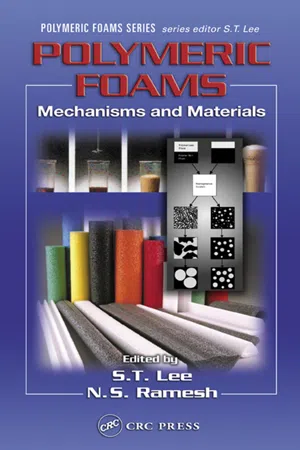
This book is the inaugural volume a series entitled Polymeric Foams: Technology and Applications. Generally, thermoplastic and thermoset foams have been treated as two separate practices in industry. Polymeric Foams: Mechanisms and Materials presents the basics of foaming in general build a strong foundation to those working in both thermoplastic a
Information
1
Introduction: Polymeric Foams, Mechanisms, and Materials
CONTENTS
1.1 Introduction
1.2 Foaming Technology
1.3 Foaming Mechanisms
1.4 Materials
References
1.1
Introduction
Foam is a material, and foaming is a phenomenon. Both involve the presence of a gas phase encapsulated by a spherical shell dense phase.
Gas exists throughout the universe and is a very interesting phase, especially on Earth. It is indispensable to organic life. Despite possessing a mass and sometimes a shape (e.g., fire), gas is basically formless. The light bonding of gas makes it almost omnipresent. There may be a large amount of gas molecules in a limited space, or a small amount in a large space. When gas is encapsulated in a dense medium, an interesting phenomenon or product is formed. In nature, cork, wood, and pumice are good examples of this type of product. In these materials, either there is a hollow space surrounded by solid, or gaseous voids are dispersed in the solid. The hollow space, as seen in bamboo and cork, is shaped like hollow sticks bundled together. But foam is often round in shape.1
The tiny hollow space acts as an amazing transport vehicle for water, from the root to the top of a tree, a process known as the capillary effect. Foam impacts almost every aspect of human life. For example, when heated, water soaked into rice grain expands and renders the grain edible; and gas is generated in flour through yeast. Both rice and flour possess a cellular structure that has been compatible with our digestive tissue as food for thousands of years. Low surface tension surfactant-induced bubbles are another interesting function that removes dirt from textiles. Moreover, natural sponge, with its open cell structure, is a useful product in absorbing and desorbing liquids. Table 1.1 shows a brief summary of foams in our lives.2
TABLE 1.1
In most synthesis, foaming is a necessary phenomenon to convert raw materials to foamed products. Our focus in this volume is on foam as a product and its processing mechanisms.
Foam contains porous structures perceived as gaseous voids surrounded by a dense phase or as a gassolid composite. The drastic differences in nature between gases and solids make foams unique combinations that have special properties for applications. For instance, the presence of a cellular structure can regulate flow velocity, dissipate disturbance, and enlarge mass transfer area. Metal foam, polymeric foam, paper foam, and ceramic foam have been developed for unique applications to enrich our lives or to explore the mysterious universe.
Since the beginning of the twentieth century, synthetic polymers have become increasingly important materials in industry. As plastication technology advanced and allowed for more sophisticated operations, the addition of a blowing agent became a natural extension of polymer processing. Combining chemistry and engineering principles, foaming methodology continued to expand in Europe and North America during and after World War II. Japan joined the developmental list in the 1960s. Presently, foam extrusion, injection molding, molded bead, x-linked foam, reactive foaming, and gelation are well-known methods of making polymeric foams, and polymeric foams have become a well-developed branch in the polymer industry. A brief developmental history of polymeric foams is presented in Table 1.2.3–10
Polymers, especially thermoplastic polymers, are characterized by their viscoelastic nature, which possesses processing and material uniqueness. When fit into processing and foaming criteria, their expanded cellular structure shows interesting properties. However, not every polymer is a good candidate for foam. Considering compatibility with gas, processing window, capability to hold dynamic foaming, and stability during gas replacement by air, few polymers are left on the list. Surprisingly, these polymeric foams developed solid and strong applications due to their unique properties.
TABLE 1.2
A Brief Development History of Polymeric Foams
A Brief Development History of Polymeric Foams
The gaseous voids dispersed in the polymeric matrix evidently alter the polymer’s structure, morphology, and properties. Its lighter density has lent itself to commercial flotation since the 1940s. Also, its cellular structure is a natural fit in insulation, which is currently a substantial business. Annual consumption of polymeric foams is forecast to rise to 7.8 billion lb in 2005, an amount valued at $17.6 billion.11 When a cell wall possesses enough elasticity, it can be used repeatedly in the athletic and furniture industries. Other industries, such as automotive, medical, and packaging, are also enhanced by the usage of polymeric foams. The growth in diversity of applications and intensity of usage continues. In essence, it is performance oriented. A simplified performance dependency summary chart is presented in Figure 1.1. Materials and mechanisms are the primary variables that directly affect structure formation. When they are combined with residual gas, mechanical and thermal characteristics are determined.
Polymeric foam can be viewed from different practical perspectives, such as products, technology, and components. Products can be categorized by dimension, density, cell size, cell density, morphology, and property; for instance, block versus film, high density versus low density, microcellular versus cellular, open cell versus closed cell, and rigid versus soft. As for technology, it is basically classified as soluble foaming and reactive foaming, or physical foaming and chemical foaming. Foam can also be classified in accordance with polymer materials such as thermoplastic and thermoset foam. Table 1.3 summarizes the perspectives, for which details can be found in References 12–14. Product variation has been addressed before, and new developments keep coming to the market, making updates necessary. However, this book focuses on technology and materials—more precisely, foaming mechanisms and materials. It is appropriate to highlight foaming technologies prior to discussing foaming and material issues.
TABLE 1.3
Foaming Perspectives
Foaming Perspectives

FIGURE 1.1
Polymeric foam performance dependency summary chart.
1.2
Foaming Technology
The method for making foam is straightforward: generating bubbles and stabilizing them within a polymeric matrix. Bubble formation, in general, is a consequence of unstable phenomena or a way to dissipate a “disturbance” to resume a stable state. Boiling is a good example that is often described as a transient phenomenon. When a system is excited into an unstable foaming state, a stabilization mechanism must be established in time to transform the foaming into a stable foamed product. Again, the fundamental concept sounds very simple, but there are a great variety of methods for making useful polymeric foams.
As pointed out, there are two major foaming methodologies in the polymeric foam industry: soluble foaming and reactive foaming, or physical foaming and chemical foaming The former involves physical variation in polymer states, and the latter is solely dependent on chemical reaction. The two methodologies can also be described as follows: blowing an agent into the polymer by mixing within a chamber to take advantage of the vaporization of gas while reducing pressure; or blending reactants to reactive conditions for gas evolution within a dense medium. In both methods, the same three steps—gas implementation, gas expansion, and foam stabilization—are involved. It is reasonable to view foaming from the perspective of material strength.
Figure 1.2 illustrates the different paths for common soluble foaming and reactive foaming. Many interesting techniques have been developed around...
Figure 1.2 illustrates the different paths for common soluble foaming and reactive foaming. Many interesting techniques have been developed around...
Table of contents
- Cover Page
- Title Page
- Copyright Page
- Dedication
- Preface
- Acknowledgments
- Editors
- Contributing Authors
- 1. Introduction: Polymeric Foams, Mechanisms, and Materials
- 2. Melt Elasticity of Polyolefins: Impact of Elastic Properties On Foam Processing
- 3. Fundamentals of Bubble Nucleation and Growth In Polymers
- 4. Material Properties Affecting Extrusion Foaming
- 5. Foam Stability In Flexible Polyurethane Foam Systems
- 6. Flexible Polyurethane Foams
- 7. Rigid Polyurethane Foams
Trusted by 375,005 students
Access to over 1.5 million titles for a fair monthly price.
Study more efficiently using our study tools.
Frequently asked questions
Yes, you can cancel anytime from the Subscription tab in your account settings on the Perlego website. Your subscription will stay active until the end of your current billing period. Learn how to cancel your subscription
No, books cannot be downloaded as external files, such as PDFs, for use outside of Perlego. However, you can download books within the Perlego app for offline reading on mobile or tablet. Learn how to download books offline
Perlego offers two plans: Essential and Complete
- Essential is ideal for learners and professionals who enjoy exploring a wide range of subjects. Access the Essential Library with 800,000+ trusted titles and best-sellers across business, personal growth, and the humanities. Includes unlimited reading time and Standard Read Aloud voice.
- Complete: Perfect for advanced learners and researchers needing full, unrestricted access. Unlock 1.5M+ books across hundreds of subjects, including academic and specialized titles. The Complete Plan also includes advanced features like Premium Read Aloud and Research Assistant.
We are an online textbook subscription service, where you can get access to an entire online library for less than the price of a single book per month. With over 1.5 million books across 990+ topics, we’ve got you covered! Learn about our mission
Look out for the read-aloud symbol on your next book to see if you can listen to it. The read-aloud tool reads text aloud for you, highlighting the text as it is being read. You can pause it, speed it up and slow it down. Learn more about Read Aloud
Yes! You can use the Perlego app on both iOS and Android devices to read anytime, anywhere — even offline. Perfect for commutes or when you’re on the go.
Please note we cannot support devices running on iOS 13 and Android 7 or earlier. Learn more about using the app
Please note we cannot support devices running on iOS 13 and Android 7 or earlier. Learn more about using the app
Yes, you can access Polymeric Foams by Shau-Tarng Lee,N. S. Ramesh in PDF and/or ePUB format, as well as other popular books in Technology & Engineering & Materials Science. We have over 1.5 million books available in our catalogue for you to explore.