- 304 pages
- English
- ePUB (mobile friendly)
- Available on iOS & Android
eBook - ePub
About this book
For over 2000 years, preparations of chamomile flowers have counted among the medicinal treasures of many cultural groups. This book provides an interdisciplinary inventory of the scientific level of knowledge about German chamomile as well as Roman chamomile, the two types of chamomile most produced. It includes information for pharmacists and the
Information
1
Introduction
Rolf Franke
The medicinal plant of chamomile and the species related to it are of manifold interest as both the drug Matricariae flos (Ph. Eur. 4.6, 2004) [1] and the native plants. Cultivated and wild plants offer a number of subjects that belong to the range of basic and applied research; on the other hand, they are of great economic interest as well.
Considering the fact that the traded chamomile flowers show a very heterogeneous spectrum of content [2], [3], a drug bound to a pharmacopoeia can—if it is to be recognized by the medical sciences in the rational sense—only reach a high standard relating to natural science provided there is a comprehensive knowledge about the biology of the medicinal plant and the species related to it, as well as the drug obtained from it.
Chamomile flowers belong to those drugs that experienced a wide medical application in ancient times [2], [3]. The curative effect of chamomile has been known by physicians for about 2500 years. Hippocrates gives a description of the drug in the 5th century B.C., and chamomile appears as a medicinal plant in the work De Materia Medica written by Dioscorides (1st century A.D.). Galen and Asclepios describe the application of a chamomile infusion at some length. In Palladius’ writings dating back to the 4th or 5th century, notes about chamomile are to be found as well. Medical applications continued in the Middle Ages. Bock, for example, gives the following report about chamomile in his Kreutterbuch of 1539 (described as “gantz gemein Chamill”: “quite ordinary/common chamomile”): “Es ist bei allen menschen kein breuchlicher kraut in der artznei als eben Chamillenblumen/dann sie werden beinahe zu allen presten gebraucht.” (In Old High German, “There is no herb in medicine for people being more usual than chamomile flowers because they are used against nearly all kinds of ailments.”)
From the New Kreuterbuch written by Mathiolus (1626) it may be gathered that “…das Kamillenöl dienet sonderlich wol wider den krampf” (“chamomile oil serves as a remedy against convulsion”). Tabernaemontanus mentions chamomile in 1664 [4]: “…zu mancherley gebrauch in der Artzeney/als in Pflaster/Salben/Behung/Säcklein/Bader und dergleichen nützlich gebraucht wird/und vielerley Artzeneyen darauâ bereiten” (“for manifold use in medicine such as in plasters/ointments/pouches, [medicinal] baths and for other useful purposes, many different medicines can be prepared out of it”). In his Medizinisches Lexikon (Medical Encyclopaedia, 1755) von Haller makes honorable mention of the pain-relieving and spasmolytic effect of chamomile flowers, and in his Praktische Arzneimittellehre (1814, Vol. 1) (Practical Pharmacology), Hecker as well as Hufeland and colleague Collenbuch report the successful use of chamomile preparations in cases of ulcerations (in Hufeland’s Journal) [5]. Saladin von Asculum mentioned the blue volatile oil of chamomile in 1488 and Hieronimus Brunschwig described the distillation of the volatile chamomile oil in 1500. High appreciation is also given to chamomile preparations in the various works written by Sebastian Kneipp (1821–1897) [6]. In the first edition of the Lehrbuch der Phytotherapie (Textbook of Phytotherapy) (1942) Weiss refers to chamomile as being one of the most significant medicinal plants, giving wider space to it in the review [7].
The summary of a choice of internationally known pharmacopoeias (see Chapter 2, Table 2.1) shows that since the publication of the German Pharmacopoeia in 1882, chamomile flowers and preparations from chamomile flowers have been included in a number of pharmacopoeias. In the current pharmacopoeia for the Federal Republic of Germany, the drug called Matricariae flos is to be found in the European Pharmacopoeia 4.6, edition 2004 [1].
Roman chamomile has also been significant as a drug from ancient times. Tabernaemontanus had already known filled and unfilled forms in 1664 [4]. This Roman chamomile is included in a number of pharmacopoeias and also in the European Pharmacopoeia, Suppl. 4.3 2003 (see Chapter 2, Table 2.2).
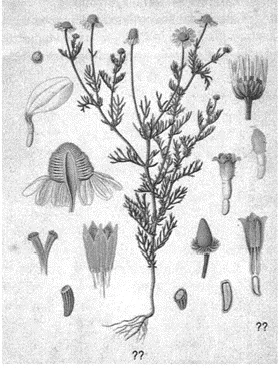
FIGURE 1.1 True chamomile (Matricaria recutita L.). (Fuchs, L.
[1543] New Kreüterbuch. Basel. With permission of Botanical Garden and Botanical Museum, Berlin-Dahlem.)
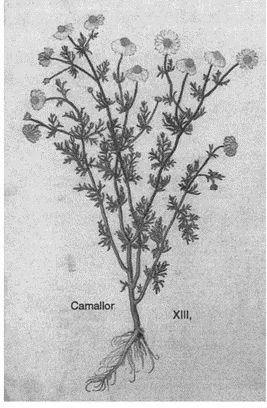
FIGURE 1.2 The capitulum of the True chamomile has a cone-shaped, hollow bottom. (Köhler [1987] Medizinal-Pflanzen in naturgetreuen Abbildungen mit kurz erläuterndem Text. Gera. Vol. With permission of Botanical Garden and Botanical Museum, Berlin-Dahlem.)
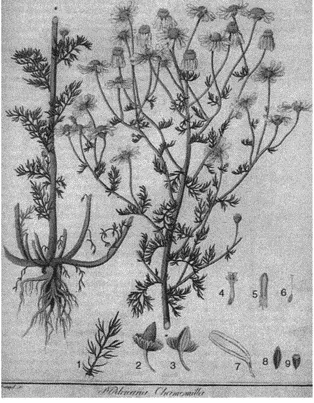
FIGURE 1.3 True chamomile (Matricaria recutita L.). (Hayne, F.G. [1805] Getreue Darstellung und Beschreibung der in der Arzneykunde gebräuchlichen Gewächse. Berlin.
Vol. 1. With permission of Botanical Garden and Botanical Museum, Berlin-Dahlem.)
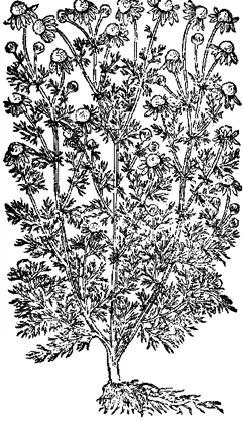
FIGURE 1.4 True chamomile (Matricaria recutita L.) [4].
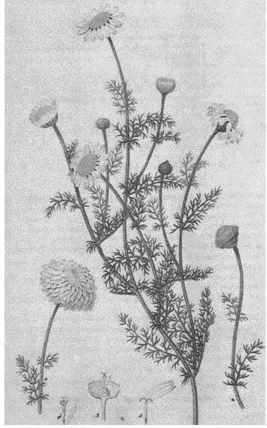
FIGURE 1.5 Roman chamomile (Chamaemelum nobile [L.] All.). (Chaumeton, F.P. [1815] Flore médicinale. Paris. Vol. 2. With permission of Botanical Garden and Botanical Museum, Berlin-Dahlem.)
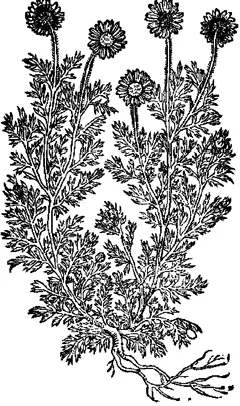
FIGURE 1.6 Roman chamomile (Chamaemelum nobile [L.] All.) (Tabernaemontanus, 1664 p. 58) [4].
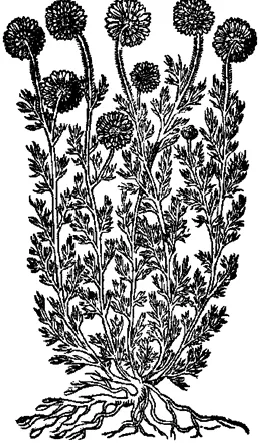
FIGURE 1.7 Roman chamomile (Chamaemelum nobile [L.] All.) (Tabernaemontanus, 1664 p. 59) [4].
In 1956 Heeger [8] reported that true chamomile has been worked on to a small extent [only] and that it is “on its way to becoming a culture plant.” In the past 40 years chamomile has developed into a real culture plant that is cultivated on a wide scale.
REFERENCES
1. European Pharmacopoeia 4.6 (edition 2004) Deutscher Apotheker Verlag, Stuttgart, Germany.
2. Isaac, O., Schimpke, H. (1965) Mitt. Dtsch. Pharmazeut. Ges., 35, 133.
3. Schilcher, H. (1973) Neuere Erkenntnisse bei der Qualitätsbeurteilung von Kamillenblüten bzw. Kamil-lenöl—Einteilung der Handelskamille in vier chemische Typen. Planta Medica, 23, 132.
4. Tabernaemontanus, J.T. (1664) New vollkommenlich Kräuter-Buch, Jacob Werenfels, Basel, 1529 pp.
5. Hufelands Journal, ref. in Madaus, G. (1979) Lehrbuch der biologischen Heilmittel. Band I.G.Olms, Hildesheim, New York.
6. Kneipp, S. (1882) Öffentliche Vorträge, p. 232 and (1985) p. 46; (1866)...
Table of contents
- Cover Page
- Title Page
- Copyright Page
- Medicinal And Aromatic Plants—Industrial Profiles
- Preface To The Series
- Preface
- Contributors
- 1: Introduction
- 2: Legal Situation Of German Chamomile: Monographs
- 3: Plant Sources
- 4: Active Chemical Constituents Of Matricaria Chamomilla L. Syn. Chamomilla Recutita (L.) Rauschert
- 5: Cultivation
- 6: Abiotic And Biotic Stress Affecting The Common Chamomile (Matricaria Recutita L.) And The Roman Chamomile (Chamaemelum Nobile L.Syn. Anthemis Nobilis L.)
- 7: Raw Plant Material And Postharvest Technology
- 8: Processing Of Raw Material
- 9: Storage Of The Dry Drug Horst BöTtcher And Ingeborg GüNther
- 10: Chemical Analysis Of The Active Principles Of Chamomile
- 11: Pharmacology And Toxicology Heinz Schilcher, Peter Imming, And Susanne Goeters
- 12: Traditional Use And Therapeutic Indications
Trusted by 375,005 students
Access to over 1.5 million titles for a fair monthly price.
Study more efficiently using our study tools.
Frequently asked questions
Yes, you can cancel anytime from the Subscription tab in your account settings on the Perlego website. Your subscription will stay active until the end of your current billing period. Learn how to cancel your subscription
No, books cannot be downloaded as external files, such as PDFs, for use outside of Perlego. However, you can download books within the Perlego app for offline reading on mobile or tablet. Learn how to download books offline
Perlego offers two plans: Essential and Complete
- Essential is ideal for learners and professionals who enjoy exploring a wide range of subjects. Access the Essential Library with 800,000+ trusted titles and best-sellers across business, personal growth, and the humanities. Includes unlimited reading time and Standard Read Aloud voice.
- Complete: Perfect for advanced learners and researchers needing full, unrestricted access. Unlock 1.5M+ books across hundreds of subjects, including academic and specialized titles. The Complete Plan also includes advanced features like Premium Read Aloud and Research Assistant.
We are an online textbook subscription service, where you can get access to an entire online library for less than the price of a single book per month. With over 1.5 million books across 990+ topics, we’ve got you covered! Learn about our mission
Look out for the read-aloud symbol on your next book to see if you can listen to it. The read-aloud tool reads text aloud for you, highlighting the text as it is being read. You can pause it, speed it up and slow it down. Learn more about Read Aloud
Yes! You can use the Perlego app on both iOS and Android devices to read anytime, anywhere — even offline. Perfect for commutes or when you’re on the go.
Please note we cannot support devices running on iOS 13 and Android 7 or earlier. Learn more about using the app
Please note we cannot support devices running on iOS 13 and Android 7 or earlier. Learn more about using the app
Yes, you can access Chamomile by Rolf Franke, Heinz Schilcher, Rolf Franke,Heinz Schilcher in PDF and/or ePUB format, as well as other popular books in Medicina & Medicina alternativa e complementare. We have over 1.5 million books available in our catalogue for you to explore.