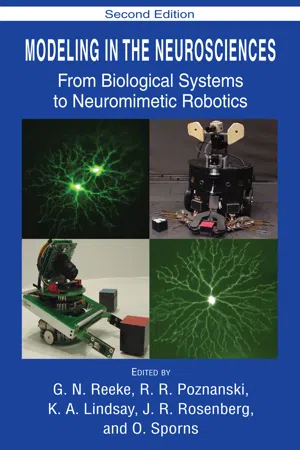
Computational models of neural networks have proven insufficient to accurately model brain function, mainly as a result of simplifications that ignore the physical reality of neuronal structure in favor of mathematically tractable algorithms and rules. Even the more biologically based "integrate and fire" and "compartmental" styles of modeling suff
eBook - PDF
Modeling in the Neurosciences
From Biological Systems to Neuromimetic Robotics
- 742 pages
- English
- PDF
- Available on iOS & Android
eBook - PDF
Modeling in the Neurosciences
From Biological Systems to Neuromimetic Robotics
About this book
Information
Topic
MatematicaSubtopic
Matematica applicataTable of contents
- Front cover
- Contents
- Preface to the Second Edition
- Contributors
- Foreword
- About the Editors
- 1 Introduction to Modeling in the Neurosciences
- 2 Patterns of Genetic Interactions: Analysis of mRNA Levels from cDNA Microarrays
- 3 Calcium Signaling in Dendritic Spines
- 4 Physiological and Statistical Approaches to Modeling of Synaptic Responses
- 5 Natural Variability in the Geometry of Dendritic Branching Patterns
- 6 Multicylinder Models for Synaptic and Gap-Junctional Integration
- 7 Voltage Transients in Branching Multipolar Neurons with Tapering Dendrites and Sodium Channels
- 8 Analytical Solutions of the Frankenhaeuser–Huxley Equations Modified for Dendritic Backpropagation of a Single SodiumSpike
- 9 Inverse Problems for Some Cable Models of Dendrites
- 10 Equivalent Cables — Analysis and Construction
- 11 The Representation of Three-Dimensional Dendritic Structure by a One-Dimensional Model — The Conventional Cable Equation as the First Member of a Hierarchy of Equations
- 12 Simulation Analyses of Retinal Cell Responses
- 13 Modeling Intracellular Calcium: Diffusion, Dynamics, and Domains
- 14 Ephaptic Interactions Between Neurons
- 15 Cortical Pyramidal Cells
- 16 Semi-Quantitative Theory of Bistable Dendrites with Potential-Dependent Facilitation of Inward Current
- 17 Bifurcation Analysis of the Hodgkin–Huxley Equations
- 18 Highly Efficient Propagation of Random Impulse Trains Across Unmyelinated Axonal Branch Points:Modifications by Periaxonal K+ Accumulation and Sodium Channel Kinetics
- 19 Dendritic Integration in a Two-Neuron Recurrent Excitatory Network Model
- 20 Spike-Train Analysis for Neural Systems
- 21 The Poetics of Tremor
- 22 Principles and Methods in the Analysis of Brain Networks
- 23 The Darwin Brain-Based Automata: Synthetic Neural Models and Real-World Devices
- 24 Toward Neural Robotics: From Synthetic Models to Neuromimetic Implementations
- Bibliography
- Index
- Back cover
Trusted by 375,005 students
Access to over 1.5 million titles for a fair monthly price.
Study more efficiently using our study tools.
Frequently asked questions
Yes, you can cancel anytime from the Subscription tab in your account settings on the Perlego website. Your subscription will stay active until the end of your current billing period. Learn how to cancel your subscription
No, books cannot be downloaded as external files, such as PDFs, for use outside of Perlego. However, you can download books within the Perlego app for offline reading on mobile or tablet. Learn how to download books offline
Perlego offers two plans: Essential and Complete
- Essential is ideal for learners and professionals who enjoy exploring a wide range of subjects. Access the Essential Library with 800,000+ trusted titles and best-sellers across business, personal growth, and the humanities. Includes unlimited reading time and Standard Read Aloud voice.
- Complete: Perfect for advanced learners and researchers needing full, unrestricted access. Unlock 1.5M+ books across hundreds of subjects, including academic and specialized titles. The Complete Plan also includes advanced features like Premium Read Aloud and Research Assistant.
We are an online textbook subscription service, where you can get access to an entire online library for less than the price of a single book per month. With over 1.5 million books across 990+ topics, we’ve got you covered! Learn about our mission
Look out for the read-aloud symbol on your next book to see if you can listen to it. The read-aloud tool reads text aloud for you, highlighting the text as it is being read. You can pause it, speed it up and slow it down. Learn more about Read Aloud
Yes! You can use the Perlego app on both iOS and Android devices to read anytime, anywhere — even offline. Perfect for commutes or when you’re on the go.
Please note we cannot support devices running on iOS 13 and Android 7 or earlier. Learn more about using the app
Please note we cannot support devices running on iOS 13 and Android 7 or earlier. Learn more about using the app
Yes, you can access Modeling in the Neurosciences by G. N. Reeke, R.R. Poznanski, K. A. Lindsay, J.R. Rosenberg, O. Sporns in PDF and/or ePUB format, as well as other popular books in Matematica & Matematica applicata. We have over 1.5 million books available in our catalogue for you to explore.