eBook - ePub
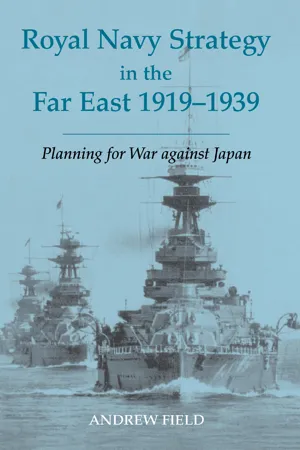
Royal Navy Strategy in the Far East 1919-1939
Planning for War Against Japan
- 288 pages
- English
- ePUB (mobile friendly)
- Available on iOS & Android
eBook - ePub
About this book
Between the ending of the Great War and the start of the Second World War in 1939, the Royal Navy remained the largest in the world. But with the League of Nations seeming to offer a solution to all future conflicts, a country weary of war and without an obvious enemy there seemed no need for a large battlefleet.
1
The Influence of a Far Eastern Strategy on British Naval Policy
Japan took its commitment to the Anglo-Japanese Alliance seriously in the Great War, participating in the hunt for Graf Spee’s squadron, escorting convoys, seizing German colonies in China and the Pacific and even putting down a mutiny in Singapore. Japanese shipyards also built ships for the allies, including a class of 12 destroyers for the French Navy. But Japanese national pride was affronted by British requests in 1916 either to buy their modern Kongo-class battle cruisers, or to have them manned by British crews and deployed with the Grand Fleet, to replace war losses. Not only did the Imperial Japanese Navy see the manning of Japanese ships by British crews as a national slur and an insult on the efficiency of their own navy, but they also saw the loss of these vessels, even temporarily, as a setback to Japanese naval expansion, based on the 8:8 Plan to provide a powerful battle fleet to equal US naval power. However, in 1917 the Japanese agreed to deploy cruisers and destroyers in the Mediterranean to protect convoys, and there the British were impressed, and had had nothing but praise for Japanese efforts and efficiency.1
The employment of Japanese ships in the Pacific had provoked a mixed response in Australia and New Zealand though. Whilst grateful for the Japanese contribution, the Dominion governments were fearful of further Japanese expansion towards their territories and disapproved of the seizure of German possessions in the Marshall, Marianas and Gilbert Islands, and especially the important cable station on Yap Island.2 Consequently, after 1918 Britain and Japan moved further apart from each other and, in April 1919, the Director of Local Defences Division (DLDD), Commander Larken, noted:
The strategical centre of gravity may be said to have shifted from the North Sea to the Pacific, and future Naval policy depends on our relations with Japan. The sooner therefore, that the intentions of our government are known in regard to the renewal, or otherwise, of the Anglo-Japanese Alliance, the better.3

Map 1: The Major Battle Fleet Strength of the World, 1931
He was expressing widely held beliefs; the Pacific was now regarded as the major strategic area of importance, and the British government needed to provide guidance regarding the attitude to be adopted towards Japan. However, British politicians were unwilling to make any hard and fast decisions until the future shape of the post-war world had finally been resolved by all of the various treaties and negotiations, even though political leaders such as MacDonald, Baldwin and Churchill acknowledged that Britain’s Empire, trade and status all depended on the Royal Navy. But the Royal Navy’s views on what was regarded as necessary to maintain command at sea – a large and well-equipped battle fleet – seldom accorded with what the Treasury thought they should be spending, and the definition of strategy and sea power often came to be decided by how much money the Treasury was prepared to grant the Admiralty, rather than being based on strategic priorities.4
War Memorandum (Eastern) and the development of the Singapore naval base are prime examples of a continuing dialogue between the Admiralty, the government and the Treasury, where it was in the Admiralty’s interests to overstate the case, the Treasury’s to understate and the government’s to say nothing that would commit them to one particular course of action.
The ending of the Great War had certainly weakened the Admiralty’s claim on a large proportion of government income, by removing any European threat and not clearly identifying any foreign naval threat to the British Empire.5 The Board of the Admiralty attempted to define imperial sea power at a time when the government was hesitant about defining strategic objectives.
Certainly, in 1919, when the Chancellor of the Exchequer recommended a reduction in the number of capital ships in commission with full crews, down to 15 capital ships and not the 21 that the Admiralty wanted, they played on the fears of a naval race with the United States and Japan, the consequent loss of prestige and trade, and the weakened bonds with the Dominions that this could result in. Both Japan and the United States were building powerful battleships and battle cruisers, all judged to be much more powerful than existing British warships. To avoid being left behind, the Royal Navy felt that it would need to build new ships and, in the absence of any firm government direction, Admiral Beatty, the First Sea Lord, and the Board were convinced that the best way to counter both the US and the Japanese naval threats was to maintain the largest possible battle fleet, based around the battleship. However, when Lord Long, the First Lord of the Admiralty, sought a definitive ruling on government policy regarding naval supremacy over the United States and other naval powers, he was instructed to plan on the basis that it was unlikely that Great Britain would be involved in another war for ten years. And in the same year that Grant wrote his paper and the United States was dismissed as a potential enemy, the Cabinet directed that the maximum amount for the 1920–21 Naval Estimates was to be £60 million, an enormous reduction on Long’s proposed £171 million and a much more serious consideration for the Admiralty. It seemed that the Treasury, and not the Cabinet as a whole, was now playing a major role in determining defence policy, dictating how much money was available for the three Services, and thus how Britain could react to situations abroad.
According to the Admiralty’s interpretation, the British, as the only Western naval power with a major naval base in the Pacific, Hong Kong, could not allow the Japanese to achieve regional superiority unchecked by alliance or other limitations. In the event of a war with Japan, a large battle fleet would not be sufficient without a base in the Pacific from which to operate and the Director of Plans, Captain Dewar, pointed out to Captain Domvile, the Deputy Chief of Naval Staff, that this raised unpleasant political questions which the Cabinet would need to address. Principally, these were whether the Anglo-Japanese Alliance was to be allowed to lapse or not, the possibility of war with Japan, and the provision of a sufficiently powerful battle fleet and the necessary bases, both along the lines of communication and in the western Pacific region itself, to support the fleet in such a war.6 This would entail a large amount of money being spent, especially on providing a naval base able to support a battle fleet in the Far East, something that did not currently exist anywhere in the region. Ad hoc war responses were to be avoided, and in their place there should be detailed plans for which ships to send, where from and where to; a defended naval base was needed.7
The first, tentative, stages in developing a strategy for a Far Eastern war had begun and one of the ways that the Admiralty felt could promote regional security and also reduce the costs to the British government was with the idea of a single, imperial navy, with unity of command on the basis of the experiences of the late war.8 For their part, the Dominion Prime Ministers felt this to be politically unacceptable and instead they requested that a prominent naval figure be sent to the region to advise them on naval matters. The former commander of the Grand Fleet and First Sea Lord, Admiral Sir John Jellicoe, was chosen by the Imperial War Cabinet in December 1918, as the figure of sufficient standing and prestige.
Jellicoe’s Mission did not advance the debate at all. As he toured the region he became more and more convinced that the Japanese posed the only real threat. Instead of the Admiralty’s ‘Imperial Fleet’, he advocated the formation of strong Dominion navies and a strong Pacific Fleet. Great Britain would be responsible for providing all eight battleships, six battlecruisers, eight cruisers, 28 destroyers and one depot ship, 22 submarines and one depot ship, two aircraft carriers, eight minesweepers and one repair ship, along with a financial contribution of £14,066,800, some 75 per cent of the total cost, whilst Australia would be responsible for the other two battlecruisers, eight cruisers, ten destroyers and a depot ship, eight submarines and a depot ship, the minelayer, four minesweepers, one aircraft carrier and one repair ship and a financial contribution of £4,024,600, or 20 per cent of the cost. The balance would be made up by New Zealand and Canada. It was an ‘Imperial Fleet’ by another name, with the British, who would make the largest contributions, more than likely to insist upon operational control, a condition the Dominions would be bound to oppose. The Admiralty had only one course of action open to them; they rejected Jellicoe’s report. However, they were equally pessimistic about the alternative, maintaining a battle fleet in the Far East, in peacetime, to match the nine Japanese battleships and eight battlecruisers. In the event of a war, British naval forces would be numerically inferior to the Japanese, incapable of doing anything more than fighting a holding action until the arrival of the British battle squadrons.9 The solution was for Singapore to be developed as a defended fortress and naval base, able to hold out against assault until relieved by the Main Fleet. The Dominions would assume responsibility for providing fuel for the transit of this Main Fleet to the region, whilst the British provided the ships and the strategy to fight a war against Japan. It was in the light of this shift in strategic focus to the Pacific that the Admiralty’s planning began to gather pace.
In the immediate future, the Royal Navy remained stronger than the Imperial Japanese Navy in all classes of vessels, with an overall fleet strength of 33 battleships, eight battlecruisers, 60 light cruisers and 352 destroyers, mainly concentrated in home waters. On paper this was a large enough navy to send a battle fleet eastwards and maintain naval superiority in home waters. But many of these ships were old, had seen arduous war service, and would need refitting or replacing, a process already planned for by the Admiralty, but dependent on high naval expenditure and likely to prompt another new naval race. Strategically it was also felt to be unwise to divide the fleet, and instead it would have to be concentrated into the Main Fleet, a mutually supporting, balanced fleet of all elements, based around the battleships of the Atlantic Fleet and Mediterranean Fleet, detached forces of cruisers securing the sea lines of communication and local defence forces, again, mainly cruisers, on foreign stations.
There were other reasons, apart from the purely strategical, as to why these deployments made sense. Capital ships operating on foreign stations missed out on the opportunity of exercising with other battleships in the same battle squadrons and fleets, with detrimental effects on their own and their battle squadron’s gunnery and overall performance; and, more significantly, the dockyard facilities were absent. Even Malta had difficulty in supporting bulged battleships until the arrival of an ex-German floating dock in 1926, and until Singapore was completed, sending any capital ships there was not a realistic deployment.10
Virtually all of Britain’s battleships were worn out by war service and as battleships remained at the core of the Admiralty’s strategic plans, the Board of the Admiralty warned the Cabinet that if Britain failed to complete new capital ships and both the Americans and Japanese completed their programmes, the Royal Navy would become unable to defend Britain’s imperial interests. Beatty, the First Sea Lord, wanted arguments to support his position regarding large ships and comparison...
Table of contents
- Cover Page
- Title Page
- Copyright Page
- Illustrations
- Maps
- Tables
- Series Editor’s Preface
- Preface
- Acknowledgements
- Introduction
- 1. The Influence of a Far Eastern Strategy On British Naval Policy
- 2. A Far Eastern Strategy: War Memorandum (Eastern)
- 3. Admiral Richmond and War Memorandum (Eastern)
- 4. Developing the Far Eastern Strategy: War Memorandum (Eastern) and Changing Circumstances, 1931– 41
- 5. Battle Fleet Tactics and a War In the Far East
- 6. The Royal Navy’s Strategic and Tactical Exercises
- 7. Japanese Naval Strategy and Tactics In the Far East
- 8. Main Fleet to Singapore: The Sinking of HMS Prince of Wales and HMS Repulse and the End of War Memorandum (Eastern)
- Conclusion: War Memorandum (Eastern) and the Royal Navy’s Strategic, Operational and Tactical Development
- Select Bibliography
Trusted by 375,005 students
Access to over 1.5 million titles for a fair monthly price.
Study more efficiently using our study tools.
Frequently asked questions
Yes, you can cancel anytime from the Subscription tab in your account settings on the Perlego website. Your subscription will stay active until the end of your current billing period. Learn how to cancel your subscription
No, books cannot be downloaded as external files, such as PDFs, for use outside of Perlego. However, you can download books within the Perlego app for offline reading on mobile or tablet. Learn how to download books offline
Perlego offers two plans: Essential and Complete
- Essential is ideal for learners and professionals who enjoy exploring a wide range of subjects. Access the Essential Library with 800,000+ trusted titles and best-sellers across business, personal growth, and the humanities. Includes unlimited reading time and Standard Read Aloud voice.
- Complete: Perfect for advanced learners and researchers needing full, unrestricted access. Unlock 1.5M+ books across hundreds of subjects, including academic and specialized titles. The Complete Plan also includes advanced features like Premium Read Aloud and Research Assistant.
We are an online textbook subscription service, where you can get access to an entire online library for less than the price of a single book per month. With over 1.5 million books across 990+ topics, we’ve got you covered! Learn about our mission
Look out for the read-aloud symbol on your next book to see if you can listen to it. The read-aloud tool reads text aloud for you, highlighting the text as it is being read. You can pause it, speed it up and slow it down. Learn more about Read Aloud
Yes! You can use the Perlego app on both iOS and Android devices to read anytime, anywhere — even offline. Perfect for commutes or when you’re on the go.
Please note we cannot support devices running on iOS 13 and Android 7 or earlier. Learn more about using the app
Please note we cannot support devices running on iOS 13 and Android 7 or earlier. Learn more about using the app
Yes, you can access Royal Navy Strategy in the Far East 1919-1939 by Andrew Field in PDF and/or ePUB format, as well as other popular books in History & Military & Maritime History. We have over 1.5 million books available in our catalogue for you to explore.