- 272 pages
- English
- ePUB (mobile friendly)
- Available on iOS & Android
eBook - ePub
About this book
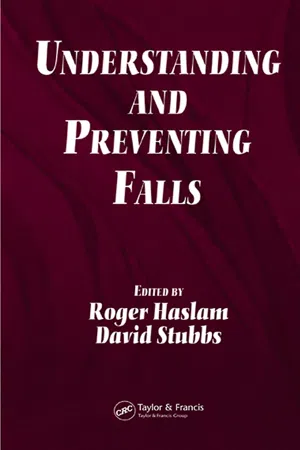
Readable and authoritative, Understanding and Preventing Falls provides a guide to the nature and extent of the problem of falls. Drawing on the latest research, the authors outline the combination of environmental factors that commonly lead to falls and explore how to prevent them. The case is made for a multifaceted approach to falls prevention,
Information
Chapter 1
Introduction
Roger Haslam and David Stubbs
1.1 Background
Falls are an intriguing problem. On the one hand, they are commonplace events, afflicting the human species from childhood through to old age. Often, the outcome is no more serious than a loss of dignity and a degree of embarrassment for the individual concerned. When injuries result, however, they can be debilitating and far-reaching, with detrimental consequences for the injured person’s family, his or her colleagues, and employer. Set against this, efforts aimed at prevention face the considerable challenge of foiling the many, varied, and interacting circumstances that cause falls to occur.
The scale of the falls epidemic was highlighted almost 25 years ago at the first University of Surrey “Slipping, Tripping and Falling Accidents” (STFA) conference in 1982. Two years later, at the second STFA ‘84 meeting, Lord Porrit, introducing the event, was perplexed by the limited attention fall accident research was receiving, disproportionate to the “… gargantuan world-wide epidemic” of the problem (Porritt 1985). Porritt went on to observe that the wider community appears to form “…a vast, disinterested host of young and old who fall over at work and at play, in the home and in the streets, seemingly without caring, except perhaps at the time of the individual incident.” Despite these strong comments, it has taken many years for this persistent leading cause of injury at home and in the workplace to be taken seriously. Fortunately, within the last 10 years, a widespread, international effort has been directed at improving understanding of the causes of falls and their prevention. Much still needs to be done, however, toward achieving a meaningful, sustained reduction in the high incidence of fatalities and injuries arising from falls.
It is appropriate to comment on what constitutes a fall. An early definition, from a study in a geriatrics context, defined a fall as “an untoward event in which the patient comes to rest unintentionally on the floor” (Morris and Isaacs 1980). This description is worthy of remark, though, because it would seem to include incidents such as an individual being knocked down after being struck violently by another person, while excluding a situation where someone falls onto something other than the floor (e.g., an item of furniture). In both cases this seems counterintuitive. The Kellogg International Working Group on the Prevention of Falls by the Elderly (1987) addressed these points to some extent by defining a fall as “an unintentional event that results in a person coming to rest on the ground or another lower level.” For the purposes of the present book, the Kellogg Working Group definition is a useful starting point. It can be added to this that fall incidents will usually involve a person moving about his or her environment or, when stationary, having his or her balance disrupted through movement of the surface on which they are standing (e.g., as might occur when standing on a moving bus or train). Other circumstances, such as the collapse of a person due to a medical condition, such as epilepsy or syncope, are not excluded from consideration, but should be represented as discrete categories of falling, with distinct causation. The same applies to an individual falling as a consequence of being struck by an object. A person losing his or her balance and falling as a result of being jostled in a moving crowd, for example, would appear to be of legitimate interest from a fall prevention perspective.
On occasions in the following chapters, falls are referred to as accidents. The term “accident” can be controversial in the field of injury prevention, owing to the possible interpretation that events leading to injury, described in this way, are due largely to chance and cannot be averted (Evans 2001). The term “accident” remains in widespread use among the safety community, however, and is used comfortably in this book in connection with falls and falling. In commenting on this point, we can be explicit that as falls are clearly more prevalent in particular situations and among certain groups in the population than others, falls cannot be regarded as random events. Moreover, it is a fundamental premise of this book that falls are not inevitable and can be prevented.
1.1.1 Extent of the Falls Problem
Falls happen on the level, on slopes, on steps and stairs, and from height, with differing causes and consequences. Together, they form a major source of injury, imposing a substantial social and economic burden on society. Statistics for the United Kingdom indicate that falls were responsible for 22% of accidental deaths in 2002 across all age groups (RoSPA 2004). In the workplace in Great Britain, falls are responsible for at least one in five deaths and one in three reported nonfatal injuries among employees (Figure 1.1) (HSE 2004). The Health & Safety Executive (HSE 2003) has estimated that slips and trips cost employers £512 million each year in lost production and other expense, with a cost to the health services of £133 million per year. In the home, U.K. Home Accident Surveillance System (HASS) data for 2002 suggest that falls account for almost half (46%) of all home accidents, with an annual incidence rate estimated at 2108 per 100,000 of the population (Figure 1.2) (DTI 2003).
Although international comparisons are impeded by different reporting and recording procedures, data from the U.S. Bureau of Labor Statistics (2004) indicate that falls are involved in 12% of fatal occupational accidents. Similarly, data presented by the National Safety Council (2003) lists falls as the third leading cause of unintentional injury deaths in the general population, behind motor vehicle and poisoning related fatalities, accounting for 15% of the total. Studies in the United States examining the economic impact of falls among older people have estimated the total cost of all fall injuries for people age 65 or older in 1994 to be $20.2 billion (Englander et al. 1996), with an average health care cost of a fall injury for individuals age 72 and over of $19,440 (including hospital, nursing home, emergency room, and home health care, but not physician services) (Rizzo et al. 1998). A similar pattern exists in other countries: Falls are a major cause of unintentional death and injury worldwide.

Figure 1.1 (a) Fatal occupational injuries to empoyees in Great Britain 2002/03 (HSE, 2004).(b) All reported occupational injuries to employees in Great Britain 2002/03 (HSE, 2004).
1.1.2 Types of Falls
In practice, falls are categorised in several ways, according to the circumstances of the fall, age of the person falling and the prevention and research communities most directly addressing the problem (Figure 1.3). In terms of location, it is customary to differentiate between falls on the level, falls on steps and stairs, and falls from height, including those from ladders, raised walking areas, windows, and balconies. Falls in any of these locations may involve a slip or a trip, with these being the common antecedents of falls on the level. Differentiation can be made between falls occurring among children, healthy adults and older people, in terms of individual capability, limitations and the nature of activities typically involved. Differences also exist in the circumstances surrounding falls that happen in domestic, leisure, sporting, and work situations.

Figure 1.2 (a) Accidental deaths in the U.K. 2002 (RoSPA, 2004). (b) Home accidents in the U.K. 2002 (DTI, 2003).
An interesting separation exists between authorities and prevention communities addressing falls among different age groups and falls in and away from the workplace. Falls among older people, for example, are a priority concern for healthcare, medical, and gerontology professionals, and have received considerable research attention. Occupational health and safety professions have primary responsibility for falls in the workplace, where there has perhaps been less research, certainly in terms of the effectiveness of intervention. Other important stakeholders are designers and architects concerned with the built environment. Given the generic aspects of falls, wherever or to whom they occur, it is perhaps surprising how little interaction there has been between specialists from different fields, with little communication or sharing of experience. Underlying this, presumably, is that the development of safety prevention activity and research is an evolutionary process, depending on where expertise is located at the outset, how this develops and the subsequent influence of funding and regulatory bodies.

Figure 1.3 Primary fall, faller, and prevention community categorisations.
1.1.3 Causes of Falls
In the most general sense, falls involve a loss of balance due to some reason, which results in a person falling to the ground or other lower level. As with other accidents, the events leading to a fall are frequently multifactorial, involving an interaction of conditions, the combination of which is necessary for the incident to occur. Prevention of falls requires a commensurate multifaceted approach.
Aspects of the environment involved in falls are the foot-floor interface and the presence of trip hazards. The frictional characteristics of footwear and flooring materials affect the likelihood of slipping, with these influenced by their condition and maintenance and also the presence of contaminants (e.g., water, ice, powders). Obstacles in the walkway may lead to tripping if they go undetected. Because the clearance between feet and the floor is so small during normal gait, deviations in the walking surface of as little as 10 mm may be sufficient to cause a trip.
Features of stairs affecting safety include the stairway dimensions (step height and depth), conspicuity of step edges, and provision of handrails. The stability of ladders depends on the angle at which they are placed and whether they have been secured or tied in at their top. When at height, the stability of the platform on which individuals are positioned is important, together with the provision of guardrails. The height of guard and balcony rails in relation to a person’s centre of gravity affects the protection afforded.
Falls from height, although not considered in detail by this book, are the types of fall responsible for the most serious injuries, especially in the building and construction industry. Inappropriate use of unsecured ladders, unguarded edges or openings to a lower level, working at height without use of suitable supporting platforms (scaffolding), and entering onto fragile roofs without crawler boards are typical causes of such falls.
Personal characteristics involved in fall accidents include gait, balance, stature, strength, vision, and behaviour (Figure 1.4). These, in turn, are influenced by individual health, fatigue, use of medication, alcohol, features of the environment (e.g., lighting and floor surface), and a person’s activity (e.g., load carriage or performance of a cognitive task).
Human ability to walk and balance is a complex process, involving integration of inputs from the visual, vestibular, and somatosensory systems. Stature influences the location of an individual’s centre of gravity and inherent stability. Strength affects ability to recover from disturbances to balance, and use of supports such as handrails. Vision, in addition to its contribution to balance, also enables monitoring of the walking surface and detection of obstacles. Behaviour may vary in terms of the caution that individuals exercise in different circumstances and the nature of the environments people establish around themselves and then seek to negotiate.

Figure 1.4 Personal factors in falls.
1.1.4 Fall Outcomes
Where physical harm results from a fall on the level, injuries may involve lower or upper limb fractures or sprains, back or head injuries, and bruising or contusions. Falls on the level are less likely to lead to serious injury and, if fortunate, the individuals involved may be able to return to their feet, brush themselves down, and continue on their way. In a small number of instances, falls on the level are fatal, where head injury occurs or where a fall exposes the victim to another hazard (e.g., approaching motor vehicle).
Falls from height are often serious in their outcome. The extent of the forces generated and severity of resulting injuries depends on the distance through which the victim falls, any features of the environment with which contact occurs during falling and the nature of the surface on which the body lands. Rigid, inelastic surfaces will cause most damage to the body, whereas a surface capable of yielding to an extent will absorb some of the energy on impact. On some occasions, a falling person may be unfortunate enough to be impaled on a protruding object, causing internal injuries.
In addition to physical injury, individuals may experience psychological harm, with distress caused by the event itself and subsequent pain, immobilisation, and inability to perform normal activities of daily living. This, in turn, may lead to work, financial, and relationship problems, accompanied by depression or anxiety. In some cases, a continuing fear of falling persists, leading to a diminished quality of life for afflicted individuals.
1.2 Book Structure
This book is divided into two sections. The first part examines the current state of knowledge relevant to understanding the causes and prevention of falls, with chapters covering human ambulation and balance on the level and on steps and stairs, followed by chapters looking at the involvement of vision and ageing. The second half of the book presents a series of case studies, illustrating how falls arise in different circumstances and differing approaches to prevention.
As indicated previously, certain aspects of falls and falling have received more attention than others. Tribological concerns (i.e., frictional properties at the foot-floor interface), for example, have been the focus of research effort, spanning at least two decades (Chang et al. 2003). The last few years have also seen appreciable growth in the interest given to falls among older people, with research and intervention programmes now in place in many countries. This is demonstrated by several substantive reviews that have now been published (e.g., American Geriatrics Society et al. 2001; Lord et al. 2001; Gillespie et al. 2003). Four chapters in the book are therefore devoted to these issues.
This book does not give explicit attention, beyond the brief mention in this introductory chapter, to certain categories of falls and fallers, namely falls among infants and children and falls from height. The editorial decision to confine attention to falls among adults on the level and on steps and stairs has been in large part due to the maturity of the research evidence available for different categories of falls and fallers.
Following this introductory chapter, Raoul Grönqvist (Chapter 2) provides a detailed account of the characteristics of human gait and foot-floor interaction, from a frictional, tribology perspective. Grönqvist explains that falls are the outcome of an unrecoverable perturbation of balance, due to a slip, trip, or other cause. Understanding the complexity of how we move and the manner in which a slip or trip may occur are central to understanding f...
Table of contents
- Cover Page
- Title Page
- Copyright Page
- Contributor
- Chapter 1: Introduction
- Chapter 2: Walking on the Level: Footwear and the Walking Surface
- Chapter 3: Steps and Stairs
- Chapter 4: Role of Vision in Falls
- Chapter 5: Ageing and Falls
- Chapter 6: Epidemiological Approaches to Investigating Causes of Occupational Falls
- Chapter 7: Investigation of Individual Fall Incidents
- Chapter 8: The Assessment and Prevention of Pedestrian Slip Accidents
- Chapter 9: Occupational Falls Outdoors: Understanding and Preventing Falls in the New Zealand Logging Industry
- Chapter 10: Falls during Entry/Egress from Vehicles
- Chapter 11: Behaviour and the Safety of Older People on Stairs
- Chapter 12: Preventing Falls
Trusted by 375,005 students
Access to over 1.5 million titles for a fair monthly price.
Study more efficiently using our study tools.
Frequently asked questions
Yes, you can cancel anytime from the Subscription tab in your account settings on the Perlego website. Your subscription will stay active until the end of your current billing period. Learn how to cancel your subscription
No, books cannot be downloaded as external files, such as PDFs, for use outside of Perlego. However, you can download books within the Perlego app for offline reading on mobile or tablet. Learn how to download books offline
Perlego offers two plans: Essential and Complete
- Essential is ideal for learners and professionals who enjoy exploring a wide range of subjects. Access the Essential Library with 800,000+ trusted titles and best-sellers across business, personal growth, and the humanities. Includes unlimited reading time and Standard Read Aloud voice.
- Complete: Perfect for advanced learners and researchers needing full, unrestricted access. Unlock 1.5M+ books across hundreds of subjects, including academic and specialized titles. The Complete Plan also includes advanced features like Premium Read Aloud and Research Assistant.
We are an online textbook subscription service, where you can get access to an entire online library for less than the price of a single book per month. With over 1.5 million books across 990+ topics, we’ve got you covered! Learn about our mission
Look out for the read-aloud symbol on your next book to see if you can listen to it. The read-aloud tool reads text aloud for you, highlighting the text as it is being read. You can pause it, speed it up and slow it down. Learn more about Read Aloud
Yes! You can use the Perlego app on both iOS and Android devices to read anytime, anywhere — even offline. Perfect for commutes or when you’re on the go.
Please note we cannot support devices running on iOS 13 and Android 7 or earlier. Learn more about using the app
Please note we cannot support devices running on iOS 13 and Android 7 or earlier. Learn more about using the app
Yes, you can access Understanding and Preventing Falls by Roger Haslam,David Stubbs in PDF and/or ePUB format, as well as other popular books in Technology & Engineering & Industrial Engineering. We have over 1.5 million books available in our catalogue for you to explore.