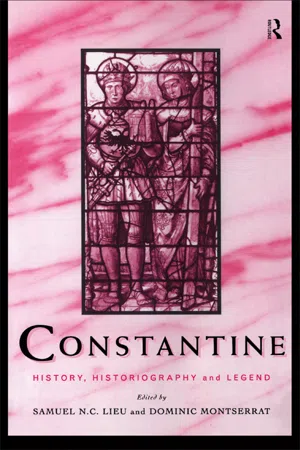
Constantine examines the reign of Constantine, the first Christian emperor and the founder of Constantinople. From a variety of angles: historical, historiographical and mythical. The volume examines the circumstances of Constantine's reign and the historical problems surrounding them, the varied accounts of Constantine's life and the plethora of popular medieval legends surrounding the reign, to reveal the different visions and representations of the emperor from saint and patron of the Western church to imperial prototype. Constantine: History, Historiography and Legend presents a comprehensive and arresting study of this important and controversial emperor.
- 264 pages
- English
- ePUB (mobile friendly)
- Available on iOS & Android
eBook - ePub
1
INTRODUCTION
Averil Cameron
Constantine the Great (sole emperor 324–337) has been for centuries a figure of major importance and major disagreement among historians. Nothing has happened in recent years to lessen either the interest or the controversy which his reign has aroused. Perhaps the extreme hostility and scepticism felt towards him in the nineteenth and early twentieth centuries as a Christian emperor have abated somewhat, as religious partisanship itself has ceased to occupy the central ground in historical consciousness. Historians of the Roman empire today are indeed interested in religious history, but their interest takes a very different form, and few will venture to produce a kind of history overtly dictated by their own personal religious agenda. This ought to be a good moment, therefore, at which to attempt a new assessment of the historical Constantine.
Most, though not all, of the chapters in this volume originated as papers at a conference organised by Sam Lieu and Dominic Montserrat at the University of Warwick in 1993; the chapters by Bill Leadbetter and Jane Stevenson are additions. The contributions are, tellingly, divided into two sections, ‘History and historiography’, and ‘Legend’, and with some qualification, this can fairly be said to represent the major directions of recent research. In the ‘History’ section, while Barnes, Tomlin and Mitchell address general historical questions, Hall returns to the analysis of the Vita Constantini as an historical source; the rest of the contributions in the volume address in different ways the history and legend of Constantine, and in particular, the ways in which he was transformed into a Christian saint and hero, whether in the history of Constantinople, or in relation to the wider Christian world. Literary, rather than historical, analysis (here represented in Anna Wilson’s chapter on the Vita Constantini) is another direction observable in recent scholarship.
The appearance of this volume is timely. Books and articles on Constantine continue to appear in uninterrupted sequence. But the appearance of Paul Magdalino’s edited collection 1 indicates a new and lively interest in the history of the Constantine myth and in the imperial image which Constantine was thought to represent. F.Winkelmann’s critical edition of the Vita Constantini (1975, revised edition 1993), and the collection of his numerous supporting articles,2 had already drawn attention to the later and legendary lives of Constantine, as had publications on their evolution in the Early Byzantine period.3 Sam Lieu and Dominic Montserrat have themselves recently published a volume of annotated translations of some of these texts.4 Also relevant is the current interest in the history of the empire as a city and as capital of an empire, for which the reality of Constantine’s achievements and the way in which they were later perceived are equally relevant. To Gilbert Dagron’s fundamental Naissance d’une capitale,5 we must add Cyril Mango, Le développement urbain de Constantinople (IV e –VII e siècles) (Paris 1985), and the essays in C.Mango and G.Dagron, Constantinople and its Hinterland (Aldershot 1995).
The sources for the reign of Constantine itself have also received attention. Commentaries such as those of H.A.Drake on Eusebius’ Tricennalian Oration, J.L.Creed on Lactantius’ De mortibus persecutorum, I.König on the Origo Constantini and C.E.V.Nixon and B.S.Rodgers on the Panegyrici Latini are making the period more accessible, and opening new solutions to traditional problems. The nature of the Vita Constantini, now recognised as not only Eusebian, but characteristically Eusebian, has attracted detailed attention from T.D.Barnes.6 Anna Wilson’s chapter in this volume recognises the artfulness of the writing of the Vita Constantini, a text strangely neglected by students of biography or hagiography, and enables us to link it to the classic fourth-century Greek works that were to follow, including Gregory of Nyssa’s Life of Moses and Life of Macrina. Stuart Hall in this volume addresses the old problem of the Constantinian documents quoted at length in the Vita Constantini; elsewhere he has shown with what scrupulous attention to detail Eusebius has crafted a subtly changed narrative in the Vita Constantini from the account he himself wrote of Constantine’s rise more than twenty years earlier. Wilson’s study here marks a contribution to the necessary rescue of Eusebius’ life from the realm of source-criticism to that of literature; the next step is to set it side by side with another highly political, and artful, life, the Life of Antony.7
Despite T.D.Barnes’ Constantine and Eusebius, which sets out a strongly argued case for seeing Constantine as a committed and proselytising Christian, the argument as to the date and degree of his commitment continues. Understanding Eusebius is critical to providing the answer, but his claims must be set against what is stated or can be deduced from other sources. In this volume, Barnes extends the argument of his Athanasius and Constantius, arguing against the traditional view of the church at this period as being dominated by the state, and of Constantine himself as ‘Caesaropapist’. Stephen Mitchell’s conclusion that there is little evidence for extensive church building in this period, despite the space devoted to this topic in the Vita Constantini, fits well with the argument of Cyril Mango, that contrary to Eusebius’ claims for its fully Christian character, Constantinople grew to be a Christian city only slowly.8 By the fifth and sixth centuries, however, Constantine himself was firmly established in the popular Byzantine mind as the saintly Christian founder of the capital, and, with his mother Helena, as the one responsible for finding the True Cross in Jerusalem. The True Cross figures more and more prominently in the later legendary accounts, until it all but obliterates the historical Constantine. All the more remarkable, then, that Eusebius never mentions the discovery in the Vita Constantini. Some scholars, indeed, have found this so hard to understand that they are willing to argue that Eusebius deliberately suppressed it.9 This seems unlikely. But the loss of the historical Constantine was real enough. The Vita Constantini was not much read in Byzantium, it seems; it passed into the limbo shared by early pagan versions of Constantine’s reign and was rescued only at the end of the Iconoclast period, though even then it met with little favour. Eusebius himself had been temporarily paraded as a newly discovered iconoclast writer, but the legendary Lives of Constantine show little or no knowledge of the original Vita Constantini from which, in a sense, they derive. Meanwhile, amid the tangle of translations and versions of apocryphal texts in the early medieval period, the legendary Constantine had passed to literature in Coptic, Syriac and other languages, and to the West, through the stories studied here by Sam Lieu, where the Constantine legend was used to justify the claims of the Roman Church; yet other details are traceable in the Irish and Anglo-Saxon traditions discussed by Jane Stevenson.
The influence of Constantine himself continued to the end. It was believed that the eighth-century Iconoclast emperor Constantine V would return on his horse and lead Byzantium to victory. The last emperor of Byzantium was another Constantine, and fell in the last day’s fighting when Mehmet II’s army entered the city in 1453; to some, however, he lived on, and his descent was claimed until the present century.10
This volume is not just about Constantine I, the first Christian emperor and founder of Constantinople. It takes the reader from the historical circumstances of Constantine’s reign, and the historical problems surrounding them, through the developing thickets of story and legend, and on to the Constantine whom the Byzantines knew as a saint or an imperial prototype, and whom the Western Church claimed as its own patron. Like the fabled phoenix, as Eusebius claims, or his eponymous successors, Constantine possessed the gift of immortality, the immortality that is conveyed by history and legend and which, rather than Constantine himself, is the real subject of this volume.
NOTES
1 Magdalino 1994.
2 Winkelmann 1993.
3 In particular Dagron 1984, Cameron and Herrin 1984, Kazhdan 1987.
4 Lieu and Montserrat 1996.
5 Dagron 1974.
6 Barnes 1989a; Barnes 1994—but see Cameron 1997.
7 For which see Cameron 1997.
8 Mango 1985.
9 So, out of several examples, Borgehammar 1991.
10 See Nicol 1992.
Part I
CONSTANTINE
History and historiography
2
CONSTANTINE, ATHANASIUS AND THE CHRISTIAN CHURCH
TimothyBarnes
It is undeniably true, as Fergus Millar has recently reminded us, that the conversion of Constantine in 312 was not ‘the moment when Christianity became “the officials religion of the Roman Empire”’.1 But it is misleading to assume, as many including Norman Baynes have done, that ‘for the student of the religious policy pursued by Constantine the crucial period is that which lies between the Battle of the Milvian Bridge and the Battle of Chrysopolis’ in 324. 2 Such an exclusive concentration on the conversion of Constantine in 312 and its immediate consequences leads directly to the erroneous inference that at no point in his reign did Constantine do more than make Christianity ‘the religion of successive emperors other than Julian’.3
Julian’. That is simply to leave out of account what Constantine did after he conquered the East in 324. For when Constantine defeated Licinius in a war which he advertised as a religious crusade to rescue the Christians of the East from persecution, he was able to go much further than he had gone after he defeated Maxentius. In the winter of 312–13 Constantine began a systematic policy of giving honours, privileges and donations to the Christian Church and Christian clergy. In 324–5, as the new master of the East, he prohibited the cultic activities which until then had characterised the traditional religions of the Roman empire, and he thus affirmed the status of Christianity as the official religion of the state and its rulers. Constantine outlawed the performance of animal sacrifice, ordered that no new cult statues of the traditional gods be dedicated, and forbade magistrates and governors to begin official business with the traditional act of casting incense or some other similar offering on an altar standing in their court for this ceremony.4 Since the persecutions between 303 and 324 had been predicated on the assumption that all inhabitants of the Roman Empire except Jews had an obligation as citizens and faithful subjects to perform such an act of symbolic sacrifice on every official occasion, this prohibition indicated that the traditional religions had now lost their established status.
Whether Constantine also in the years after 324 bestowed on Christianity the privileged standing of which he deprived paganism is a question on which my views are well known and controversial.5 In this chapter, however, I do not wish to traverse this boggy terrain yet again. My purpose is, rather, to set out some of the more important general conclusions which seem to me to follow from my detailed reconstruction of the episcopal career of Athanasius.6
In recent scholarship, the dominant model of the relationship between the Christian Church and t...
Table of contents
- COVER PAGE
- TITLE PAGE
- COPYRIGHT PAGE
- CONTRIBUTORS
- ACKNOWLEDGEMENTS
- ABBREVIATIONS
- 1 INTRODUCTION
- PART I CONSTANTINE HISTORY AND HISTORIOGRAPHY
- PART II CONSTANTINE LEGEND
- BIBLIOGRAPHY
Trusted by 375,005 students
Access to over 1.5 million titles for a fair monthly price.
Study more efficiently using our study tools.
Frequently asked questions
Yes, you can cancel anytime from the Subscription tab in your account settings on the Perlego website. Your subscription will stay active until the end of your current billing period. Learn how to cancel your subscription
No, books cannot be downloaded as external files, such as PDFs, for use outside of Perlego. However, you can download books within the Perlego app for offline reading on mobile or tablet. Learn how to download books offline
Perlego offers two plans: Essential and Complete
- Essential is ideal for learners and professionals who enjoy exploring a wide range of subjects. Access the Essential Library with 800,000+ trusted titles and best-sellers across business, personal growth, and the humanities. Includes unlimited reading time and Standard Read Aloud voice.
- Complete: Perfect for advanced learners and researchers needing full, unrestricted access. Unlock 1.5M+ books across hundreds of subjects, including academic and specialized titles. The Complete Plan also includes advanced features like Premium Read Aloud and Research Assistant.
We are an online textbook subscription service, where you can get access to an entire online library for less than the price of a single book per month. With over 1.5 million books across 990+ topics, we’ve got you covered! Learn about our mission
Look out for the read-aloud symbol on your next book to see if you can listen to it. The read-aloud tool reads text aloud for you, highlighting the text as it is being read. You can pause it, speed it up and slow it down. Learn more about Read Aloud
Yes! You can use the Perlego app on both iOS and Android devices to read anytime, anywhere — even offline. Perfect for commutes or when you’re on the go.
Please note we cannot support devices running on iOS 13 and Android 7 or earlier. Learn more about using the app
Please note we cannot support devices running on iOS 13 and Android 7 or earlier. Learn more about using the app
Yes, you can access Constantine by Samuel N. C. Lieu,Dominic Montserrat in PDF and/or ePUB format, as well as other popular books in History & Ancient History. We have over 1.5 million books available in our catalogue for you to explore.