eBook - ePub
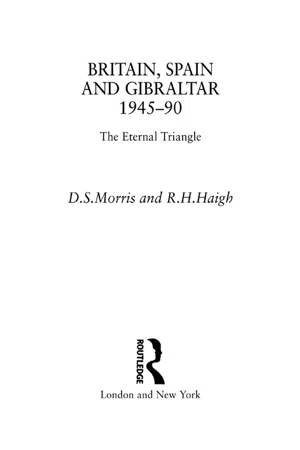
Britain, Spain and Gibraltar 1945-1990
The Eternal Triangle
- 192 pages
- English
- ePUB (mobile friendly)
- Available on iOS & Android
eBook - ePub
About this book
Since 1945 Gibraltar's sovereignty has repeatedly been questioned. A strategic possession overlooking Africa at the mouth of the Mediterranean, Gibraltar is the victim of both history and geography and continues to be the barometer of Anglo-Spanish relations. Arguing that Gibraltar has played a much more proactive role in negotiations than is assumed, the book describes the objectives and actions of the Gibraltarians against the wider map of Anglo-Spanish relations.
1
THE AWAKENING PROBLEM
Even before the Second World War reached its conclusion there was an acceptance in Britain that the pre-war relationship that had existed between the mother country and her empire could not be re-established on its old basis and according to its previous tenets. New links would have to be forged to accommodate the new circumstances which global conflict, on a previously unheralded scale, had occasioned. The magnitude of change— political, social and economic—resulting from the second major conflagration of the twentieth century necessitated the granting of political advancement to territories which still lay under British colonial administration. Gibraltar was not to prove an exception to this general trend and on 29 December 1944 constitutional changes affecting the Colony were announced.1
For Gibraltar, constitutional changes could be viewed as reward for the part played by the Colony throughout the wartime years. A bastion guarding the Atlantic approaches to the Mediterranean Sea, the Colony had been a key factor in both the North African and Italian campaigns. Increased autonomy constituted not only recognition of that contribution but also served as recompense to the citizens of Gibraltar for the suffering they had endured between 1939 and 1945. The fortress nature of Gibraltar, allied to its strategic position, had made necessary the introduction of a compulsory evacuation programme for its non-service personnel. The programme began in the late spring of 1940 and involved the evacuation of some 15,000 civilians, mainly women and children, who were despatched to such disparate destinations as the United Kingdom, Madeira, Jamaica and Tangier.2
By April 1944 the majority of the evacuees had returned home but a sizeable minority remained overseas and a demonstration calling for a hastening of the repatriation process took place. On 25 February 1945, Mrs Horsburgh, Parliamentary Secretary, Ministry of Health, told the House of Commons that 5,800 of the Gibraltarian evacuees were still in the United Kingdom and that their departure for home was being delayed by a lack of shipping and a shortage of housing accommodation in Gibraltar. This minority group had initially been evacuated to the London area but had been relocated to reception camps in Northern Ireland when the capital came under attack from V-bombs.3 Indeed, as the war ended, the delays to the repatriation programme seemed to suggest that the relationship between Gibraltar and Britain was more acrimonious than the relationship between Gibraltar and Spain.
Although Britain had emerged victorious from the Second World War she had been much weakened, industrially, commercially and economically by her exertions, and her former political eminence as a world power of the first order was reduced still further by the growing international ascendancy of two of her wartime allies: the United States and the Soviet Union. Demands for increasing political independence from her colonial possessions seemed certain to ensure that Britain would have to seek a new role in world affairs; a role which would, from necessity and expediency, lack the grandeur of earlier decades.4
Nevertheless, Phillip Dennis expresses the view that:
At the end of World War II the Rock seemed more British than ever before…and the idea that Spain might even consider claiming sovereignty over Gibraltar was far removed from anybody’s thoughts in Britain.5
Such a conclusion, however, depends for its validity more on an assessment of Spanish weakness than from an assessment of British self-confidence; a weakness originating in the turmoil of civil war6 and compounded by Spain’s relative international isolation in the immediate post-1945 years. Spain’s exclusion from the community of nations was itself a consequence of her non-belligerent but proAxis orientation during the Second World War and her form of governance: a military dictatorship much out of keeping with the spirit of increased democratisation which was high on the agenda of post-war international political life.7
Medhurst offers a pertinent summary of Spain’s situation with the return of peace:
During the 1940’s the central issue in Spanish politics was the Regime’s survival. Its defeated enemies were in no position to fight back but they hoped that a combination of international pressures and internal divisions would provoke a collapse. Abroad the regime’s reputation was mortgaged because of its links with the Axis powers…. After 1945, therefore, Spain was subjected to diplomatic isolation and economic blockade.8
Paradoxically, those international pressures which might have served to engender political change in Spain enabled Franco to portray himself as a symbol of Spanish national interest in the face of external hostility and thus to consolidate his position, and the regime which he had founded, at a time when it appeared to be most vulnerable to internal divisions and factionalism.9
The growing intensity of Cold War antagonisms between East and West in the late 1940s and into the 1950s served to lessen the hostility felt towards Spain by the democratic members of the international community. As Medhurst notes:
Such developments signalled an end to Spain’s isolation. At home they killed any doubts about the regime’s durability and respectability. In the 1950s few continued to expect a quick collapse.10
Spain’s first readily discernible step away from international isolation and back into the community of nations came with the signing by the Spanish Foreign Minister, Señor Martin Artajo, and the US Ambassador, Mr James Dunn, in Madrid on 27 September 1953, of three bilateral agreements between the United States and Spain which provided for the construction and use of military bases in Spain by the USA, US economic assistance to Spain, and US military supplies to Spain. Washington stressed that these agreements were executive agreements and not a treaty of alliance requiring Senate approval.11
No official details were given as to the locations of the US bases on Spanish soil but press reports in America contained speculation that initially airfields near Madrid, Barcelona and Seville and naval bases at Coruna, Cadiz and Cartagena were likely to be utilised. Work on the bases was to begin immediately with monies drawn from special funds made available by the US Defense Department for the construction of overseas installations.
Although the three bilateral agreements between the US and Spain did not require approval from the American Senate they, nevertheless, received warm support from several leading Senators. However, less enthusiasm was afforded the agreements by certain sections of the American press. In particular, the New York Times exhibited some trepidation when it commented:
We are now faced with the necessity of swallowing a bitter pill —the military agreement with Franco Spain. Let us all hope that the medicine will do more good than harm.12
Not surprisingly, Franco expressed no such reservations and in a message to the Cortes, on 30 September, he hailed the agreements as ‘the most important achievement of our contemporary foreign policy’. Arguing that Spain, from the time of the civil war, had been the only European nation to consistently warn of the danger of communism, Franco conceded that during and after the Second World War, Spain had appeared to be alone in pointing to the prospect of communist expansion and that this had led to her isolation from the mainstream of European political life because ‘of the blindness with which our aims were received’. Confronted by the ‘persistent hostility and incomprehension of the European Powers’ Spain had orientated herself towards the more perceptive and receptive United States. Pointing to the fact that Soviet communism would not cease its expansion at the Spanish frontier, Franco contended that the agreements signed with the US would produce the external collaboration necessary for Spain to prepare her defences, without implying that she was dependent on other nations to defend her, whilst at the same time consolidating the strategic unity of the Iberian Peninsula which had been initiated with the signing of the 1939 Treaty of Friendship and Non-aggression with Portugal.13
The agreement was described in Paris by a spokesman for the Quai d’Orsay as a ‘purely Spanish-American affair’ before adding that the French Government had been kept informed of the negotiations by the United States. In London, there was no comment from official sources but The Times pointed to some of the wider implications of the agreement:
The European members of NATO are bound to be affected by this direct and close military agreement between the leading member of the alliance and a country of great strategic concern to all members alike. All of Spain’s neighbours are within the Treaty; the seas around her are covered by NATO commands … The objections likely to be heard will be mainly political … The ground for this agreement is military necessity…it is not the first time that a military necessity has been regretted by many on other grounds.14
In Moscow there was condemnation of the agreement which was described as ‘an open military alliance between the USA and Franco Spain’ and as ‘an attempt on the part of the USA to bind Franco Spain de facto, if not de jure, to the war bloc in Europe’.
A direct consequence of this eradication of internal and external pressure upon the Franco regime was a growth in the regime’s selfconfidence and self-assertiveness and one aspect of this new found vigour was seen in the renewal of Spanish claims to Gibraltar.
Following her coronation in June 1953, Queen Elizabeth, accompanied by the Duke of Edinburgh, embarked on a six-month Commonwealth tour in the autumn which was to culminate in a visit to Gibraltar on 10–11 May 1954. On 17 January the British Foreign Office revealed that five days earlier the Spanish Ambassador in London, the Duke de Primo de Rivera, had called on the Foreign Secretary, Mr Anthony Eden, and requested that the Queen’s projected visit to Gibraltar be cancelled. The Ambassador had been informed that the British Government could not countenance representations from a foreign power regarding visits made by Her Majesty to any of her territories.
Two days after the disclosure in London of the meeting between the Spanish Ambassador and the British Foreign Secretary, the Spanish Foreign Ministry, in Madrid, issued a statement about that meeting in which it was pointed out that the Duke de Primo de Rivera had indicated the ‘resentment’ felt by the Spanish people that ‘the fortress of Gibraltar’ had been included in the itinerary of the Queen’s Commonwealth tour and had intimated that such an event would be ‘imprudent’, that it might have an adverse effect on Anglo-Spanish relations, and that it would inevitably call forth a ‘national protest’ from the Spanish people given that ‘Gibraltar is Spanish territory to which the Spanish people do not renounce their claim’.
Such a statement proved to have all of the weight of a self-fulfilling prophecy as widespread anti-British demonstrations by Spanish university students took place on 22 and 25 January in several cities including Barcelona, Cordoba, Granada, Madrid and Seville.
In Barcelona several hundred students staged anti-British demonstrations during the course of which windows were smashed at the British Consulate and British Institute. In Cordoba, students paraded through the streets demanding that Gibraltar be returned to Spain while in Granada windows were broken at the British Vice Consulate and the Spanish flag was raised over the building. The most serious disturbances were reserved for Madrid where, on 22 January several thousand students carrying Spanish and Falangist flags demonstrated outside the British Embassy and smashed windows before being dispersed by police. A second, and more violent demonstration, took place three days later in Madrid when a crowd, estimated at 30,000, repeatedly charged and stoned a strong police presence protecting the British Embassy. The police retaliated by firing blank cartridges into the air and by launching a series of baton charges which left 30 demonstrators and 18 policemen injured and in need of hospital treatment. A number of arrests were also made. During the demonstrations anti-British slogans were chanted, demands made for the return of Gibraltar to Spain, Falangist Party songs sung and banners advising, ‘Cuidado, Reina Isabel’ were prominently displayed. In Seville, a crowd of some 3000 students threw oranges at the British Consulate and cried, ‘Franco, Franco. We want Gibraltar’.
Sir John Balfour, the British Ambassador in Madrid, lodged two strong protests with the Spanish Government over the demonstrations and damage done to British property, without receiving a reply. However, the Spanish Government did issue a statement on 28 January saying that the Madrid demonstrations had been initially inspired by ‘high patriotic motives’ but had led to ‘distressing incidents which are deplored by all’. The statement went on to say that inquiries were being undertaken to establish the facts and where responsibility for the riots lay but that it was already clear that ‘extraneous elements…had mixed with the students with the aim of spoiling their noble intentions’. On the same day the British Admiralty announced in London that the Home Fleet had cancelled visits to have been made by some naval units, in the spring, to Spanish and Spanish Moroccan ports. Plans for the Queen’s visit to Gibraltar remained unchanged.
However, extensive security precautions were taken in Gibraltar for the royal visit in view of the Spanish request that it be cancelled and in the wake of the anti-British demonstrations. On 1 May the Spanish Consulate in the Colony was closed. The reason for this decision was given as being that the volume of business transacted no longer justified its retention, but other reasons were also suggested, among these being that in the circumstances it would be impossible for the Spanish Consul to attend official functions or fly the Spanish flag over the Consulate during the Queen’s visit. On 7 May all of the 12,000 Spanish workers who daily crossed the frontier to work in Gibraltar were subjected to a thorough documentation check and a personal search, and during the two days of the Queen’s visit no exit permits were issued by the Spanish authorities except at the request of the Gibraltarian authorities. Those who were allowed to enter the Colony from Spain, chiefly hotel workers and those engaged in essential public service, were not permitted to return to Spain until after the royal party had left Gibraltar.
By the mid-1950s, therefore, Gibraltar had clearly become an issue on the Anglo-Spanish agenda but it was an issue which neither party to the relationship seemed over-anxious to pursue. Britain was clearly content to maintain the status quo over Gibraltar whilst Spain confronted economic problems which increasingly came to the forefront of her domestic political debate. As Medhurst notes:
international circumstances and the regime’s revivalist temper impelled (Spain) to adopt a policy of autarchy…requiring massive state intervention. The economy’s basic structure, however, remained unchanged, and when…there was a measure of economic recovery, its basic weaknesses became apparent.15
Autarchy, the subject of criticism in Spanish business and academic circles, was increasingly replaced after 1957 by economic management being placed in the hands of technocrats charged with a relaxation of state controls and improvements in overseas trade as a means of attaining economic growth.
In 1958, the limitations of this ‘new’ approach had also become apparent and a full-scale deflationary and ‘stabilisation’ programme was launched.
This marked the start of Spain’s full acceptance into the international financial and t...
Table of contents
- COVER PAGE
- TITLE PAGE
- COPYRIGHT PAGE
- FOREWORD
- ACKNOWLEDGEMENTS
- 1 THE AWAKENING PROBLEM
- 2 THE PROBLEM GROWS
- 3 A DEEPENING PROBLEM
- 4 NO SOLUTION IN SIGHT
- 5 CONTINUING GLOOM
- 6 A GLIMMER OF HOPE
- 7 HOPE IS SUCCOURED
- 8 SIGNS OF PROGRESS
- 9 OTHER PRIORITIES
- 10 HOPE RENEWED
- 11 PARTIAL RESOLUTION
- 12 AN EYE TO THE FUTURE
- NOTES
Trusted by 375,005 students
Access to over 1.5 million titles for a fair monthly price.
Study more efficiently using our study tools.
Frequently asked questions
Yes, you can cancel anytime from the Subscription tab in your account settings on the Perlego website. Your subscription will stay active until the end of your current billing period. Learn how to cancel your subscription
No, books cannot be downloaded as external files, such as PDFs, for use outside of Perlego. However, you can download books within the Perlego app for offline reading on mobile or tablet. Learn how to download books offline
Perlego offers two plans: Essential and Complete
- Essential is ideal for learners and professionals who enjoy exploring a wide range of subjects. Access the Essential Library with 800,000+ trusted titles and best-sellers across business, personal growth, and the humanities. Includes unlimited reading time and Standard Read Aloud voice.
- Complete: Perfect for advanced learners and researchers needing full, unrestricted access. Unlock 1.5M+ books across hundreds of subjects, including academic and specialized titles. The Complete Plan also includes advanced features like Premium Read Aloud and Research Assistant.
We are an online textbook subscription service, where you can get access to an entire online library for less than the price of a single book per month. With over 1.5 million books across 990+ topics, we’ve got you covered! Learn about our mission
Look out for the read-aloud symbol on your next book to see if you can listen to it. The read-aloud tool reads text aloud for you, highlighting the text as it is being read. You can pause it, speed it up and slow it down. Learn more about Read Aloud
Yes! You can use the Perlego app on both iOS and Android devices to read anytime, anywhere — even offline. Perfect for commutes or when you’re on the go.
Please note we cannot support devices running on iOS 13 and Android 7 or earlier. Learn more about using the app
Please note we cannot support devices running on iOS 13 and Android 7 or earlier. Learn more about using the app
Yes, you can access Britain, Spain and Gibraltar 1945-1990 by R. H. Haigh,D S Morris,D. S. Morris in PDF and/or ePUB format, as well as other popular books in Physical Sciences & Geography. We have over 1.5 million books available in our catalogue for you to explore.