eBook - ePub
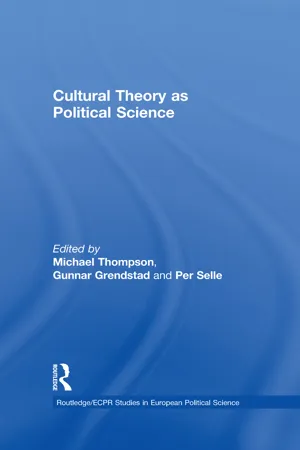
Cultural Theory as Political Science
- 272 pages
- English
- ePUB (mobile friendly)
- Available on iOS & Android
eBook - ePub
Cultural Theory as Political Science
About this book
This is the first major European political science book to discuss the growing interdisciplinary field of 'cultural theory', proposing a coherent and viable alternative to mainstream political science. The authors argue that three elements - social relations, cultural bias and behavioural strategy - illuminate political questions at a level of analysis on any scale: from the household to the state; the international regime to the political party.
Information
1
Cultural Theory as Political Science
Michael Thompson, Gunnar Grendstad and Per Selle
The boundary line between the political and the non-political, Cultural Theorists point out, is not self-evident; it is socially constructed. And, since some people are busily constructing that line in one way and others in different ways, its position is always in dispute. This is no trivial quibble. Indeed it is difficult to imagine what could be more political than getting everyone to agree to your drawing of that line (which, of course, is what those who are gathered around each of these contending positions are all the time trying to do).
Of course, it can be objected that to abandon the insistence on a single, self-evident line between the political and the non-political is to open the floodgates of an unconstrained relativism in which there are as many rival drawings of the line as there are people in the polity. This would indeed be the case, were it not for the fact that culture has to do with values and beliefs that are shared. Since it takes at least two people to share something, the relativism is inevitably constrained, and this means that we can attempt to make sense of this messy state of affairs by teasing out the various drawings of the line in terms of these constraints. That essentially, is what Cultural Theory does; and, in doing this, it shows us how the relativism-rejectors, in excluding 'the politics of the political', have given away something important that rightfully belongs to political science.
Cultural Theory's focus is on the various ways in which we bind ourselves to one another - social solidarities — integral to each of which, it argues, is a distinctive patterning of beliefs and values: a distinctive cultural bias. Cultural Theory's typology of cultural biases then allows us to go 'inside' any of the social units (nations, firms, churches and so on) that are conventionally characterised in terms of their distinctive cultures. Where the conventional approach zooms in on the cultural particularities that make the French different from the Germans, or Toyota different from Renault, or Protestants different from Catholics, Cultural Theorists begin by looking for the different biases that each of the contending forms of social solidarity, within each of these social units, imparts to that social unit's distinctive culture. These social solidarities (five in all - we will explain them in a moment) will be found, according to Cultural Theory, in differing proportions and patterns of interaction, in each of these culturally unique social units. In other words, the solidarities are universal; they take us beyond the particularities of each social unit, in much the same way that scientists, once they had gone 'inside' the atom, were able to understand the differences between the elements in terms of the different numbers of electrons, protons and neutrons that each is comprised of, and the various orbits into which those few varieties of fundamental particle arrange themselves. Before that, all they had were 90 or so atoms, each of which was different from the others, and no way of understanding why and how they were different.
Without universals our explanations, no matter how impressively we may dress them up, are trapped in a distressingly small circle: the Chinese behave the way they do because they're Chinese! Likewise for all the other social units. And if we have no way of going inside the social units we study then we cannot avoid the idea that the French are pretty much all the same and different from the Germans, who are also pretty much all the same, and so on. This, as students of political culture now know, is simply not the case.
There is not a British civil culture, nor a German, French or Italian one. The differences among countries are differences in degree, not of kind, differences of a few percentage points. The differences within nations appear greater than the differences among nations. There are more similarities in the beliefs of a French and German social democrat than between a French socialist and a French conservative or between a German social democrat and a German Christian democrat.
(Dogan 1988: 2-3)
So Cultural Theory provides a conceptual framework that comports with, rather than contradicts, the empirical evidence.1 That, you could say, is its most immediate and practical contribution. And, in embracing social constructivism without at the same time spiralling away into totally unconstrained relativism, it allows us not to draw a single, self-evident line between the political and the non-political. This is a deeper and, on the face of it, less practical contribution. Appearances, however, can be deceptive and, in this case, they are! In allowing us to confront and analyse the endless process of contention between the different drawings of the line, Cultural Theory puts the politics of the political back where it belongs: at the very centre of political science.
The underlying theory
The basic argument is that beneath all the particularities - the luxuriant diversity of human customs and languages - there are just five viable forms of social solidarity, all of which will be found, in varying strengths and patterns of interaction, in any social system. This is Cultural Theory's impossibility theorem (stated in Thompson, Ellis and Wildavsky [1990] and proved, it transpired, some ten years earlier by Schmutzer and Bandler [1980, also see Schmutzer 1994]) and it provides the bold, explicit and rigorous foundation that supports the entire enterprise.2 However, there is, as they say, more than one way to skin a rabbit, and Mary Douglas (the founding mother of it all) has taken a more practical course that does not concern itself too much with high-flown theorising and concentrates on the application of a heuristic device: 'grid-group analysis'. Grid and group - her two 'dimensions of sociality' - give a fourfold typology of solidarities: individualism, hierarchy, fatalism and egalitarianism (with the fifth one - autonomy, exemplified by the hermit - being acknowledged but 'taken off the social map').3 Most applications of Cultural Theory have relied on this grid-group analytical scheme, and together they have now built an impressive case for it to be taken seriously.
That it works, however, raises the question of why it works, and it is in this way that the practical business of applying an analytical scheme eventually leads to the need for an explicit theory. Since this logical sequence also roughly matches the historical development of Cultural Theory, we will follow it here: first showing how it works and then showing why it works.
Grid-group analysis, as originally propounded (Douglas 1978), is a way of classifying an individual's social context: the way in which he or she is caught up in the process of social life. Whether or not an individual can be caught up in a number of different ways in different parts of his or her life — that is, can be a vital component in more than one form of solidarity - was not of much concern to begin with. The focus was much more practical: to understand policy debates (for instance, over nuclear power, environmental clean-up, the siting of hazardous facilities, and keeping the world supplied with energy4) in which people (to the dismay of the proponents of incrementalism, who have to assume that there is an agreed base) are clearly arguing from different premises and, what is more, showing no tendency to converge towards consensus as the debate progresses.
The idea is to go into some specific setting - the handling of radioactive material in a Boston hospital is a nice example (Rayner 1986) - and use the analytical scheme to sort out the various actors according to how grouped and gridded they are. Of course, dimensions (which are continuous) are not really a valid way of distinguishing between social solidarities (which are discontinuous patterns of beliefs, transactions and decisions) but the practical point is that, if the patterns are there, these dimensions will sort them out for us.5 It is in this spirit - a rough-and-ready way of taking a first cut at these crucial social discontinuities — that grid and group should be entertained, even though we can also discern much of the underlying theory in Douglas' characterisation of the four solidarities that her analytical scheme captures (especially in her How Institutions Think (1987) which, she explained with disarming candour, was the book she should have written first, before all the others (1978, 1982b, 1985, and [with A. Wildavsky] 1982) that those who were eager to understand Cultural Theory had been digesting for the past 15 or so years).
The group dimension, Douglas explains, taps the extent to which 'the individual's life is absorbed in and sustained by group membership'. A lower group score would be given to an individual who 'spends the morning in one group, the evening in another, appears on Sundays in a third, gets his livelihood in a fourth' (Douglas 1982b: 202), than to a person (an Amish, say) who joins with others in 'common residence, shared work, shared resources and recreation' (ibid: 192). Lowest score of all would go to the person who took care to avoid all group involvement, in the manner of Groucho Marx who wouldn't join any club that would have him as a member.
Though the grid dimension is less familiar to social scientists, the concept it denotes is not; it is much the same as Durkheim's notion of 'regulation' (Durkheim 1951: ch. 5). A high grid (that is, a highly regulated) social context is characterised by 'an explicit set of institutionalised classifications that keeps individuals apart and regulates their interactions' (Douglas 1982b: 203). In such a setting, 'male does not compete in female spheres, and sons do not define their relations with fathers' (ibid: 192). As one moves down-grid, individuals are increasingly expected to negotiate their own relationships with others.
- Strong group involvement coupled with minimal regulation produce social relations that are egalitarian. With everyone transacting symmetrically with everyone else, and no one transacting with the wider world, there can be no internal authority structure. All the structure is in the group's boundary: the 'wall of virtue', as it has been called, that separates the caring and vulnerable 'us' from the harsh and rapacious 'them'. Witch-hunting and schism are endemic in the egalitarian solidarity, because individuals can exercise control over one another only by claiming to speak in the name of the group: a claim that is supported only in those situations where everyone gives their support to a decision. Active participation, with decisions based on the direct consent of everyone, is the only basis for legitimacy.
- When an individual's social environment is characterised by strong group boundaries and binding prescriptions (high grid) the resulting solidarity is hierarchical. Individuals are subject both to the control of their fellows and the demands of socially imposed roles. In contrast to egalitarianism, which has few means short of expulsion for controlling its members, hierarchy 'has an armoury of different solutions to internal conflicts, including upgrading, shifting sideways, downgrading, resegregating, redefining' (Douglas 1982b: 206). The exercise of authority, and inequality more generally, is justified on the grounds that different roles for different people enable them all to live together more harmoniously than do alternative arrangements.
- People who are bound neither by group incorporation nor prescribed roles constitute an individualistic solidarity. In such an environment all boundaries are provisional and subject to negotiation. Although the individualist is, by definition, relatively free from control by others, that does not mean that he or she is not engaged in exerting control over others. On the contrary, the individualist's success is often measured by the size of the following commanded.
- A person who finds himself or herself subject to binding prescriptions and excluded from group membership is a constituent of the fatalistic solidarity. The fatalist, like the hierarchist, may have few options, having little choice about how he/she spends his/her time, with whom he/she associates, what he/she wears or eats, where he/she lives and works. Unlike the hierarchist, however, the fatalist is excluded from membership of the solidarities that are responsible for making the decisions that rule his or her life.
These four solidarities that are captured by the grid-group analytical scheme possess the dual advantage of holding onto the best in previous research, thus cumulating findings, while opening up relatively unexplored, but important, avenues of cultural expression and social cohesion. Any approach to social solidarity must be able to account for the two modes of organising - hierarchies and markets - that dominate social science theories (Lindblom 1977, for instance, and Williamson 1975, but also, in various guises, the 'masters': see Part II of Thompson, Ellis and Wildavsky 1990). Sensing that there may be more than hierarchies and markets, some theorists occasionally mention 'clans' (Ouichi 1980) or 'clubs' (Williamson 1975) or 'collegiums' (Majone 1986), and others speak of 'alienation', 'marginalisation', 'dependencia' and 'social exclusion' (for an overview see O'Riordan et al. 1998: 362) but only the grid-group scheme captures the egalitarian and fatalistic solidarities with the same parsimonious dimensions that also capture the more familiar hierarchy and individualism.6
So the grid-group analytical scheme is certainly intriguing from the theoretical perspective, nor does it tail off when we come to its applications. A scheme that can clarify and re-order fields as varied as workplace crime (Mars 1982), household consumption styles (Dake and Thompson 1993; Mars and Mars 1993), environmental concern (Grendstad and Selle 1997; Ellis and F. Thompson 1997b), fanaticism (Lockhart 1997b), the world's energy futures (Schwarz and Thompson 1990), technological risk (Douglas and Wildavsky 1982; Wildavsky and Dake 1990), the definition of rigour in mathematics (Bloor 1982), Himalayan deforestation (Thompson, Warburton and Hatley 1986), the siting of liquefied natural gas terminals (Kunreuther et al 1983), cognitive styles in geology (Rudwick 1982), the different ways of being poor (Thompson and Wildavsky 1986a), the Salem witchcraft trials (Owen 1982), changing definitions of rape and of altruism (Wildavsky 1993b), the translation of the earliest known Chinese texts (McLeod 1982), attitudes towards silt in the Indian state of Bihar (Dixit 1997) and global climate change (Rayner and Malone 1998a,b, especially vol. 1), to which, of course, can be added the applications set out in this volume, deserves a second glance.
A second glance from whom? From sociologists, economists, environmental scientists, security experts, engineers, policy analysts, mathematicians, foresters, risk assessors, geologists, social workers, jurists, game theorists, historians of China in the first millennium BC, [...] geomorphologists and climatologists? The list, it would seem, can be as long (and as transdisciplinary) as we care to make it, but, in every instance, the light that is being shone on these gloriously varied subjects is a political science light. Each time, the clarification and re-ordering stems from the ability of this analytical scheme to sort out the different ways in which crucial dividing lines are drawn: between acceptable and unacceptable risks, between silt that is wanted and silt that is not wanted, between fact and conjecture ('I wouldn't have seen it', as geologists ruefully admit, 'if I hadn't believed it'), between the deserving and the undeserving, between order and disorder, between glaring anomaly and judicious adjustment, between 'yes' and 'no', between insisting that someone is to blame and agreeing that it is no one's fault, between credible and incredible ..., on and on. Drawing a line in such a way that it supports your solidarity, and then defending that particular drawing of the line against other drawings that appear so reasonable (self-evident, even) to the members of other solidarities, is the very stuff of politics. Yet it is all too often ignored, with all the attention being focused on how people set about getting the different things they want and no one asking why it is that different people want different things. To say that 'People act in their interests' is to say very little. It be...
Table of contents
- Cover Page
- Half Title Page
- Title Page
- Copyright Page
- Contents
- List of tables
- List of figures
- List of contributors
- Series editor's preface
- Preface
- 1 Cultural Theory as Political Science
- Part 1 Preferences
- Part 2 Organisations
- Part 3 Political Cultures
- Part 4 Democracies
- Bibliography
- Index
Trusted by 375,005 students
Access to over 1.5 million titles for a fair monthly price.
Study more efficiently using our study tools.
Frequently asked questions
Yes, you can cancel anytime from the Subscription tab in your account settings on the Perlego website. Your subscription will stay active until the end of your current billing period. Learn how to cancel your subscription
No, books cannot be downloaded as external files, such as PDFs, for use outside of Perlego. However, you can download books within the Perlego app for offline reading on mobile or tablet. Learn how to download books offline
Perlego offers two plans: Essential and Complete
- Essential is ideal for learners and professionals who enjoy exploring a wide range of subjects. Access the Essential Library with 800,000+ trusted titles and best-sellers across business, personal growth, and the humanities. Includes unlimited reading time and Standard Read Aloud voice.
- Complete: Perfect for advanced learners and researchers needing full, unrestricted access. Unlock 1.5M+ books across hundreds of subjects, including academic and specialized titles. The Complete Plan also includes advanced features like Premium Read Aloud and Research Assistant.
We are an online textbook subscription service, where you can get access to an entire online library for less than the price of a single book per month. With over 1.5 million books across 990+ topics, we’ve got you covered! Learn about our mission
Look out for the read-aloud symbol on your next book to see if you can listen to it. The read-aloud tool reads text aloud for you, highlighting the text as it is being read. You can pause it, speed it up and slow it down. Learn more about Read Aloud
Yes! You can use the Perlego app on both iOS and Android devices to read anytime, anywhere — even offline. Perfect for commutes or when you’re on the go.
Please note we cannot support devices running on iOS 13 and Android 7 or earlier. Learn more about using the app
Please note we cannot support devices running on iOS 13 and Android 7 or earlier. Learn more about using the app
Yes, you can access Cultural Theory as Political Science by Gunnar Grendstad, Per Selle, Michael Thompson, Gunnar Grendstad,Per Selle,Michael Thompson in PDF and/or ePUB format, as well as other popular books in Politics & International Relations & Politics. We have over 1.5 million books available in our catalogue for you to explore.