Archaeology and Language I represents groundbreaking work in synthesizing two disciplines that are now seen as interlinked: linguistics and archaeology. This volume is the first of a three-part survey of innovative results emerging from their combination.
Archaeology and historical linguistics have largely pursued separate tracks until recently, although their goals can be very similar. While there is a new awareness that these disciplines can be used to complement one another, both rigorous methodological awareness and detailed case-studies are still lacking in literature. Archaeology and Language I aims to fill this lacuna.
Exploring a wide range of techniques developed by specialists in each discipline, this first volume deals with broad theoretical and methodological issues and provides an indispensable background to the detail of the studies presented in volumes II and III. This collection deals with the controversial question of the origin of language, the validity of deep-level reconstruction, the sociolinguistic modelling of prehistory and the use and value of oral tradition.
eBook - ePub
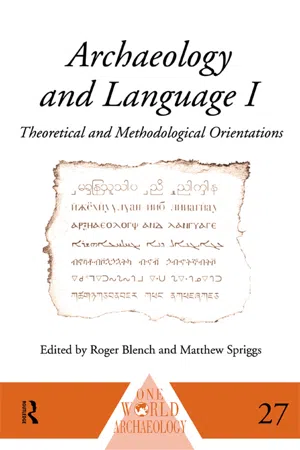
Archaeology and Language I
Theoretical and Methodological Orientations
- 320 pages
- English
- ePUB (mobile friendly)
- Available on iOS & Android
eBook - ePub
Archaeology and Language I
Theoretical and Methodological Orientations
About this book
Information
Part I
PREHISTORY OF LANGUAGE
1 Evolution and the biological correlates of linguistic features
BERNARD H.BICHAKJIAN
INTRODUCTION
Though basic intelligence and average insight applied to readily observed data would be enough to make logical deductions, stimulate research, and seek ever-deeper understanding of underlying processes, the human mind, instead, has much too often taken perverse pleasure in referring to higher motives to deny what is obvious and impair the search for valid explanations (cf. Gross and Levitt 1994:24 passim). That the study of evolution and the scholars who have conducted it have suffered—metaphorically and literally—from such an attitude hardly needs to be stated. But, however sad they may have been, those sufferings have been consigned to history, and today evolution is accepted by all serious thinkers.
What is generally accepted, however, is the evolution of species. The evolution of behaviour is certainly finding a growing number of new advocates, who deserve credit for having succeeded in reopening the nature—nurture debate. Future data and debate in the neurosciences will tell whether their conception of nature is the right one. In mainstream linguistics, evolution is simply taboo—species evolve, behaviour has perhaps an evolutionary background, but it is adamantly maintained, no doubt for ‘higher motives’, that languages do not evolve (Bichakjian 1993). The situation is comparable with the one denounced by Richard M.Restak, who reminds his reader that
even as recently as the late 1960s…psychiatry—certainly American psychiatry—was heavily committed to the idea that mental illness resulted from psychological causes. Those few psychiatrists and psychiatric trainees who suggested that much mental illness might have physical causes…were invited to pursue other specialty interests.
(Restak 1994:73)
Superficially, Chomsky's innate model seems to conform with the alternative approach that Restak is advocating, but in fact the MIT model is strongly relativist. It remains so in Pinker and Bloom's (1990) recent variant, where it is argued that the alleged DNA correlates of the would-be Universal Grammar have developed according to Darwinian principles (Paul Bloom, however, is not opposed to the idea of language evolution, while Steven Pinker remains adamantly relativist [pers. comm.]).
The application of evolutionary principles to linguistics is a welcome step, but it remains to be seen whether the newly proposed scenario can be supported with empirical data and methodological arguments. This chapter will point out that such support is lacking and that the MIT model is totally untenable. Instead, it will be argued:
- that the history of languages displays important unidirectional changes;
- that the study of the neurological interface of outgoing and incoming linguistic features reveals an optimization process; and
- that this optimization process is produced by the biological mechanisms that are also responsible for the physical and ethological evolution of our species.
THE UNTENABLE SCENARIO
While Chomsky had always maintained that the genetic correlates of his innate grammar had no specific phylogenetic history, Pinker and Bloom (1990) argued that the alleged DNA material had developed in interaction with grammar-related selection pressures. Though it is legitimate for Pinker and Bloom to oppose their scenario to Chomsky's, on close scrutiny their claim amounts to no more than the tautological explanation of an assumption. If syntactic structures are indeed coded in our genes, then, given the importance of language for humans, it is tautological to say that they have developed through the interplay of genetic variations and selection pressures since the Synthetic Theory has long taught us that that is how permanent features are acquired. The essential question is whether our genome does indeed code for linguistic structures, and the only objective answer is that no empirical evidence has been found to substantiate such an assumption.
From their vantage point, linguists would have been in a strong position if they could have shown that some syntactic structures are universal. Though the gap between universality and genetic coding would still remain to be bridged, the pan-linguistic occurrence of certain structural patterns would have consolidated the claim. Unfortunately, after an intensive search by an unprecedented number of linguists over nearly four decades, universality remains frustratingly elusive. Not only do some languages have structures branching out to the right while others pattern in the opposite direction, not only do some use tense while others make aspectual distinctions, but the basic structure of a sentence is not universal: languages using nominative syntax have developed subject and object functions and make sentences that are statements about the subject, while the ergative languages, where the grammatical functions have remained close to their cognitive ancestry, are structured in terms of agents and patients and produce sentences that are statements about the patient, since the latter, and not the agent, is the unmarked item.
Of course, one could always conceive abstract structures of which the existing linguistic sequences would be presumed to be the concrete implementations, just as one could imagine a universal limb underlying fins, wings, and arms, but these are mental constructs. The universal limb does not exist, and no species has such a universal code in its genes. If they have limbs, species have an evolutionary variant of the primitive model. Likewise, universal structures do not exist, languages have supplanted the ancestral model with evermore developed alternatives.
If linguistic structures were coded in our genes, the corresponding DNA sequences would trigger the formation of a neural network and thus provide humans with language areas of the brain that would be partially prewired. Since there are no universal grammatical structures, nor even universal grammatical constraints (cf. Bichakjian 1989), the linguistic data do not suggest such a hypothesis; indeed they plead against it. Even a would-be supporter of the innateness theory feels ‘a mismatch between the broad exciting aims of U[niversal] G[rammar] and the triviality of some of the details’; he denounces ‘the theory['s being]…obsessively concerned with [only] certain areas of [syntax]’ and the use of ‘potentially misleading’ ‘sentences and constructions [that] self-perpetuate themselves in the literature’ (Cook 1988:167; see also p. 79).
But linguists are not alone in their rejection of the prewired model. The evidence is also lacking at the neurological side of the interface. That the human vocal tract has been adapted to speech and that humans have developed neurons which together are capable of producing and processing linguistic messages is of course true, but this cerebral material is a genetically coded form with a functional potential, within biological constraints (speed of articulation, range of auditory perception, memory span, etc.), not a form with linguistic functions outlined within innate grammatical constraints. Such a model with prewired linguistic instructions is emphatically rejected by Merlin Donald, who, speaking of Bickerton, asks rhetorically: ‘Does he still believe in innate categories and some form of genetically determined, built-in set of grammatical rules?’ (1993:780; see also Donald 1991:60 for a rejection of Chomsky's model). Instead, Donald suggests in humans the existence and the attendant phylogenetic development of what he calls a ‘linguistic controller’. On the model of Umberto Eco's quip that literature is a picnic where the author brings the words and the reader the interpretations, one could represent Donald's account of speech as a picnic where the genes bring the operating device and the (language-specific) words the operating instructions (1991:259–60). Since syntax can never be derived from words—for instance, what would be the lexical trigger of an ergative sentence pattern?—a picnic where genes supply the operating device, and languages (not words) bring the operating instructions would best represent the linguistic and neurological realities of speech.
Not only do the diversity of linguistic structures and the present understanding of neurological processes plead against the existence of a genetically coded Universal Grammar but the hypothesis of an emergence without further development is itself in complete contradiction to the principles of evolution. The advocates of the innate model claim that when our species appeared, or when it began to speak, the blueprint of the alleged Universal Grammar became part of our DNA and has remained static to this day. Actual implementations of the alleged innate model vary in space, and they have varied in time, but such differences are not given any significance because it is assumed that the changes are not oriented and that alternative implementation models are equally gratuitous.
If speech is the important asset that we know it is for our species, how could the linguistic implements that are needed for mental operations and communicative expression not have been subject to selection pressures? While selection pressures have produced our geographic adaptations, have driven technology from stone artefacts to space engines, and fostered our less-than-perfect, but also less-than-negligible civilizations, why would the techniques of mental representation and oral (and written) communication be immune to similar evolutionary forces? In one of the commentaries that accompanied Pinker and Bloom's 1990 paper, Bates and MacWhinney (p. 728) captured with biting humour the inadequacy of a scenario where selection pressures suddenly stop after the initial development by comparing them to anti-abortionists, who, in the words of Mario Cuomo, ‘believe that life begins at conception and stops at birth’.
Would it not be more logical to expect that in the above described picnic genes would continue to supply the operating device, while natural selection would pressure languages into bringing instructions that are evermore functional and evermore efficient? It would also be logical to wonder whether selection pressures would not have driven the genes into producing an evermore powerful operating device, but such a query cannot be answered since we will never be able to study the molecular composition of the brains of our ancestors 50–100,000 years ago and compare it to ours.
Pinker and Bloom's abortive scenario must therefore be at variance with the principles of Darwinian evolution, and since neither linguistics nor the neurosciences provide any empirical support for it, the hypothesis of a universal grammar being coded in our genes remains for the time being a gratuitous assumption. Having reached the conclusion that the innate grammar hypothesis is neither empirically founded nor theoretically tenable, this chapter will now present evidence showing that the historical record clearly displays a continuous optimization of linguistic features and argue that selection pressures, working through the recognized biological channels, have produced the evolution of languages by fostering this process.
THE HISTORICAL RECORD
When one looks at the empirical data with an open mind, the changes that are essentially unidirectional are easy to observe. I shall use examples from the Indo- European family because it provides the most representative data-bank for the study of language evolution. It has one of the longest histories; the reconstruction of its pro to-language, though always hypothetical, is based on the broadest and most intensive scholarly effort; its history is the most richly documented; and it has expanded to more geographic areas and to more populations than any other language family. This is not to say of course that other language families do not provide equally interesting or even older illustrations, but the Indo-European languages have the distinct advantage of providing the most competitively analysed and best known set of data. I shall nevertheless return to non-Indo-European languages later in this chapter.
The presentation of changes that are essentially unidirectional can be organized under the headings of the three major linguistic components: phonology, morphology, and syntax. The lexicon and the attendant field of semantics will be left out, not because they do not manifest the processes observed in the other branches of linguistics but because lexicological and semantic data are less amenable to systematic studies.
In phonology two major changes can be observed. On the vowel side, the laryngeal h-like sonorants were eliminated very early and replaced with newer vowels such as a and o, and a set of long vowels. In turn the systematic use of the long/short distinction receded and even disappeared altogether with newer vowels such as the French y, the English u (of but), or the Russian coming in their stead. The shift from the Latin to the French set of vowels provides a clear illustration of the second evolutionary step. On the consonantal side, and omitting the sonorants, the shift has been away from a set essentially made of stops with secondary and tertiary articulations to a set made of simple stops and the corresponding fricatives, with the voicing feature used to double the inventory of stops and often that of fricatives. The shift becomes clearly visible when one compares the Indo-European and French obstruents (or true consonants)—see Table 1.1.
In morphology, the Indo-European languages have known three distinct devices for forming grammatical variants. Vowel alternation, as seen in the English sing/sang/ sung, was common in the proto-language, used along with suffixation, which became increasingly dominant before yielding the way to independent particles. This is how prepositions, personal pronouns, articles, and modal and temporal auxiliaries emerged. Not only the marking strategy but also the nature of the grammatical distinctions within paradigms are subject to change. A significant one took place in the verbal paradigm, where the ancestral modo-aspectual system was reorganized into a set of distinctions where tense plays the major role (cf. Meillet 1952:xii, 29ff.). The history of the Indo-European languages also displays the development of a passive voice, which gradually replaced the earlier middle (Benveniste 1966:168). It is worth observing here that if the passive voice and the passive transformation are commonly used in English and many other modern languages, neither the verbal voice nor the corresponding transformation are a universal feature of human languages. Some have developed such a distinction and the attendant syntactic potential, others have not come so far in this particular area (cf. for example, Brettschneider 1979:381).
Table 1.1 Comparison of Indo-European and French obstruents
In syntax, a major change had taken place in the ancestral days of the proto-language, when the ergative sentence structure had been replaced with the nominative model used today by the overwhelming majority of human languages. Afterwards, and probably after the proto-language had lost its unity, the technique of embedding one sentence into another was developed, first by correlating the two elements together (as in the English As you sow, so will you reap) and later by subordinating one to the other (cf. Meillet 1964:373). The other major changes consisted of reordering the constituents of syntactic units. Modern linguistics has shown that each syntactic unit is made of two parts of which one governs the other. In the most frequently used terminology the governing item is called the head, the governee is called the modifier. Though a full consensus is still lacking on what is the head and what is the modifier, everyone will agree that verbs and prepositions are heads and their objects are modifiers. Likewise temporal and modal auxiliaries are heads an...
Table of contents
- COVER PAGE
- TITLE PAGE
- COPYRIGHT PAGE
- ONE WORLD ARCHAEOLOGY
- FIGURES
- TABLES
- CONTRIBUTORS
- PREFACE
- GENERAL INTRODUCTION
- INTRODUCTION
- PART I: PREHISTORY OF LANGUAGE
- PART II: DEEP-LEVEL LINKAGES/ HYPOTHESES
- PART III: PROBLEMS OF METHOD
- PART IV: ORAL TRADITIONS
Trusted by 375,005 students
Access to over 1.5 million titles for a fair monthly price.
Study more efficiently using our study tools.
Frequently asked questions
Yes, you can cancel anytime from the Subscription tab in your account settings on the Perlego website. Your subscription will stay active until the end of your current billing period. Learn how to cancel your subscription
No, books cannot be downloaded as external files, such as PDFs, for use outside of Perlego. However, you can download books within the Perlego app for offline reading on mobile or tablet. Learn how to download books offline
Perlego offers two plans: Essential and Complete
- Essential is ideal for learners and professionals who enjoy exploring a wide range of subjects. Access the Essential Library with 800,000+ trusted titles and best-sellers across business, personal growth, and the humanities. Includes unlimited reading time and Standard Read Aloud voice.
- Complete: Perfect for advanced learners and researchers needing full, unrestricted access. Unlock 1.5M+ books across hundreds of subjects, including academic and specialized titles. The Complete Plan also includes advanced features like Premium Read Aloud and Research Assistant.
We are an online textbook subscription service, where you can get access to an entire online library for less than the price of a single book per month. With over 1.5 million books across 990+ topics, we’ve got you covered! Learn about our mission
Look out for the read-aloud symbol on your next book to see if you can listen to it. The read-aloud tool reads text aloud for you, highlighting the text as it is being read. You can pause it, speed it up and slow it down. Learn more about Read Aloud
Yes! You can use the Perlego app on both iOS and Android devices to read anytime, anywhere — even offline. Perfect for commutes or when you’re on the go.
Please note we cannot support devices running on iOS 13 and Android 7 or earlier. Learn more about using the app
Please note we cannot support devices running on iOS 13 and Android 7 or earlier. Learn more about using the app
Yes, you can access Archaeology and Language I by Roger Blench, Matthew Spriggs, Roger Blench,Matthew Spriggs in PDF and/or ePUB format, as well as other popular books in Social Sciences & Archaeology. We have over 1.5 million books available in our catalogue for you to explore.