eBook - ePub
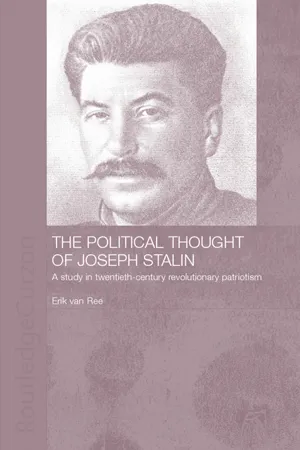
The Political Thought of Joseph Stalin
A Study in Twentieth Century Revolutionary Patriotism
- 384 pages
- English
- ePUB (mobile friendly)
- Available on iOS & Android
eBook - ePub
The Political Thought of Joseph Stalin
A Study in Twentieth Century Revolutionary Patriotism
About this book
This book presents a comprehensive analysis of the political thought of Joseph Stalin. Making full use of the documentation that has recently become available, including Stalin's private library with his handwritten margin notes, the book provides many insights on Stalin, and also on western and Russian Marxist intellectual traditions. Overall, the book argues that Stalin's political thought is not primarily indebted to the Russian autocratic tradition, but belongs to a tradition of revolutionary patriotism that stretches back through revolutionary Marxism to Jacobin thought in the French Revolution. It makes interesting comparisons between Stalin, Lenin, Bukharin and Trotsky, and explains a great deal about the mindset of those brought up in the Stalinist era, and about the era's many key problems, including the industrial revolution from above, socialist cultural policy, Soviet treatment of nationalities, pre-war and Cold War foreign policy, and the purges.
Information
1 Jacobinism
In the eighteenth century, French philosophers concluded that human society should be made all over again. It should be returned to harmony with the basic laws and principles that were inherent in nature itself, but which had unfortunately been put under a dark cloud when classical antiquity went to its ruin – or perhaps even since the dawn of mankind. The principles that had been lost and waited to be retrieved were those of reason. At some point in history, man lost sight of his own inherent rationality. He plunged himself into ignorance and darkness, and thus caused unreason to prevail.
The philosophes believed that society should be mercilessly stripped of the crust of unreason that it had allowed to grow upon its own rational essence. But reason clearly did not have its way spontaneously. If the people understood their own rationality of themselves, the tragedy of unreason would never have occurred in the first place. Reason ought to be assisted, and this is where the “Enlightenment” came in. Wise educators showed the world the road back to its lost essence. The philosophes made themselves available for the historic task of bringing liberation to the people from the obscurantist priests and kings who had led them into slavery. They showed the people the way out of this rotten “feudal” world.
Reason is a concept with many interpretations. It may have associations of either common sense or logic. Forming a contrasting pair with emotion, it always has to do with the mind in the narrow sense – the intellect. But it is not immediately clear what a “reasonable” society is. In the eighteenth century, it was believed to be one based on the twin principles of freedom and equality, but there were, again, different interpretations of these ideals. In his The Origins of Totalitarian Democracy, Talmon argued that, on account of their respective interpretations of these basic ideals, the various tendencies of Enlightenment thought could be broadly divided into two. One tendency was bound to develop into modern liberalism and the other into modern totalitarianism. This is a highly schematic division, and it should be understood as ideal-typical. But provided that that is understood, it is illuminating.
For the proto-liberals, freedom and equality turned mainly around individual rights. “Feudal” society hindered individuals in their rightful endeavours. Citizens should be endowed with equal rights and be free to do anything not violating the rights of their fellows. According to the other interpretation, reason found its home not primarily in the individual citizen but in the community as a whole. A “reasonable” society was homogeneous and unified. Instead of the chaotic “feudal” structure, in which each of the various estates had its own specific powers and privileges, it was a tightly bound, compact community in which all individuals were not only equal in rights but also renounced their own “particular interests.” The highest virtue was “virtue” itself: total dedication, denial of everything that smelled of selfishness, unreserved association of the individual citizen with the general good. According to Talmon, this interpretation carried the danger that, although all citizens had the equal right to participate in the life of the community, no one had any “particular” rights as opposed to the community.
A society built on total dedication has extraordinary features to show for. On the one hand, the citizen has no basis on which to defend his private rights. Rights are not legitimate once they conflict with the common good. But dedication means that citizens are at the same time expected to engage actively in the body politic. Not to participate means not to dedicate oneself but to withdraw behind the protective walls of one’s “particular interests.” Dedication to the common good means ideally that citizens unite with their fellows in all respects – in deed, in word and even in thought. In this state, community of purpose and community of action are among the most respected values. It is a strongly integrated society, pervaded by an atmosphere of active participation of the whole citizenry. The principle of equality in its “totalitarian” interpretation is not primarily an equality of rights but an equality of sacrifice and effort.
According to Talmon, the godfather of “totalitarian democracy” was Jean-Jacques Rousseau. The latter proceeded from a concept of total and indivisible popular sovereignty. He was driven by fear of any articulation of “particular interests” that might put itself up against the collective of the people. His teaching was at once ultra-democratic and dictatorial. On the one hand, Rousseau believed that in a system of representative democracy the delegates of the people inevitably developed into a particular interest group. Therefore the people should not allow themselves to be represented. The state should consist of assemblies of the people – pure self-government with popular participation developed to a maximum. But in this direct democracy, the individual rights of citizens were also a dangerous expression of “particularity.” To endow the people with rights in opposition to the democratic state meant to throw the common good to the lions of private interest. Therefore he demanded the “total alienation by each associate of himself and all his rights to the whole community.” Each put his person “under the supreme direction of the general will.” And with that act of association there would be created an “artificial and collective body composed of as many members as there are voters in the assembly.” Thus that body acquired “its unity, its common ego, its life and its will.”
There remained the problem that even the sum of private wills might not add up to a real universality. Even the collected people could be misled and therefore will the wrong thing. “There is often,” Rousseau wrote sadly, “a great difference between the will of all and the general will.” The assembly could even unanimously diverge from the general will, making the democratic vote a futile exercise. To avoid this, the philosopher hoped that a ban on factional organisations of citizens prevented a process of hardening of private interests. He also considered whether private property, which formed the basis of the particular interest that he so despised, should be banned. Rousseau remarked that once the citizens joined in a social contract, the state naturally became “master of all their goods.” But he was not prepared to take this step in all seriousness. Having received the property of its citizens, the state returned it. Every owner was regarded as a “trustee of the public property.” Had he taken the final step towards collective property, Rousseau would have ended up a communist.
Meanwhile, the philosopher acknowledged that pure direct democracy did not work. Some kind of bureaucracy, which I will simply define as a body of professional administrators, must exist. Now according to Rousseau, “sovereignty, being nothing other than the exercise of the general will, can never be alienated.” But while the will could not be delegated, power could. Thus he introduced a distinction between the legislative power, representing the general will, and the executive power, which could not belong to the sovereign people, since this was “exercised only in particular acts.”1 For the executive power, the bureaucratic principle was acceptable, provided that the directly democratic legislature remained in sovereign charge. The executive power was never more than a humble servant, the one to take the sin of “particularity” on its shoulders. Thus, although accepting the inevitability of a bureaucracy, there was established a marked hostility towards the executive. To summarise, Rousseau’s popular sovereignty combined radical direct democracy and popular participation, a totalitarian concept of subjection of the individual interest to the state and the acceptance of a subjected, limited bureaucracy.
Finally, the rich work of Rousseau also provides a natural starting point for our discussion of the problem of patriotism. The French philosopher was a declared opponent of what he called “cosmopolitanism.” In his view, patriotism was a wholesome passion, because it stimulated virtue. Self-love was a negative trait in man but one hard to suppress. But love of one’s own fatherland allowed a person to indulge in it, but in virtuous ways because in that case the self-love was combined with dedication to a whole greater than oneself.2 How, then, did this patriotic pride tally with democracy? The philosopher would have considered this a strange question. For him the nation, the true fatherland, was the democratically collected citizenry. Thus the pride of the patrie was, really, the pride of democracy.
But there was more to it. Essentially, the French Enlightenment doctrine operated with a purely political concept of the nation. Nations were rational communities that need not have specific cultural marks. But there was a paradox hidden here, and Rousseau discovered it. If all countries established their own democratic “general wills,” one ended up with a number of particularities after all – namely those countries themselves. The new world consisted of a large number of separate communities, the members of which were expected to surrender themselves completely to them. Thus all these nations would naturally tend to be inward-looking and acquire a specific cultural identity and character of their own. Despite its primarily political character, the popular community, the “nation,” was coloured in by providing it with a cultural identity common to all its members.
The idea that nations had a cultural character of their own was not unique to Rousseau among the Enlighteners. The same thesis can be found, for example, in the Encyclopédie of Diderot and d’Alembert. The idea was widely shared in the eighteenth and nineteenth centuries. Hegel believed in it, and so did Goethe. The most important ideologist of national character and culture was not Rousseau but Johann Gottfried Herder, who also abhorred cosmopolitanism but identified it with French classicism.3 Nevertheless, there was an important difference in accent between the cultural nationalism of the “French” type and the “German.” In the case of Rousseau, national cultures remained a variety of universal culture. The universal remained the yardstick by which to measure the national. For Herder, although he believed firmly in the peaceful co-operation of nations, national specificity was the point of departure. Furthermore, the German nationalists were less inclined to see the nation as a product of the break-up of the old world than the French. They were, on the contrary, always searching for the medieval roots of their culture. The nation should be consolidated by making it conscious of its own origins instead of by overcoming them.
During the French Revolution, the consequences of Rousseau’s concepts, the wholesome as well as the terrifying, came to light. France soon fell under the dictatorship of the Jacobin Club. This party was based in Paris with its artisans, while the rival Girondins had their main constituency in the outlying, peasant provinces. Correspondingly, the former stood for state control of prices and for all-out war against “food speculation” on behalf of the urban poor; against the latter, who favoured a liberal price policy. In the political field, Jacobin Paris stood for strict centralism, for la République une et indivisible, against the provinces, which hoped for a federalist structure of the new state. Repression was severe. Aristocrats accused of plotting were executed, and the property of suspects was confiscated and divided among poor “patriots.”
This raises the question of whether this “despotism of liberty,” as Robespierre called his own regime, represented a betrayal of the original democratic idea. However, the crucial principle of equality before the law was upheld even more consistently by the Jacobins than by their predecessors. And they did not abolish civic participation in the state but established it. The French nation was prepared for war in 1793 through the first great mass mobilisation in modern history, the levée en masse. Rather than seeing it as the abandonment of the democratic revolution, the Jacobin project can be more fruitfully understood as a totalitarian interpretation of it. The logic behind Robespierre’s rule was not a very complex one. The Incorruptible was a great believer in Rousseau’s general will, and what he did essentially was to develop it in a ruthless way. First, he believed that the people needed the direction of an enlightened agency to show them what they truly “willed.” That justified his own dictatorship. And, second, he knew for a fact that a community truly living according to a united will lived by total virtue. All citizens were expected to forget about themselves and dedicate themselves totally to the nation. Those who could not live up to this high standard should be destroyed.4 Thus dictatorship and the elimination of individual freedom arose from an interpretation of democratic community.
The Jacobins were great patriots. Hobsbawm has nicely caught the revolutionary character of their original “patriotism” – a term pioneered by Dutch revolutionaries – in the following terms. Patriots were
those who showed the love of their country by wishing to renew it by reform or revolution. And the patrie to which their loyalty lay, was the opposite of an existential, pre-existing unit, but a nation created by the political choice of its members who, in doing so, broke with or at least demoted their former loyalties.5
Jacobin patriotism was of a primarily political rather than cultural type. The state was not first conceived as a cultural community but as a political unit establishing itself by the very act of the establishment of legal equality. Legal equality was the birthmark of the nation, and it continued to be perceived as its essence. But the Jacobins also enthusiastically accepted Rousseau’s conclusion that modern nations necessarily had a cultural identity of their own. That identity was also created, not found. The French revolutionaries were the first to make an attempt at a modern policy of linguistic homogenisation. The republic was not only une et indivisible but also française. Small local languages should be rooted out as counter-revolutionary, barbarian and backward.6
Furthermore, the Girondins were accused of forgetting the interests of the French people in the name of abstract internationalism. The concepts of political equality and French cultural identity were closely mixed up, because the “feudal” classes embodying traditional inequality were at the same time believed to be far removed from the nation as a cultural community. The Jacobins decried the aristocracy as a “cosmopolitan” parasite on the body of the nation. With their old family ties and properties throughout Europe, and their international court culture, they lacked any dedication to their own land and people. In Joep Leerssen’s words, the Jacobins saw the aristocracy as a “transnational jetset without national roots.”7
And this brings me, finally, to the Jacobin model of foreign policy. The revolutionary French state accepted Danton’s doctrine that a modern, sovereign nation could not do without “natural frontiers.” In reaction to the old dynastic world, where princes ruled over scattered territories that they could acquire and exchange at will according to their family ties, modern states needed a homogeneous national basis. Correspondingly, they were entitled to a more or less fixed, consolidated existence within secure frontiers. For France, this meant the sea, the Alps, the Pyrenees and the River Rhine.
As “revolutionary patriots” the Jacobins further hoped to transform the world abroad. The French state acted as a kind of replicator of nations. For the purpose of spreading “liberty” to patriots abroad, a network of “sister republics” was established along the French borders. There is no doubt about it that the French considered themselves the vanguard nation. They lorded it over the other nations they were supposed to liberate. But it is equally the case that they attempted to eradicate the “feudal” type of inequality in the wake of their armies. They hoped to create a new world of nations and legal equality. And that cause continued to be pursued even after Napoleon took over. For all his imperial arrogance, the emperor spread it throughout Europe.
The Jacobin state collapsed before many of its goals could be achieved. But radicals all over Europe hoped for a replay, and they tortured themselves wondering what had gone wrong. Why had the wonderful ideal of the virtuous community of equals gone sour? A new understanding was reached by the radical Jacobins Babeuf and Buonarotti, who concluded that nations could only achieve unity of interest and will if they abolished private property, the source of the evil of “private wills.” Robespierre had been incoherent. He failed to create a communist economic foundation appropriate to his reign of virtue. This analysis provided the starting point for the growth of the communist branch from the Jacobin tree. It also fortified the notion of revolutionary minority dictatorship. For, as Babeuf and Buonarotti concluded, people whose opinions were formed under a regime of inequality were unsuitable to elect their leaders. The general will ought to be expressed temporarily by an agency other than the popular assemblies. Popular sovereignty ought to be prepared by an educational dictatorship.8
The tenets of Jacobinism continued to influence radical socialist European opinion throughout the nineteenth century. The great revolutionary Louis-Auguste Blanqui provides a powerful example of the strength of the tradition. Like Babeuf and Buonarotti, he believed in universal manhood suffrage, but he too was an opponent of its immediate introduction. In order to become ripe for sovereignty, the people should first be enlightened by the revolutionary dictatorship. Blanqui’s name is mainly associated with the conspiratorial societies that he set up with an eye to the organisation of a socialist coup d’état. He created the model of the disciplined vanguard organisation of professional revolutionaries.
In nineteenth-century Europe, nationalism was still understood as a revolutionary project. It was not strange for the International to be sung together with the Marseillaise, with its “Allons enfants de la patrie.” Socialists recognised the struggle for statehood of cultural nations like the Poles, Germans and Italians as their own. It was hoped that newly created states would become radical democracies. The Paris Co...
Table of contents
- Cover
- Title
- Copyright
- Contents
- List of illustrations
- Acknowledgements
- Introduction
- 1 Jacobinism
- 2 Marxism, Leninism and the state
- 3 Proletarian revolution in a backward country
- 4 Marxist nationalism
- 5 Stalin: the years before October
- 6 The years under Lenin
- 7 Socialism in one country
- 8 Stalin’s economic thought
- 9 The sharpening of the class struggle
- 10 Total unity
- 11 Stalin and the state
- 12 The cult of personality
- 13 Stalin on society, culture and science
- 14 Socialist in content, national in form
- 15 Did Stalin “betray the world revolution?”
- 16 Revolutionary patriotism
- 17 The philosophy of revolutionary patriotism
- Conclusion
- Notes
- Bibliography
- Index
Trusted by 375,005 students
Access to over 1.5 million titles for a fair monthly price.
Study more efficiently using our study tools.
Frequently asked questions
Yes, you can cancel anytime from the Subscription tab in your account settings on the Perlego website. Your subscription will stay active until the end of your current billing period. Learn how to cancel your subscription
No, books cannot be downloaded as external files, such as PDFs, for use outside of Perlego. However, you can download books within the Perlego app for offline reading on mobile or tablet. Learn how to download books offline
Perlego offers two plans: Essential and Complete
- Essential is ideal for learners and professionals who enjoy exploring a wide range of subjects. Access the Essential Library with 800,000+ trusted titles and best-sellers across business, personal growth, and the humanities. Includes unlimited reading time and Standard Read Aloud voice.
- Complete: Perfect for advanced learners and researchers needing full, unrestricted access. Unlock 1.5M+ books across hundreds of subjects, including academic and specialized titles. The Complete Plan also includes advanced features like Premium Read Aloud and Research Assistant.
We are an online textbook subscription service, where you can get access to an entire online library for less than the price of a single book per month. With over 1.5 million books across 990+ topics, we’ve got you covered! Learn about our mission
Look out for the read-aloud symbol on your next book to see if you can listen to it. The read-aloud tool reads text aloud for you, highlighting the text as it is being read. You can pause it, speed it up and slow it down. Learn more about Read Aloud
Yes! You can use the Perlego app on both iOS and Android devices to read anytime, anywhere — even offline. Perfect for commutes or when you’re on the go.
Please note we cannot support devices running on iOS 13 and Android 7 or earlier. Learn more about using the app
Please note we cannot support devices running on iOS 13 and Android 7 or earlier. Learn more about using the app
Yes, you can access The Political Thought of Joseph Stalin by Erik van Ree in PDF and/or ePUB format, as well as other popular books in Politics & International Relations & Politics. We have over 1.5 million books available in our catalogue for you to explore.