eBook - ePub
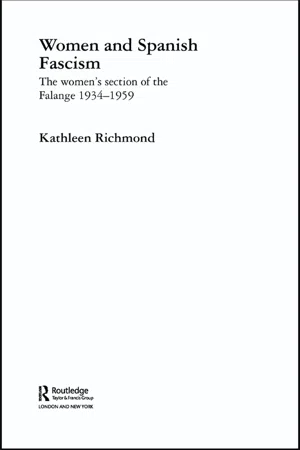
Women and Spanish Fascism
The Women's Section of the Falange 1934-1959
- 192 pages
- English
- ePUB (mobile friendly)
- Available on iOS & Android
eBook - ePub
About this book
Using forty-five interviews with former members and sympathisers, this book traces the development of the Women's section of the Franco government from its roots in the Spanish fascist party to its role in the dictatorship up to 1959. The study reveals that despite its anti-feminist agenda, the section was, in some areas, a catalyst for women's emancipation in post-Franco Spain.
1 Starting the Revolution: SF’s programme for all women
The Nationalist victory of 1939 sealed the defeat not only of the democratic structures of the Second Republic but also of the moral and cultural beliefs on which it was founded. In its determination to eradicate the recent past, the regime continued to insist that the Civil War had been a ‘Crusade’. The Republic was cast as the ‘anti-Spain’ and its supporters demonized, especially the organized working classes and those who sought to reform the Army and weaken the power of the Catholic Church. The ‘New State’ sought to return Spain to the spiritual and patriotic values of its Golden Age, within which the economic interests of the privileged and powerful would be safeguarded.
Central to the regime’s determination to turn back the clock was its focus on the lives of women. The foundations of patriarchal society were perceived to have been undermined by the emancipating legislation of the Second Republic. But it was not only the female vote and the Republic’s divorce law which were cited as causes of the breakdown of the old order. Improved social legislation and changes to the Civil Code had given women more rights in the workplace and within the family structure, challenging the traditional authority of the male.1
The regime’s attempts to restore gender divisions by returning women to the home were made for ideological reasons, ignoring the reality that paid female employment was helpful for the national economy and a financial necessity for many women. There was a parallel in Nazi Germany and Fascist Italy, where employment legislation was intended to discourage women from many areas of work and gross inequalities in wages ensured that women could not attain parity with men.2 The justification by both regimes was the perceived demographic problem caused by high infant mortality and the declining birth rate. In these circumstances, it was argued, the workplace (especially in an urban environment) was unsuitable for women.
But in addition to legislation, the Franco regime–again in common with Germany and Italy–used women themselves to drive home its reactionary message to the whole of the female population.3 The role of Sección Femenina (SF) was both to intervene in the lives of other women to ensure their compliance with the regime’s social and political aims and themselves serve as exemplars of traditional gender roles.
The roles were interconnected. Understood by SF members as the ‘Falangist Revolution’, its work with girls and adult women was designed to underline the importance of the family, reinforce patriarchal authority and bring rudimentary welfare and health care to the population at large. There was, however, an essential contradiction between SF’s advocacy of traditional gender roles for unaffiliated women and the personal qualities and lifestyle required of the bearers of that message. Its elites were to be the conveyors of political dogma but different in every way from feminist politicians of the Second Republic. This chapter traces the origins of the gender politics of the regime which elite members transmitted to others. Relatedly, it examines the ways found by SF to interpret its mandate and the ensuing ambiguities and contradictions as it sought to model itself on the equivalent women’s organizations of Germany and Italy.
The context for SF’s intervention was, as Michael Richards has stated, the ideological construction of Spain as a ‘natural entity’, contaminated and sick following recent political failures.4 Within this vision, early post-war propaganda cast SF workers as both do-gooders and avenging angels. Amidst the appalling social and economic conditions of the early post-war period, the rhetoric of the ‘reconquest of the home’5 could be read as an appeal to patriotic duty. In the cause of national regeneration, SF prepared to intervene directly into the lives of the female population, in the knowledge that its elite members (mandos) were part of a minority ‘whose first steps will not be understood by the masses’.6 The relief programmes of the war years, such as the feeding of the poor and the care of orphan children, continued and acquired a specific propaganda function. There was enormous political capital in the vision of women entering newly ‘liberated’ provinces. Headlines such as ‘Campaign to disinfect Madrid from the misery left by Marxism’ referred as much to the need for political as for actual decontamination.7 Against the claim that the citizens of Madrid were almost all infected with parasites, the perceived remedy was medical inspections together with registration of affected houses and people. The women of SF were to be frontline workers in the cleansing of Spain, their brooms and disinfectant the external embodiment of a moral and spiritual campaign. Falangist nurses would be ‘immunizing the spirit of Spaniards from unhealthy doctrines’.8 Meanwhile, mobilized women in the laundries and workshops of the rearguard were ‘helping to bring about the principle which is stamped on the walls of shower compartments for the soldiers of Franco which says “Clean bodies, clean clothes, clean souls” ‘.9 After the war, too, teams of SF health workers supplied soap, whitewash and cleaning materials to poor areas and as a former staff member recalls: ‘It deloused a lot of children.’10
SF’s identification with the rhetoric of ‘cleansing the nation’ went deep. Paralleling the government’s ‘redemption of sentences’ (Redención de Penas) system, whereby political prisoners could redeem part of their sentence through hard labour, SF started a domestic school in the women’s prison in Madrid. Selected inmates were taught politics, religion and domestic subjects for five hours daily over one year. Those deemed to have passed the course had their sentences reduced by the same period.11
While SF capitalized on the ideological base for improved hygiene, its programmes also echoed government concern about domestic issues which pre-dated the Second Republic. The importance of cleanliness to public health in general was well documented, and its relevance to the health of infants and mothers had been a cause of concern for many years. Spain’s infant mortality record was poor, and in the fight to stem tuberculosis it was recognized that clean, airy houses were essential to stop the spread of infection. Government Health Department statistics of 1932, for example, painted a depressing picture of a high incidence of tuberculosis and infant mortality. Even more striking was the number of deaths from enteric disorders, a marker of the state of public health and hygienic conditions generally.12
In the same years, however, domestic issues were coming to the fore in the context of a changing representation of the home in the popular press and women’s magazines. Danièle Bussy Genevois comments how a petty bourgeois ideal of a comfortable, spotless and uncluttered space was projected increasingly as an area in which moral control could be exercised.13 The housewife was being helped, via domestic appliances and gadgets, to entertain more and have a less closed role within the home. In this context, domestic skills were an enabling tool, allowing the housewife more control over her environment. SF’s publications (the journals Revista ‘Y’ and Medina, for example) were able to capitalize on this trend, blending political articles with a mix of recipes, suggestions for interior design and photographs of ideal homes.
Domestic expertise was thereby able to be presented as necessary and desirable. It became the cornerstone of post-war SF educational programmes and was the primary area of control for SF staff members. Unlike the health and welfare programmes, it needed no male intervention or guidance. Elite members would be exemplars of housewifely perfection themselves and teachers to the wider female population. Post-war programmes were an extension of the voluntary courses started in 1937. They began in earnest three years later with the opening of the first SF domestic school (escuela de hogar) in Madrid, offering evening classes to married women and day-time courses for servants, nannies and nursery nurses.14 As the network of these schools was extended throughout Spain, women were offered domestic training to equip them for the extremely difficult post-war economic circumstances. Members were told at the 1940 national conference:
We must focus on a diet which … allows the body to operate in the most efficient way and which is appropriate to the economic circumstances of the individual…. This is the work started by the Sección Femenina…. In the domestic school, where a food policy already exists in outline, we will put our idea into action.15
SF’s role as the national manager of domestic efficiency increased when housecraft was introduced into the school curriculum and made a compulsory subject in both State and private schools in 1946. The role was further highlighted with the introduction of a period of compulsory social service for unmarried women, in which domestic education played a central part.
Social service dated from 1937, when it had been devised by the head of the Falangist welfare department. Mercedes Sanz Bachiller, the widow of one of the earliest Civil War victims, Onésimo Redondo, had started Social Aid (Auxilio Social) in Valladolid as a response to the nutritional and welfare problems of the old, the sick and children orphaned by the war.16 Much to the displeasure of Pilar, who would have preferred all such initiatives to be the responsibility of SF, it became the body through which aid to the newly conquered provinces was channelled. Pilar and Mercedes were soon rivals, with the social service scheme at the heart of the dispute. Mercedes’ original intention in establishing the scheme, however, had nothing to do with the relationship between Social Aid and S F. She had seen the potential of a female equivalent of military service which would ensure a ready supply of unpaid help to the war effort. Single women of between seventeen and thirty-five years of age were to work without payment for a period of six months in the service of Spain, receiving a certificate of service in acknowledgement. In the post-war years, the currency of this certificate became greater, as it became necessary for entry to the professions, government employment and even to obtain a passport or driving licence. During the Civil War, the scheme was at its simplest, consisting of unpaid work in welfare institutions such as orphanages and a training course carried out in the Social Aid residences (residencias–hogares).17 But in 1939, when the scheme was taken over by SF, the taught element was standardized to follow on from SF’s existing training programmes and took place in its domestic schools and local headquarters. Its content was largely domestic subjects.18
Social service was arguably the most wide-reaching example of SF intervention into women’s lives. Its training course was effectively a re-stating and continuation of the material that was being progressively introduced into secondary schooling programmes–namely domestic education, politics and physical education. It was the vehicle for SF to realize its task of ‘the total education of the woman’ as directed by Franco at the end of the war.19 What had started as a co-ordinated response to a national emergency very quickly became a tool for political persuasion. Women were to be drawn, via SF teachings, ‘to their daily tasks, to their children, to the kitchen, the house and the vegetable garden’.20
As SF’s most ambitious attempt to mobilize unaffiliated women, social service was unsuccessful. Its element of compulsion was widely resented after the war, and despite the increasing regulations and controls governing the scheme, only a minority of women were ever recorded as completing it in any one year.21 The irony was that it was likely to be the neediest women who were affected, because social service was a requirement for many jobs, particularly in the State sector. Women who were better-off, not at university and not intending to work, could avoid it with few consequences.22
But other SF programmes were also intrusive. Its health programmes gave form to what Mary Nash has described as twentieth-century society’s increasingly critical opinion of women’s ability to cope as mothers without the intervention of medical experts.23 In this, the Francoist State was reflecting concerns about the health of the nation that went back to the dictatorship of General Primo de Rivera. Worries about population, birth rate and mortality rates ran alongside a wider debate about so-called ‘racial hygiene’. Differing theoretical models of how future generations might be healthier and live longer were being discussed in various European countries. In Spain, as early as the 1920s, the king’s physician, Gregorio de Marañón, had put forward ideas of how health–and particularly maternal and infant health–could be improved. He recognized the problems of multiple childbirth and premature ageing of the mother, quoting a figure of 46 per cent infant mortality from 1,534 families in the area of his own hospital.24
The writings of Marañón were followed in 1928 and again in 1933 by national conferences debating the health of the nation and (among other things) the responsibility of women in this regard.25 All could agree that motherhood should be undertaken responsibly, but there were varying definitions of ‘conscious maternity’ (maternidad consciente). In the 1920s and 1930s, it was for many inseparable from the promotion of birth control and came to be part of the wider political debate about the rights and role of women in society. But Marañón declared birth control ‘an attack against society and a sin’ and advocated abstinence as the way to control family size.26 For him, ‘conscious maternity’ was a question of educating the woman for...
Table of contents
- Cover Page
- Title Page
- Copyright Page
- Illustrations
- Acknowledgements
- Introduction
- 1 Starting the Revolution: SF’s programme for all women
- 2 The construction of ideology: icons, rituals and private spaces
- 3 Modernity and Reaction: SF and Religion
- 4 Loyalty, influence and moral authority: SF 1936–1949
- 5 Continuing the Revolution: SF 1945–1959
- 6 Gender, Class and the SF mandos
- Conclusion
- Appendix: the oral sources
- Notes
- Bibliography
Trusted by 375,005 students
Access to over 1.5 million titles for a fair monthly price.
Study more efficiently using our study tools.
Frequently asked questions
Yes, you can cancel anytime from the Subscription tab in your account settings on the Perlego website. Your subscription will stay active until the end of your current billing period. Learn how to cancel your subscription
No, books cannot be downloaded as external files, such as PDFs, for use outside of Perlego. However, you can download books within the Perlego app for offline reading on mobile or tablet. Learn how to download books offline
Perlego offers two plans: Essential and Complete
- Essential is ideal for learners and professionals who enjoy exploring a wide range of subjects. Access the Essential Library with 800,000+ trusted titles and best-sellers across business, personal growth, and the humanities. Includes unlimited reading time and Standard Read Aloud voice.
- Complete: Perfect for advanced learners and researchers needing full, unrestricted access. Unlock 1.5M+ books across hundreds of subjects, including academic and specialized titles. The Complete Plan also includes advanced features like Premium Read Aloud and Research Assistant.
We are an online textbook subscription service, where you can get access to an entire online library for less than the price of a single book per month. With over 1.5 million books across 990+ topics, we’ve got you covered! Learn about our mission
Look out for the read-aloud symbol on your next book to see if you can listen to it. The read-aloud tool reads text aloud for you, highlighting the text as it is being read. You can pause it, speed it up and slow it down. Learn more about Read Aloud
Yes! You can use the Perlego app on both iOS and Android devices to read anytime, anywhere — even offline. Perfect for commutes or when you’re on the go.
Please note we cannot support devices running on iOS 13 and Android 7 or earlier. Learn more about using the app
Please note we cannot support devices running on iOS 13 and Android 7 or earlier. Learn more about using the app
Yes, you can access Women and Spanish Fascism by Kathleen J.L. Richmond in PDF and/or ePUB format, as well as other popular books in History & World History. We have over 1.5 million books available in our catalogue for you to explore.