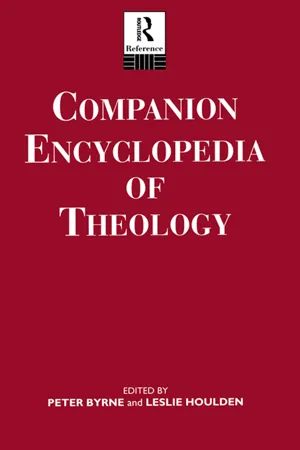
The Companion Encyclopedia of Theology provides a comprehensive guide to modern theological thought. An international team of theologians and practitioners of both the Christian and Jewish faiths investigate and consider aspects of theology in 48 self-contained articles. Neither partisan and denominational, nor detached and abstract, this Companion explores the resources and applications of theology in the light of Christianity's place in the modern world.
The Structure
The Companion Encyclopedia of Theology is divided into six parts. The first three deal with major foundational aspects of Western theological reflection:
* the Hebrew and Christian Bible
* the Tradition
* the contribution of Philosophy
The second half of the Companion is concerned with application:
* in relation to Spirituality
* in relation to contemporary Ethics
* in relation to issues in and aspects of present-day theological construction
The 48 essays are descriptive, informative and analytical; their wide-ranging content is bound into a unified perspective by the editors' general introduction and the introductions to each of the six parts. At the end of each article, there are suggestions for further reading and the work is concluded with a comprehensive index.
This Companion Encyclopedia is a valuable source of reference for students, teachers and both lay and clerical practitioners of Christian and Jewish theology.
Key Features
* Broad Coverage - contains 48 in-depth essays covering both the history and application of Western theological thought
* International Authorship - written in non-technical language by a distinguished team of editors and authors from both Christian and Jewish faiths
* Balanced Approach - discusses and analyses the key issues without imposing any single viewpoint
* Clearly Presented - at the end of each article, there are suggestions for further reading and the work contains a comprehensive index
- 1,120 pages
- English
- ePUB (mobile friendly)
- Available on iOS & Android
eBook - ePub
Companion Encyclopedia of Theology
About this book
Information
I

The Bible
Introduction
There can be useful argument whether a treatment of Christian thought should begin with the Bible or with the tradition. The issue is commonly and sometimes crudely thought of as that which fundamentally divides the Protestant element in the Christian world on the one hand from the Catholic and Eastern Orthodox elements on the other. It is of course not as simple as that: no Christian community considers itself to be other than dependent on the authority and pervasive influence of Scripture or to be independent of what it conceives to be authentic tradition. The fact that, with this common basis, they can disagree so profoundly merely shows how varied is the interpretation to which both Scripture and tradition are susceptible. These massive entities, the one in literary bulk, the other in temporal, conceptual and human expanse, cannot reasonably be expected to yield simple and clear directives to those who would base themselves upon them.
What is undeniable is that there has always been a complex interaction between the Bible and tradition. From one point of view, the Bible as Christians have received it is itself the product of tradition, one (albeit towering) element in the Christian story. Though much of it (the Old Testament) was inherited from Judaism, those books were arranged—in early Christian tradition—in a Christianly significant order rather than a Jewish order, and the original Christian writings (the New Testament) were as much deposits of, as formative of, early Christianity, that is they were a fruit of the tradition. In that basic sense, tradition has priority.
But from another point of view, Scripture has occupied a normative place in Christianity that has been unrivalled. In realistic terms, it is arguable that the creeds or the eucharistic liturgies, both of them succinct and, by their repeated use, deeply influential embodiments and formers of faith, have, as it were, largely carried Christianity along on the tide of history. But, despite the tenacious reverence accorded to these formulas by most Christian communities, they have never received the deference and devotion given to the Bible. In however strange (to us) or partial the manner of its use, Scripturehas been the court of appeal to which upholders of doctrine have turned and the source from which they have reckoned to derive their tenets. It has been Scripture whose terms have had to be met and it has been to Scripture that, directly or obliquely, Christians have chiefly turned for religious nourishment and guidance.
Here in our present context, however, it is not only the massive, public and ‘up-front’ role played by the Bible in Christianity as a matter of sheer fact that leads to its appearing first in this volume. Nor does that position reflect a decision between the Bible and tradition as claimants to primacy in authority: such a decision would, in the constraints of this brief chapter, be rash or crude, and in any case is inappropriate in an academic work such as this. What is involved is more straightforwardly the plain historical datum that the Bible, in the shape of the Old Testament, is the primary surviving bond linking Christianity to its ancient Jewish antecedents and, indeed, its ever-present Jewish contemporaries, with whom its relationship has been always so complex, problematic, and often so tumultuous or catastrophically scandalous. In that perspective at the very least, the Bible pushes itself to the front in any orderly survey of Christian thought.
In part, it is also an obstacle to be circumnavigated, or at any rate treated with caution. For much else in Christian thought has been couched so commonly (and so early, and even when Scripture was ostensibly the source) in abstract or philosophical patterns that, whatever the claims and appearances, the Bible, with its quite different idioms, chiefly narrative and poetry, has been left far behind, as far as its own thought worlds are concerned. Historical approaches to the Bible, developed in recent centuries, have made that so utterly plain that the Bible has become, despite the profligate and even fanatical use of it in many Christian circles, in many ways an alien work—all too clearly mishandled when too readily handled, yet often also in practice treated like a precious icon, revered from afar but not closely examined, lest its native language should prove largely beyond our capactiy to absorb and use, even when understood intellectually.
It is in this perspective that the chapters that follow should be read. They begin with an account of the make-up of the Hebrew Bible in the complicated and drawn-out context of its assemblage as a normative body of sacred writings. But John Barton provides more than this. In drawing attention to the vast range and diversity of the background of this literature, he draws our attention implicitly to its alienness as far as all subsequent readers and users are concerned—all those, that is, who, in whatever precise spirit, lump it together as a canonical whole and make it authoritative, as God-given words. We cannot help but feel the (unwitting) audacity of that step.
It is a step which two major inheritors have taken, or rather a step which is at the start of two different paths. The second chapter traces the movement, from the beginnings that Barton described, down the initial stretches of the Jewish path, that is, in the period when Judaism and Christianity, bothreckoning Scripture as their major authority and each unabashedly confident in their favoured way of interpreting it, were establishing the camps from which they would henceforward stare at each other, from time to time launching missiles—and, until very recently, being largely without comprehension of or even respect for each other’s readings of their common sacred literary inheritance. ‘Neutral’ academic scholarship has in recent years at least given some Jews and some Christians a fruitful common land.
The third chapter outlines the parallel Christian development in patristic and medieval times, so different from mainline Jewish scriptural interpretation, but, paradoxically, owing much to the Philonic strain in first-century Alexandrian Judaism which Judaism itself so soon lost, ignored or forswore, thus losing the major possibility of a common language in which the two faiths might conceivably (hope against hope) have interpreted their shared writings.
Modern (i.e. post-Enlightenment) historical study of the Old Testament, whose story is told in the fourth chapter, has, in part, operated as a boomerang. It has made available the knowledge of Scripture’s past and especially its origins, which the earlier chapters have described. In doing so, it has sabotaged the traditional theological purposes to which both Christians and Jews have put the Scriptures, showing those uses up as anachronistic, arbitrary or, at any rate by historical standards, unjustifiable—for all their ingenious learning. John Rogerson’s chapter shows equally, however, that these inevitable challenges to traditional ways of regarding the Old Testament have not led Christian scholars to abandon this literature to the Jews or, more neutrally, to the historical limbo of its own original times. No, Christian scholars have, by a variety of strategies, risen to the challenges and found in the Old Testament a renewed source of edification or formation, whether seeing it in its own right or as giving shape to themes whose further destiny lay ahead in the career of Jesus and early Christian reflection on him. Both the theological thrusts of the Old Testament and its irresistible historical character have given major contributions to Christian thought, recalling it to a neglected Hebrew inheritance.
The next three chapters attend to various aspects of the New Testament, partly in tandem with the treatment already given to the Old Testament writings. The fifth chapter highlights the essential gap, not immediately apparent to the reader of the Bible as a single book, between the two Testaments. At one level, it is a gap of time—that which scholarship labels ‘the inter-testamental period’, a time whose Jewish literary deposit, so far as it has survived, at Qumran or elsewhere, never achieved canonical, i.e. biblical status; yet, historically, it contributed to the world of thought in which Christianity arose, so that to ignore it is to distort the picture of that world. What is involved is the culture of first-century Judaism—including not only its literary possessions but its methods for interpreting them. This volume, being concerned with the biblical texts, can do no more than draw attention to this factor, so important from a historical point of view.
More importantly, there is a profound conceptual gap. Not only do the New Testament writings fail to follow those of the Old in immediate and uninterrupted temporal sequence; they also arise by what we may describe as a quite different mechanism. From one point of view they are indeed, within their far narrower time-scale, the record of the history, beliefs and practices of a community of faith, just as is the Old Testament. But more significantly, they are, in their diverse literary forms, all responses to and reflections on the figure of Jesus, seen as the decisive and all-embracing agent of God for human salvation. This dominating personal presence and force has no counterpart in the Old Testament—which indeed he was also quickly seen to dominate, for it foreshadowed him and he fulfilled it. In Christian perception, he is more than one character in a long story: he colonizes all of it, from start to finish. More modestly, we may say that the terms and images of the Old Testament, suitably adapted and developed, alone made him intelligible: in the first years, there was no other resource.
In the sixth chapter, John Muddiman shows how richly and diversely the writings of the New Testament served as the ‘proofs’ for Christian beliefs about God and Christ as they developed, with increasing sophistication, chiefly of a philosophical kind, in the subsequent period—expressed as they were in conceptual idioms that were as foreign to most, if not all, of the New Testament as to the Old.
This process, once brought unavoidably to our attention by candid historical investigation and the use of historicality of imagination, raises questions of great urgency for standard Christian theology, some of whose tenets and much of whose idiom seem undermined by an awareness of its traditional pedigree in New Testament terms and proof texts. These issues, still scarcely absorbed in much of the theological and ecclesiastical establishment, are raised in one dimension by Heikki Räisänen in chapter seven and in a more persistently biblical and literary way by Stephen Prickett’s concluding chapter. Here we read of some of the profound questions posed by the presence of a ‘holy book’, now that we know so much about it and about its functioning.
Thus we end without a closure, with pointers towards a future which theological reflection had better not refuse, for its own health and integrity. As many of these chapters indicate, it is a future in which, on the one hand, the Bible is a fast disappearing cultural force in society at large and even in practice in some major parts of the Christian world; while on the other hand, in the academy it is read and studied by both believers and unbelievers, with unprecedented fertility, as new methods and approaches continually arrive on the scene, some more theological in their bearing than others. It is a perplexing state for the Bible to be in.
1
The Hebrew Bible: Formation and Character
This chapter is divided into two sections. The first deals with the growth of Hebrew literature and its gradual formation into the canon of the Hebrew Bible. The second discusses the matrix from which Hebrew Scripture came, and especially its roots in the social life of ancient Israel.
The Formation of the Hebrew Scriptures
The Hebrew Bible is the product of two processes, distinct yet interacting at many points. One is the growth of the national literature of Israel, built up as the sayings of sages, the hymns and poems of singers, narratives of early historians, oracles of prophets, and the judgements of lawyers were written down and shaped by many subsequent generations of scribes. The other process, which began as early as the time of the Babylonian Exile (586–532 BCE), is the selection and codification of the core of these disparate works to form the official literature of the nation. Before the Exile only the first process was clearly at work, though some legal materials already had an authoritative status from the seventh century, perhaps even earlier. After about the second century BCE the second process was virtually complete, with only marginal disputes about the scriptural status of a few books possibly continuing down into the Christian era. But between these dates ‘sacred writings’ were still being produced even though other, more ancient ones were already fixed and settled as the core of Holy Scripture. Once some books were already regarded as ‘holy’, that had an effect on how other books were written: pastiche of earlier biblical books became common. Later books of the Bible thus have a complex relationship with earlier ones, and this will be explored below by examining first, the growth of Israel’s national literature; second, its acceptance as Scripture; and finally, the interaction of the two processes (Sanders 1992).
Growth of the Literature
The bulk of the Hebrew Bible was composed between the early days of the monarchy (tenth century BCE) and the period of Persian dominance (fifth century BCE). Most of the books we now have are the result of a long process of reworking and rewriting, in which editors introduced new material, either composed for the purpose or taken from existing documents. Hardly any of the major books of the Bible seems to derive from a single author in the modern sense, and the few that may do so (e.g. Jonah, Ruth) are generally from a somewhat later time, perhaps the Hellenistic age (fourth century and later). For theology, this aspect of the way the national literature of Israel was formed raises questions about inspiration, revelation, and authority, and also about the relation of religious content to literary form (Barr 1983). Six broad types of literature will be examined: narrative, law, wisdom, poetry, prophecy and psalmody.
Narrative
Unusually in the ancient world, even the earliest fragments of Israelite storytelling or historical narration are in prose (Alter 1981). In the Pentateuch, Genesis contains stories about the ‘patriarchs’ (Abraham, Isaac, Jacob, and Jacob’s twelve sons), and Exodus about Moses and the escape of the Israelites from Egypt, which may derive from a source document (‘J’) written perhaps as early as the tenth century, and based on yet older materials. Other narrative books also contain what seem to have been originally independent legends or folk memories—stories about prophets, for example, in the books of Samuel and Kings (see 1 Sam. 9–10; 1 Kgs. 13, 18–22; 2 Kgs. 1–2). It was not until the fifth century that all the disparate materials in the Pentateuch came together to form the five books as we now have them, and much that was then included was certainly later than the early sections just mentioned. In the meanwhile, Israelite historiography had developed to a degree of sophistication unparalleled among the other nations in the ancient Near East. It is usual to single out the account of David’s monarchy in its middle and later years (including his affair with Bathsheba, the near loss of his throne to his son Absalom, and the eventual succession of Solomon) as a separate ‘Court History’ or ‘Succession Narrative’, comprising 2 Samuel 9–20 and 1 Kings 1–2 (Whybray 1968). But the whole of 1 and 2 Samuel exhibit much the same skill in narration, and may show that such literary skills were already developing well before the monarchies of Israel and Judah went into terminal decline in the eighth century (Gunn 1978, 1980). The greatest work of compilation and editing can be found in the single ‘history’ running from Joshua through Judges and Samuel and ending with Kings (thus incorporating the already existing Succession Narrative), which was probably put together from older materials, or reworked from earlier editions, during the Exile in the sixth century BCE (Noth 1981). This massive narrative work is traditionally known as the ‘Former Prophets’ but in modern scholarship as the ‘Deuteronomistic History’, since it is an interpretation of the history of Israel down to the Exile according to criteria in part derived from the book of Deuteronomy.
All Israel’s narrative literature is interpretative—narration necessarily interprets what it narrates. But a comparison of the finished Deuteronomistic History with its underlying sources, and with narratives in the Pentateuch, brings out two characteristic features of the interpretation of history in Hebrew literature. First, from the earliest times for which we have any evidence the narrators interpreted the history of the nation in religious terms. Israel’s God is involved in what happens to the Israelites. This may be true at a local level, when a prophet or patriarch experiences the events that befall him as a contact with the divine; or it may be at a national or even international level, with events being interpreted as part of an unfolding divine purpose for the whole people of Israel, or even for the whole world. But second—and perhaps surprisingly—the divine element in human history tends to be heightened as Israelite historiography develops. Modern readers may expect that the earlier a story is, the more ‘supernatural’ it will be, but, if anything, the reverse is the case. It is in the Succession Narrative that the most ‘secular’ accounts of human events are to be found; the Deuteronomistic History tends to heighten the divine control of history, ...
Table of contents
- Cover Page
- Half Title page
- Title Page
- Copyright Page
- Contents
- General Introduction
- The Contributors
- I The Bible
- II The Tradition
- III Philosophy
- IV Spirituality
- V Practical Theology
- VI Christian Theology: Scene and Prospect
- Index
Trusted by 375,005 students
Access to over 1.5 million titles for a fair monthly price.
Study more efficiently using our study tools.
Frequently asked questions
Yes, you can cancel anytime from the Subscription tab in your account settings on the Perlego website. Your subscription will stay active until the end of your current billing period. Learn how to cancel your subscription
No, books cannot be downloaded as external files, such as PDFs, for use outside of Perlego. However, you can download books within the Perlego app for offline reading on mobile or tablet. Learn how to download books offline
Perlego offers two plans: Essential and Complete
- Essential is ideal for learners and professionals who enjoy exploring a wide range of subjects. Access the Essential Library with 800,000+ trusted titles and best-sellers across business, personal growth, and the humanities. Includes unlimited reading time and Standard Read Aloud voice.
- Complete: Perfect for advanced learners and researchers needing full, unrestricted access. Unlock 1.5M+ books across hundreds of subjects, including academic and specialized titles. The Complete Plan also includes advanced features like Premium Read Aloud and Research Assistant.
We are an online textbook subscription service, where you can get access to an entire online library for less than the price of a single book per month. With over 1.5 million books across 990+ topics, we’ve got you covered! Learn about our mission
Look out for the read-aloud symbol on your next book to see if you can listen to it. The read-aloud tool reads text aloud for you, highlighting the text as it is being read. You can pause it, speed it up and slow it down. Learn more about Read Aloud
Yes! You can use the Perlego app on both iOS and Android devices to read anytime, anywhere — even offline. Perfect for commutes or when you’re on the go.
Please note we cannot support devices running on iOS 13 and Android 7 or earlier. Learn more about using the app
Please note we cannot support devices running on iOS 13 and Android 7 or earlier. Learn more about using the app
Yes, you can access Companion Encyclopedia of Theology by Peter Byrne,Leslie Houlden,Rev Prof Leslie Houlden in PDF and/or ePUB format, as well as other popular books in Teología y religión & Religión. We have over 1.5 million books available in our catalogue for you to explore.