We face an environmental catastrophe of global proportions. The ecological rationality of modern society, and of science in particular, is in question. Science still responds to crises at the level of technocratic expertise, and still treats society as an adaptive system.
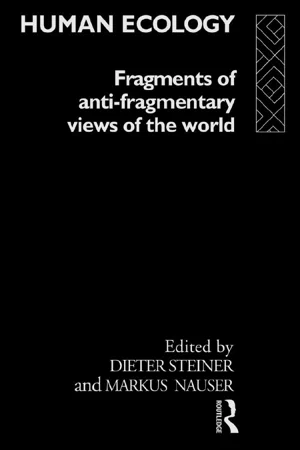
By bringing together a number of integrative approaches to the human-environment problem, Human Ecology shapes a more radical, fundamental agenda for change. The book creates a framework for a cohesive discourse, for a "new human ecology". From the notion that the individual person is an agent mediating between society and environment, the individual contributors recognize that the environmental crisis is really a crisis of society - manifesting itself in an increasing fragmentation of lives in general and knowledge in particular. Arguing for environmentally sustainable lifestyles, the book envisages a new kind of consciousness and a new environment.
- 392 pages
- English
- ePUB (mobile friendly)
- Available on iOS & Android
eBook - ePub
Human Ecology
About this book
Information
1
GENERAL INTRODUCTION
The story of human ecology is part tradition, part response to crisis. Its origins can be traced back to developments over several decades of scientific interest in human-environment relationships which, for the most part, occurred separately in a number of disciplines. A brief overview of this background is given in the following first section of this introduction. An intensified pursuit of the topic set in with the advent of the planetary ecological crisis. This new kind of human ecology strives for integration in the form of interdisciplinary linkages and trans-scientific connections. A number of remarks regarding this development can be found in the second section of this introduction.
It is the aim of this volume to contribute to this more recent development. Conceptual and theoretical considerations related to the establishment of an integrated human ecology are discussed in the four contributions of Part I. Part II contains five papers that deal in various ways with the different levels of consciousness that humans (as agents whose actions may be relevant to the environment) possess, and this leads to questions related to epistemology, methodology and morality. Part III is composed of three articles that discuss aspects of structuration which we see as a central theme of a general human ecology. Structuration refers to the fact that there is a duality with regard to human agents acting as members of human societies: they act within social as well as spatial-environmental structures, but, by so doing, also help to re-establish those structures. Finally, the five contributions of Part IV in various ways address the importance of the regional dimension. A regional differentiation of modern society rather than a global, functional one is expected to constitute an important step towards the goal of ecological sustainability.
Each part of the volume begins with an introduction. The aim here is not simply to summarize what is to come, but rather to pick up some important themes relevant to the part in question and to enrich the discussion with further thoughts in such a way that threads are drawn together which otherwise might remain loose.
1 TRADITION: INTERDISCIPLINARY ROOTS OF HUMAN ECOLOGY
The following brief summary sketches the development of concepts of human ecology that can be called traditional. The interested reader can find more detailed information in a paper by Young (1974) and in a reader edited by the same author containing a collection of seminal papers by representatives of the human ecology orientations of the past (Young 1983). For further remarks about the development of human ecology see also Jaeger (1991, Introduction) and Lawrence (this volume).
1.1 Biology
Ecology is known as a branch of biology. The term ‘ecology’ was coined by Ernst Haeckel in 1866 to describe the science dealing with the relationships of organisms to the surrounding outer world (Aussenwelt). Since then this understanding of ecology has basically remained the same. A definition in a recent textbook reads: ‘Ecology, if one goes by the usual definition, is the study of the relationship between organisms and their environment’ (Smith 1986:3). However, the author adds a note of caution: ‘that definition can be faulted unless you consider the words relationship and environment in their fullest meaning. Environment includes not only the physical but also the biological conditions under which an organism lives; and relationships involve interactions with the physical world as well as interrelationships with members of other species and individuals of the same species.’ As pointed out by Young (1974:4), to the extent that ecology is founded on the notion of organisms adapting to a selecting environment, ‘the formal beginnings of the ecological approach…lie in evolutionary biology, in the work of Darwin’.
The usual understanding of ‘environment’ is one that is specific to the type of organism concerned: it refers to those features of the surrounding world which affect or are affected by the organism in question. Nevertheless, the use of the term is a source of frequent confusion, in particular in the context of human ecology. Do we, by ‘environment’, mean natural components in our surroundings as opposed to human-made features and modifications? Or do we include the latter? Clearly a comprehensive human ecology must refer to the environment ‘as is’. However, the recent development of human ecology has grown out of a concern for the dwindling degree of naturalness of this environment. A different kind of distinction is made by Knötig (1972). He contrasts what he calls a ‘Haeckelian environment’ with an ‘Uexküllian environment’. The former refers to the common notion held in ecology about an environment being given and an organism being largely a passive respondent to variables describing this environment, such that physical, chemical, biological or psychological relations result. The latter refers to notions developed by Uexküll (1928). He sees an organism rather as an active being which selects and modifies its surroundings such that, in fact, it creates its own environment according to its needs. To the extent that this process is based on the use of an ‘inner model’ we have here the beginning of a concept that becomes particularly useful in a context involving humans as organisms.
To start with, however, one can obviously be interested in humans as purely biological organisms and their interactions with the environments, disregarding any potential mental faculties, and then call this interest the subject of human ecology. For some people this is indeed what human ecology is all about: a concern with questions related to the biophysical foundations of human existence, on the one hand, and to the influence of humans on the biophysical environment, on the other. More recent examples of approaches along this line include Ehrlich et al. (1973) and Freye (1986). Typically these books comprise topics such as population dynamics, carrying capacity of the land, food and energy production and consumption, nutritional problems, pollution affecting ecosystem functioning, and health hazards under natural conditions (e.g. parasites) as well as resulting from anthropogenic toxic waste. The concern is with individuals and populations as aggregates of individuals and their immediate relationships to the environment in terms of biophysical variables. The fact that ultimately the quality of these relationships is heavily influenced by the kind of society a population forms and the kind of culture it carries is recognized but not considered any further.
1.2 Sociology
An outstanding feature of human beings is precisely, however, that they are very eminently social animals. They form societies with arrangements that tend to influence the purely biophysical relationships of humans to their environment. Early in this century, starting with Park in 1916, the sociologists of the so-called Chicago School became interested in this question. As they were concerned primarily with cities, they were dealing with built-up and socially defined rather than natural environments (for this reason the Chicago human ecology is also referred to as ‘social ecology’). They held the opinion that there are underlying biological motives to human actions such as a drive for competition, but that these drives become restrained by superimposed social rules. The resulting processes, however, in the view of these Chicago sociologists, could still be described by a biological language: the migration of populations through a city and the change of neighbourhoods could be understood in analogy to the succession of plant societies. Variants of this sociological style of human ecology have survived to this very day. A system-theoretic version is presented by Hawley (1986): human populations as collectives are ecosystems in the sense that they are capable of adapting themselves to an environment.1 An overview of the development of social ecology can be found in Rojo (1991). An extensive treatment of the subject is also provided by Friedrichs (1977). Of a quite different nature, representing an opposite point of view, are recent contributions that criticize the discipline for disregarding relationships between social and nonsocial facts, in particular human environmental impact, and hence demand an ecological perspective on human societies which stresses questions such as carrying capacity and sustainability (see, for example, Catton 1983).
1.3 Cultural anthropology
The question of the relationship between nature and culture in human societies has been the focus of a branch of cultural anthropology, known as cultural ecology, a term coined by Steward (1955). Since the latter part of the previous century there has been an alternation between opinions favouring an environmental determinism and notions postulating the dominance of culture over nature in a way which Orlove (1980:236) describes as ‘a number of swings on intellectual pendulums’. The more recent development is marked by positions that are more intermediate with respect to this question. On the other hand a new controversy has developed concerning the ‘sociological question’: is it appropriate to treat human societies in terms of system theoretic approaches or should one rather use action-oriented models? A comprehensive introduction to cultural ecology is provided by Bargatzki (1986), an overview of its history and its significance to a development of a general human ecology by Steiner (1992). For the latter the findings of cultural ecology are of interest despite or perhaps precisely because of the fact that classical cultural anthropology investigates pre-industrial societies almost exclusively. We cannot avoid noting that these societies to a large extent have shown a marvellous adaptation to different kinds of environments with equilibrating relationships (see, for example, Campbell 1983) and hence the question arises as to how this situation has been guided by the cultural values of those societies.
1.4 Geography
There is a long-standing claim by geography to be a scientific discipline dealing especially with the theme of human-environment relationships. Geography indeed is an unusual discipline because, with the internal distinction between physical and human geography, it is anchored in the natural as well as in the social and cultural sciences. We can note a number of parallels with the development of cultural ecology mentioned above. Classical geography, in a similar way, went through periods alternating between environmental and cultural determinism, the difference being that the focus was on the environment in terms of landscapes and regional patterns rather than on society and culture. It must be pointed out, however, that, while early German geographers such as Alexander von Humboldt, Carl Ritter and Friedrich Ratzel still had a truly integrated view of their subject, the later discussion about the interplay between environment and humans was relegated to a large extent to the realm of the philosophy of geography. The actual scientific work was marked by an increasingly strong division of labour between the physical and the human geographers. Geography thus has not really made good its promise and has succumbed also to the general trend of increasing scientific specialization. This has happened despite early attempts to create a geographical human ecology. In fact, Barrows in 1923 maintained that geography is human ecology, but his kind of thinking did not bear much fruit. Typically, in a paper with the same title fifty years later, Chorley (1973) argues that the spreading ecological crisis is not a reason for trying to bring physical and human geography together, but, on the contrary, it is a proof that their union is impossible.2 At the same time, however, we also witness the attempts of a number of distressed geographers to swim against the current. Examples are Hewitt and Hare (1973) who maintain that geography should become a ‘modern human ecology’,3 and Weichhart (1975) who tries to establish foundations of an ‘ecogeography’.
1.5 Psychology
Compared with the other disciplines mentioned above the variety of ecological approaches is in psychology perhaps greatest, and so is probably the resulting confusion. These approaches are variously called ‘ecological psychology’, ‘environmental psychology’, and ‘psychological ecology’. Also, the history of an ecological orientation is shorter. Young (1974) earmarks the work by Barker starting in the fifties as pioneering (it is summarized in his book published in 1968). Decisive is ‘the movement out of the laboratory with its controlled experiments on human behavior and into the field for direct observation of behavior under uncontrolled field conditions’ (Young 1974:23). However, one can see this innovation as a consequence of the work by Lewin (1936), whose student Barker was. Lewin developed a concept of lifespace as a field of activating and deactivating forces in which the individual person represents a point. Although his notions and terminology are highly physicalistic it is interesting to note that he saw this field as purely psychologically defined. In contrast, Barker stressed the material, biophysical reality of the environment as a ‘behavior setting’, a setting within which human behaviour can unfold. A more recent development includes Gibson’s brand of ecological psychology which sees an animal or a human being and its environment as merely two aspects of one and the same irreducible system (Gibson 1979). The contribution by Carello in this volume is representative of this kind of thinking. A comprehensive compendium of the various approaches is provided in the handbook by Stokols and Altman (1987), and a useful overview by Miller (1986).
2 RESPONSE TO CRISIS: HUMAN ECOLOGY AS A GENERAL PERSPECTIVE
2.1 Integration through a common denominator?
A common feature of the developments mentioned above is that they represent endeavours within particular disciplines and are grounded in the general scientific motive of knowledge accumulation. Human ecology thus has quite a variety of backgrounds and different people mean different things by it. This is still largely true and presumably to some extent unavoidable. There cannot be any single view on such a highly complex topic as the relationship between humans and the environment.4 Ample evidence for the existing diversity of backgrounds and opinions can be found in a number of recent conference volumes such as those from four conferences of the Society for Human Ecology (SHE)5 and those edited by Glaeser (1989) and by Kilchenmann and Schwarz (1991).
Nevertheless, more recent developments are based on at least one common denominator: a growing awareness of the ecological crisis. We seem to have here a case of science responding to a public concern. Ever since the publication of Rachel Carson’s Silent Spring (Carson 1962) an environmental movement growing in size and scope has made itself felt, even within scientific circles. First of all, this has affected the further development of the intradisciplinary human ecologies mentioned above. For example, the main concern of classical cultural ecology has been human-environment relationships in pre-industrial societies. More recently some authors such as Rappaport (1979) have extended their thinking to a critical analysis of modern society and possible reasons for the ecological disorder it creates. Within geography there is a mounting feeling that any further argumentation about the scientific incompatibility of its physical and its human branch is rather cynical. It was precisely for this reason that the working group mentioned in the Preface was set up by the Swiss Association of Geographers, an undertaking which led to the Appenberg conference and finally to the present book. Also, of course, there are new, environmentally oriented developments within scientific disciplines which previously have disregarded to a great extent the existence of a biophysical environment. A case in point is economics with its new environmental or ecological branches.
It was an early understanding of the members of the geographical working party just mentioned that substantial contributions to the ecological question can, if at all, eventually be expected only from some kind of interdisciplinary human ecology. Indeed this understanding simply reflects an already widespread recognition of a need for integration, one that is reflected in a growing number of scientific organizations (the foremost example at present being the previously mentioned US-based Society for Human Ecology)6 and meetings (such as the International Conference on Human Ecology held in June 1991 in Göt...
Table of contents
- Cover Page
- Title Page
- Copyright Page
- Figures
- Tables
- Contributors
- Preface
- 1 General Introduction
- Part I Human Ecology
- Part II The Implicit and the Explicit
- Part III Structuration
- Part IV The Regional Dimension
Trusted by 375,005 students
Access to over 1.5 million titles for a fair monthly price.
Study more efficiently using our study tools.
Frequently asked questions
Yes, you can cancel anytime from the Subscription tab in your account settings on the Perlego website. Your subscription will stay active until the end of your current billing period. Learn how to cancel your subscription
No, books cannot be downloaded as external files, such as PDFs, for use outside of Perlego. However, you can download books within the Perlego app for offline reading on mobile or tablet. Learn how to download books offline
Perlego offers two plans: Essential and Complete
- Essential is ideal for learners and professionals who enjoy exploring a wide range of subjects. Access the Essential Library with 800,000+ trusted titles and best-sellers across business, personal growth, and the humanities. Includes unlimited reading time and Standard Read Aloud voice.
- Complete: Perfect for advanced learners and researchers needing full, unrestricted access. Unlock 1.5M+ books across hundreds of subjects, including academic and specialized titles. The Complete Plan also includes advanced features like Premium Read Aloud and Research Assistant.
We are an online textbook subscription service, where you can get access to an entire online library for less than the price of a single book per month. With over 1.5 million books across 990+ topics, we’ve got you covered! Learn about our mission
Look out for the read-aloud symbol on your next book to see if you can listen to it. The read-aloud tool reads text aloud for you, highlighting the text as it is being read. You can pause it, speed it up and slow it down. Learn more about Read Aloud
Yes! You can use the Perlego app on both iOS and Android devices to read anytime, anywhere — even offline. Perfect for commutes or when you’re on the go.
Please note we cannot support devices running on iOS 13 and Android 7 or earlier. Learn more about using the app
Please note we cannot support devices running on iOS 13 and Android 7 or earlier. Learn more about using the app
Yes, you can access Human Ecology by Markus Nauser,Dieter Steiner in PDF and/or ePUB format, as well as other popular books in Biological Sciences & Environmental Science. We have over 1.5 million books available in our catalogue for you to explore.