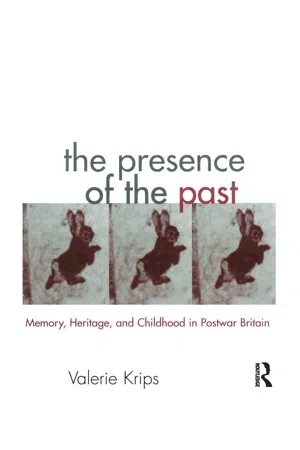
The presence of the Past studies the interaction of heritage and fiction written for children over a 40 year period in Britain, exploring a range of works for children from The Tale of Peter Rabbit to I Spy.
eBook - ePub
The Presence of the Past
Memory, Heritage and Childhood in Post-War Britain
- 126 pages
- English
- ePUB (mobile friendly)
- Available on iOS & Android
eBook - ePub
About this book
Information
CHAPTER 1
Introduction: Arrears of Memory
The destruction of the past, or rather of the social mechanisms that link one’s contemporary experience to that of earlier generations, is one of the most characteristic and eerie phenomena of the late twentieth century,
—ERIC HOBSBAWM
This is a book about heritage and childhood. The heritage I am concerned with is a phenomenon of the second half of the twentieth century; the childhood is that imagined by adults who wrote books for children during that time. Heritage and the imagined childhood of children’s fiction share the remarkable quality of bringing the past into the present, an attribute that much of this book will be concerned to analyze.
It seems that we cannot do without the past even though, as Eric Hobsbawm remarks, we seem bent on destroying it. What is the role of heritage in this circumstance of destruction? And how does fictional childhood become involved? In answering these questions I turn to a specific place and period in the story of the contemporary versions of “heritage.” That place is Britain, and the period is that which immediately follows World War II, that is, from 1945 on.
It is my argument that Britain’s reckoning with the past was anatomized in fiction written for children postwar. This is not to suggest that Britain’s relation to its past was then, or is now, inherently childlike or childish. Instead I indicate the extent to which a psychologized and individualized sense of self, looking inward for origins and history, and representing the world in its own image, found a potent realization in the “heritage” representations of the past, which developed between 1945 and 1980. I shall argue that such a selfhood found a symbol in the fictional child, a character who was to be as important for the collective relation of past to present as it was for the individual.
In many respects, Britain’s postwar experience was little different from that of other western European countries, all of which had to rebuild their industrial and commercial bases and respond to a new political and economic world order after the war. Yet Britain’s case was particular to the extent that very soon after the war, certain “structures of feeling”—to use Raymond Williams’ term for the flux of social experience as registered in its immediacy—were coalescing around heritage.1 By comparison, it was not until the early 1980s that the European Commission would begin its own action to support conservation of “heritage.”2
The early moments in the development of heritage in Britain involved a turn to the past unlike any of the nation’s previous invocations of history or tradition. The past to which Britain turned postwar was not that of empire and imperial conquest, but what Patrick Wright, in his seminal book on heritage in Britain On Living in an Old Country, has called “precious and imperilled traces.”3 These traces, “a closely held iconography of what it is to be English—all of them appealing in one covertly projective way or another to the historic and sacrosanct identity of the nation,” were metonymic of a world lost not only to history-books, records, and archives, but also to the day-to-day experience of individuals.4
Drawing on the work of Agnes Heller, Wright suggests that an essential part of quotidian life is an “everyday historical consciousness” constituted in large part by habit, the frameworks of thought and lived experience through which the individual places him or herself within broader social networks.5 Habit provides the essential foundation for the individual since “the subject of everyday life is constantly re-evaluating and rearranging itself—a process which is centrally concerned with the relationship of inner and outer, with ‘the problem of the unity of the inner life and of finding a “home” in the “world.”’”6
Like many other critics, Wright notes that the twentieth century was particularly marked by a dislocation of memory, and of traditional social integrative patterns. These dislocations and disintegrations, he suggests, affect everyday historical consciousness and disrupt habit, and as a result, everyday life is impoverished, devalued, and disenchanted. Wright understands the tendency to an “anxious revaluation of the past” in postwar Britain, and the growing nostalgia for a lifeworld imagined in terms of settled and established patterns, to be a response to a profound devaluation of historical consciousness.7
The kinds of changes registered in Britain in the decades following 1945 were as varied as they were substantial. Before the war, in the stories the nation told of itself, the past had been glorious. As Peter Clarke reminds us, “In 1900 Britain was arguably the greatest power in the world.”8 Its greatness was reflected in “[t]he Navy, the Empire, and the gold standard, interlocking and mutually supportive, [which] were at once the three symbols and the three pillars of British power and preeminence.”9 By the time the first of the novels for children I discuss had been written, both the empire and Britain’s economic powerbase had dramatically declined.10 However, the illusion of great power status lingered into the late 1950s. Britain stood by its imperial defense commitments, and although it staggered from one financial crisis to another, retained the fiscal structures of the sterling area, a remnant of Britain’s nineteenth-century economic supremacy. But even these residues of past power came under increasing threat from the mid-1950s on, not only from politicians at home, concerned with budgets and defense spending, but also from the rest of the world. In 1956 President Nasser of Egypt nationalized the Suez Canal, Britain’s traditional route to the East. British troops, as part of a coalition with France and Israel, invaded the Canal Zone, only to find the canal blockaded by Egyptian ships.
International pressure, and a United Nations condemnation of Britain, forced a humiliating retreat. Clarke writes: “What Suez demonstrated with brutal frankness was that Britain was no longer in the great-power league, was no longer capable of playing by its rules, and simply looked absurd when it tried to cheat.”11
Outriders of other transformations less dramatic, but equally vital to Britain’s sense of itself and its relation to the past, were already apparent at home. The years between World Wars I and II, for example, had seen a change of ownership of land in Britain “unparalleled since the confiscations of the Civil War, or the dissolutions of the monasteries, or even the Norman Conquest,” writes François Bédirada.12 Changes in land ownership meant not only that many small farmers came to own the land they had previously worked as tenants, but also that former great estates, which had created the modern landscape of Britain, were broken up. Consequent upon the dispersal of land, the country houses that had been historic symbols of power and influence, nationally as well as locally, began to decline.
Yet even as some of the huge country houses of the gentry were being pulled down, efforts to “save” those that were left were being made. After the countryside itself, which had been the primary target for conservation by the National Trust before the war, the country house was to be one of the chief objects of postwar conservation and heritage. As “heritage” objects, the houses were to be transformed: they were to inhabit a newly imagined public sphere, their rooms and gardens opened to tourists. As objects of “conservation,” they were to be preserved from the degenerations of the day-to-day and held like flies in amber, in a temporal never-never land that was neither fully historic nor fully contemporary.
An unexpected result of these developments was that primarily functional places and spaces in the great country houses, kitchens and servants quarters previously hidden away behind green baize doors, became among the most visited. Tourists were invited to see how the lives of those below stairs were lived and, as a result, the house and what remained of the estate were subtly democratized, viewed from a new perspective.
It is from the position of such democratizations that Britain’s turn to the past can be seen as positive, a reclamation made by those who previously had little say in the construction of history. The expansion of historical culture in the period, about which Raphael Samuel has written in Theatres of Memory, produced a new inclusiveness that encouraged the claims of keepers of “unofficial knowledges,” such as the collectors of memorabilia, family historians, local archivists, and so on, to construct history.13 The history thus created, which took as its material people, places, and events far removed from the interests of “official” historical narratives, motivated a remembrance that prepared the way for a “whole new family of histories.”14 These histories, sometimes oppositional to “official” narratives, played their part in the development of heritage, greatly expanding the scope of what was found worthy of remembering and preserving.
Britons were able to visit the newly opened country houses, buildings that had suddenly become part of their “heritage,” because of other important innovations. In 1957 the then Prime Minister, Harold Macmillan, told Britons that they had “never had it so good,” an ironic remark intended as a warning against inflation, which was, however, taken at face value.15 But his remark was prophetic. The late 1950s ushered in the so-called “affluent society.” Consumer goods, home ownership and foreign holidays came within the grasp of the general population, while the car offered an unprecedented freedom of travel. The Britai...
Table of contents
- CHILDREN’S LITERATURE AND CULTURE
- Contents
- Series Editor’s Foreword
- Preface
- CHAPTER 1 Introduction: Arrears of Memory
- CHAPTER 2 Lieux de Mémoire
- CHAPTER 3 The Trace of Old Characters
- CHAPTER 4 Forgetting the Past
- CHAPTER 5 The Taint of History
- CHAPTER 6 The Memory of Objects
- Bibliography
- Index
Trusted by 375,005 students
Access to over 1.5 million titles for a fair monthly price.
Study more efficiently using our study tools.
Frequently asked questions
Yes, you can cancel anytime from the Subscription tab in your account settings on the Perlego website. Your subscription will stay active until the end of your current billing period. Learn how to cancel your subscription
No, books cannot be downloaded as external files, such as PDFs, for use outside of Perlego. However, you can download books within the Perlego app for offline reading on mobile or tablet. Learn how to download books offline
Perlego offers two plans: Essential and Complete
- Essential is ideal for learners and professionals who enjoy exploring a wide range of subjects. Access the Essential Library with 800,000+ trusted titles and best-sellers across business, personal growth, and the humanities. Includes unlimited reading time and Standard Read Aloud voice.
- Complete: Perfect for advanced learners and researchers needing full, unrestricted access. Unlock 1.5M+ books across hundreds of subjects, including academic and specialized titles. The Complete Plan also includes advanced features like Premium Read Aloud and Research Assistant.
We are an online textbook subscription service, where you can get access to an entire online library for less than the price of a single book per month. With over 1.5 million books across 990+ topics, we’ve got you covered! Learn about our mission
Look out for the read-aloud symbol on your next book to see if you can listen to it. The read-aloud tool reads text aloud for you, highlighting the text as it is being read. You can pause it, speed it up and slow it down. Learn more about Read Aloud
Yes! You can use the Perlego app on both iOS and Android devices to read anytime, anywhere — even offline. Perfect for commutes or when you’re on the go.
Please note we cannot support devices running on iOS 13 and Android 7 or earlier. Learn more about using the app
Please note we cannot support devices running on iOS 13 and Android 7 or earlier. Learn more about using the app
Yes, you can access The Presence of the Past by Valerie Krips in PDF and/or ePUB format, as well as other popular books in Literature & English Literary Criticism. We have over 1.5 million books available in our catalogue for you to explore.