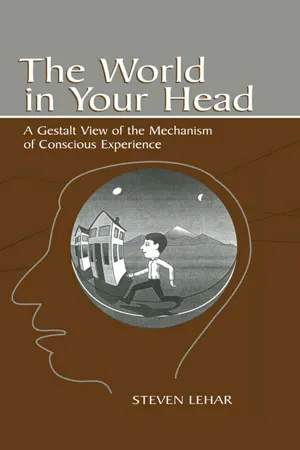
The World In Your Head: A Gestalt View of the Mechanism of Conscious Experience represents a bold assault on one of the greatest unsolved mysteries in science: the nature of consciousness and the human mind.
Rather than examining the brain and nervous system to see what they tell us about the mind, this book begins with an examination of conscious experience to see what it can tell us about the brain.
Through this analysis, the first and most obvious observation is that consciousness appears as a volumetric spatial void, containing colored objects and surfaces. This reveals that the representation in the brain takes the form of an explicit volumetric spatial model of external reality. Therefore, the world we see around us is not the real world itself, but merely a miniature virtual-reality replica of that world in an internal representation. In fact, the phenomena of dreams and hallucinations clearly demonstrate the capacity of the brain to construct complete virtual worlds even in the absence of sensory input. Perception is somewhat like a guided hallucination, based on sensory stimulation.
This insight allows us to examine the world of visual experience not as scientists exploring the external world, but as perceptual scientists examining a rich and complex internal representation. This unique approach to investigating mental function has implications in a wide variety of related fields, including the nature of language and abstract thought, and motor control and behavior. It also has implications to the world of music, art, and dance, showing how the patterns of regularity and periodicity in space and time--apparent in those aesthetic domains--reflect the periodic basis set of the underlying harmonic resonance representation in the brain.
eBook - ePub
The World in Your Head
A Gestalt View of the Mechanism of Conscious Experience
- 298 pages
- English
- ePUB (mobile friendly)
- Available on iOS & Android
eBook - ePub
About this book
Information
Publisher
Psychology PressYear
2003Print ISBN
9780415652797
9780805841763
Edition
1eBook ISBN
9781135636593
Chapter 1
The Two Worlds of Reality
The brain is wider than the sky,
For, put them side by side,
The one the other will contain
With ease, and you besides.
—Emily Dickenson
THE PHILOSOPHICAL DIVIDE IN THEORIES OF VISION
The scientific investigation into the nature of biological vision has been plagued over the centuries by a persistent confusion over a central philosophical issue. Simply stated, this is the question of whether the world we see around us is the real world itself, or whether it is merely a copy of the world presented to consciousness by our brain in response to input from our senses. In philosophical terms, this is the distinction between direct realism and indirect realism. Although not much discussed in contemporary neuroscience, this issue is of the utmost significance to our understanding of the nature of visual processing. Although the issue is most often either avoided altogether, or passed off as a pseudoproblem, it is very real and very significant. The frequent evasive handling of it can be traced to the fact that current theories of neurocomputation are often based implicitly on the direct realist view that the world we see around us is the world itself. This view, however, is demonstrably wrong on logical grounds, and therefore most theories of visual processing and representation can be shown to be founded on false assumptions.
The direct realist view, also known as naive realism, is the natural intuitive understanding of vision that we accept without question from the earliest days of childhood. When we see an object, such as this book that you hold in your hands, the vivid spatial experience of the book is assumed to be the book itself. This assumption is supported by the fact that the book is not merely an image, but appears as a solid three-dimensional object that emits sounds when we flip its pages, emits an odor of pulp and ink, and produces a vivid spatial sensation of shape, volume, texture, and weight as we manipulate it in our hands. Our belief in the reality of our perceived world is continually reaffirmed by the stability and permanence of objects we perceive in the world. Nevertheless, there are deep logical problems with the direct realist view that cannot be ignored if we are ever to understand the true nature of perceptual processing.
The problem arises if we accept the modern materialistic view of the brain as the organ of consciousness. According to this view, every aspect of visual experience is a consequence of electrochemical interactions within our physical brain in response to stimulation from the eyes. In other words, there is a direct correspondence between the physical state of the brain, and the corresponding subjective experience, such that a change of a particular sort in the physical brain state results in a change in the subjective experience. Conversely, any change in the subjective experience reflects some kind of change in the underlying brain state. It follows therefore that a percept can be viewed in two different contexts, either from the objective external context, as a pattern of electrochemical activity in the physical brain expressed in terms of neurophysiological variables such as electrical voltages or neural spiking frequencies, or from the internal subjective context, where that same percept is viewed as a subjective experience expressed in terms of subjective variables such as perceived color, shape, motion, and so on. Like the two faces of a coin, these very different entities can be identified as merely different manifestations of the same underlying structure. The dual nature of a percept is analogous to the representation of data in a digital computer, where a pattern of voltages present in a particular memory register can represent some meaningful information, either a numerical value, or a brightness value in an image, or a character of text, or what have you, when viewed from inside the appropriate software environment. When viewed in external physical terms, those same data take the form of voltages or currents in particular parts of the machine.
This materialistic view of perception, which is generally accepted in modern neuroscience, is at odds with a most fundamental property of visual experience: the fact that objects of the visual world are experienced as outside of ourselves, in the world itself, rather than within our brain where we assume the neurophysiological state to be located within our head. (See Russell, 1927, Harrison, 1989, and Smythies, 1994, for insightful discussion of the problem and its implications.) The flow of visual information is exclusively unidirectional, from the world through the eye to the brain. The causal chain of vision clearly shows that the brain cannot experience the world out beyond the sensory surface, but can register only the data transmitted to it from the sensory organs. In other words, if your subjective experience of the vivid spatial percept of this book corresponds to physical processes occurring within your brain, then in a very real sense this book too, as you perceive it, is also necessarily located within your physical brain. A percept cannot escape the confines of our physical brain into the world around us any more than the pattern of voltages in a digital computer can escape the confines of particular wires and registers within the physical mechanism.
Neither can we explain the external nature of perception by the fact that internal patterns of energy in our physical brain are connected to external objects and surfaces by reference, any more than the voltages encoded in a computer register can be considered external to a computer just because they refer to the external values that they represent. Although a sensor may record an external quantity in an internal register or variable in a computer, from the internal perspective of the software running on that computer, only the internal value of that variable can be “seen,” or can possibly influence the operation of that software. In exactly analogous manner, the pattern of electrochemical activity that corresponds to our conscious experience can take a form that reflects the properties of external objects, but our consciousness is necessarily confined to the experience of those internal effigies of external objects, rather than of external objects themselves. Yet we observe in subjective experience the perceptual structures and surfaces of our world of experience as present external to our bodies, as if superimposed on the external world in a manner that appears to have no correspondence to the manner of representation in a digital computer.
It is the external nature of perception that has led many philosophers through the ages to conclude that there is something deeply mysterious about consciousness, which is forever beyond our capacity to fully comprehend. As Searle (1992) explained, when we attempt to observe consciousness, we see nothing but whatever it is we are conscious of; there is no distinction between the observation and the thing observed. It seems impossible in principle to endow a robotic intelligence with the powers of external perception the way we experience our own visual world, for a robot cannot in principle experience the world directly, but only through the image projected by the world on the sensory surface of the robot’s electronic eye. Unless we invoke mystical processes beyond the bounds of science, this same limitation must also hold for human and animal perception: that is, we can only know what occurs within our brain, which is the organ of conscious experience. How then can we explain the external nature of the visual world as observed in subjective experience?
KANT’S INSIGHT: DUAL NATURE OF REALITY
The solution to this paradox was discovered centuries ago by Immanuel Kant (1781) with the concept of indirect realism. Kant argued that there are in fact two worlds of reality, which he called the nouminal and the phenomenal worlds. The nouminal world is the objective external world, which is the source of the light that stimulates the retina. This is the world studied by science, and is populated by invisible entities such as atoms, electrons, and various forms of radiation. The phenomenal world is the internal perceptual world of conscious experience, which is a copy of the external world of objective reality constructed in our brain on the basis of the image received from the retina. The only way we can perceive the nouminal world is by its effects on the phenomenal world. Therefore the “world” we experience as external to our bodies is not actually the world itself, but only an internal virtual reality replica of that world generated by perceptual processes within our head.
The distinction between these two views of perception is illustrated schematically in Fig. 1.1. In the direct realist view, your perceptual experience of the world around you as you sit reading this book is identified as the world itself, that is, you perceive yourself where you sit, surrounded by your physical environment, as suggested in Fig. 1.1A. In the indirect realist view of perception, the world you see around you is identified as a miniature perceptual copy of the world contained within your real physical head, as suggested schematically in Fig. 1.1B. The nouminal world and your nouminal head are depicted in dashed lines, to indicate that these entities are invisible to your direct experience.

Fig. 1.1 (A) Your perceptual experience of the world as you sit reading this book, as conceptualized in the direct realist view of perception. (B) The true situation as conceived in the philosophy of indirect realism, where your percept of the world around you is identified as an internal pattern in your head, with the real external world (shown in dashed lines) being beyond your direct experience.
According to this view, consciousness is indeed directly observable, contrary to Searle’s contention, for the objects we experience as being in the world around us are the products or “output” of consciousness rather than the “input” to it, and the experience of a three-dimensional object occupying some portion of perceived space is also a direct observation of consciousness; only in a secondary fashion is that percept also representative of an objective external entity. This remarkable insight into the true nature of reality ranks with those other great revolutions in our view of our place in the cosmos, such as the fact that the earth is round rather than flat as it appears locally, or that the earth rotates under the sun rather than the reverse as it appears from the earth’s surface, or that solid objects contain more empty space than solid matter, as they appear perceptually. However, although Kant’s great insight is now more than two centuries old, this basic fact of human experience is not generally taught in school. Even more remarkably, neither is it generally known or even discussed in those sciences where it would be of the utmost relevance. Instead, theories of perception and neural representation continue to be advanced that are based either explicitly or implicitly on direct realist assumptions.
The reason for the persistent confusion over this issue is that Kant’s insight is particularly difficult to visualize or to explain in unambiguous terms. For example, even the description of the causal chain of vision is itself somewhat ambiguous, because it can be interpreted in two alternative ways. Consider the statement that light from this page stimulates an image in your eye, which in turn promotes the formation of a percept of the page up in your brain. The ambiguity inherent in this statement can be revealed by the question, “Where is the percept?” There are two alternative correct answers to this question, although each is correct in a different spatial context. One answer is that the percept is up in your head (the one you point to when asked to point to your head), which is correct in the external or direct realist context of your perceived head being identified with your objective physical head, and because your visual cortex is contained within your head, that must also be the location of the patterns of energy corresponding to your percept of the page. The problem with this answer, however, is that no percept is experienced within your head where you imagine your visual cortex to be located. The other correct answer is that the percept of the page is right here in front of you where you experience the image of a page. This answer is correct in the internal spatial context of the entire perceived world around you being within your head. However, the problem with this answer is that there is now no evidence of the objective external page that serves as the source of the light. The problem is that the vivid spatial structure you see before you is serving two mutually inconsistent roles, both as a mental icon representing the objective external page that is the original source of the light, and as an icon of the final percept of the page inside your head, thus, the page you see before you represents both ends of the causal chain, and our mental image of the problem switches effortlessly between the internal and external contexts to focus on each end of the causal chain in turn. It is this automatic switching of mental context that makes this issue so elusive, because it hinders a consideration of the problem as a whole.
INTROSPECTIVE RETROGRESSION
The distinction between the nouminal and phenomenal worlds can be clarified with an exercise in phenomenology I call introspective retrogression. In fact, it was while performing this exercise that I first encountered the truth of indirect realism. Suppose that you are watching a ball game on television. It is possible, while watching the game, to redirect your attention from the game itself to the glowing phosphor dots on your television screen. This attentional shift can be made without moving the eyes, or even changing their focus, because you are looking at exactly the same thing, the television screen, but you have stepped backward conceptually from the game being recorded, to the screen that presents the recorded data. By careful analysis of the picture it is possible to separate out features that belong to the game itself, such as the images of the ball and the players, from features that belong to the screen, such as the glowing phosphor dots that twinkle and scintillate as the moving images pass over them. It may even be possible to identify features introduced by components in the long chain of transmission between the ball game and your screen. For example, raindrops on the protective glass plate in front of the television camera can be identified as being between the ball game and the photosensor array of the television camera. If a dark pixel-sized spot were observed on the screen that remained fixed despite panning and zooming of the scene, this blemish might reflect either a bad pixel in the photosensor array of the recording camera or perhaps faulty phosphor dots on your own screen. If, however, the bad pixel disappeared when you changed channels, or when the view of the ball game switched to a different camera, then the blemish could be identified with a camera at the transmitting end rather than the screen at the receiving end. Speckles of “snow” on the television screen can be identified with the electrical noise from household appliances if that noise correlates with the operation of those appliances. All of the factors along the long chain of transmission between the camera and the screen are collapsed onto the picture on the screen. By careful analysis, these factors can often be separated and assigned to specific points along the transmission chain.
Now step further back from the screen to the retina of your own eye that is viewing the scene. Where in your view of the scene around you is the evidence of the retina on which the scene is recorded? Everyone knows the experience of temporarily bleaching the retina by looking at a camera flash, or staring at a bright light bulb, which leaves a darkened after-image in your visual field. The fact that this after-image moves with your eyes as you glance around the room indicates that it is anchored in the retina. And yet that moving fleck appears not at the spot where you believe your retina to be located, but rather beyond the retina, out in the world itself. The entire scene that you see around you is therefore downstream of the retina. If the camera flash were in the form of an erect arrow, the image of this light on the retina would be inverted by the lens to form an inverted arrow on your physical retina, where it could in principle be viewed from the outside using an ophthalmoscope, at the same time that it is perceived subjectively from the inside. But your subjective experience of that inverted after-image appears right-side-up. This clearly indicates that the subjective world is oriented parallel to the inverted retinal image rather than to the erect external world. The image you experience on your own retina therefore appears subjectively not at the point at the back of your eyeball where you suppose your retina to be, but rather it is seen in the entire scene that appears to be out beyond your eye, out in the world around you.
Now to retrogress one more step, consider: Where in the visual world do we see evidence of the visual cortex? Again, it is no good looking at the back of your head, where you believe the cortex to be located, because all you see there is an imageless void. The image itself is again to be found out in the world you see around you. There is a very interesting perceptual phenomenon known as Emmert’s Law (Coren, et al., 1994). When you experience a bleaching of the retina due to a bright light, the after-image of that light is seen in depth at the same distance as the surface against which it is viewed. When you look at your hand three inches from your face, the after-image appears as a tiny fleck on the surface of your hand. When you look at distant mountains, on the other hand, the after-image becomes a huge blob, blotting out many acres of the mountain side. The size of the after-image on the retina of course remains constant in terms of visual angle. Nevertheless, it appears to change with its perceived distance, appearing small when perceived close, and large when perceived far.
This phenomenon can help us factor out the retinal from the cortical contribution to the perceived world, for it shows us that the retinal image, which is two-dimensional and without depth, is perceived nevertheless as a depth percept, and that therefore this depth component must be added to the scene by cortical processing. If you can picture the world you see around you as a flat two-dimensional projection (which is not easy to do) then you are viewing the retinal component of the scene. When viewing the more natural three-dimensional percept, you are viewing the cortical component of the scene. In a very real sense, therefore, the world you see around you is not the world itself, but rather a pattern of activity in your own visual cortex. By observing the nature of the world you see around you therefore, you are observing the nature of the representation of a visual scene in the visual cortex, together with any visual artifacts introduced along the chain of transmission from the object you view to its representation in the cortex. It is only in secondary fashion that that percept is also representative of the more remote external world of objective reality.
A DOUBLE MENTAL IMAGE REFLECTS TWO WORLDS OF REALITY
There is a curious paradox in this view of the world you perceive around you as a double entity, which is identified simultaneously with both ends of the causal chain of vision. I propose an alternative mental image to disambiguate the two spatial contexts that are so easily confused: Out beyond the farthest things you can perceive in all directions, that is, above the dome of the sky, and below the solid earth under your feet, or beyond the walls, floor, and ceiling of the room you see around you, is located the inner surface of your true physical skull. And beyond that skull is an unimaginably immense external world of which the world you see around you is merely a miniature internal replica. This can only mean that the head you have come to know as your own is not your true physical head, but merely a miniature perceptual copy of your head in a perceptual copy of the world, all of which is contained within your real head in the external objective world. In other words, the vivid spatial experience of the world you see around you is the miniature world depicted in Fig. 1.1B, and is therefore completely contained within your nouminal head in the nouminal world. This mental image is more than just a metaphorical device, for the perceived and objective worlds are not spatially superimposed, as is assumed in the direct realist model, but the perceived world is completely contained within your head in the objective world. Although this statement can only be true in a topological, rather than a strictly topographical sense, the advantage of this mental image is that it provides two separate and distinct icons for the separate and distinct internal and external worlds, which can now coexist within the same mental image. This no longer allows the automatic switching between spatial contexts that tends to confuse the issue. Furthermore, this insight emphasizes the indisputable fact that every aspect of the solid spatial world that we perceive to surround us is in fact primarily a manifestation of activity within an ...
Table of contents
- Cover
- Half Title
- Title Page
- Copyright Page
- Table of Contents
- Preface
- 1 The Two Worlds of Reality
- 2 The Dimensions of Conscious Experience
- 3 The Enigma of Gestalt Phenomena
- 4 The Computational Mechanism of Perception
- 5 The Perception of Illumination
- 6 Recognition versus Completion
- 7 Relation to Neurophysiology
- 8 Harmonic Resonance Theory
- 9 Image Theory of Language and Cognition
- 10 Motor Control and Field Theory
- 11 A Psycho-Aesthetic Hypothesis
- References
- Author Index
- Subject Index
Trusted by 375,005 students
Access to over 1.5 million titles for a fair monthly price.
Study more efficiently using our study tools.
Frequently asked questions
Yes, you can cancel anytime from the Subscription tab in your account settings on the Perlego website. Your subscription will stay active until the end of your current billing period. Learn how to cancel your subscription
No, books cannot be downloaded as external files, such as PDFs, for use outside of Perlego. However, you can download books within the Perlego app for offline reading on mobile or tablet. Learn how to download books offline
Perlego offers two plans: Essential and Complete
- Essential is ideal for learners and professionals who enjoy exploring a wide range of subjects. Access the Essential Library with 800,000+ trusted titles and best-sellers across business, personal growth, and the humanities. Includes unlimited reading time and Standard Read Aloud voice.
- Complete: Perfect for advanced learners and researchers needing full, unrestricted access. Unlock 1.5M+ books across hundreds of subjects, including academic and specialized titles. The Complete Plan also includes advanced features like Premium Read Aloud and Research Assistant.
We are an online textbook subscription service, where you can get access to an entire online library for less than the price of a single book per month. With over 1.5 million books across 990+ topics, we’ve got you covered! Learn about our mission
Look out for the read-aloud symbol on your next book to see if you can listen to it. The read-aloud tool reads text aloud for you, highlighting the text as it is being read. You can pause it, speed it up and slow it down. Learn more about Read Aloud
Yes! You can use the Perlego app on both iOS and Android devices to read anytime, anywhere — even offline. Perfect for commutes or when you’re on the go.
Please note we cannot support devices running on iOS 13 and Android 7 or earlier. Learn more about using the app
Please note we cannot support devices running on iOS 13 and Android 7 or earlier. Learn more about using the app
Yes, you can access The World in Your Head by Steven M. Lehar in PDF and/or ePUB format, as well as other popular books in Psychology & Cognitive Psychology & Cognition. We have over 1.5 million books available in our catalogue for you to explore.