The impact of public narratives has been so broad (including effects on beliefs and behavior but extending beyond to emotion and personality), that the stakeholders in the process have been located across disciplines, institutions, governments, and, indeed, across epochs. Narrative Impact draws upon scholars in diverse branches of psychology and media research to explore the subjective experience of public narratives, the affordances of the narrative environment, and the roles played by narratives in both personal and collective spheres. The book brings together current theory and research presented primarily from an empirical psychological and communications perspective, as well as contributions from literary theory, sociology, and censorship studies.
To be commensurate with the broad scope of influence of public narratives, the book includes the narrative mobilization of major social movements, the formation of self-concepts in young people, banning of texts in schools, the constraining impact of narratives on jurors in the court room, and the wide use of education entertainment to affect social changes.
Taken together, the interdisciplinary nature of the book and its stellar list of contributors set it apart from many edited volumes. Narrative Impact will draw readership from various fields, including sociology, literary studies, and curriculum policy.
Providing new explanatory concepts, this book:
*is the first account on the psychology of narrative persuasion and brings together the relevant conceptualizations from within various sectors of psychology together with the major issues that concern cognate disciplines outside of psychology;
*focuses on understanding the mechanisms that underlie the power of public narratives to achieve broad historical and social changes;
*offers breakthroughs to the future: the role of "presence" in virtual reality narratives; the role of "zines" in females' fashioning of their selves; and the central role of imagery in transportation into narrative worlds;
*explains varying roles of emotion in narrative immersion; and
*addresses the growing blurring of fact and fiction: mechanisms and implications for beliefs and behavior.
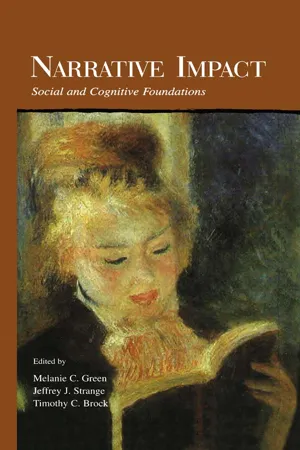
eBook - ePub
Narrative Impact
Social and Cognitive Foundations
- 396 pages
- English
- ePUB (mobile friendly)
- Available on iOS & Android
eBook - ePub
Narrative Impact
Social and Cognitive Foundations
About this book
Information
Publisher
Psychology PressYear
2003Print ISBN
9780415650359
9780805831245
Edition
1eBook ISBN
9781135673277
1
Power Beyond Reckoning
An Introduction to Narrative Impact
Timothy C. Brock
Jeffrey J. Strange
Melanie C. Green
Public narratives—the stories we hear everyday in the news media and the stories that we consume in books, films, plays, soap operas, and so forth—command a large share of our waking attention. Despite the ubiquity of narratives, calls for deeper understanding of their impact are rarely heard from the controllers of public narratives such as censors, school boards, religious leaders, and pundits. Few such calls are issued because these controlling “elders,” as well as most parents of school-age children, simply take narrative impact for granted. On the other hand, producers, such as fiction writers, are absolved of responsibility for narrative impact in part via the well-known disclaimer that similarity to real persons and events is coincidental. Other producers, such as journalists, are more accountable for impact but enjoy appropriate First Amendment freedoms. And so both primary controllers and primary producers of public narratives appear to be joined unwittingly in an agnostic conspiracy against understanding the processes that may underlie impact.
Despite the widespread apathy by practitioners and gatekeepers, the impact of public narratives on beliefs and behavior has received substantial scholarly investigation in disciplines such as sociology (e.g., Gamson, 1992), communications (e.g., Bryant & Zillman, 1994; Gerbner, Gross, Morgan, & Signorielli, 1994), humanities (e.g., Booth, 1988), and political science (e.g., Iyengar & Kinder, 1988). The primary aim of the present volume is to provide a coherent understanding of narrative impact by juxtaposing perspectives from these disciplines with perspectives from cognitive/experimental psychology and social psychology. The aim is accomplished by first focusing on individuals’ experiencing of narrative (Part I) and then expanding the discussion to important public-narrative arenas (Part II). Finally, theoretical integrations are offered (Part III).
Although narrative impact has long been a focus in some disciplines (see previous discussion), it has been relatively ignored, or even discounted (McGuire, 1986), within psychology. Researchers, particularly social psychologists who claim persuasion processes as their domains, have neglected narratives. Instead, during the second half of the 20th century, advocacy messages such as advertising, billboards, sermons, speeches, health campaigns, wartime propaganda, and so forth, have received exhaustive and illuminating scientific study (e.g., Hovland, Lumsdaine, & Sheffield, 1949; Shavitt & Brock, 1994). In contrast, during the same half-century, psychologists have largely overlooked the attitudinal impact of communications whose aim is not advocacy or influence but rather something else, such as entertainment, education, and news reporting. As a result, rhetoric, rather than poetics, has been the focus of the scientific study of persuasion within psychology. This unfortunate imbalance has been the case although, in our everyday world, narrative, in its multifarious manifestations, is far more prevalent than rhetoric. Nonetheless, it is rhetoric that has been the beneficiary of sophisticated theorizing and painstaking empirical inquiry by psychology researchers (e.g., Petty & Wegener, 1998). In the most recent comprehensive graduate-level textbook devoted to the psychology of attitude change (Eagly & Chaiken, 1993), there are more than 2,800 references: None of these thousands of studies addressed the subject of this book, the impact of public narratives, communications that purport to serve functions other than advocacy and propaganda.
Our mandate, to place psychological understanding within the context of a coherent, multidisciplinary approach to narrative impact, stems in part from the magnitude of the effects of such impact. The impact of public narratives can be, and has been, enormous beyond reckoning, as three examples now show. Following these examples, the organization of the book is further delineated, the contributors are introduced, and context for the principal issues and questions is provided.
Uncle Tom’s Cabin: The South and Britain
Other than the Bible, Uncle Tom’s Cabin (Stowe, 1852), a fictional novel, was the best-selling book of the 19th century (Auerbach, 1993, p. 13).
Most Americans are aware that the novel expanded abolitionist sentiment in the years prior to the Civil War, and most Americans may have heard that President Lincoln is alleged to have said to author Harriet Beecher Stowe, “So you’re the little lady who wrote the great book that started this great war.” However, it is less well known that Uncle Tom’s Cabin was even more popular in Britain than in America, with British sales of 1,200,000 within 12 months of publication (Johnson, 1997, p. 416).
British schoolchildren had their ideas of America shaped by Eliza, Tom, and Eva. Britain, which had received much preaching about democracy and equality from Webster and Emerson, now viewed America as morally suspect. Johnson (1997) made a strong case that the book’s success ensured that the British, whose economic interests were intertwined with the Souths (e.g., cotton-based textile industry), remained neutral when the Civil War began. On this view, Stowe’s potboiler not only raised abolitionist sentiment sufficiently to enable the recruitment of Northerners into a war against slavery, it also contributed to Union victory by keeping Britain, with its formidable navy and army, from fighting alongside the South. It is very hard to make the case that any rhetorical presentation of the 19th century (Lincoln’s Gettysburg Address, say) had an impact that was even remotely comparable to that of the fictional narrative, Uncle Tom’s Cabin.
Old New Land: Herzl and Israel
Theodor Herzl, a writer and statesman at the turn of the last century, founded national Zionism and the World Zionist Organization. His name and lifework, the political resurrection of the Jewish people, are engraved in the Israeli consciousness. “Death to the Jews,” the cry from a Parisian mob at the 1895 Dreyfus trial, imbued Herzl with an idea: “a work of infinite grandeur … a mighty dream … if my conception is not translated into reality, at least out of my activity can come a novel” (Potok, 1978, p. 379). The novel was put on hold while more practical steps toward a Jewish homeland were undertaken. These initiatives—all failures—included the enlistment of financial support from wealthy Jewish philanthropists, of political support from the German Kaiser, and of geopolitical support from the Turkish Ottoman empire. The ensuing World Wars and the Holocaust effectively sundered early Zionist organizational efforts. However, in the end, Herzl’s inspiring dream, as embodied in his novel, Altneuland, prevailed.
A visionary novel in which Herzl depicted the harsh wasteland of Palestine as seen by a Jew and a non-Jew during their trip to a distant land—and then seen again some decades later by the same travelers after the land had become a Jewish state. People have labored cooperatively with the resources of modern science to transform the land into a green world of canals, farms, gleaming cities, trains, roads. Jericho is a winter resort. Old Jerusalem has been cleaned, its streets and alleys paved with new stones. Around the old city there are modern suburbs, with parks, tree-shaded boulevards, institutions of learning, markets, lovely homes. Wrote Herzl in the epilogue, “All the acts of mankind were dreams once and will become dreams again.” (Potok, 1978, p. 386)
Herzl died in 1904, at age 44, but his fictional-narrative prophesy, a Jewish state within 50 years, was realized with the founding of modern Israel in 1948. The novelist’s vision prevailed whereas Herzl’s considerable practical efforts foundered.
Christopher Columbus: Public Narrative Trumps Historical Truth
Columbus is only one of two persons honored by name with a national holiday in the United States, and Columbus, Ohio is only one of dozens of eponymous cities and towns. In Spain, four disparate sites vie for the honor of Columbus’s final resting place, and his six-story statue bestrides a major plaza in downtown Madrid. Columbus is so archpivotal that Western Hemisphere history is demarcated into pre- and post-Columbian epochs.
The collective Columbus story (Nina, Pinta, Santa Maria, etc.), as told in 20th century American schoolbooks (Loewen, 1995, p. 44) is shown in Table 1.1a. There is solid evidence for the upper-case text but no evidence for the lower-case embellishments (arduous journey, not realizing what he had done, died penniless) that comprise the story that is so familiar to generations of schoolchildren (Loewen, 1995, p. 44).
The embellishments (Table 1.1a: lower case) surely seem as harmless improvements to an otherwise prosaic account. However, by strengthening the narrative they help mask the actual history. Embellishments notwithstanding, the real power of myth often lies in omissions.
Representative portions of the historical evidence (e.g., including excerpts from Columbus’s diaries, letters) are given in Table 1.1b.
TABLE 1.1a
The Schoolbook Columbus Story: Embellishment Versus Fact
The Schoolbook Columbus Story: Embellishment Versus Fact
BORN in Genoa of humble parents, CHRISTOPHER COLUMBUS GREW UP TO BECOME AN EXPERIENCED SEAFARER, VENTURING AS FAR AS ICELAND AND WEST AFRICA. His adventures convinced him that the world must be round and that the fabled riches of the East—spices and gold—could be had by sailing west, superseding the overland routes, which the Turks had closed off to commerce. TO GET FUNDING FOR HIS ENTERPRISE, HE BESEECHED MONARCH AFTER MONARCH IN WESTERN EUROPE. After at first being dismissed by Ferdinand and Isabella of Spain, Columbus finally got his chance when ISABELLA DECIDED TO UNDERWRITE A modest EXPEDITION. COLUMBUS OUTFITTED THREE pitifully small SHIPS, THE NINA, THE PINTA, AND THE SANTA MARIA, AND SET FORTH FROM SPAIN. AFTER AN arduous JOURNEY of more than 2 months, during which his mutinous crew almost threw him overboard, Columbus discovered the WEST INDIES ON OCTOBER 12, 1492. Unfortunately, although HE MADE THREE MORE VOYAGES TO AMERICA, he never knew he had discovered a New World. COLUMBUS DIED in obscurity, unappreciated, and penniless. Yet without his daring, AMERICAN HISTORY WOULD HAVE BEEN VERY DIFFERENT, for in a sense he made it all possible.
Note. Untrue or unsubstantiated embellishments are in lower case (Loewen, 1995, p. 44).
In summary, “Columbus revolutionized race relations and the modern world by talcing land, wealth, and labor from indigenous people, leading to their extermination (our italics), and by initiating a transatlantic slave trade which created a racial underclass” (Loewen, 1995, p. 55). His legacy includes genocide and racism.
The power of the Schoolbook Columbus narrative appears enormous beyond reckoning. Imagine that some decades after 1492, a pious and wealthy monarch (Phillip II of Spain, say) decided to pay reparations for the crimes of the Columbus voyages. The magnitude of the heinousness of Columbus’s conduct, (Table 1.1b), and, thus, by the same token, the enormousness of the eclipsing power of the Schoolbook narrative (Table 1.1a), is seen in the following truth: Even if reparation funds were available and exceedingly generous, by 1555 there was no one left to pay because the targeted indigenous nations had no living survivors! (Loewen, 1995, p. 55).
Public narratives have not only been important engines of major historical transitions and of reconfigurations of peoples’ worldviews; narrative impact is a mundane phenomenon and a quotidian issue. For example, censorship has always been ubiquitous: In the United States, one of out of three high school students experiences banning of books (Davis, 1979). A film version of the “fourth best English-language novel published this century”: Lolita (Modern Library Board, 1998) was withheld for 2 years during the 1990...
Table of contents
- Cover Page
- Half Title page
- Title Page
- Copyright Page
- Contents
- Foreword
- Preface
- Power Beyond Reckoning An Introduction to Narrative Impact
- The Experience of Stories
- Mythic Structures in Narrative The Domestication of Immortality
- Emotions and the Story Worlds of Fiction
- “Get Up and Win!” Participatory Responses to Narrative
- The Evolution of Interactive Media Toward “Being There” in Nonlinear Narrative Worlds
- Real-World Impact of Narratives
- Controversial Narratives in the Schools Content, Values, and Conflicting Viewpoints
- Entertainment Education and the Persuasive Impact of Narratives
- Girls, Reading, and Narrative Gleaning Crafting Repertoires for Self-Fashioning Within Everyday Life
- The Narrative Integration of Personal and Collective Identity in Social Movements
- Theoretical Perspectives
- How Does the Mind Construct and Represent Stories?
- How Fictional Tales Wag Real-World Beliefs Models and Mechanisms of Narrative Influence
- The Pervasive Role of Stories in Knowledge and Action
- In the Mind's Eye Transportation-Imagery Model of Narrative Persuasion
- Insights and Research Implications Epilogue to Narrative Impact
- Author Index
Trusted by 375,005 students
Access to over 1.5 million titles for a fair monthly price.
Study more efficiently using our study tools.
Frequently asked questions
Yes, you can cancel anytime from the Subscription tab in your account settings on the Perlego website. Your subscription will stay active until the end of your current billing period. Learn how to cancel your subscription
No, books cannot be downloaded as external files, such as PDFs, for use outside of Perlego. However, you can download books within the Perlego app for offline reading on mobile or tablet. Learn how to download books offline
Perlego offers two plans: Essential and Complete
- Essential is ideal for learners and professionals who enjoy exploring a wide range of subjects. Access the Essential Library with 800,000+ trusted titles and best-sellers across business, personal growth, and the humanities. Includes unlimited reading time and Standard Read Aloud voice.
- Complete: Perfect for advanced learners and researchers needing full, unrestricted access. Unlock 1.5M+ books across hundreds of subjects, including academic and specialized titles. The Complete Plan also includes advanced features like Premium Read Aloud and Research Assistant.
We are an online textbook subscription service, where you can get access to an entire online library for less than the price of a single book per month. With over 1.5 million books across 990+ topics, we’ve got you covered! Learn about our mission
Look out for the read-aloud symbol on your next book to see if you can listen to it. The read-aloud tool reads text aloud for you, highlighting the text as it is being read. You can pause it, speed it up and slow it down. Learn more about Read Aloud
Yes! You can use the Perlego app on both iOS and Android devices to read anytime, anywhere — even offline. Perfect for commutes or when you’re on the go.
Please note we cannot support devices running on iOS 13 and Android 7 or earlier. Learn more about using the app
Please note we cannot support devices running on iOS 13 and Android 7 or earlier. Learn more about using the app
Yes, you can access Narrative Impact by Melanie C. Green, Jeffrey J. Strange, Timothy C. Brock, Melanie C. Green,Jeffrey J. Strange,Timothy C. Brock in PDF and/or ePUB format, as well as other popular books in Psychology & History & Theory in Psychology. We have over 1.5 million books available in our catalogue for you to explore.