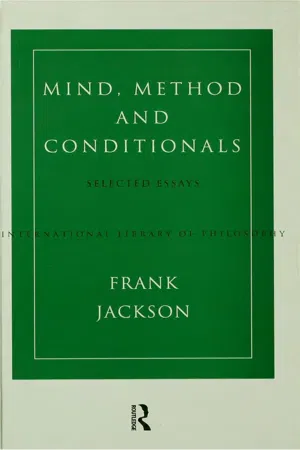
- 296 pages
- English
- ePUB (mobile friendly)
- Available on iOS & Android
eBook - ePub
About this book
First Published in 2004. This collection of essays brings together some of Jackson's most influential publications on mind, action, conditionals, method in metaphysics, ethics and induction. The papers have been revised for this volume and the collection also includes additional material by ay of endnotes and corrections. It also includes two new postscripts- one on conditionals and one disavowing the knowledge argument.
Information
Conditionals
1
On Assertion and Indicative Conditionals
The circumstances in which it is natural to assert the ordinary indicative conditional 'If P then Q' are those in which it is natural to assert 'Either not P, or P and Q', and conversely. For instance, the circumstances in which it is natural to assert 'If it rains, the match will be cancelled' are precisely those in which it is natural to assert 'Either it won't rain, or it will and the match will be cancelled'. Similarly, the circumstances in which it is natural to assert 'Not both P and Q' are precisely those in which it is natural to assert 'Either not P or not Q'. We explain the latter coincidence of assertion conditions by a coincidence of truth conditions. Why not do the same in the case of the conditional? Why not, that is, hold that 'If P then Q' has the same truth conditions as 'Either not P, or P and Q'?
This hypothesis – given the standard and widely accepted truth functional treatments of 'not', 'or', and 'and' – amounts to the Equivalence thesis: the thesis that (P → Q) is equivalent to (P ⊃ Q). (I will use '→' for the indicative conditional, reserving '→ →' for the subjunctive or counterfactual conditional.) In this chapter I defend a version of the Equivalence thesis.
As a rule, our intuitive judgements of assertability match up with our intuitive judgements of probability, that is, S is assertable to the extent that it has high subjective probability for its assertor. Now it has been widely noted that when (P ⊃ Q) is highly probable but both ~P and Q are not highly probable, it is proper to assert (P → Q).1 The problem for the Equivalence thesis is to explain away the putative counter-examples to '~P→(P → Q)' and 'Q →(P Q)', the only too familiar cases where despite the high probability of ~P or of Q, and so of (P ⊃ Q), (P → Q) is not highly assertable.
I will start in §1 by considering the usual way of trying to explain away these counter-examples and argue that it fails. An obvious reaction to this failure would be (is) to abandon the Equivalence thesis, but I argue in §2 that another is possible, namely, that the general thought behind the usual way of explaining away the paradoxes of material implication is mistaken. This leads, in §3, to the version of the Equivalence thesis I wish to defend. In §4 I point out some of the advantages of this account of indicative conditionals, and in §5 I reply to possible objections.
1.1 The usual way of explaining away the counter-examples
Suppose S1 is logically stronger than S2: S1 entails S2, but not conversely. And suppose S1 is nearly as highly probable as S2. (It cannot, of course, be quite as probable, except in very special cases.) Why then assert S2 instead of S1? There are many possible reasons: S2 might read or sound better, S1 might be unduly blunt or obscene, and so on. But if we concentrate on epistemic and semantic considerations widely construed, and put aside more particular, highly contextual ones like those just mentioned, it seems that there would be no reason to assert S2 instead of S1. There is no significant loss of probability in asserting S1 and, by the transitivity of entailment, S1 must yield everything and more that S2 does. Therefore, S1 is to be asserted rather than S2, ceteris paribus.
This line of thought, which I will tag 'Assert the stronger instead of the weaker (when probabilities are close)', has been prominent in defences of the Equivalence thesis that the ordinary indicative conditional (P → Q) is equivalent to the material conditional, (P ⊃ Q).2 The Equivalence theorist explains away the impropriety of asserting (P ⊃ Q) when one of ~P or Q is highly probable, by saying that, in such a case, you should come right out and assert the logically stronger statement, namely, either ~P, or Q, as the case may be.
The same idea can be put in terms of evidence instead of probability.3 If your evidence favours (P ⊃ Q) by favouring one of ~P or Q, you should simply assert ~P, or assert Q, whichever it is, and not the needlessly weak conditional.4 But I will concentrate in the main on the probabilistic formulation when presenting my objections.
My first objection is that a conditional like 'If the sun goes out of existence in ten minutes' time, the Earth will be plunged into darkness in about eighteen minutes' time' is highly assertable. However the probability of the material conditional and the probability of the negation of its antecedent are both very close to one; and so at most the probability of the conditional is only marginally the greater. Hence this is a case where the weaker is assertable despite the absence of any appreciable gain in probability, contrary to the maxim 'Assert the stronger instead of the weaker'.
The second objection is that conditionals whose high probability is almost entirely due to that of their consequents may be highly assertable. Suppose we are convinced that Carter will be re-elected whether or not Reagan runs. We say both 'If Reagan runs, Carter will be re-elected' and 'If Reagan does not run, Carter will be re-elected'. The high subjective probability can only be due to that of the common consequent, yet the consequent is allegedly logically stronger and so, by the maxim, the conditionals ought not to be assertable.
Moreover, such cases cannot be handled by a conventional exemption from the maxim in the case of conditionals with very probable consequents,5 Both the following conditionals are highly unassertable, but have very probable consequents: 'If the history books are wrong, Caesar defeated Pompey in 48 BC'; 'If the sun goes out of existence in ten minutes' time, the Earth will not be plunged into darkness in eighteen minutes' time'.
The third objection is that there is a third paradox of material implication. If the Equivalence thesis is true, then ((P → Q) v (Q → R)) is a logical truth. But evidently it is not in general highly assertable. Of course logical truths are as logically weak as you can get, nevertheless 'Assert the stronger instead of the weaker' is of no assistance in explaining away the third paradox. Whatever you think about this maxim in general, it does not apply universally to logical truths. 'If that's the way it is, then that's the way it is'; 'George must either be here or not here'; 'The part is not greater than the whole' and so on, are all highly assertable.
The fourth objection is that 'Assert the stronger instead of the weaker' is, of necessity, silent about divergences in assertability among logical equivalents, simply because logical equivalents do not differ in strength. But equivalence theorists must acknowledge some marked divergences among equivalents. According to them, ((P & (~P → R)) and (P & (~P → S)) are logically equivalent, both being equivalent to P. But their assertability can differ sharply. 'The sun will come up tomorrow but if it doesn't, it won't matter' is highly unassemble, while 'The sun will come up tomorrow but if it doesn't, that will be the end of the world' is highly assertable.
My final objection is that if the standard way of trying to explain away the paradoxes is right, 'or' and '→' are on a par It would, for instance, be just as wrong, and just as right, to assert 'P or Q' merely on the basis of knowing P as to assert (P ⊃ Q) merely on the basis of knowing not P. And, more generally, 'P → (P or Q)' and 'Q →(P or Q)' should strike us as just as much a problem for the thesis that 'P or Q' is equivalent to (P v Q) as do the paradoxes of material implication for the Equivalence thesis. It is a plain fact that they do not. The thesis that 'P or Q' is equivalent to (P v Q) is relatively non-controversial; the thesis that (P → Q) is equivalent to (P ⊃ Q) is highly controversial.
This objection, of course, applies not just to attempts to explain away the paradoxes in terms of 'Assert the stronger', but to any attempt which appeals simply to considerations of conversational propriety. It leaves it a mystery why we – who are, after all, reasonably normal language users – find it so easy to swallow one thesis and so hard to swallow the other.
Should we respond to these objections by abandoning the Equivalence thesis, or by looking for a different way of explaining away the paradoxes? An argument for the latter is that the thought behind 'Assert the stronger rather than the weaker' contains a serious lacuna, as I now argue.
1.2 A reason for sometimes asserting the weaker
Suppose, as before, that S1 is logically stronger than S2, and that S1s probability is only marginally lower than S2's. Consistent with this, it may be that the impact of new information, I, on S1 is very different from the impact of I on S2. in particular, it may happen that I reduces the probability of S1 substantially without reducing S2's to any significant extent (indeed S2's may rise). I will describe such a situation as one where S2 but not S1, is robust with respect to I. If we accept Conditionalisation, the plausible thesis that the impact of new information is given by the relevant conditional probability, then 'P is robust with respect to I' will be true just when both Pr(P) and Pr(P/I) are close and high6 (Obviously, a more general account would simply require that Pr(P) and Pr(P/I) be close, but throughout we will be concerned only with cases where the probabilities are high enough to warrant assertion, other things being equal.)
We can now see the lacuna in the line of thought lying behind 'Assert the stronger instead of the weaker'. Despite S1 and S2 both being highly probable, and S1 entailing everything S2 does, there may be a good reason for asserting `S2 either instead of or as well as S1. It may be desirable that what you say should remain highly probable should I turn out to be the case, and further it may be that Pr(S2/I) is high while Pr(S1/I) is low. In short, robustness with respect to I may be desirable, and (consistent with S1 entailing S2) S2 may have it while S1 lacks it.
Examples bear this out. Robustness is an important ingredient in assertability. Here are two examples taken from those which might be (are) thought to be nothing more than illustrations of 'Assert the stronger instead of the weaker'.
Suppose I read in the paper that Hyperion won the 4.15. George asks me who won the 4.15. I say, 'Either Hyperion or Hydrogen won'. Everyone agrees that I have done the wrong thing. Although the disjunction is highly probable, it is not highly assertable. Why? The standard explanation is in terms of 'Assert the stronger instead of the weaker'.7 But is this the whole story? Consider the following modification to our case. What I read is...
Table of contents
- Cover
- Half Title
- Title
- Copyright
- Contents
- Preface
- PART I Conditionals
- PART II Mind
- PART III Method in metaphysics
- PART IV Ethics and action theory
- PART V Induction
- Bibliography
- Index
Trusted by 375,005 students
Access to over 1.5 million titles for a fair monthly price.
Study more efficiently using our study tools.
Frequently asked questions
Yes, you can cancel anytime from the Subscription tab in your account settings on the Perlego website. Your subscription will stay active until the end of your current billing period. Learn how to cancel your subscription
No, books cannot be downloaded as external files, such as PDFs, for use outside of Perlego. However, you can download books within the Perlego app for offline reading on mobile or tablet. Learn how to download books offline
Perlego offers two plans: Essential and Complete
- Essential is ideal for learners and professionals who enjoy exploring a wide range of subjects. Access the Essential Library with 800,000+ trusted titles and best-sellers across business, personal growth, and the humanities. Includes unlimited reading time and Standard Read Aloud voice.
- Complete: Perfect for advanced learners and researchers needing full, unrestricted access. Unlock 1.5M+ books across hundreds of subjects, including academic and specialized titles. The Complete Plan also includes advanced features like Premium Read Aloud and Research Assistant.
We are an online textbook subscription service, where you can get access to an entire online library for less than the price of a single book per month. With over 1.5 million books across 990+ topics, we’ve got you covered! Learn about our mission
Look out for the read-aloud symbol on your next book to see if you can listen to it. The read-aloud tool reads text aloud for you, highlighting the text as it is being read. You can pause it, speed it up and slow it down. Learn more about Read Aloud
Yes! You can use the Perlego app on both iOS and Android devices to read anytime, anywhere — even offline. Perfect for commutes or when you’re on the go.
Please note we cannot support devices running on iOS 13 and Android 7 or earlier. Learn more about using the app
Please note we cannot support devices running on iOS 13 and Android 7 or earlier. Learn more about using the app
Yes, you can access Mind, Method and Conditionals by Frank Jackson in PDF and/or ePUB format, as well as other popular books in Philosophy & Philosophy History & Theory. We have over 1.5 million books available in our catalogue for you to explore.