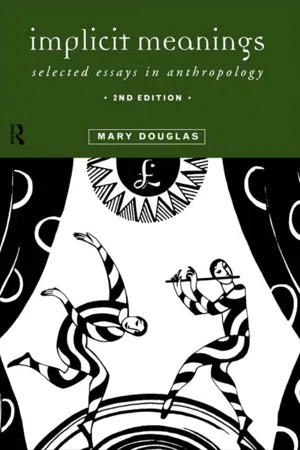
Implicit Meanings was first published to great acclaim in 1975. It includes writings on the key themes which are associated with Mary Douglas' work and which have had a major influence on anthropological thought, such as food, pollution, risk, animals and myth. The papers in this text demonstrate the importance of seeking to understand beliefs and practices that are implicit and a priori within what might seem to be alien cultures.
- 342 pages
- English
- ePUB (mobile friendly)
- Available on iOS & Android
eBook - ePub
About this book
Information
Part I
Essays on the implicit
Introduction
1975
It seems hardly worth noting that some matters are deemed more worthy of scholarship than others. If there is any one idea on which the present currents of thought are agreed it is that at any given moment of time the state of received knowledge is backgrounded by a clutter of suppressed information. It is also agreed that the information is not suppressed by reason of its inherent worthlessness, nor by any passive process of forgetting: it is actively thrust out of the way because of difficulties in making it fit whatever happens to be in hand. The process of ‘foregrounding’ or ‘relevating’ now receives attention from many different quarters. But for obvious reasons the process of ‘backgrounding’ is less accessible. The chapters in this section focus on ‘backgrounding’. They identify a number of different situations in which information is pushed out of sight. At one extreme it is automatically destroyed by reason of its conflict with other information. For example, the continuity of human with animal life is a piece of information which is consistently relegated to oblivion by all the social criteria which allow humans to use a discontinuity between nature and culture for judging good behaviour. The history of the behavioural sciences has been to reclaim bit by bit and make significant to us our common animal nature.
By a less extreme process of relegation, some information is treated as self-evident. The logical steps by which other knowledge has to be justified are not required. This kind of information, never being made explicit, furnishes the stable background on which more coherent meanings are based. It is referred to obliquely as a set of known truths about the earth, the weight and powers of objects, the physiology of humans, and so on. This is a completely different pigeonhole of oblivion from the first. Whereas the former knowledge is destroyed by being labelled untrue, the latter is regarded as too true to warrant discussion. It provides the necessary unexamined assumptions upon which ordinary discourse takes place. Its stability is an illusion, for a large part of discourse is dedicated to creating, revising, and obliquely affirming this implicit background, without ever directing explicit attention upon it. When the background of assumptions upholds what is verbally explicit, meanings come across loud and clear. Through these implicit channels of meaning, human society itself is achieved, clarity, and speed of clue-reading ensured. In the elusive exchange between explicit and implicit meanings a perceived-to-be-regular universe establishes itself precariously, shifts, topples, and sets itself up again.
A third kind of backgrounding stems from the first two. This is the creation of dirt, rubbish, and defilement. Humble rules of hygiene turn out to be rationally connected with the way that the Lele cosmos is constructed. Rejection of body dirt and rejection of inedible animals is an indivisible part of the foregrounding processes by which the universe is classified and known. For example, there cannot be any possibility of truth, in a cognitive system such as that of the Lele, for the notion that menstrual blood is harmless or that its contagion is not conveyed through food cooked on a fire tended by a menstruating woman. The whole cosmos would topple if such a piece of tendentious and obviously false information were accepted.
The essay on ‘Pollution’ (Chapter 7) opens the topic in a strictly anthropological vein. Defilement and magic were not thought to be worthy of a nineteenth-century scholar’s attention and to poke into the processes of thought which attached the label of impurity was suspect in the same way as the investigation of sex or death in our day. In consequence, a lot of unexplained assumptions have lumbered the study of primitive religion. This paper was being editorially processed before Purity and Danger was drafted, though it was published two years later – producing an encyclopaedia is necessarily a stately business. The central theme of Purity and Danger is stated here: each tribe actively construes its particular universe in the course of an internal dialogue about law and order. The currently accepted tribal wisdom invests the physical world it knows with a powerful backlash on moral disorder. Peter Berger and Thomas Luckmann say much that is valuable about the social construction of reality (1961). But, like other followers of Alfred Schutz, they make an unnecessary and misleading distinction between two kinds of reality, one social and one not social. This prevents them from being able to appreciate the social uses of the environment as a weapon of mutual coercion. If they could be more radical in their thought, if they could admit that the environment is for enlisting support, and therefore that all reality is social reality, then they could embark on the comparative project. How many kinds of appeals to the objective environment can be used to drum up support? What sort of typology of morality-sustaining universes could be made that would embrace ours and those of primitive societies? It is easier to see that tribesmen project the moral order upon their universe than to recognise the same process working among ourselves. Therefore the two essays, one on ‘Environments at risk’ (Chapter 16) and one on ‘Couvade and menstruation’ (Chapter 12), take the argument of Purity and Danger out of its secluded anthropological context. They challenge us to discover how we ourselves have constructed in collusion the constraints which we find in our universe. Our fears about the perils of global over-population or destruction of resources or the evil effects of thoughtless procreation, pornography, and a failure of parental love, match those of a tribal society worrying about epidemics unleashed by incest or game animals disappearing from the forest because of human quarrelling. Our consciousness has so internalised these fears that we are fascinated by the symptoms and unable to look dispassionately at the social relations that generate them.
But the alternative, true consciousness, scarcely bears contemplation. The implicit is the necessary foundation of social intercourse. For men to speak with one another with perfect explicitness, uttering no threats of a backlash from nature – science fiction would be hard put to make such a society convincing. Ethnomethodologists, who disparage the assumed environment for its political inertia, cannot tell us what society would be like with all communication fully verbalised and none oblique. But if that is unimaginable, there are many problems about the implicit that can be discussed. Once we agree that the idea of nature is put to social uses, the challenge is to examine the social relations it masks.
The next two essays consider how and why some information has to be discounted. Information that forms an intelligible pattern in that very process destroys competing information. How the notion of primitive man is presented at any one time is a case in point. ‘Heathen Darkness’ shows the idea of primitive man being chopped to this or that shape to fit the dialectical needs of parties to a political debate. It was modern man they were talking about when they hotly argued that primitives were deeply religious or deeply superstitious. Realising that primitive man includes the whole gamut of human possibility, and realising that how he worships is part of how he lives and has little comfort one way or another for theology, we can remove the filters that showed him in any preordained light. Suddenly masses of suppressed information surface about thoroughly secular, pragmatic primitives. The screening out process is switched off, but not before we have caught it at work.
‘Do Dogs Laugh?’ (Chapter 11) considers the screening of information from another angle. It asks the reader to take a standpoint from within any verbal debate and note how much information is given and received through non-verbal channels. It is an attempt to reverse the usual organic analogy by which society is seen as a body. Instead the body is seen as an information coding and transmitting machine, a communication system which can be wired to carry a number of different loads. The heavier the load of messages, the more economical the use of available space and time. The total load and the total pressure of control are determined by the expected density of significant interactions, by something, that is to say, in the social system as it affects the communicating individuals. In a heavily loaded system each signal has to register its effect with less use of the resources of the bodily system as a whole. Vice versa, with light loading, each signal can use more of the communication resources. The underlying assumption reverses a common one in the social sciences, that loss of control is the exception needing to be explained. Here it is assumed that more control is more improbable and needs more explaining than less control. The narrower upshot is to suggest that the screening out of irrelevant bodily information is one of the distinctively human capacities. Animals are presumed to take account of involuntary smells and eructations: we select according to a screening and assessing principle which submits free bodily expression to the demand to be informed about the social situation. By means of such a systemic approach, problems can be solved which cannot even be formulated by a piecemeal interpretation of discrete signals and responses.
It is all very well to repeat that foregrounding and backgrounding are necessary for creating form. When the whole social process is taken integrally as the production of meaning, the next sets of questions to be tackled have to do with the relation between different channels of expression.
In ‘Jokes’ (Chapter 10) we suppose that in communication the conveyor of information seeks to achieve some harmony between all possible sources of information. It is not exactly a daring assumption. We have seen that the cognitive drive to demand coherence and regularity in experience requires the destruction of some information for the sake of a more regular processing of the rest. At the same time, for the same reasons, it musters agreement from the different channels of communication. Senders of information seek to convince their wouldbe receivers. Under the threat of refusing to ratify the credibility of information given in contradictory styles, the very situation of communication forces the different channels to strive to match their separate performances. This article uses joke-perception as an example of concordances between different channels. In its structure the verbal joke replicates the situation in which it is uttered and so it can be perceived to be a joke. The laugh is a bodily response which mimes both the verbal and social structures. Freud’s analysis of wit suggests further miming at a psychological level. By such mimesis, when one area of experience figured upon another is rendered intelligible, all domains, the social, the physical, the emotional, snap into alignment. This set of correspondences, which results from the subject’s organising effort, is the subjective recognition of truth. Intelligibility organises the subject as well as the object of knowledge. If this description holds good for jokes, it ought to be demonstrable from other formally patterned experience.
Where does the energy for foregrounding some information and destroying or backgrounding some other information derive? in case the point is missed, I emphasise again that this vast energy is not an undirected, random intellectual force. It can only be generated directly in and as part of social interaction. Most forms of social life call somewhere for coherence and clear definition. The same energy that constrains disruptive passions and creates a certain pattern of society also organises knowledge in a compatible, workable, usable form.
Since the whole social process is too large and unwieldy for dissection, there are great problems of method in trying to study how related channels of communication agree so well that they tend to deliver the same message each in its different way. One solution is to study units of behaviour whose limits are formally recognised within the flow of communications. Like an illness, a rite or a meal, a joke’s beginning and end are established. This is because the social roles which sickness, ritual, meals, and jokes permit are also bounded. As a delimited enactment the joke lends itself to our study. By noting the multi-layered repetition of formal patterns that deliver the joke we can see that it is anchored in a social situation. Particular meanings are parts of larger ones and these refer ultimately to a whole in which all the available knowledge is related. But the largest whole into which all minor meanings fit can only be a metaphysical scheme. This itself has to be traced to the particular way of life which is realised within it and which generates the meanings. In the end, all meanings are social meanings.
Though all the essays in this section deal with rituals and symbolic systems, they all transcend the distinction between sacred and secular, mystical and real, expressive and instrumental. They approach the so-called expressive order full of wariness against the misleading implications of the verb ‘to express’. That word establishes a distinction between the expression and that which is expressed. The object of our study discloses no such cleavage. Knowledge is a continuous process of realisation involving both the implicit and the explicit.
Chapter 1
The Lele of the Kasai
First published in D. Forde (ed.) (1954), African Worlds, Oxford, International African Institute
The Lele1 are the western neighbours of the Bushongo2 in the southwest of the Belgian Congo. The population of 20,000 has a density of about four to the square mile, but the total density of the district they inhabit is doubled by recent immigrants of the Luba and Cokwe tribes. The region is bounded on the north and east by the Kasai river, whose tributary, the Lumbundji, divides it into eastern and western sub-regions, each a separate chiefdom. It is with the western sub-region, lying between the Loange and the Lumbundji, that I am familiar and from which my observations are drawn. However, what I have learnt in the west is probably true also of the easterly chiefdom, which shares similar ecological conditions. There is a third group of Lele living to the south, whose country is predominantly savannah, instead of mixed savannah and forest. It is unlikely that my observations about the western Lele apply also to these southerners.
Lele country is at the extreme edge of the equatorial forest belt,3 hence the great change of scene in the 150 miles from north to south. The Nkutu, their northern neighbours on the other bank of the Kasai, inhabit dense forest. Their southern neighbours, the Njembe, live in rolling grassland. Lele country has thickly forested valleys separated by barren grasstopped hills.
It is useless to discuss any aspect of Lele religion without first summarising the material conditions of their life. This is not because these seem to have determined the bias of their religious thinking. On the contrary, the manner in which they have chosen to exploit their environment may well be due to the ritual categories through which they apprehend it.
MATERIAL ENVIRONMENT AND ECONOMY
A straightforward account of Lele material culture would not give the impression that hunting is their most important activity. By comparison with the Cokwe hunters, who have immigrated from the Kwango district into Lele country, they even seem inefficient in this pursuit. On the contrary, the culture of the raffia palm would seem to be their most vital economic activity, and if their ritual values were derived from their social and economic values, then we would expect the Lele religion to be centred round the cultivation of the raffia palm. Yet this is not so. Again, assuming that a people long settled4 in their environment normally exploit it to the full, it is difficult to see why the Lele refuse to breed goats and pigs (which thrive locally), and why the cultivation of groundnuts is left entirely to the women. These problems find some solution, however, when they are seen in the context of their metaphysical assumptions and religious practice.
The Lele village, a compact square of 20 to 100 huts, is always set in the grassland. From each corner of the village, paths run down to the nearest part of the forest. They wind first through groves of palms which ring the village round, and then through the grass and scrub. The palm groves give shade to the men working at their weaving-looms. Each corner of the village belongs to one of the four men’s age-sets, which has its own groves adjacent to its row of huts. Alternating with the men’s groves are other groves used by their women-folk for pounding grain. Farther away still is another ring of groves where the women prepare palm-oil. The layout of the village shows a deliberate separation of sexes. In all their work, feeding, and leisure, the women are set apart from the men. This separation of the sexes is a formality which they observe, a rule of social etiquette, not a natural principle derived from the nature of the work they perform, for in many of their economic activities there is a close collaboration between men and women. The separation and interdependence of the sexes is a basic theme of their social organisation and ritual, and one which is reiterated in almost every possible context.
Their staple food is maize, cultivated in the forest by slash and burn methods. With such a scattered population no land shortage is recognised and no crop rotation is practised. Maize is only planted once in a forest clearing, and fresh clearings are made each year for the new crop.5 The original clearing is kept open for several years, until the other crops planted in it have matured. The most important of these is raffia palm, and in recent years manioc has become nearly as important as maize. Small quantities of pineapples, red peppers, and hill rice are also cultivated.
The palm takes four or five years to mature, and is very carefully cultivated. All its products are used; its main ribs for hut wall and roof supports, its fibres as string in hut building and basketry, its smaller ribs as arrow shafts, its outside leaves as thatching for the walls and roofs of huts. The inner cuticle of the young leaf is the material from which they weave their raffia cloths. Finally, one of the most valued products of the palm is the fermented wine, which forms the second staple article of diet. When the wine is all drawn off and the palm dead, its rotting stem harbours grubs which are a highly prized delicacy. When they ...
Table of contents
- Cover Page
- Title Page
- Copyright Page
- Preface, 1999
- Preface, 1975
- Part I: Essays on the implicit
- Part II: Critical essays
- Part III: Essays on the a priori
Trusted by 375,005 students
Access to over 1.5 million titles for a fair monthly price.
Study more efficiently using our study tools.
Frequently asked questions
Yes, you can cancel anytime from the Subscription tab in your account settings on the Perlego website. Your subscription will stay active until the end of your current billing period. Learn how to cancel your subscription
No, books cannot be downloaded as external files, such as PDFs, for use outside of Perlego. However, you can download books within the Perlego app for offline reading on mobile or tablet. Learn how to download books offline
Perlego offers two plans: Essential and Complete
- Essential is ideal for learners and professionals who enjoy exploring a wide range of subjects. Access the Essential Library with 800,000+ trusted titles and best-sellers across business, personal growth, and the humanities. Includes unlimited reading time and Standard Read Aloud voice.
- Complete: Perfect for advanced learners and researchers needing full, unrestricted access. Unlock 1.5M+ books across hundreds of subjects, including academic and specialized titles. The Complete Plan also includes advanced features like Premium Read Aloud and Research Assistant.
We are an online textbook subscription service, where you can get access to an entire online library for less than the price of a single book per month. With over 1.5 million books across 990+ topics, we’ve got you covered! Learn about our mission
Look out for the read-aloud symbol on your next book to see if you can listen to it. The read-aloud tool reads text aloud for you, highlighting the text as it is being read. You can pause it, speed it up and slow it down. Learn more about Read Aloud
Yes! You can use the Perlego app on both iOS and Android devices to read anytime, anywhere — even offline. Perfect for commutes or when you’re on the go.
Please note we cannot support devices running on iOS 13 and Android 7 or earlier. Learn more about using the app
Please note we cannot support devices running on iOS 13 and Android 7 or earlier. Learn more about using the app
Yes, you can access Implicit Meanings by Professor Mary Douglas,Mary Douglas in PDF and/or ePUB format, as well as other popular books in Social Sciences & Anthropology. We have over 1.5 million books available in our catalogue for you to explore.