Timothy O'Hagan investigates Jean-Jacques Rousseau's writings concerning the formation of humanity, of the individual and of the citizen in his three master works: the Discourse on the Origin of Inequality among Men, Emile and the Social Contract. He explores Rousseau's reflections on the sexes, language and religion. O'Hagan gives Rousseau's arguments a close and sympathetic reading. He writes as a philosopher, not a historian, yet he never loses sight of the cultural context of Rousseau's work.
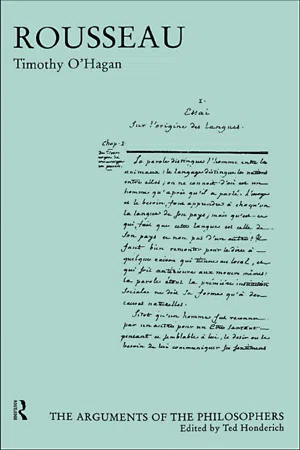
- 332 pages
- English
- ePUB (mobile friendly)
- Available on iOS & Android
eBook - ePub
Rousseau
About this book
Information
Topic
PhilosophySubtopic
Modern PhilosophyNotes
Introduction Rousseau: the life and the work
1 This sketch is based on the magisterial biographies of Guéhenno and Cranston and on the ‘Chronologie’ of Gagnebin and Raymond (OC 1.ci-cxviii). My periodization of Rousseau’s life was based on that in La route Rousseau, pp. 75–7 (‘Quelques dates’), but ended up somewhat different from it.
2 Gagnebin and Raymond (OC 1.1264) and Cranston, Jean-Jacques, the Early Life and Work of Jean-Jacques Rousseau, 1712–1754, London: Allen Lane, 1983, p. 17, note that Jean-Jacques pretended, in the opening pages of the Confessions (Conf I.6/7), that his mother was the daughter, rather than the niece, of a pastor.
3 For this phrase and for this understanding of Rousseau’s relationship to the philosophes I am indebted to Hulliung, The Autocritique of Enlightenment: Rousseau and the Philosophes, Cambridge, MA: Harvard University Press, 1994.
4 Condorcet, Esquisse d’un tableau historique des progrès de l’esprit humain (10e. période), Paris: Editions Sociales, 1966, p. 274 (English translation, p. 193). On the significance of Condorcet’s slogan, see Hollis, Trust within Reason, Cambridge: Cambridge University Press, 1998.
5 On this, see especially Hulliung, op. cit.
6 Quoted by Guéhenno, Jean-Jacques Rousseau, vol. 2, 1758–1778, London: Routledge & Kegan Paul, 1966, pp.
165–6.
165–6.
7 Osmont, Introduction to RJJJ in OC 1.lv.
8 See Kelly, Rousseau’s Exemplary Life: the ‘Confessions’ as Political Philosophy, Ithaca: Cornell University Press, 1987, p. 240, for the relationship between the Confessions and Rousseau, Judge of Jean-Jacques.
9 See Rousseau, ‘History of the Preceding Writing’, OC 1.978/CW 1.248. For the most sensitive analysis of these strange events, see Starobinski, Jean-Jacques Rousseau: la transparence et l’obstacle, Paris: Gallimard, 1970, pp. 270–3.
10 This section is based on Starobinski, ‘La maladie de Rousseau’, ibid., pp. 430–44.
11 Ibid., p. 438.
12 Admittedly this includes some duplicated material, drafts of the Emile and the Social Contract, for instance, as well as Rousseau’s laundry lists and bakery bills. But the volume of work is still daunting.
13 Hume, The Letters of David Hume, ed. Greig, Oxford: Clarendon Press, 1932, vol. 2, #314, p. 313.
14 In particular those of Goldschmidt, Masters and Dent.
15 There are several gaps in my book. In particular I make no attempt to treat Rousseau’s writings on music, the most enduring and important love of his life. This deprives the reader of an analysis of some of Rousseau’s most important work and it distorts the exegesis of the Essay on the Origin of Languages. Insofar as Rousseau’s thoughts about music are an integral part of his critical reaction to contemporary culture, in ignoring his musicology, I am ignoring a major part of that critique. My only excuse for this omission is my incompetence in this field and my inability to add anything to the outstanding work on the subject that is readily available. See in particular Wokler’s magnum opus Rousseau on Society, Politics, Music and Language: an Historical Interpretation of his Early Writings, New York: Garland, 1987, and his brief, elegant summary in Rousseau, Oxford: Oxford University Press, 1995. See also the works of Starobinski and Kinzler referred to in Chapter IX below.
16 Hume, op. cit., vol. 1, #196, p. 364.
Chapter I
Rousseau’s Divided Thought: the Morality of the Senses and the Morality of Duty
1 Locke, An Essay Concerning Human Understanding IV.3.6.
2 For the classic statement of the problem of interaction, see Descartes’ letter to Princess Elisabeth (28 June 1643) (AT III.691–2/CSMK III.227). For a remarkable and sympathetic interpretation of Descartes’ theory, see Baker and Morris, Descartes’ Dualism, London: Routledge, 1996.
3 Gauthier gives a luminous account of Rousseau’s strategies in ‘The politics of redemption’, in Moral Dealing, Ithaca, NY: Cornell University Press, 1990; ‘Le Promeneur Solitaire: Rousseau and the emergence of the post-social self’ in Paul, Miller and Paul (eds), Ethics, Politics, and Human Nature, Oxford: Blackwell, 1991; ‘Making Jean-Jacques’, in O’Hagan (ed.), Jean-Jacques Rousseau and the Sources of the Self, Aldershot: Avebury, 1997.
4 Starobinski, Jean-Jacques Rousseau: la transparence et l’obstacle, Paris: Gallimard (Collection Tel), 1971 (1970), p. 256.
5 Ibid., p. 254.
6 Gagnebin and Raymond, whose notes to the Confessions provided the starting point of my discussion of bad faith, commented: ‘[Starobinski’s] criticism [of Rousseau] is impeccable from an intellectual point of view. But one might object that in reality it is not at all the same man who first organizes his environment, and then gives way to his action. It is possible to be successively the mystifier and the mystified. Is there bad faith in deliberately submitting to a régime which one expects will provide one’s salvation? The better part of us (according to our choice) decides somehow to exorcize the worse, with the help of things’ (OC I.1470). I agree with them that people engaged in the morality of the senses are not necessarily involved in bad faith. But I differ from them since I hold that such moral agents are neither mystifiers nor mystified. They arrange their environment in such a way that they can lead a life which is both spontaneous and good.
7 See Schwartz, The Sexual Politics of Jean-Jacques Rousseau, Chicago: Chicago University Press, 1984, p. 139.
8 Cf. the letter to Franquieres, 15 January 1769: ‘This word virtue means force. There is no virtue without combat…’ (CC 37#6529, p. 21). At Em V.817/ 444 Bloom translates the French force as ‘strength’, and that is indeed its primary meaning. I prefer ‘force’ to bring out the connection with struggle or combat, since that seems to be at the heart of this strand of Rousseau’s thought.
9 Indeed the definition of political virtue in the Third Discourse suggests an ideal of harmony rather than domination: ‘as virtue is only this conformity of the particular will to the general will, make virtue rule’ (3D 252/ 149).
10 Cranston, The Noble Savage: Jean-Jacques Rousseau, 1754–1762, London: Allen Lane, 1991, p. 265.
11 The Abbe’s letter is at CC 8#1331, pp. 184–95, 27 February 1761. Readers who are disturbed by the moral blackmail, laced with a whiff of incest, are right to be so. For an illuminating reading of Julie, ou la Nouvelle Héloïse, see Tanner, ‘Julie and “La Maison Paternelle”: another look at Rousseau’s La Nouvelle Héloïse,’ in Daedalus, 105, 1976.
12 OC 1.1725.
13 Gilson, ‘La methode de M.de Wolmar’, in Les idées et les lettres, Paris: Vrin, 1932, pp. 283–4.
14 Cassirer, The Question of Jean-Jacques Rousseau, trans. Gay, New York: Columbia University Press, 1954 (‘Das Problem Jean-Jacques Rousseau’, first published in Archivfur Geschichte der Philosophie, 1932).
15 Cassirer, op. cit., p. 99.
16 Cassirer, op. cit., p. 104.
17 Ibid.
18 Cassirer, op. cit., p. 118.
19 Kant, Critique of Practical Reason (1788), trans. White Beck, Indianapolis: Bobbs Merrill, 1956, p. 129. On this see O’Hagan, ‘Hegel’s critique of Kant’s moral and political philosophy’, in Priest (ed.), Heg...
Table of contents
- Cover Page
- Title Page
- Copyright Page
- Acknowledgements
- Introduction: Rousseau: The Life and the Work
- I. Rousseau’s Divided Thought: The Morality of the Senses and the Morality of Duty
- II. The Discourse On the Origin of Inequality Among Men
- III. The Emile
- IV. The Social Contract: Principles of Right
- V. The Empire of the Laws: The General Will and Totalitarianism
- VI. The Social Contract: Maxims of Politics
- VII. Amour-Propre
- VIII. Men and Women
- IX. Language
- X. Religion and Politics
- XI. Negative Theology: Revealed Religion Criticized
- XII. Positive Theology: Natural Religion Defended
- Concluding Reflections
- Notes
- Bibliography and Reference Conventions
Trusted by 375,005 students
Access to over 1.5 million titles for a fair monthly price.
Study more efficiently using our study tools.
Frequently asked questions
Yes, you can cancel anytime from the Subscription tab in your account settings on the Perlego website. Your subscription will stay active until the end of your current billing period. Learn how to cancel your subscription
No, books cannot be downloaded as external files, such as PDFs, for use outside of Perlego. However, you can download books within the Perlego app for offline reading on mobile or tablet. Learn how to download books offline
Perlego offers two plans: Essential and Complete
- Essential is ideal for learners and professionals who enjoy exploring a wide range of subjects. Access the Essential Library with 800,000+ trusted titles and best-sellers across business, personal growth, and the humanities. Includes unlimited reading time and Standard Read Aloud voice.
- Complete: Perfect for advanced learners and researchers needing full, unrestricted access. Unlock 1.5M+ books across hundreds of subjects, including academic and specialized titles. The Complete Plan also includes advanced features like Premium Read Aloud and Research Assistant.
We are an online textbook subscription service, where you can get access to an entire online library for less than the price of a single book per month. With over 1.5 million books across 990+ topics, we’ve got you covered! Learn about our mission
Look out for the read-aloud symbol on your next book to see if you can listen to it. The read-aloud tool reads text aloud for you, highlighting the text as it is being read. You can pause it, speed it up and slow it down. Learn more about Read Aloud
Yes! You can use the Perlego app on both iOS and Android devices to read anytime, anywhere — even offline. Perfect for commutes or when you’re on the go.
Please note we cannot support devices running on iOS 13 and Android 7 or earlier. Learn more about using the app
Please note we cannot support devices running on iOS 13 and Android 7 or earlier. Learn more about using the app
Yes, you can access Rousseau by Timothy O'Hagan in PDF and/or ePUB format, as well as other popular books in Philosophy & Modern Philosophy. We have over 1.5 million books available in our catalogue for you to explore.