- 304 pages
- English
- ePUB (mobile friendly)
- Available on iOS & Android
eBook - ePub
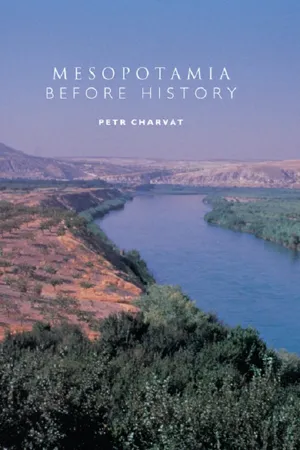
Mesopotamia Before History
About this book
Mesopotamia was one of the earliest regions to produce writing, literature and the fine arts, as well as being one of the first areas to construct states. This comprehensive and detailed survey of the region's prehistory and protohistory shows how these fascinating developments were possible.
Petr Charvát explores the economic, social and spiritual spheres in Mesopotamia from the Palaeolithic to the time of the early states, c. 100,000 BC to 2334 BC. The narrative is supplemented by numerous descriptions of the principal archaeological sites for each phase, and by conclusions outlining the most important developments and changes.
Chapter One
The Palaeolithic
PILOT SITES
Shanidar
A cave at an altitude of 750 m above sea level in the lower part of a mountain valley, 35 km west of Rawanduz. A US excavation of 1951, 1953, 1956–1957 and 1960 directed by R.S.Solecki. The four stratigraphical horizons of the cave are marked from above (A, B, C and D). The deepest D layer has yielded settlement evidence belonging to the Mousterian (Middle Palaeolithic). A C-14 date from the upper part of this layer is 48,300+/−3000 BC but the Mousterian settlement obviously ends at a time around 40,000 BC. The Neanderthal settlers of Shanidar lived by hunting wild goats, sheep, cattle and boar, deer, bear, fox and other animals as well as by collecting turtles, molluscs, snails and doubtlessly other edible substances as well. Excepting the organic materials for which no evidence has survived, they made stone tools, chipping off flakes from small globular or disc-shaped cores and shaping these into points, blades and burins. This may be the first instance in history in which obsidian, imported in other periods of Mesopotamian history from the territory of present-day Turkey, has been treated by human hand (on obsidian in general see Hurcombe 1992). The deposits of horizon D have yielded remains of nine human individuals (2 infants, 3 young adults and 4 older adults) either buried or left in the empty cave. The remains of one of these individuals bear traces of multiple wounds and illness, as a consequence of which this man, who died at an age around 40 years, was almost immobile and could hardly pursue any activities beyond the closest proximity of the campsite, much like another individual the remains of whom were found here. In the course of investigation of another burial of this horizon the existence of a layer consisting of flowers has been indicated by pollen analysis. The grave bottom(?) might thus have been covered with flowers. An elderly man whose remains were left at the site might have died as a consequence of a stab wound between his eighth and ninth rib on the left side of his chest (the earliest trace of intra-species human violence?). On the site see Solecki 1954; Braidwood and Howe 1960, esp. pp. 60, 147, 149, 152–153, 156, 165–166; Hrouda 1971, 28–29; Kozlowski and Sliwa 1977, 48–49 and 78; Trinkaus 1983; Solecki 1997.
Layer C, radiocarbon-dated approximately between 35,000 and 25,000 BC, has yielded evidence for an Upper Palaeolithic blade industry called Baradostian, of rather mediocre quality (burins, scrapers, points, blades, notched blades, flakes, perforators and fabricators: Braidwood and Howe 1960, 147 and 154). Pollen analysis indicates a colder and more humid climate than that of the present time for the period when the cave was not inhabited, i.e. 25,000–12,000 BC.
Horizon B has been divided by the excavator into two stages, B2 and B1. Of these, only the B2 stage, which has yielded evidence of the Upper Palaeolithic Zarzian culture and a C-14 date of 10,050 +/−400 BC, belongs to the Palaeolithic. In the vicinity of the site, pollen analysis bears out the presence of plant cover including cypress, pinia and chestnut, of a rather savannah-like character. The local climate is likely to have been colder and more humid than today but drier than in the preceding phase. The local community hunted again wild goat, sheep, cattle and boar, bear, fox and beaver (an innovation) and collected, among others, turtles and molluscs, in greater numbers than in the earlier period. The chipped industry is dominated by denticulated and notched blades and features scrapers, burins and borers. Some 10 per cent of these products are made up of microliths (bladelets, triangles, lunates, etc.). Obsidian, possibly of east Turkish origin, is prominently represented here but no evidence for coarse ground or chipped industry has been retrieved (Braidwood and Howe 1960, 60, 155–156, 170; Solecki and Solecki 1983, 126–129; Hole 1987a, esp. pp. 355ff.; Annex 732; Solecki 1997).
Palegawra
A shallow rock shelter at an altitude of c. 1,080 m in a mountain slope overlooking a valley 20 km west-north-west of Sulaimaniyah. A US excavation of 1951 and 1955 directed by R.J. Braidwood. Six C-14 dates reaching from 12,530 to 9640 BC (Annex 727). Of the two layers represented at the site, the upper one belongs to the fourth-third pre-Christian millennium and to later times, perhaps as far as the Islamic period. A base of this layer at a depth of c.60 cm has yielded a group of artifacts which may date into the Mesolithic (microliths, obsidian tools, crushing stones, pebble grinders, fragment of a chipped and ground heavy axe or hoe, fragments of ground and polished marble bracelets). It is only with the lower layer that we arrive at the Upper Palaeolithic. Palaeobotanical evidence attests to the woodland character of the ancient landscape (principally oak, also tamarisk, poplar and an unidentified coniferous tree). The local community procured their subsistence by hunting onager(?), wild goat and sheep and less so gazelle, wild cattle, deer, wild boar, wolf, fox, lynx(?), small rodents, small birds, unidentified fish and sweetwater crab. They also collected hedgehog, turtle, frog, sweetwater molluscs and snails. This site has yielded the most ancient possible evidence available up to now for the domesticated dog (Clutton-Brock 1980, 39; van Loon 1991a, 300; Cauvin 1994, 35). Abundant finds attest to the utilization of chipped stone industry items such as blades, scrapers, burins, borers, fabricators, cores and geometrical microliths and, to a lesser extent, of bone implements and pendants. Imported obsidian is present at the site. A newly introduced artifact category represents the coarse chipped and ground industry of stone such as a stone with a groove, perhaps for straightening arrow or other shafts, a big axe or hoe and a grinding stone. (See Braidwood and Howe 1960, 28, 57–59 and 180; Hrouda 1971, 29; Solecki and Solecki 1983, 126–127; Hole 1987a, esp. p. 357.)
INTERPRETATION
The origin of man as a biological species
Taxonomically, the family of Hominidae includes all living and extinct forms of man. This family is presently divided into two genera: Australopithecus, totally extinct today, and Homo, covering both living and extinct representatives.
On present evidence, the very first truly human creatures—erect Australopithecinae moving on two legs—appeared on the present-day territories of Tanzania and Ethiopia some 3,800,000–3,500,000 years ago. Living in south and east Africa for some three million years, they disappeared approximately one million years ago.
Figure 1.1 This pre-pottery Neolithic skull from a Palestinian site has received a most peculiar surface treatment by modelling (after Schmandt-Besserat 1998b, 9, Fig. 10).

May we see in it a depiction of the fashion of hair styles in prehistoric times?
Some time between 2,200,000 and 1,800,000 years ago, the same region has yielded evidence for different hominids with greater volume of brain space. In this case it remains to be decided whether these belong to the highest form of Australopithecus or to representatives of a quite different species and genus, Homo habilis. The most recent Homo habilis remains date back to 1,300,000 years ago.
For a certain period of time, both above-mentioned hominids obviously lived contemporaneously, and sometimes even on the same territory (north-east Afirica) with another form of extinct predecessor of man, named Homo erectus. The most ancient representatives of this last-named species roamed the earth some 1,900,000 years ago and it is possible that their external appearance fell into the variation range of the documented forms of modern man. Homo erectus might have survived as late as c.400,000 years ago and, in addition to Africa, appears to have settled both Asia and possibly Europe.
Homo erectus seems to constitute the development substrate for the archaic forms of both the present Homo sapiens known from the Old World c.600,000–500,000 years ago and the classical Neanderthal man, Homo sapiens neanderthalensis, documented in Europe and south-west Asia since about 130,000–90,000 years ago.
Development in the direction of the presently existing human species, Homo sapiens sapiens, seems to have taken place in Africa, perhaps from as early as 100,000 years ago. From that continent our ancestors crossed first to south-west Asia (Qafzeh, present-day Israel, 90,000 years ago?, Cauvin 1994, 29) and then continued to Europe (35,000 years ago?). On their way they might have integrated and completely assimilated the communities of classical Neanderthals (Bruce Dickson 1990, 31–37; Trinkaus and Shipman 1993; Tattersall and Schwartz 2000).
The Palaeolithic of ancient Mesopotamia
The most ancient human remains known presently from the ancient Near East might have been excavated at the Ubaidiya site in the valley of Jordan (Kozlowski and Sliwa 1977, 35–37; Noy and Brimer 1987; Negev 1990, 389; Bar-Yosef 1997a). Supposed to belong to an individual of the Homo erectus species, they date from about one million years ago. Nevertheless, the earliest traces of physical presence of man in Mesopotamia come from the Shanidar cave of a much later time period and I shall therefore commence with them.
Economy
In spite of the prevalence of rather adverse climatic conditions in the Middle Palaeolithic age, human beings of that time occupied a much wider range of geographical and ecological zones than before, displaying an amazing versatility in finding a variety of approaches to the problem of food procurement. There is nevertheless a possibility that the Mesopotamian environment was less harsh than other parts of the earth’s surface and that the local conditions did not differ much from the present-day climate (Braidwood and Howe 1960, 166–167). A major component of the diet of these early communities must have been meat of large and medium-size mammals, ambushed or hunted collectively. Climatic conditions probably helped to preserve the considerable volume of meat procured in this way. Although the collection of plant food is likely to have played an important role, no information is available on this subject.
The face of the earth changed in Upper Palaeolithic times (c. 15,000–10,000 years ago). The maximum of the cold and dry phase datable around 18,000 BC was followed by a gradual rise in the average temperature which led to the expansion of woodland, woodland-steppe or steppe vegetation over most of the Mesopotamian territory. The ensuing proliferation of all forms of wildlife wrought a profound effect on the subsistence strategies of the early hunters who no longer felt the necessity to amass large meat volumes as reserves, choosing at large among all sorts of game and complementing their diet with birds, fish or aquatic animals in which they had not been interested before (on the Mesolithic diet of inhabitants of the Syrian site of Abu Hurayra see Molleson and Jones 1991, esp. p. 538). This must also have been the age of considerable development of plant food collection (on its role in ethnographic societies see most instructively Sahlins 1972). That large quantities of wild ancestors of modern cereals, growing in mountain valleys of the ancient Near East, may be collected without any particular effort has been clearly demonstrated by Jack Harlan’s experiments (see Cauvin 1978, 72; Hruška 1986, 216–217; Harlan 1994). An additional factor which might have contributed to the welfare of communities of this age is the trend, observed in recent nomadic and hunter-gatherer societies and doubtlessly valid for the Upper Palaeolithic as well, of seasonal movement of the communities in a calendrical cycle determined by the availability of resources in accordance with the properties of various ecological niches. For our region we may envisage winter gatherings of people in the riverine plains where they could hunt animals in great numbers and perhaps catch a crop after the winter rains. In the hot weather, such communities would (disperse? and) seek subsistence in the mountains, with their fresh supplies of wild animals and well-watered valley bottoms offering all kinds of edible plants. A summary of information on this mode of Palaeolithic subsistence may be found in Peoples and Bailey 1988, 138–139, as well as in Bruce Dickson 1990, 188–189. European specialists now propose seasonal movements of this kind over distances up to 200 km but some particularly valuable commodities might have involved travel much farther (up to 900 km, see Weniger 1991, esp. pp. 92–93 and 98–101).
Society
Though the range of information on social life of the Neanderthal communities is understandably very limited, blood kinship and the nuclear family seem to have played a major role together with group solidarity. Child burials show that minors did enjoy full membership in human groups and remains of individuals who lived fairly long in spite of health problems like lowered mobility (Shanidar) or loss of teeth indicate the amount of help that members of individual communities extended to one another. Nonetheless, it was in this age that man, in the first documented instance, raised a violent hand against one of his or her own kind. This is shown by the wound sustained by one of the individuals buried(?) at Shanidar.
The complexity of social life of Upper Palaeolithic groupings ostensibly grew. In that age, the significance of kinship surpassed blood ties and became a principle on which even wider social bodies were structured. We may imagine an overall diffusion of reciprocal gifts and services as well as the increasing significance of the wider group (‘band’), especially as holder of corporate rights to the use of subsistence sources such as hunting grounds or springs of potable water. Cooperation and pooling of labour may not have been a rarity, especially in larger communal undertakings such as hunting. This brought forth food surplus which even the Upper Palaeolithic hunter-gatherers might have employed, especially in the process of (ceremonial) exchanges, as a cementing agent of new alliances and a means for the construction of bigger social units (e.g. Weniger 1991, 97–98). In spite of the extraordinary measure of mobility of such nomadic groups, specialists have become aware that in situations when human communities open up abundant and geographically well cir-cumscribed resources, fully sedentarized communities of hunter-gatherers may well exist (on all these questions see Sahlins 1972). Nevertheless, most of the ancient communities probably adopted the nomadic lifestyle with the cyclical transfers in search of fresh resources which, in fact, supplied constant abundance (see Bray 1976 on the related problems) but which also inhibited the growth of human population groups beyond a certain ‘safety range’ by the practical obstacles it presented to the rearing of children (see Vencl 1991, 225).
Metaphysics
The very dim light that modern research has been able to shed in the mental sphere of the Neanderthals outlines hardly more than the first signs of appreciation of the aesthetic appeal of the outer world (first evidence for ornament) and the only ‘rite de passage’ evidenced for a very long period to come, that of burial of the dead. Children were most frequently laid to rest in graves, followed by men and by very rare interments of women (Freeman 1980, 85; Bruce Dickson 1990, 48–52 and 90; Bar-Yosef 1997b, esp. p. 425). The dead sometimes received tools or joints of meat and were thus presumably believed to continue their existence in some other world. Behaviour addressing the symbolic sphere may be envisaged behind the possible presence of flowers in the grave of one of the Shanidar Neanderthals. This may allude to colour symbolism, uniting, in a number of human communities, in the assignation of such values as vigour, life and sex to the colour red, purity and fertility to white and mourning, death and putrefaction to black (Bruce Dickson 1990, 206).
In the reconstruction of the spiritual world of the Upper Palaeolithic hunter-gatherers of Mesopotamia it may be legitimate to resort to an analogy with their counterparts living in the Mediterranean. People of that age probably viewed the world as essentially determined by sets of binary oppositions making up an unstable but recurrent equilibrium. They perhaps believed in the determination of movement of both the world and human society by the periodicity of cyclically repeated acts linked to one another and setting all the poles of the binary structures into their respective trajectories, perhaps in the manner of the Chinese Yin-Yang symbolics. Among these sets of binary oppositions sexuality, and especially female sexuality, played a particular role. This is likely to be reflected not only by the well-known ‘Venus’ figures of Europe but changes in the social position of women probably lay at the root of the fact that more women received burial than before and that they now went to the nether world with their grave goods much as men. The Mediterranean area has brought forth the first examples of what may have been shrines or sacred spaces of this age. A fixed place in contemporary communities belonged to the first specialists in spiritual affairs, the shamans, who ventured into the non-material world and undertook operations involving manipulations of the supernatural order to achieve practical results. None of these are known from ancient Mesopotamia.
Chapter Two
The Mesolithic or Epipalaeolithic
PILOT SITES
Shanidar B1
This phase probably belongs to the ninth pre-Christian millennium (a C-14 date: 8650 +/−300 BC, Annex 732). In this age, colder and more humid than today but drier than the preceding period, as the pollen analysis shows (for all citations see pp. 1–2), a human community made use especially of the front part and portal of the cave. The proportion of pollen of wild grasses of the type of predecessors of modern cereals is suspected to have risen. The hunters of the community brought in wild goats (mainly) and wild sheep, constituting together 90 per cent of all the bones, killing especially young (male?) animals. Unlike their fellows of the nearby and contemporary Zawi Chemi Shanidar site they did not bring deer to the site, if they caught it. Food collection is evidenced by the occurrence of snails and of grinding stones, presumably for plant victuals. They used stone for the production of chipped industry (denticulated and notched blades, scrapers, borers, burins, up to 25 per cent of microliths, most frequently of bladelets and lunates) and ground and polished items (grinding-stone sets, whetstones?, bored stone spheres). Other substances treated include organic materials (basketry) and small quantities of raw copper and imported obsidian. The site showed pits and pavements in some areas. A certain time after the ...
Table of contents
- Cover
- Halftitle
- Title
- Copyright
- Contents
- List of Figures
- Introduction
- 1. The Palaeolithic
- 2. The Mesolithic or Epipalaeolithic
- 3. The Neolithic
- 4. The Chalcolithic
- 5. The Uruk culture: A civilization is born
- 6. When kingship descended upon the earth: The Jemdet Nasr and Early Dynastic periods
- 7. Conclusions
- Bibliography
- Index
Trusted by 375,005 students
Access to over 1.5 million titles for a fair monthly price.
Study more efficiently using our study tools.
Frequently asked questions
Yes, you can cancel anytime from the Subscription tab in your account settings on the Perlego website. Your subscription will stay active until the end of your current billing period. Learn how to cancel your subscription
No, books cannot be downloaded as external files, such as PDFs, for use outside of Perlego. However, you can download books within the Perlego app for offline reading on mobile or tablet. Learn how to download books offline
Perlego offers two plans: Essential and Complete
- Essential is ideal for learners and professionals who enjoy exploring a wide range of subjects. Access the Essential Library with 800,000+ trusted titles and best-sellers across business, personal growth, and the humanities. Includes unlimited reading time and Standard Read Aloud voice.
- Complete: Perfect for advanced learners and researchers needing full, unrestricted access. Unlock 1.5M+ books across hundreds of subjects, including academic and specialized titles. The Complete Plan also includes advanced features like Premium Read Aloud and Research Assistant.
We are an online textbook subscription service, where you can get access to an entire online library for less than the price of a single book per month. With over 1.5 million books across 990+ topics, we’ve got you covered! Learn about our mission
Look out for the read-aloud symbol on your next book to see if you can listen to it. The read-aloud tool reads text aloud for you, highlighting the text as it is being read. You can pause it, speed it up and slow it down. Learn more about Read Aloud
Yes! You can use the Perlego app on both iOS and Android devices to read anytime, anywhere — even offline. Perfect for commutes or when you’re on the go.
Please note we cannot support devices running on iOS 13 and Android 7 or earlier. Learn more about using the app
Please note we cannot support devices running on iOS 13 and Android 7 or earlier. Learn more about using the app
Yes, you can access Mesopotamia Before History by Petr Charvát in PDF and/or ePUB format, as well as other popular books in History & Ancient History. We have over 1.5 million books available in our catalogue for you to explore.