- 352 pages
- English
- ePUB (mobile friendly)
- Available on iOS & Android
eBook - ePub
About this book
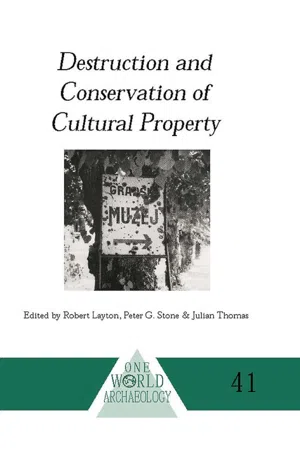
In 1991 the mosque at Ayodhya in India was demolished by Hindu fundamentalists who claim that it stood on the birthplace of a legendary Hindu hero. During recent conflicts in former Yugoslavia, ethnic groups destroyed mosques and churches to eliminate evidence of long-term settlement by other communities. Over successive centuries, however, a single building in Cordoba functioned as a mosque, a church and a synagogue. The Roman Emperor Diocletian's Palace in Split is occupied today by shops and residential apartments. What circumstances have lead to the survival and reinterpretation of some monuments, but the destruction of others?
This work asks whether the idea of world heritage is an essential mechanism for the protection of the world's cultural and natural heritage, or whether it subjugates a diversity of cultural traditions to specifically Western ideas. How far is it acceptable for one group of people to comment upon, or intercede in, the way in which another community treats the remains which it claims as its own? What are the responsibilities of multinational corporations and non-governmental organisations operating in the Developing World? Who actually owns the past: the landowner, indigenous people, the State or humankind?
Information
1 Introduction: the destruction and conservation of cultural property
ROBERT LAYTON AND JULIAN THOMAS
DESTRUCTION OR CONSERVATION?
Why are historic artefacts and monuments sometimes deliberately destroyed, and under what conditions are they carefully preserved? To the archaeologist, artefacts and monuments are chiefly significant as a kind of archive, evidence of past human activity. Preservation allows the archive to be consulted whenever new questions about the past are generated. This is only one way of understanding the material traces of the past, however, and one which is deeply embedded in those conditions of Western modernity that gave birth to the archaeological discipline.
The modern era in the West has seen rapid social, economic and technical change (Berman 1982: 29). Intellectually, the period has been characterized by attempts to understand reality as a unified whole, but at the same time society and culture have become increasingly fragmented. Religion and tradition have lost much of their binding force, with the consequence that social order has been maintained through the enforcement of learned codes of morality (Bauman 1993: 6). These, however, have been based upon a contradiction. The legal and ethical codes of the West appeal to universal reason, suggesting modes of moral conduct which apply to all human beings, and yet they simultaneously divide people on grounds of nationality or ethnicity. Moral universalism and objective rationality have been promoted by nation-states, the distinctive political entities of modernity, which have nonetheless acted in support of their own interests in a highly parochial manner (ibid.: 14). This conflict at the heart of modern societies has played itself out in a variety of ways. Olsen’s chapter in this volume, for instance, points to the role of ‘scientific internationalism’ in maintaining the intellectual hegemony of the Western powers (also see Olsen 1991: 213). The acquisition of knowledge is presented as the prerogative of all humankind, yet in most cases the powerful nations are the subjects of knowledge, while the rest of the world is rendered as object. Cleere (this volume, Chapter 2) calls universality and cultural heritage ‘the uneasy bedfellows’. Not all societies use the remains of the past as a means of substantiating their identities, or securing their claims to territory. As Pedro Funari shows (Chapter 7), in Brazil the national culture aspires to modernity, and the architectural traces of the past are often wilfully destroyed to enable more up-to-the-minute buildings to be constructed. Identity is grounded not in the memory of the past, but in the modernist drive toward the future. Archaeology carries little weight, since it documents the past existence of native peoples and blacks, who are often still seen in negative terms. Even worse, the antiquities of poor countries are looted and illegally exported to satisfy the desire of the rich to own a portion of the ‘universal’ human heritage (see chapters by Mbunwe-Samba, and Tubb and Brodie).
The notion of a society founded upon disinterested rationality was codified during the Enlightenment, that is, from the end of the seventeenth century. Different points of view could be brought into reasoned debate with one another, and a definitive resolution could be arrived at (Gray 1995: 150). For this reason, the Enlightenment conception of history was one in which the progressive freeing of human reason was gradually leading toward a more perfect state of affairs amongst people. Since reason was singular and universal, it was possible to imagine a single universal (and progressive) historical narrative (ibid.: 165). This linear vision of history culminated with the emancipation of the rational individual, freed from the shackles of religion and tradition (Carroll 1993: 121). Yet again, this universalism was compromised by the particularity of the kind of individual that was being promoted as the modern political subject: a male, white, heterosexual gentile. The Enlightenment envisaged a political community of active participants, yet this was only to be realized through a series of exclusions. This is graphically demonstrated in the case of the American Declaration of Independence, a document heavily influenced by Enlightenment views, proclaiming universal freedom yet signed by a group of men the majority of whom were slave-owners.
Beverley Butler’s and Mark Johnson’s chapters in this volume explore the problems raised by universalism and linear views of history. Johnson (Chapter 6) looks at two contemporary viewings of monuments in Hue, the ancient capital of Vietnam. One emphasizes natural processes of decay and deterioration, the other destruction during war. Butler (Chapter 5) relates how the archaeological investigation and rebuilding of Alexandria are presented as a rediscovery of origins, a recovery of a lost past. The role of the past is to provide a precedent for contemporary developments. In practice, however, there is no universal narrative and different interests draw on different epochs to create their own past. The Egyptian state emphasizes the Ptolemaic period, the tourist industry promotes the Pharaonic era, while the fundamentalists imagine Egypt as exclusively Islamic, and would have the monuments of other religions destroyed.
On 6 December 1992 the Babri Masjid, a 450-year-old mosque in the north Indian town of Ayodhya, was destroyed by Hindu fundamentalists. The fundamentalists claim that the mosque stood on the foundations of a Hindu temple marking the birthplace of the legendary Hindu hero-king Rama. The mosque was built by Babur, the first Mughal emperor, in AD 1528–9 and became an object of dispute between groups of Hindus and Muslims during the nineteenth century. This dispute reached a climax in 1949, when Hindu images were placed within the building. The Indian government ordered the mosque to be locked and it remained unused until its destruction forty-two years later.
Archaeology has been closely involved in the Ayodhya debate. In 1975, B.B. Lal, recently retired from the post of Director General of the Archaeological Survey of India (ASI), began research on the archaeology of sites named in the Ramayana epic. He conducted two seasons of excavations at Ayodhya. Excavations close to the Babri mosque revealed a massive brick wall, house floors, rubble collapse and the wells associated with the archaeological Northern Black Polished Ware culture. His excavations showed that habitation continued after the Northern Black Polished Ware period into historic times. After the Gupta empire [AD 320–467], however, Ayodhya was deserted. It was not reoccupied until at least the eleventh century (Lal 1976–7, 1981; see also Lal, this volume and Ratnagar 1993). In October 1988, Professor Lal presented a paper at a conference organized by the Indian Council of Historical Research. On this occasion he provided previously unannounced details of his findings at Ayodhya. He reported, in particular, that he had uncovered ‘a series of brickbuilt bases that evidently carried pillars thereon’ adjacent to the mosque (see Lal in this volume, Chapter 9). Lal surmised that carved black stone pillars incorporated into the Babri mosque might originally have stood on these bases. Proponents of the argument that Babur had destroyed a Hindu temple seized on Lal’s report as evidence in support of their case: the pillar-bases appeared to continue under the mosque and the motifs carved on the black stone pillars were identified as Hindu.
During September and October 1990 Mr L.K. Advani, a senior leader of the Bharatiya Janata Party (BJP), led a procession through several states, campaigning for the demolition of the mosque and its replacement with a temple. On 30 October 1990 Kar sevaks (Hindu volunteers) broke through a police cordon and assaulted the mosque. Violence broke out in several parts of India, with deaths from stabbing and arson. On 6 December 1992 the Kar sevaks attacked the mosque again, and this time demolished it completely. The number who died in the ensuing riots is difficult to determine, but contemporary newspaper reports put the figure at around 1000 (see Rao and Reddy in this volume, Chapter 11).
BACKGROUND TO THE CONFERENCE
Nandini Rao proposed that a session on the role of archaeology in the destruction of the mosque at Ayodhya should be included in the programme of the third World Archaeological Congress, due to meet in New Delhi in 1994. WAC is dedicated to exploring the politics of archaeology and Nandini’s proposal was entirely appropriate. Unfortunately, the second anniversary of the mosque’s destruction would take place during the Congress. Furthermore, key members of the local organizing committee had argued in favour of the prior existence of a temple. Rao (1995) records that at the WAC Inter-Congress held in Mombasa in 1993, ‘the destruction of the mosque was noted, and an attempt to condemn the destruction was thwarted by the Indian representatives’. The local organizing committee of WAC-3 therefore had two reasons for opposing Rao’s proposal, one acceptable to WAC(avoidance of potentially violent demonstrations), one unacceptable (limitation of free speech).
Nandini Rao wrote to Peter Ucko and Jack Golson in 1994 complaining that ‘WAC, which stands for the breaking of hegemonic domination in archaeology and a more critically self-conscious and reflexive undertaking of academics, had been taken over by people known to be involved in the [ab]use of archaeology for political ends and in the chauvinistic and selective re-writing of the past’ (Rao 1994). Many members of the WAC Executive who met in Delhi at the start of the conference were unfortunately unaware of what had happened in Mombasa. The organizers’ demand for a ban, while contravening WAC’s principles, appeared justified in order to forestall unrest or even violence against people arriving for the conference or even members of the Indian public. S.P. Gupta, one of the local organizers, told the executive that the government minister sponsoring the Congress had asked for the veto. The executive agreed to a ban ‘because it recognized that there was a risk of adverse practical consequences within the Indian community which were beyond the executive’s control if the issue of Ram Janma Bhumi-Babri [Masjid] were discussed at the time of the anniversary of recent events.’ The executive stated it was responding to requests from the Indian Organizing Committee and the Minister of Human Resource Development (HRD).
Indian archaeologists and historians who had bravely spoken out against the argument that the mosque had replaced a temple were understandably dismayed that WAC should have capitulated to the local organizing committee. Local media reported that, when Professor Irfan Habib attempted to approach the podium at a pre-conference meeting of the WAC Council to clarify the situation, he was pushed to the floor by Prakash Charan Prasad, Director of Archaeology for the Government of Bihar, who had participated in the demolition of the Babri mosque (New Age [India], 11–14 December 1994). The Minister of Human Resource Development denied he had asked for a ban when speaking to reporters after he opened the conference. On 4 December the All India Students’ Association demonstrated outside the building where the Congress was taking place in protest at the ban.
Western academics were also disturbed that WAC had forsaken its principles. Lord Renfew and Rhys Jones circulated a motion reasserting WAC’s key commitments to further free and untrammelled discussion of all issues relating to cultural heritage, and condemning any destruction of archaeological or cultural monuments on sectarian or ethnic grounds.
The demonstrations across India that marked the second anniversary of the Babri mosque’s destruction were in fact peaceful. It was, ironically, the Congress itself that came close to violence during the closing plenary session, which was accurately reported in the Indian Express of 12 December 1994:
Tempers ran high at the Plenary Session of the World Archaeological Congress on Sunday afternoon over the passing of [an Indian-sponsored] resolution explicitly condemning destruction of the historical structures. The reference obviously was to the Babri Masjid demolition … . As more than 200 shellshocked foreign delegates looked on, the supporters of the two groups climbed onto the dais in the auditorium. For over 30 minutes the air was filled with vociferous slogans as they tried to snatch the microphone from each other … . The first paragraph of the resolution held that: ‘Born in the fight against apartheid, the WAC-3 reiterates its uncompromising opposition to the infusion of racial, religious or national chauvinistic claim into archaeology and condemns without reservation all fraudulent manipulation of evidence and destruction of or damage to historical structures in order to further such claim or in consequence thereof.’ As the resolution was read out, the auditorium broke into applause. For a few moments even the pro-RSS [Hindu Nationalist] delegates started clapping – apparently not making much out of the long-winded phrases. But it didn’t take them long to separate the message from the medium and from that point, they were unstoppable … . A crucial resolution which could not be taken up at all was moved by the eminent archaeologist, Lord Renfrew of Cambridge University, seconded by Professor Rhys Jones.
The council of WAC afterwards dissociated itself from the Plenary Session (minutes of council meeting 11 December 1994). It also agreed to set up a forum where the Ayodhya issue could be freely debated, and the proceedings published (see WAC News 5 (1): 1997). Peter Stone, Julian Thomas, Nandini Rao and Robert Layton undertook to organize the conference. We decided Ayodhya should be put in a broader context, hoping to learn what circumstances put cultural properties at greatest risk of destruction, and what circumstances might improve their chances of conservation.
At first, the organizers had no success in finding an organization willing to host the conference. But in 1996 Peter Stone, WAC CEO, met Dino Milinović, Secretary General of the Croatian Commission for UNESCO, and they discussed the possibility of holding the conference in Croatia. Given the recent war in former Yugoslavia, and the destruction of cultural property that had taken place, Croatia seemed an obvious place although, with the memory of war and destruction so fresh, it might also be the wrong place. At Dino Milinović’s suggestion, Peter Stone and Robert Layton flew to Croatia in April 1997 and met with the Croatian Minister for Culture. Milinović was present, and outlined WAC’s scope and aims at the start of the meeting. Stone and Layton described the background to the conference, and stressed the need for any organization hosting a WAC meeting to agree to adhere to WAC’s statutes, allowing free and full discussion of any issue, and the need to let participants of any national or ethnic affiliation attend. The minister agreed to accept these conditions. He promised to provide funding for the conference through the Croatian Archaeological Society, who would be designated the conference’s local organizer. The Croatian Archaeological Society also undertook to adhere to WAC’s statutes.
The Croatian Government’s generous support enabled WAC to use the bulk of conference fees to assist participants from the Third World to attend. The Inter-Congress took place on the island of Brač from 3–7 May 1998. The government and the society adhered to their commitment, despite the inclusion of two papers critical of the conduct of Croats in the recent war, one of which is included in this volume (Barakat et al.). Four papers were given at the conference in defence of the prior existence of a temple on the site of the mosque at Ayodhya (one is included here, by B.B. Lal); and three against (Sharma’s is included in this volume). Rao and Reddy’s chapter explains the political background to the mosque’s destruction and examines its reporting in the Indian press.
We especially thank Professor Ante Rendić-Miočević, President of the Croatian Archaeological Society, who organized the funding of the conference, Dino Milinović, who made enormous efforts to ensure all participants were admitted to Croatia despite problems in obtaining visas in their home countries, Robin Evans, Director of the British Council in Croatia, who provided further financial support for the conference, and Branko Kirigin of Split Archaeological Museum, the local conference organizer.
THE ARCHAEOLOGY OF AYODHYA
The Ramayana probably dates to the first millennium BC (Keay 2000: 4, 44). Rama’s capital was Ayodhya. The account of his rule in the Ramayana became the ideal that many historic leaders have aimed to realize. Ayodhya itself became the ideal capital, and was reproduced in many subsequently Aryanized state systems, such as the pre-Bangkok capital of Thailand (‘Ayuthia’) and the senior sultanate of central Java (Jogjakarta, derived from Javanese rendering of Ayodhya) (ibid.: 46–7). Lal’s excavations demonstrated that Ayodhya was first occupied during the Painted Grey Ware period of north Indian pre-history, which spans the period from about 700 to 400 BC (Habib 1998: 20–1). The geographical distribution of the painted grey ware corresponds approximately to the distribution of sites mentioned in the earlier, but culturally related Mahabharata epic (ibid.: 42).
The timing of Ayodhya’s reoccupation is significant for the debate concerning the former existence of a temple marking Rama’s birthplace. Lal dated the reoccupation to the eleventh century. The initial Islamic conquests in India were achieved under Turkish leadership, from the year 1206. These leaders became known as the Delhi Sultans, and they destroyed many Hindu temple complexes (Keay 2000: 213, 241). Babur (Zahir-ud-din Muhammad) was the first of the Mughal emperors of India (289), defeating the Delhi Sultanate in 1525.
In 1838 a British surveyor, Montgomery Martin, expressed the view that the pillars in the mosque had been taken from a Hindu temple. The carvings on the pillars are, it is argued, securely dated to the eleventh century and the brick pillar-bases must therefore date from the same period. If the pillars date from the eleventh century, they cannot be Buddhist or Jain (as some critics have claimed), but must be Hindu (Ramachandran n.d., part 2: 17). The mosque is built of brick and lime. Several large pieces of stone incorporated in the walls of the mosque must, it is argued, therefore have come from the temple.
During the campaign to destroy the mosque and (re)build a temple, a group of Indian archaeologists claimed to have discovered further evidence for the temple (Sharma et al. 1992). A ‘hoard’ of about twelve pieces of stone sculptures was reportedly found in a large pit about 8.8 metres from the mosque. About 9 metres south-east of the mosque four layers of floor were uncovered. The lowest was made of brick. A brick wall of about sixteen courses was also revealed. The wall had been disturbed by two pits, both sealed by floor 3 (see plates on pp. 3, 4 and 12 of Sharma et al. 1992). These finds were cited as evidence for a ‘pre-Islamic’ building which had suffered massive destruction (Sharma et al. 1992: 13). It has also been claimed that further stone objects were found during destruction of the mosque. Some were reportedly sealed within the walls while others were said to have been discovered 220 metres south-west of the mosque. Of the first group, the most significant was a stone plaque carrying an inscription recording the construction of a temple dedicated to Rama (see Lal, this volume).
The archaeological argument against the temple can be summarized as follows. According to S.P. Gupta, quoted in Ramachandran (Ramachandran n.d., part 2), pieces of Islamic medieval glazed ware with a white base and blue floral paintings were found in Lal’s excava...
Table of contents
- Cover Page
- Title Page
- Copyright Page
- Figures
- Plates
- Tables
- Contributors
- Foreword
- 1 Introduction: the destruction and conservation of cultural property
- 2 The uneasy bedfellows: universality and cultural heritage
- 3 Should developing countries restore and conserve?
- 4 The end of history? Archaeology and the politics of identity in a globalized world
- 5 Return to Alexandria: conflict and contradiction in discourses of origins and heritage revivalism
- 6 Renovating Hue (Vietnam): authenticating destruction, reconstructing authenticity
- 7 Destruction and conservation of cultural property in Brazil: academic and practical challenges
- 8 From museum to mantelpiece: the antiquities trade in the United Kingdom
- 9 A note on the excavations at Ayodhya with reference to the Mandir-Masjid issue
- 10 The Ayodhya issue
- 11 Ayodhya, the print media and communalism
- 12 The protection of Croatia’s cultural heritage during war 1991–95
- 13 Challenges and dilemmas facing the reconstruction of war-damaged cultural heritage: the case study of Počitelj, Bosnia-Herzegovina
- 14 Immanent or eminent domain? The contest over Thessaloniki’s Rotonda
- 15 The politics of the past: Emain Macha (Navan), Northern Ireland
- 16 Making news out of archaeological sites: the experience at Ijaye Orile, Nigeria
- 17 The changing use of worship in Roman and Medieval Córdoba
- 18 The Adriatic Islands Project: monument destruction and protection in the Central Dalmatian Islands
- 19 ‘Pious Vandals’: restoration or destruction in Sri Lanka?
- 20 Destruction or conservation? Some aspects of monument policy in British India (1899–1905)
- 21 Use, value and significance in heritage management
- 22 Is the past a non-renewable resource?
- 23 Cape Town’s District Six and the archaeology of memory
Trusted by 375,005 students
Access to over 1.5 million titles for a fair monthly price.
Study more efficiently using our study tools.
Frequently asked questions
Yes, you can cancel anytime from the Subscription tab in your account settings on the Perlego website. Your subscription will stay active until the end of your current billing period. Learn how to cancel your subscription
No, books cannot be downloaded as external files, such as PDFs, for use outside of Perlego. However, you can download books within the Perlego app for offline reading on mobile or tablet. Learn how to download books offline
Perlego offers two plans: Essential and Complete
- Essential is ideal for learners and professionals who enjoy exploring a wide range of subjects. Access the Essential Library with 800,000+ trusted titles and best-sellers across business, personal growth, and the humanities. Includes unlimited reading time and Standard Read Aloud voice.
- Complete: Perfect for advanced learners and researchers needing full, unrestricted access. Unlock 1.5M+ books across hundreds of subjects, including academic and specialized titles. The Complete Plan also includes advanced features like Premium Read Aloud and Research Assistant.
We are an online textbook subscription service, where you can get access to an entire online library for less than the price of a single book per month. With over 1.5 million books across 990+ topics, we’ve got you covered! Learn about our mission
Look out for the read-aloud symbol on your next book to see if you can listen to it. The read-aloud tool reads text aloud for you, highlighting the text as it is being read. You can pause it, speed it up and slow it down. Learn more about Read Aloud
Yes! You can use the Perlego app on both iOS and Android devices to read anytime, anywhere — even offline. Perfect for commutes or when you’re on the go.
Please note we cannot support devices running on iOS 13 and Android 7 or earlier. Learn more about using the app
Please note we cannot support devices running on iOS 13 and Android 7 or earlier. Learn more about using the app
Yes, you can access Destruction and Conservation of Cultural Property by R Layton, P Stone, J Thomas, R Layton,P Stone,J Thomas in PDF and/or ePUB format, as well as other popular books in Social Sciences & Archaeology. We have over 1.5 million books available in our catalogue for you to explore.