eBook - ePub
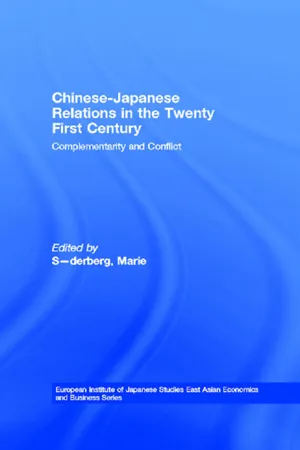
Chinese-Japanese Relations in the Twenty First Century
Complementarity and Conflict
- 224 pages
- English
- ePUB (mobile friendly)
- Available on iOS & Android
eBook - ePub
About this book
This important collection analyses the changing context of China's relationship with Japan. Its eminent international contributors address core issues including strategic concerns; security; the issue of Taiwan; diplomacy; economic relations; trade; the role of firms and currency. The book brings together a wide range of perspectives to offer a rich and varied understanding of one of Asia's most crucial and complex relationships.
1 Mirror for the Future or the History Card?
Understanding the ‘History Problem’
Over the last decade or so, issues related to the history of Japan’s military invasion of China more than half a century ago have come to cast a huge cloud over the relations between the two Asian neighbours. The most recent high-level clashes over history issues took place during Chinese President Jiang Zemin’s state visit to Japan in late 1998. In his speech at Waseda University in Tokyo, after elaborating on age-old friendly exchanges between the two countries over many centuries, he went on to note that:
Unfortunately, Japan embarked on the path of militarism at the end of the 19 th century. It occupied the Chinese territory of Taiwan after the First Sino-Japanese War. After the Russo-Japanese War of 1905, Japan for a time occupied China’s Lushun [Port Arthur] and Dalian. Beginning from the 1930s, Japanese militarism launched full-scale war of aggression against China, causing China to suffer a casualty of 35 million people and property loss exceeding 600 billion US dollars. This war brought about profound national disaster to the Chinese people; it also caused much suffering to the Japanese people.1
Jiang repeatedly brought up the history issue in his meetings with his Japanese hosts. In the end, China failed to obtain a written apology, which the Japanese government had made to the visiting Korean President Kim Dae Jung the month before. If anything, Jiang’s insistence did much to annoy many Japanese, to a considerable extent due to the unfavourable press coverage in Japan.
Why did the past come back to haunt present China-Japan relations with such a vengeance? Was Beijing’s obsession with history a demonstration of its leaders playing the ‘history card’ against Japan, as many Japanese and Western observers believe? Or was it a legitimate reaction to the resurgence of nationalism in present-day Japan? Was this brawl over history a temporary phenomenon that will dissipate over time? Or do these outbursts reveal deeper structural fault lines in the bilateral relationship that may spell great disaster for the future? What are its implications for arguably the most important bilateral relationship in East Asia? What can be done about it? In this chapter I examine how these issues have been dealt with in political and intellectual circles as well as popular opinion in both China and Japan.2
Is there a Problem with History?
Put simply, the ‘history problem’ between China and Japan has developed into a vicious cycle of emotional outbursts over the history of Japanese aggression against China during the half century before and during World War II.3
Currently, the Chinese government considers the ‘history problem’ to be one of the major ‘sensitive political issues between China and Japan’, followed by issues such as Taiwan, the Diaoyu/Senkaku Islands, US-Japan security relations, and the Kokaryo Dormitory in Kyoto. According to the Chinese Foreign Ministry:
The history question of how to understand and deal with [renshi he duidai] Japanese militarist aggression in China was already a focal point in the 1972 negotiation over the Chinese-Japanese diplomatic normalization. It was clearly spelt out in the Sino-Japanese Joint Declaration and Sino-Japanese Treaty of Peace and Friendship, and has become the political foundation of China-Japan relations. The Chinese side always advocates ‘history not forgotten is a guide to the future’, and is willing to look to the future and develop lasting friendship between the two peoples on the basis of respecting history.4
A few points are worth noting here. First, the ‘history problem’, listed by the Foreign Ministry as a category separate from ‘war reparations’ and ‘chemical weapons abandoned by Japan in China’, seems to China to be above all an issue of attitude, albeit with real implications. During his Japanese visit, the Foreign Ministry notes, President Jiang ‘explicated China’s principles and positions in comprehensive, profound, and systematic manners. The Japanese side for the first time [emphasis mine] recognised [chenren] aggression against China and expressed profound self-reflection and apology [fanxin he daoqian], and jointly reaffirmed that correct understanding of and dealing with history is an important basis for developing China-Japan relations’. It goes on to say that during Prime Minister Obuchi’s visit to China in July 1999, ‘both China and Japan once again reaffirmed the agreement over the history issue reached in 1998. The Japanese side also expressed the willingness to squarely face history [zhenshi lishi] on this basis, to join hands (with China) to create the future, and to continue to contribute to peace with concrete actions’. Second, China continues to warn against what it calls ‘an extremely small right-wing force in Japan’ that ‘from time to time denies and whitewashes the history of aggression, and creates disturbances in China Japan relations’. In language reminiscent of the 1960s, it claims that ‘We carried out timely, necessary struggle [jinxin le biyao douzhen] against them, and urged the Japanese Government to fulfil the pledges made on the history issue with concrete actions, to strictly restrain the extremely small right-wing forces, and to educate its people with correct views of history’.5
Although the history problem has not made it to Gaimushō’s (MOFA’s) home page, in recent speeches at the Chinese government institutes the then Japanese Ambassador to China Tanino Sakutaro devoted special attention to the subject (followed by the Taiwan question):
Regarding the so-called ‘history problem’: first of all, during a certain period in the past, Japan embarked on the mistaken path of militarism, and caused much harm to the peoples of Asia beginning from China; secondly, concerning this the Japanese Government apologised [shazai], and most Japanese did as well [mōshiwakenaikoto]. Moreover, it is unmistakable that, upon sincere self-reflections over such mistaken national policies, Japan has chosen the righteous path of peace and prosperity in the postwar period.6
Here, the admission of a problematic past was straightforward. The timeframe of ‘a certain period’ is at best unclear and probably begins with 1931, which suggests an aberration rather than the logical outcome of the Meiji nation-state. (Taking over Taiwan in 1895 and incorporating the Senkaku Islands was thus not covered.) Second, the ambassador finds it difficult to accept that the history problem still exists, let alone any suggestion that Japan has not done enough – whether in terms of apologies or compensations. Ambassador Tanino then goes on to give a lengthy lecture on Japan’s rebirth after the war as a result of learning the lessons of history:
As a result, Japan rejected the path of a military power after the war and pledged in the constitution to renounce the use of force or the threat of use of force as means of solving international conflict, abolished conscription system, and rejected possession of strategic weapons such as long-range offensive missiles, long-range offensive aircraft carriers, and long-range bombers. Moreover, possessing various advanced technologies, Japan does not export any weapons to foreign countries. Its armed forces changed its name to Self-Defense Force; namely, that its mission lies solely in defending the Japanese territories is a fundamental consideration. Moreover, Japan considers the guarantee of its own peace and development in the pace and development of Asia, and strenuously strives to provide economic assistance to Asian countries. As a result, for the past seven years in a row since 1991, the Japanese government has provided the largest foreign economic assistance in the world.7
It is quite obvious that both governments recognise that they face a serious problem with history, real or otherwise. It is well known that when Japan and China normalised diplomatic relations in 1972, in return for China agreeing not to ask for reparations, the Japanese side acknowledged that it was ‘keenly aware of Japan’s responsibility for causing enormous damage in the past to the Chinese people through war and deeply reproaches itself’. After a period of warm relations in the late 1970s, the bilateral relations became subject to periodic downward swings over economic and other issues. The early 1980s marked the beginning of history problems in the relationship: alleged Japanese government whitewashing of textbooks to minimise past aggression, as well as statements to a similar effect by Japanese politicians prompted fierce Chinese (and other Asian governments’) condemnation, leading (in most cases) to the resignation of the Japanese officials involved. Conversely, repeated Chinese protests and demands for Japan’s repentance in turn fanned the sense of indignation in Japan over perceived Chinese interference in Japan’s domestic affairs.8 In 1987 the events took a particularly nasty turn. Against the background of bilateral economic problems, the legal dispute over a Kyoto dormitory, and the increase in Japan’s defence spending, Chinese leader Deng Xiao-ping brought out the history issues, telling the visiting Komeito delegation that ‘Japan is the country most indebted to China’. While China did not ask for reparations in 1972, Deng intimated, it was now dissatisfied with the state of affairs between the two countries. Deng’s injection of the history issue into current bilateral relations brought about much consternation in Japan.9
In addition to these government-level spats, the brewing conflict over history also took on an increasingly populist turn in both countries: since the mid-1980s Chinese students have staged demonstrations over Japanese actions such as the visit to the Yasukuni Shrine by cabinet members. In the 1990s, Chinese victims of Japanese wartime atrocities in China, including the Nanjing Massacre, bacteriological warfare, sexual slavery of the ‘comfort women’, and forced labour, began their own lawsuits against the Japanese government or corporations demanding apologies and compensation. Although Japanese courts rejected most of them, the end of the legal battle is not in sight.10
What is the impact of the history problem on China-Japan relations? One of the most noticeable casualties seems to be the deterioration in the popular perceptions of each other. Although there are many causes of this phenomenon, repeated clashes over the past is certainly a major factor. Opinion polls in China in the late 1990s indicated a much-heightened public awareness of Japan’s past aggression in China, whereas Japanese polls registered an all-time low (since 1972) in their favourable feelings toward China. In a nationwide Chinese survey conducted in 1996, the 1937 Nanjing Massacre topped the list of terms the Chinese would commonly associate with Japan (84 per cent), followed by ‘Japan’s war aggression to China’ (81 per cent). The Japanese national flag, to 96.6 per cent of those Chinese surveyed, reminded them of Japan’s war against China. ‘Japan’s attitude toward the history of aggression’ was considered by 93.3 per cent to be the biggest obstacle to developing China-Japan relations (followed by the ‘Diaoyu Islands problem’ (75.5 per cent) and ‘Japanese politicians revising militarism’ (74.7 per cent)). Even taking into consideration the methodological bias and timing of the poll, it is quite obvious that the history problem has an immense impact on Chinese perceptions of present-day Japan.11 Although polls in Japan in general have avoided such bluntly direct questions, the trend is nonetheless clear. If the newspaper editorials and public reaction to Jiang’s 1998 visit were any indication, there seemed to be a ‘history fatigue’ vis-à-vis China, if not outright indignation. Japanese TV talk show host Tahara Soichiro, in an on-camera interview last March, bluntly told the Chinese ambassador that the biggest cause for the worsening of Japanese attitudes toward China is China’s incessant demands for an apology from Japan.12
As many analysts have pointed out, the problem with the history of its past aggression has become a constraint on Japan’s foreign policy, especially in its diplomacy vis-à-vis China. After the 1989 Tiananmen Square bloodshed, Japanese Prime Minister Uno Sosuke cited special historical as well as geographical circumstances for not forcefully condemning Beijing’s bloody crackdown. As Japanese political scientist Ijir...
Table of contents
- Cover
- Half Title
- Title Page
- Copyright
- Contents
- List of Tables and figures
- List of Contributors
- Preface
- List of Abbreviations
- Note on Names
- Introduction
- 1. Mirror for the Future or the History Card? Understanding the ‘History Problem’
- 2. Sino-Japanese Relations in the Context of the Beijing-Tokyo-Washington Triangle
- 3. Engagement Japanese Style
- 4. Sino-Japanese Relations and Ballistic Missile Defence (BMD)
- 5. The Taiwan Question: Reconciling the Irreconcilable
- 6. The Background and Trend of the Partnership
- 7. The Role of ODA in the Relationship
- 8. Economic Relations: What can we Learn from Trade and FDI?
- 9. Japanese Firms in China: What Problems and Difficulties are they Facing?
- 10. Managing the Global-Local Dilemma: Problems in Controlling Japanese Subsidiaries in China
- Index
Trusted by 375,005 students
Access to over 1.5 million titles for a fair monthly price.
Study more efficiently using our study tools.
Frequently asked questions
Yes, you can cancel anytime from the Subscription tab in your account settings on the Perlego website. Your subscription will stay active until the end of your current billing period. Learn how to cancel your subscription
No, books cannot be downloaded as external files, such as PDFs, for use outside of Perlego. However, you can download books within the Perlego app for offline reading on mobile or tablet. Learn how to download books offline
Perlego offers two plans: Essential and Complete
- Essential is ideal for learners and professionals who enjoy exploring a wide range of subjects. Access the Essential Library with 800,000+ trusted titles and best-sellers across business, personal growth, and the humanities. Includes unlimited reading time and Standard Read Aloud voice.
- Complete: Perfect for advanced learners and researchers needing full, unrestricted access. Unlock 1.5M+ books across hundreds of subjects, including academic and specialized titles. The Complete Plan also includes advanced features like Premium Read Aloud and Research Assistant.
We are an online textbook subscription service, where you can get access to an entire online library for less than the price of a single book per month. With over 1.5 million books across 990+ topics, we’ve got you covered! Learn about our mission
Look out for the read-aloud symbol on your next book to see if you can listen to it. The read-aloud tool reads text aloud for you, highlighting the text as it is being read. You can pause it, speed it up and slow it down. Learn more about Read Aloud
Yes! You can use the Perlego app on both iOS and Android devices to read anytime, anywhere — even offline. Perfect for commutes or when you’re on the go.
Please note we cannot support devices running on iOS 13 and Android 7 or earlier. Learn more about using the app
Please note we cannot support devices running on iOS 13 and Android 7 or earlier. Learn more about using the app
Yes, you can access Chinese-Japanese Relations in the Twenty First Century by Marie Söderberg in PDF and/or ePUB format, as well as other popular books in History & Asian History. We have over 1.5 million books available in our catalogue for you to explore.