eBook - ePub
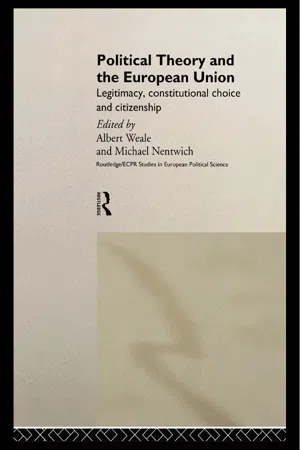
Political Theory and the European Union
Legitimacy, Constitutional Choice and Citizenship
- 220 pages
- English
- ePUB (mobile friendly)
- Available on iOS & Android
eBook - ePub
Political Theory and the European Union
Legitimacy, Constitutional Choice and Citizenship
About this book
The contributors to this book examine the issues of constitutional choice that face the governments and citizens of today's Europe. Divided into three sections this study addresses: questions of political legitimacy and the meaning of democratic deficit in the EU; the reality of what institutional reforms and decision making processes are possible; and the rights of citizenship and values that should be protected.
Information
1
Introduction
Michael Nentwich and Albert Weale
The political development of the European Union has now reached the point where the governments and citizens of Europe are confronted with constitutional choices that raise issues of fundamental political principle. At one time commentators on the EU hoped that the Inter-Governmental Conference (IGC) leading to the Treaty of Amsterdam would be the forum within which some of these issues could be addressed. In the event, despite a significant strengthening of the powers of the European Parliament, the EU continues to present important unresolved issues of constitutional choice: the continuing democratic deficit; the lack of agreement about the functions that should be exercised at different levels of political organisation within Europe; controversy over the legitimacy of EU decision rules; and the design of structures of political representation. As we seek to show in this introduction, the Treaty of Amsterdam still leaves unresolved fundamental questions of political principle of the sort discussed in this volume. Enlargement, bringing with it the need to confront issues that were postponed at Amsterdam, will make these issues more, not less, serious.
Two features stand out about these questions of constitutional choice. First, they are irreducibly normative, in the sense that the answers that are given to them rely implicitly or explicitly on political principles or values. We cannot, for example, determine how we should rectify the democratic deficit without first deciding on the importance of the principle of democracy in social and political organisation or without appealing to values like political equality or accountability. Second, these normative issues are intertwined with questions of institutional analysis. Evaluating alternative institutional proposals cannot be done without understanding how the existing decision-making institutions of the EU actually work and what the feasible range of alternatives to current practice might be. In other words, issues of European constitutional choice require the skills both of the normative political theorist and of the student of institutional and comparative politics.
It was because they recognised that the political developments of the EU raised these twin sets of issues that the contributors to this volume met at the ECPR Joint Sessions in Oslo between 30 March and 3 April 1996 to examine and discuss some of the questions in detail. As luck would have it, the group began its meeting on the same day as the IGC started its work. The present volume contains the papers from that session revised and rewritten in the light of the discussion in Oslo and of the outcome of the IGC at Amsterdam in 1997.
One assumption of the group, confirmed in its subsequent work, was that advance in the understanding of some of these questions in part involves conceptual work. That is to say, we need to clarify the meaning of key terms that are used in the debates about the political future of the EU. Examples of such conceptual questions include the following. How should we characterise the democratic deficit of the EU? Is it identical to a deficit that might exist in a nation state, or does it have some distinctive features? Is it primarily a matter of decision rules, decision-making structures, lack of accountability, lack of democratic responsiveness, the absence of a European civic culture or what? But the theoretical debate also goes beyond these conceptual questions to issues of political substance, to do with the principled basis on which different political positions may be held about the future of the EU. What would be a justifiable set of decision rules for reformed EU institutions? Should the popular majority principle be given greater scope in EU decision making, or does the social, political and economic pluralism of Europe require a system of concurrent majorities or super-majoritarian decision rules? What are the appropriate structures of political representation within the EU? How should a European constitutional order seek to balance the representation of member states with the representation of individual citizens?
Moreover, the manner in which these questions of institution building are answered has implications for values like social justice, economic efficiency, political equality and human rights. Procedures do not simply define a way of taking decisions: they also encode certain sorts of outcomes rather than others. Hence the answers that are given to the procedural questions also need to be considered alongside issues of substance. What constitutional principles are appropriate for protecting rights in Europe? How far is democracy a matter of economic control as well as political influence? What rights are due to citizens in the EU and to those outside?
Such issues of European constitutional choice tend to be interrelated. Thus, to take a simple example, one’s view on the proper role of the member states in the EU decision process has implications for one’s view of the extent to which there should be direct participation in the making of decisions by the citizens of Europe. So it is not easy to look at some of these questions without at the same time touching on many of the others. However, as an aid to understanding, it may be useful to see such issues falling into three groups: those concerned with the question of political legitimacy and the meaning of the democratic deficit in the EU; those concerned with the character of the decision rules that can be justified by appeal to the principles of democratic theory; and those concerned with the rights of citizenship and the values that should be protected in the construction of an EU constitutional order. This is how the individual papers are presented in this volume.
In the next section, we provide an outline of these issues as they are raised in the individual papers, before looking at the decisions that were made in Amsterdam and the bearing that normative political theory might have on their evaluation. To anticipate our conclusion: we suggest that the unresolved issues arising from Amsterdam will need even more intensive normative, as well as institutional, scrutiny.
Political legitimacy and the democratic deficit
The basic principles of political legitimacy in the modern world are democratic in character; the democratic deficit of the EU thus calls into question its political legitimacy. Political legitimacy is a complex concept, however, as David Beetham and Christopher Lord remind us in Chapter 2. They see a political system as being legitimate to the extent that it can meet criteria of legality (political power is exercised through recognised rules), normative justifiability (the rules are justified in terms of the ends of government), and legitimation (governments are authorised by means of institutions of consent).
To identify these three dimensions of political legitimacy provides no more than a conceptual framework to understand questions of legitimacy, but such a framework can be a powerful way of organising our thoughts. Thus, Beetham and Lord argue that, as the powers of the EU have increased, so it can no longer rely upon the principle that its normative justifiability can be wholly derivative from the authority of the nation states who established it as an international organisation. Instead, it must satisfy the general criteria that apply to the justification of any liberal democratic political system, involving some form of shared identity, adequate procedures for the authorisation and accountability of political power, and a certain level of performance in the delivery of rights, goods and services. Though structurally similar to the legitimation requirements of existing liberal democratic nation states, it is no part of Beetham and Lord’s argument to deny that the EU is sui generis, such that the exact specification that the normative justification takes will vary from that of the typical nation state.
How much should it vary, however? The three subsequent papers by Føllesdal, Weale and Gustavsson take different views on this question. In the first paper, Andreas Føllesdal seeks to develop a contractualist analysis of the democratic deficit in the EU. He notes that one criticism of the EU is that it lacks the institutions of majority rule that characterise liberal democracies at the national level. However, the relationship between political legitimacy and majority rule is not one that can be taken for granted, but needs to be understood in terms of a broader account of justice, which seeks to specify how political power is to be distributed fairly.
To this end, Føllesdal invokes contractualism as a method of reasoning in political theory. Contractualism seeks to derive an account of political evaluation from a thought-experiment about the principles that could be accepted by persons who had to agree on a social contract with one another. Such a theoretical approach provides a justification of majoritarianism in general, seeing it as the best way to secure, to an acceptable extent, the relevant interests of affected parties from standard harms. However, majoritarianism is not the sole implication of the contractual method. It also legitimises a concern for minority rights. In this way, standard constitutional protections for minorities, which involve taking certain sorts of issues, like civil and political rights, off the majoritarian political agenda, are also justified.
From this perspective, the legitimate form of the EU would be federal in character, with more decisions being brought within the scope of the majority principle and with a constitutional order in which certain rights were guaranteed to European citizens. Føllesdal acknowledges that this will involve a reduction in the powers of the existing nation states, but sees this as essentially a problem of implementation. It means no more than that any transfer of powers should take place slowly to secure existing expectations. It does not betoken any claim to the independent moral standing of the institutions of the nation state.
Albert Weale too sees the legitimation of any future EU constitution as lying between principles of parliamentary representation and constitutionalism, but he is more willing to see the continued influence of the member states in the European system of governance as being legitimate. He detects two strands in democratic theory: one majoritarian implying institutions of parliamentary government; the other super-majoritarian implying a system of concurrent majorities. Although the general justification of democratic institutions is that they promote certain common interests, this is compatible with recognising that established political identities also have a proper place in any legitimate system of government. Moreover, parliamentary government requires certain conditions to be in place before it can function successfully, and these conditions are not met in the case of the EU. In consequence we may well have an inconsistent triad in which any two, but not all three, of the following are possible: the system of concurrent decision making, the acquis communautaire and the promotion of common interests.
Sverker Gustavsson takes this logic a stage further by arguing that it is premature to seek to abolish the EU’s democratic deficit. He describes his own position as preservationist, wishing to uphold the asymmetry between suprastatism and democratic accountability. To seek to abolish this asymmetry prematurely would threaten the democratic achievements that have been secured in the member states. He defends this position by an analysis of the arguments used by the German Constitutional Court in its judgment on the Maastricht Treaty of 12 October 1993. The source is an important one because, as Gustavsson notes, for reasons of history the German political system had to use legal means to resolve the conflicts over the Maastricht Treaty that in France and Denmark were resolved by the political device of the referendum. The Court recognised that there was a potential conflict between the principles of parliamentary government and the ceding of powers to the EU. It sought to square the circle of this conflict by appealing to certain conditions that should be in place if the yielding of powers was to be regarded as legitimate. In particular, the Court argued that the Bundestag in agreeing to the Maastricht Treaty did not surrender sovereignty but merely delegated its use. Provided delegation of sovereignty met the tests of marginality, predictability and revocability, there could be no constitutional objection.
Gustavsson accepts the logic of this argument but points out the irony that the conditions are not met in respect of the central part of the Maastricht Treaty, namely the arrangements for monetary union. In Gustavsson’s view the acceptance by the Court of the arrangements for European Monetary Union are inconsistent with those provisions of the German constitution that establish the principles of democratic government irrevocably as the basis of the German political system. By extension, the argument runs, other countries are ceding important powers to the European Central Bank that ought to be retained as matters of democratic choice by duly elected representative assemblies.
Taken together then these papers respond in different ways to the challenge to produce arguments of normative justifiability contained in the opening paper of Beetham and Lord. All see a problem in reconciling our understanding of the nation state with a vision of the democratisation of the EU. The tension is felt least sharply in Føllesdal’s paper, where the conflict is seen essentially as one of not upsetting existing legitimate expectations in the democratising of the EU. By contrast, though in different ways, Weale and Gustavsson see some connection between the principles of democratic theory and the continued existence of the nation state. One way around the controversy implicit in these different views is to ask whether it is possible to reform the system of political authority in the EU to give sufficient scope to the political pluralism of which the nation state is but one expression. This is the task faced in the second set of papers.
Decision rules and the constitutional construction of the EU
Tsinisizelis and Chryssochoou open the debate by discussing the dynamics of the evolution of the EU using the concept of confederal consociation. The essence of their argument is that the EU continues to act as a means for strengthening the domestic power base of national leaders, in part because the European system of governance rests upon the separate constitutional orders of the member states, and in part because collective decisions within the EU are made by closed processes of bargaining among political elites that resemble the classic forms of consociationalism. Thus, in place of a politically organised demos at the European level, the EU can be seen as the institution of distinct demoi involved in a process of mutual governance. Tsinisizelis and Chryssochoou argue that the dynamics of reform will be governed by the continuing desire of European political elites to manage the processes of institutional reform, so that in consequence it will be difficult for a transnational European demos to emerge. Rather than form following function, function is more likely to follow existing form. Thomas Christiansen focuses his attention upon the Commission. He argues that the demand for increased political accountability has to be set against the equally legitimate demands for improved system effectiveness and the maintenance of national diversity. Drawing upon empirical evidence, he argues that there are inherent weaknesses in the Commission’s mode of working arising from national influences through secondments and comitology. One way to overcome these difficulties, he suggests, might be to take seriously the idea that the regulatory tasks of the Commission could be undertaken through more independent agencies who would have to render a public account of their decisions.
Questions about the constraints on the reform process do not, however, entirely determine the character and limits of possible reforms. In her paper Heidrun Abromeit proposes one possible way in which transnational democratic rights might be enhanced. She starts from the assumption that democracy is not the same as parliamentary government, but she is also critical of the existing system of EU governance for its ability to impose external costs upon those actors not involved in the decision process. Using a contractarian form of argument (borrowed from James Buchanan, not, like Føllesdal, from John Rawls), she argues for the establishment of veto rights on policy formation. Regions and transnationally organised groups would be able, through the device of a referendum, to veto policy initiatives decided upon by normal EU processes of decision making. One advantage of such an arrangement, Abromeit argues, is that the ability to impose external costs would be reduced, since those who were most likely to bear the costs would be able to protect themselves through the exercise of the veto. Abromeit acknowledges that the use of the veto might involve increasing the transaction costs associated with decision making, but she points out that the use of a blocking referendum would prevent the EU intervening in too many areas and would also prevent the inefficiencies associated with the creation of package deals under existing arrangements.
If the idea of countervailing democratic rights is to be developed, then it will require the creation of opportunity structures for citizen participation, and the range and form of such opportunity structures is the theme of the paper by Michael Nentwich. His account of such structures reveals a wide possible range, involving the referendum but also including an interactive network of communication, changing the rules of standing in the European Court of Justice, deliberative opinion polling and various experiments with teledemocracy. He argues that there is a powerful case for extending the use of such devices at the European level in order to counterbalance the loss of participatory opportunities for citizens of the member states as functions and competences move upwards.
Citizenship and constitutional choice
Issues of citizen participation raise questions about the substantive values that may be promoted or hindered by various institutional arrangements. And this brings us to the topics of the last set of papers, all of which are concerned with citizens’ rights in the new Europe.
Richard Kuper argues that one must move beyond a conception of democracy as a set of institutional arrangements to the conception of democracy as a process. Political legitimacy is not created by institutional reforms but by engagement with the political concerns of citizens, as expressed, for example, through social movements. There is thus a need to ensure the capacity of members of society to participate actively as democratic citizens. Since the outcomes of democratic decisions can affect the capacity of people to participate in future decisions, issues of substance and process cannot easily be separated, and there is a need for Europe both to incorporate social rights in its political order and to allow the flourishing of economic organisation at the regional level.
Dora Kostakopoulou takes up the theme of exclusion that is touched upon in Kuper’s analysis. She argues that the EU provides a context in which it should be possible to fashion a post-national view of citizenshi...
Table of contents
- Cover Page
- Title Page
- Copyright Page
- Contributors
- Series Editor’s Preface
- Abbreviations
- 1. Introduction
- Part I: Political Legitimacy and the Democratic Deficit
- Part II: Decision Rules and the Constitutional Construction of the European Union
- Part III: Citizenship and Constitutional Choice
Trusted by 375,005 students
Access to over 1.5 million titles for a fair monthly price.
Study more efficiently using our study tools.
Frequently asked questions
Yes, you can cancel anytime from the Subscription tab in your account settings on the Perlego website. Your subscription will stay active until the end of your current billing period. Learn how to cancel your subscription
No, books cannot be downloaded as external files, such as PDFs, for use outside of Perlego. However, you can download books within the Perlego app for offline reading on mobile or tablet. Learn how to download books offline
Perlego offers two plans: Essential and Complete
- Essential is ideal for learners and professionals who enjoy exploring a wide range of subjects. Access the Essential Library with 800,000+ trusted titles and best-sellers across business, personal growth, and the humanities. Includes unlimited reading time and Standard Read Aloud voice.
- Complete: Perfect for advanced learners and researchers needing full, unrestricted access. Unlock 1.5M+ books across hundreds of subjects, including academic and specialized titles. The Complete Plan also includes advanced features like Premium Read Aloud and Research Assistant.
We are an online textbook subscription service, where you can get access to an entire online library for less than the price of a single book per month. With over 1.5 million books across 990+ topics, we’ve got you covered! Learn about our mission
Look out for the read-aloud symbol on your next book to see if you can listen to it. The read-aloud tool reads text aloud for you, highlighting the text as it is being read. You can pause it, speed it up and slow it down. Learn more about Read Aloud
Yes! You can use the Perlego app on both iOS and Android devices to read anytime, anywhere — even offline. Perfect for commutes or when you’re on the go.
Please note we cannot support devices running on iOS 13 and Android 7 or earlier. Learn more about using the app
Please note we cannot support devices running on iOS 13 and Android 7 or earlier. Learn more about using the app
Yes, you can access Political Theory and the European Union by Michael Nentwich,Albert Weale in PDF and/or ePUB format, as well as other popular books in Politics & International Relations & Politics. We have over 1.5 million books available in our catalogue for you to explore.