eBook - ePub
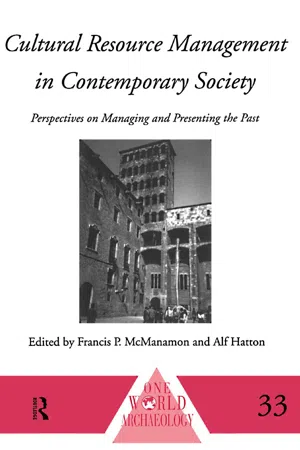
Cultural Resource Management in Contemporary Society
Perspectives on Managing and Presenting the Past
- 360 pages
- English
- ePUB (mobile friendly)
- Available on iOS & Android
eBook - ePub
Cultural Resource Management in Contemporary Society
Perspectives on Managing and Presenting the Past
About this book
This innovative collection of essays from an international range of contributors describes various means of preserving, protecting and presenting vital cultural resources within the context of economic development, competing claims of "ownership" of particular cultural resources, modern uses of structures and space, and other aspects of late twentieth-century life.
Information
1 Introduction: considering cultural resource management in modern society
FRANCIS P.MCMANAMON AND ALF HATTON
WHAT ARE CULTURAL RESOURCES?
We began assembling this collection of chapters with a working title for the volume of Archaeological Heritage Management in Modern Society. After some thought and discussion, in part spurred by David Lowenthal’s Possessed by the Past (1996), we backed away from using ‘heritage’ in the title. Lowenthal’s principal point in his volume is to distinguish between the real remains and well-reasoned, documented interpretations of past actions and events, which he equates with ‘history’, and careless, popularized physical reconstructions and accounts of history, which he uses the word ‘heritage’ to define. Lowenthal’s concerns in drawing this distinction and considering it at length are with authenticity, accuracy and legitimacy. The principle, or espoused value, of authenticity drives much of the activity from the constituent parts of the contemporary ‘heritage industry’ (Hewison 1987). Museums, historic houses, national parks, archaeological excavations, townscapes, landscapes, etc. strive to present themselves or the items they contain or seek as the authentic, the ‘real thing’ (Wickham Jones 1988; Gable and Handler 1996). Authenticity has been one of the main concepts in the world of cultural resource management (CRM) and heritage management, and has been pivotal in almost all debate on the subject of heritage and in the fields of archaeology, anthropology, museum management, conservation, etc. since the Second World War.
Yet to interpret Lowenthal’s distinction simplistically would be to ignore the very considerable and growing body of work suggesting that any intervention or intermediation between ‘the past’, however we may define it within our differing cultural parameters, and experience of it (e.g. through museum exhibition, interpretive programmes, trail leaflets, tour guide commentaries or, for that matter, authoritative written academic histories), changes that very past. One might conceive of this phenomenon as the ‘uncertainty principle’ of historical interpretation.
In the title and body of an earlier volume, Lowenthal (1985) himself asserts this fundamental point, that The Past is a Foreign Country; it cannot be revisited other than vicariously. This is not to say that the practice of the various professions that sometimes swirl around the term ‘heritage’, though some abjure the term, should ignore questions of authenticity and interpretation, let alone conservation and documentation. In fact, it is clear that there are degrees of distance from historical fact. Some in heritage endeavours adhere closely to the ‘history’ of Lowenthal’s definition; others range much farther afield. It is important to be able to distinguish among these links to historical fact and real places or things.
The distinction between ‘history’ and ‘heritage’ used by some shows no signs of being dislodged despite being a simplistic, or at any rate, underdeveloped conceptual distinction. It is being used actively as the single most important distinction in university promotional literature, e.g. ‘History offers us true stories about the past; heritage sells or provides us with the past we appear to desire’ (University of York 1996). Yet in other contexts, ‘heritage’ as distinct from ‘history’ in the terms described above is not in common usage. In the USA, the Forest Service has adopted the title of ‘Heritage Management’ for all its programmes dealing with various kinds of cultural resources; the National Park Service has used ‘Heritage Preservation Services’ as the title for one of its most important CRM programmes.
It also is clear that different perspectives on the world and the past colour personal interpretations of both terms. These underpinning, divergent but conjoining, streams of perspective, activity and belief will require more adjustments in the new millennium. We can expect that more peoples, in particular those with more traditional perspectives, will repossess their pasts. Robinson and Taylor and Anyon et al. (this volume) describe the variation among Indian tribes in different parts of the US in pursuing this objective and incorporating western, professional methods and techniques to advance their goals. As this trend continues, new forms of professional practice will emerge, indeed are already emerging. Those of us whose main perspective is from a developed world and a professional stance, will need not only to make further willing adjustments, but also to learn from them, because they represent emergent practice, and will most certainly contain lessons for us in terms of our own actions.
Similarly, those entering this dialogue with a native or traditional perspective must be prepared to adjust and accommodate professional or scientific perspectives. The chapters by Folorunso, Robinson and Taylor and Anyon et al. suggest that this is occurring in places throughout the world. Also in this volume, Merriman outlines his view of ‘multivocalism’ as a means, mechanism and emergent professional standard for dealing with precisely this issue. Adjusting perspectives is never easy; paradigm shifts do not just happen. They require open discussion, willingness to engage in true communication, an environment of equality, and an acknowledgment that some shifting of positions may be desirable (McManamon 1997).
Indeed, that ‘the past’ should be considered a single, unambiguous phenomenon that can or even should be the subject of attempts, professional or otherwise, to locate, define and ‘stabilize’ it, in the sense of Green’s (1985) ‘sanitization of the past’, would be to miss the main point of modern ‘critical thinking’ approaches to heritage in particular and culture in general. That ‘the past’ in modern society is not only subject to, but absolutely dependent on, multiple perspectives should be clear to all. That the processes by which individuals and groups define their pasts are as revealing as the contents of these pasts is an essential insight to those whose jobs are involved with ‘history’ and ‘heritage’ (e.g. Leone et al. 1987; Leone and Preucel 1992).
Asombang, Anyon et al. and others in this book frequently use the terms ‘heritage management’, ‘cultural resource management’ and ‘archaeological resource management’ more or less interchangeably. This seems to us to underline a number of points worth consideration while reading the volume: (1) there is as yet no agreed and undisputed term for this topic; (2) all the activities covered by the various terms include both policy making at local, regional, national and international levels of government, as well as the day-to-day business of managing both the organizations that administer ‘heritage’ and the cultural resources themselves; (3) this merging of policy making and day-to-day management may potentially contain the seeds of mission-failure, in that this wide spectrum can give the impression to outside investigators, or potential funding sources, of a graphic lack of clarity and focus; (4) there are key themes that bind this loose amalgam together globally (as described in the chapters in this volume); and finally, (5) whichever perspective marks our starting point for ‘heritage’, professional or amateur, developed or developing world, scientist or traditionalist, archaeologist or museum curator, historian or interpreter, academic or practitioner, there is commonality shared by those working on these matters. There is, for example, broad agreement that cultural resources and ‘heritage’ are more than just in situ archaeological resources or out-of-the-ground remains of the past. The resources of concern include above-ground historic, prehistoric and vernacular structures, museum collections, living traditions, and much more, and indeed it is also more than popularized accounts of ‘history’. Many of the authors in this volume, for example, consider and discuss resources that are substantial historic structures, some of them very substantial, e.g. the medieval Hindu city of Vijayanagara, and the monasteries, castles and great houses of Northern Ireland. Other authors include non-physical aspects of traditional cultures in their discussions (e.g. Asombang, Anyon et al.).
A narrow definition of ‘heritage’, though a key point in any debate on the topic, seemed to us to confuse the intent and coverage of the following chapters. The authors definitely are dealing with ‘the real stuff’: how to identify it, document it, care for it and interpret it. Viewed narrowly, ‘heritage’ did not seem entirely appropriate for an unambiguous term to use for the title of this volume. We were left with ‘cultural resource management (CRM)’ as a widely used alternative. Yet, this term also has its problems. Mainly, the difficulty with CRM as a term is that it is often used to refer exclusively to archaeological resources. McManamon (this volume) describes briefly the etymology of ‘cultural resource management’, noting that its origin in the US was from discussions of archaeological concerns, but that the term was viewed by its originators from the beginning as including a wide range of resource types— historic structures, historic and prehistoric archaeological sites, traditional cultural properties and others.
Clearly, more attention to definitions of our terms would be helpful. We believe that implicit in all the chapters in this volume, and explicit in many, is the concept of promoting ‘heritage’ as a means of accurate and effective public education and outreach that also has a dynamic future and supports the long-term preservation of the real things and places of history. Such a perspective would benefit the cultural resources we seek to preserve by making heritage education, outreach and, ultimately, understanding more central to everyone’s experience. Carrying out CRM, we are best placed to describe and promote a stewardship and conservation ethic that is linked to use and enjoyment.
CRM has developed a standard literature and set of reference works. Although much of this body of work is nation-specific, most of it can be read to elicit general principles and methods that transcend national statutory requirements and regulatory procedures (e.g. Rains [1966] 1983; McGimsey 1972; King et al. 1977; Schiffer and Gummerman 1977;Wilson and Loyola 1981; Fowler 1982; Knudson 1986; Wilson 1987; Murtagh 1988; Andah 1990; Smith and Ehrenhard 1991; Hutt et al. 1992; Lee 1992; McManamon 1992; Hunter and Ralston 1993; Cooper et al. 1995; Harrison 1995; ICAHM 1996).
The broader working definition of CRM we refer to above is aptly illustrated in, among others, Harrison (1995), where ‘heritage’ includes natural (landscape, countryside, nature conservation), man made (historic properties, built environment, artefacts, museums), and maritime resources. As Middleton (1995:3) states, ‘heritage is a broad church’ and ‘within the broad church the tenets of faith are widely agreed, although people working in one form of heritage, such as museums, typically have relatively few points of contact with people working in other forms, such as nature reserves’.
It is this last point about the fragmented nature of ‘heritage’ that leaves us somewhat disturbed. In parallel with the literature of CRM, other literatures have grown up around ‘heritage’, but there does not seem yet to be a coming together of their different authors, practitioners, or even complete perspectives. Instead, different and distinct literatures are developing. For instance, interpretation has its own literature (see Lunn et al. 1988; Tabata et al. 1991), developed much as the One World Archaeology Series was, from international conferences (1985 Banff, Canada; 1988 Warwick, UK; 1991 Hawaii, USA and 1995 Sydney, Australia). Though smaller in volume, these collections have developed a distinctiveness in a key area of what we consider within the framework of CRM—the interpretation of cultural and historic sites and structures.
Museum studies is another very well-developed literature, much of which focuses on interpretation (education) and public interaction. The museum studies literature has its own flavour, paralleling CRM almost exactly in scope, in that it deals fairly comprehensively with an entire heritage process: collect, conserve, document, interpret and exhibit. Lately, a specifically museum management section has been developing (e.g. see Moore 1994; Keene 1996; Fopp 1997). Gurian (1995) and Janes (1995) describe museum management specifically in relation to change and how it affects both institution and staff. None of these issues can be peculiar only to museums within our ‘broad church’.
Also, tourism has developed a distinct section within its broader sphere of interest which deals with the management of travel, access to, marketing and interpretation of heritage sites. Of particular note, the tourism literature has a growing predominance of field research-based work which examines critically aspects of heritage management relevant to CRM. For example, Frochot (1996) attempted to develop a service quality standard for historic houses. Chapters by Anyon et al., Lerner and Hoffman, and Fritz (this volume) also describe, from a CRM perspective, the impacts of recent increases in cultural tourism.
Large-scale public usage, such as visitation to cultural sites and historic structures, and smaller-scale usage, such as access to information, are becoming important aspects of effective heritage management. Follows (1988) notes that resource interpretation has a complex set of tasks to accomplish for visitors and the resources being visited. The impacts of the visitors must be minimized while enhancing visitor experiences. The visitor experience must be accomplished in such a manner and by such means as will leave the primary resources unimpaired for the continued enjoyment and multiple experience use of future generations.
Hooper Greenhill (1994) describes museum initiatives to attract broader audiences than the traditional ones. As she states: ‘in these sophisticated and competitive days, it is those museums that offer comfortable, welcoming experiences, where many members of varied groups can feel secure but extended, that will nourish and grow’ (Hooper Greenhill 1994:84).
These developments of distinct strands in the literature of other fields is, of course, being replicated in university and other training courses. Distinctions are now made between heritage tourism, heritage interpretation and heritage management, such that they are emerging as different professions, rather than different professional specializations. This may be no bad thing: object and building conservation are now distinct from archaeology, architecture and curatorship, and the condition and preservation of artefacts and historic structures are the better for it. What disturbs us are the relatively few points of contact, which may lead to unnecessary and unresolved conflict in perspectives and standards, and, worse still, in some sort of territoriality. A better solution would be for experts in these fields to continue to interact, learning from one another and incorporating into each other’s fields the useful concepts, products and resolutions to problems developed independently.
The following sections of this Introduction summarize the main themes of contemporary CRM that are covered by the chapters in this book. To be effective, CRM must be supported by a national system of statutes, regulations and policies, as well as some level of public financing. Effective CRM also must recognize, understand and address local situations, including the needs and controlling conditions for local human populations. New approaches and developments of methods, techniques and concepts are essential sources of improvement in the effectiveness and efficiency of CRM. Public education and outreach are necessary means of justifying and promoting CRM. Such activities are needed to ensure that present and future generations realize the importance of cultural resources in understanding our heritage, history and selves.
As we have edited these chapters, we have been struck by the many common threads of challenges and opportunities, problems and solutions faced by those concerned with cultural resources, their interpretation and preservation. The commonality connects individuals working in developed and developing countries, at national and local levels, and those working on field activities or physical conservation, interpretation and public outreach, and programme development or administration.
These chapters cover a range of cultural resource types; archaeological sites and districts, historic structures and districts, cultural traditions, collections, archives, and libraries, all are mentioned or considered in detail by the authors. Most of the authors are archaeologists by training, so there is an archaeological emphasis in the subject matter of most chapters, in particular in the examples discussed. The anthropological and historical orientation of professional training in archaeology in the United Kingdom and the United States is apparent in the authors’ perspectives. Yet there is much in the volume and individual chapters that will be useful for other specialists in CRM: historians, historical architects, curators and others.
THE NECESSITY OF NATIONAL SYSTEMS
By national systems, we mean those laws, regulations, guidelines and government programmes related to legal mandates for the identification, evaluation, inventory and treatment of archaeological and other kinds of cultural resources. Most countries have such systems which have developed historically within the country or have been set up during colonial eras by colonial governments (Cleere 1984, 1989; O’Keefe and Prott 1984).
To be effective, national public policy for the protection and preservation of cultural resources must have three components:
- it must be a strong statement of national intent to protect and preserve cultural sites, structures and other resource types;
- it must have political support in its implementation; and
- it must be implemented cooperatively among agencies, departments or ministries at the national level, with other levels of government, and with the public.
For a national system to function effectively, the definition of cultural resources must be clear. We suggest that a broad definition for the term be utilized, and most authors of these chapters adhere to such a definition, although several point out that such a broad view is not typical for some CRM projects in their countries. Schofield (this volume) describes efforts in a developed country, England, to define and develop preservation and interpretation strategies in a better way for poorly understood and little recognized types of cultural resources.
National laws and policies are statements of the public interest in the protection and preservation of the nation’s cultural resources. This interest must transcend other public interests in at least some circumstances and be considered equivalent to others in most circumstances. The greater the number of other interests, such as housing, revenues, pipelines, etc., that can be required to take into account the protection and preservation of cultural resources as part of their activities, the stronger will be the public policy for cultural resources.
Ministries responsible for heritage preservation and those responsible for economic development, tourism, law enforcement and other related areas must work cooperatively. Solli (this volume) describes the reality of working for intergovernmental cooperation in the treatment of cultural resources within the environmental agencies of Norway, frankly describing the challenges she had to overcome even with bureaucrats sympathetic to related natural resource conservation issues. Likewise, the wider the range of circumstances in which the protection ...
Table of contents
- Cover Page
- Title Page
- Copyright Page
- Figures
- Tables
- Contributors
- Preface
- 1 Introduction: considering cultural resource management in modern society
- 2 The future of Cameroon’s past
- 3 Third World development and the threat to resource conservation: the case of Africa
- 4 The protection of archaeological resources in the United States: reconciling preservation with contemporary society
- 5 Conflict between preservation and development in Japan: the challenges for rescue archaeologists
- 6 Archaeological heritage management in Northern Ireland: challenges and solutions
- 7 Now we know: the role of research in archaeological conservation practices in England
- 8 Protection of the environment and the role of archaeology
- 9 The World Heritage Convention in the Third World
- 10 Heritage management in Rhode Island: working with diverse partners and audiences
- 11 Heritage management by American Indian tribes in the Southwestern United States
- 12 The Arkansas Archeological Survey: a statewide cooperative programme to preserve the past
- 13 Articulation between archaeological practice and local politics in northwest Argentina
- 14 Lebanon’s archaeological heritage on trial in Beirut: what future for Beirut’s past?
- 15 Regional aspects of state policy relating to the protection of the cultural heritage and natural environment in the Russian Federation
- 16 Documentation at Vijayanagara: an experiment in surface archaeology
- 17 Following fashion: the ethics of archaeological conservation
- 18 Bringing archaeology to the public: programmes in the Southwestern United States
- 19 Reducing the illegal trafficking in antiquities
- 20 America’s archaeological heritage: protection through education
- 21 Public interpretation, education and outreach: the growing predominance in American archaeology
- 22 The crisis of representation in archaeological museums
- 23 Museums and the promotion of environmental understanding and heritage conservation
- 24 Teaching archaeology at the Museum San Miguel de Azapa in northernmost Chile
Trusted by 375,005 students
Access to over 1.5 million titles for a fair monthly price.
Study more efficiently using our study tools.
Frequently asked questions
Yes, you can cancel anytime from the Subscription tab in your account settings on the Perlego website. Your subscription will stay active until the end of your current billing period. Learn how to cancel your subscription
No, books cannot be downloaded as external files, such as PDFs, for use outside of Perlego. However, you can download books within the Perlego app for offline reading on mobile or tablet. Learn how to download books offline
Perlego offers two plans: Essential and Complete
- Essential is ideal for learners and professionals who enjoy exploring a wide range of subjects. Access the Essential Library with 800,000+ trusted titles and best-sellers across business, personal growth, and the humanities. Includes unlimited reading time and Standard Read Aloud voice.
- Complete: Perfect for advanced learners and researchers needing full, unrestricted access. Unlock 1.5M+ books across hundreds of subjects, including academic and specialized titles. The Complete Plan also includes advanced features like Premium Read Aloud and Research Assistant.
We are an online textbook subscription service, where you can get access to an entire online library for less than the price of a single book per month. With over 1.5 million books across 990+ topics, we’ve got you covered! Learn about our mission
Look out for the read-aloud symbol on your next book to see if you can listen to it. The read-aloud tool reads text aloud for you, highlighting the text as it is being read. You can pause it, speed it up and slow it down. Learn more about Read Aloud
Yes! You can use the Perlego app on both iOS and Android devices to read anytime, anywhere — even offline. Perfect for commutes or when you’re on the go.
Please note we cannot support devices running on iOS 13 and Android 7 or earlier. Learn more about using the app
Please note we cannot support devices running on iOS 13 and Android 7 or earlier. Learn more about using the app
Yes, you can access Cultural Resource Management in Contemporary Society by Alf Hatton, Francis P. MacManamon, Alf Hatton,Francis P. MacManamon in PDF and/or ePUB format, as well as other popular books in Social Sciences & Archaeology. We have over 1.5 million books available in our catalogue for you to explore.