eBook - ePub
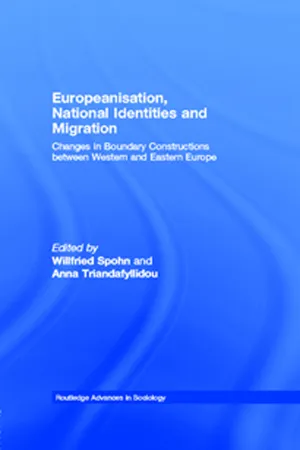
Europeanisation, National Identities and Migration
Changes in Boundary Constructions between Western and Eastern Europe
- 264 pages
- English
- ePUB (mobile friendly)
- Available on iOS & Android
eBook - ePub
Europeanisation, National Identities and Migration
Changes in Boundary Constructions between Western and Eastern Europe
About this book
This book provides theoretical and empirical discussion of migration, identity and Europeanisation. With contributions from leading international scholars, it provides both an overview of theoretical perspectives and a comprehensive set of case studies, covering both Eastern and Western Europe. Contributors draw from disciplines such as historical sociology, discourse analysis, social psychology and migration studies, while the editors bring these subjects into a coherent theoretical and historical framework, to discuss the emergence of new collective identities and new borders in Europe today.
Information
1 Introduction
Anna Triandafyllidou and Willfried Spohn
Introduction
The decade following the European revolution of 1989–91 has witnessed a progressive, although in many ways difficult, reconnection of the divided Europe. With this development, the basic structural and cultural pluralism of a common ‘European civilisation’ (Eisenstadt 1987) – damaged by the Second World War and torn apart by the Cold War system – is in the process of restoration. This overall process includes particularly the restoration and re-organisation of the European system of nation-states and with them the redefinition and often intensification of national identities and reciprocal boundary constructions. The contemporary reconstruction and restructuration of nation-states in Europe, however, does not simply continue the thread of the pre-Second World War and pre-Cold War era of the modern nation-state. Rather, two major social forces are at work in contemporary Europe: the dynamics of European integration and the growing consequences of international migration and with them the transformation of national identities.
The European integration process, on the one hand, has developed in deepening and widening movements in Western Europe since 1945, pooling and mediating the sovereignty of the participating member states. The imminent Eastern enlargement of the European Union will have similar impacts on the post-communist nation-states of Central and Eastern Europe. As a consequence, the classical model of the nation-state as a sovereign entity of political-territorial centre-formation is to an increasing degree in the process of modification. International migration, on the other hand, has for several decades had an impact on the most developed nation-states in Western Europe, yet in the last decade it has not only been intensifying, but its impact has also been increasingly felt in Southern and Central Eastern Europe (see the chapters by Romaniszyn and Morawska in this volume). With it, the notion of cultural homogeneity as the basis of the politically-centralised nation-state is to a growing measure modified by ethnic minorities and immigrant communities. Both of these processes of transnational modification of states and nations in Europe also manifest themselves – at least as a tendency – in a stronger weight of European and multicultural elements in collective identities.
The contributions assembled in this volume address these two major social forces of transnational modifications of nation-states and collective identities in contemporary Europe in a Western and Eastern comparative perspective. Most of these contributions have been presented at a workshop held at the European University Institute in Florence and as part of a two-year Thematic Network on Europeanisation, Collective Identities and Public Discourses (IDNET) funded by the European Commission, Research DG. The contributions are divided into three parts.
The five chapters of Part I present different theoretical approaches to the Europeanisation and multicultural transformation of nation-states and national identities. The focus, here, is on the theoretical conceptualisation and comparative analysis of the relationships between national, European and multicultural components of collective identities. Bernhard Giesen, Richard Münch and John Hutchinson discuss the (non-)emergence of a European identity in the context of the European Union. The debate is complemented by two chapters (by Krystyna Romaniszyn and Andrew Geddes) that concentrate on immigration and European integration.
This first part of the book does not aim to provide a definite answer to sociological and political dilemmas such as: Will the European Union prove a viable political project? Has a sense of belonging to Europe developed? or What is the nature of the European demos today and how will it develop in the decade to come? Rather our aim is to cast new light on the debate by highlighting different aspects of a dynamic and quickly-evolving process of European integration that includes many tensions, discrepancies and inconsistencies. Through the different viewpoints adopted by the contributors to this volume, we seek to provide a fuller picture of the complex process of redefining a collective identity that takes place today in Europe.
The three chapters of Part II (by Miroslava Marody, Erhard Stölting and Willfried Spohn) look at the redefinition of national identities as a consequence of the reconnection of Europe and the eastward expansion of the European integration project. The case studies chosen include Germany, Poland and Russia, as these countries demarcate the territorial and symbolic boundaries (and their current re-organisation) of Europe between its Eastern and Western components.
The contributions included in Part III (by Ewa Morawska, Norbert Cyrus, Judith Tóth and Endre Sik) also refer to both Western and Central-Eastern European countries and concentrate on the transformation of collective identities in relation to European integration, the Eastern enlargement and contemporary migration processes. The case studies presented in this part cover three of the countries located along the current Eastern border of the EU, namely Germany, Hungary and Poland and provide for comparative insights on migration processes in the context of EU integration and Eastern enlargement.
Through these two sets of case studies presented in Parts II and III of the book, our aim is to examine the concrete sociological processes of collective identity transformation that take place in the context of European integration and in relation to neighbouring countries (be they fellow member states or accession countries) and immigrant groups. We seek thus to highlight that collective identity change takes place in a complex and fluid societal environment where nations and dominant discourses on nationhood are confronted with supra-national political entities like the European Union and an emerging awareness of ‘being European’ among their constituencies as well as sub-national challenges activated by immigration flows between Eastern and Western Europe in particular.
In the sections that follow we will present the thematic axes around which this volume is organised and the theoretical debates with which they are associated. We shall also briefly underline how the contributions included in this volume address such debates and cast new light on important conceptual and sociological issues.
Regarding the relationships between European and national identities and boundary constructions, within the reconstruction of Europe and the expansion of the European integration project to the East, four issues are fundamental: (1) the historical processes of and current changes in state formation and nation-building in Western and Eastern Europe; (2) the impact of the European integration process and its extension to the East on states and nations in Western and Eastern Europe; (3) within this context the changing relationships between national and European identities and boundary constructions; and last but not least (4) the ‘multicultural’ impact of growing international migration and immigration on the historically-formed nations, national identities and boundary constructions in the context of European integration.
State formation and nation-building in Western and Eastern Europe
The implosion of the Soviet communist system has enabled the restoration and reconstruction of independent nation-states in Central-Eastern Europe. These processes were accompanied by political transitions to democratic regimes and social transformations towards capitalist market societies. The ‘great transformation’ in the post-communist societies in Central and Eastern Europe has been predominantly seen by social and political scientists as a bundle of catching-up processes of modernisation, emulating the Western European model of a modern, democratic and capitalist nation-state. To be sure, the processes of political and economic transformation in post-communist Central and Eastern Europe have displayed considerable variations (Beyme 1996; Linz and Stepan 1996). The evolution of political regimes ranges from the consolidation of liberal-constitutional democracies, to the development of mixed democratic/authoritarian structures or the reversal of authoritarian political systems. The transformation to capitalist market societies varies from relatively successful evolution to crisis-prone development and continuous decline. The processes of state formation and political/legal institution-building have generally been weak and, inversely, the tendency to create ethnically homogeneous nations generally strong. But despite these variations, the Western European capitalist and democratic nation-state has served as a forceful model for the Eastern European transformations. In this sense the modern nation-state has been developing, diversifying, not dying (Mann 1993) and, with it, the European structural pluralism of independent nation-states in Western as well as in post-communist Central and Eastern Europe has been reconstituted.
Under the impression of the enormous changes brought about by the implosion of the Soviet Empire, there emerged in the social and political sciences a renewed interest in the nature of the modern nation-state, the processes of state formation and nation-building and related political movements and identities. For many in a valid way, Ernest Gellner has defined the modern nation-state as the congruence between the state as a territorial–political unity of centre-formation and the nation as a shared culture of a political community (Gellner 1983). The socio-historical foundations of the formation of the modern nation-state and related national movements and identities, according to his modernisation theory, are the development of a capitalist–industrial economy, the standardisation of a common high culture and political democratic participation. At the same time, it has remained unclear whether this model of the modern nation-state constitutes an ideal-type in Max Weber’s sense of social-action orienting idea or a real-type in the sense of a historically-materialising formation (Balakrishnan 1996; Hall 1997). As an ideal-type, this model seems to be a valid vision particularly for modernising national movements and political elites but has come under mounting criticism by alternative, post-nationalistic and multicultural ideas of political organisation. As a real-type, this model has been questioned regarding its teleological–evolutionary assumptions in view of the different historical preconditions, varying developmental trajectories and multiple modern types of the nation-state.
From this perspective, the contemporary reconnection of Europe is not simply reconstituting a pan-European system of converging modern nation-states. Rather, there have developed and are continuing to develop varying forms of modern nation-states on the basis of their differing historical trajectories in the various European regions. As particularly Stein Rokkan (see the recent reconstruction by Peter Flora, Stein Kühnle and Derek Urwin 1999) proposed and also Ernest Gellner suggested, it makes sense to distinguish between at least four major European time zones of state-formation and nation-building. The first Western European state formation zone has been characterised by early processes of political-territorial centralisation and corresponding high cultures; here, aristocratic incorporation enabled the inclusion of different ethnic groups very early on. The second Western Central European time zone has for a long time remained under the influence of the declining Western Roman Empire and was characterised by political fragmentation on the basis of cities and regions combined with two major high cultures; here, aristocratic inclusion remained territorially dispersed, contributing to the endurance of ethnically mixed populations. The third East Central European time-zone at the intersection between Western and Eastern Christianity has become until recently the victim of Empire-building; political centralisation here was predominantly part of imperial state-building in opposition to peripheral forms of nation-building. And the fourth time zone of nation-state formation has been created by the core regions of the Eastern Empires with imperial bureaucracies on the top of segmented ethno-religious groups; here, nation-state formation has involved the dismantling of Empires and subsequent ethnic nation-building.
In a parallel comparative perspective, there have developed attempts to construct typologies of nationalism and national identity in the European geographical and historical context. Hans Kohn (1964) and later Anthony Smith (1991) as well as John Hutchinson (1994) have proposed to distinguish between the Western state-led civic-territorial model and the Eastern state-seeking ethnic model of nationalism and national identity formation. In the recent debate, this binary opposition has been criticised as too categorical and a-historical. As Rogers Brubaker (1999) has recently proposed, it is more appropriate to see the ethnic and civic elements as two general, but in their combination varying and historically changing, components of nationalism and national identity. Accordingly, it makes sense to relate – more systematically than has been done so far – the varying forms of nationalism and national identity in the present to the different time zones of state formation and nation-building in Europe as well as to the historical development and expanding waves of democratisation during the nineteenth and twentieth centuries. Regarding the different time zones of nation-state formation, there are crucial differences between the French and British rather political nationalism (first Western European zone), the German or Swiss more federal nationalism (second city-belt zone), the Polish and Hungarian peripheral nationalism (third continental interface zone), or the Russian imperial nationalism (fourth continental Empire-building zone). Regarding the historical waves of democratisation, the early nineteenth-century dividing line between civic-territorial and ethnic types of nationalism at the Rhine moved during the late nineteenth and early twentieth centuries further eastward, retreated again with the rise of fascism, Soviet communism and the European Cold-War divide, but was after 1945 moving again to Western Central Europe and is now expanding further eastward. In a parallel, the institutional components of citizenship and the civic elements of nationalism or national identity are not fixed entities, but historically changing in their weight and scope.
European integration and its expansion toward the East
The reconstruction of the pluralistic system of sovereign modern nation-states, whatever their individual configuration of statehood and civic or ethnic nationhood, in Western and Eastern Europe is, however, only one basic feature of the contemporary bridging of the Cold War European divide. Another feature is the deepening and widening process of European integration that started after the Second World War in the core of Western Europe, and which then included in several enlargement waves most parts of North Western, Southern and Northern Europe, intensified in cyclical and concentric movements, and is now on the move to expand to the East. Although bound to the basic pluralism of the European state system and perhaps even an important rescuer of the European nation-state (Milward 1992), the European integration process has developed into a European system of transnational governance that essentially modifies the model of the modern nation-state. One crucial feature is the pooling of the member states’ national sovereignty into the transnational European Community/Union level that, although with the basic consent of each member, nevertheless restricts and mediates the independent power of each individual nation-state. Another crucial feature is the functional integration of particular political, economic or social issues that were traditionally in the hands of an individual state or society and are now merged into transnational institutions and policies. At the same time, the degrees of sovereignty transfers and functional integration vary according to national preferences. As a result, there has developed a multi-level system of European governance with a variable geometry of different speeds and scopes of integration.
In the public and scholarly debate, European integration as both a complex socio-economic process and the resulting type of European political system in relation to the member states, has been quite a controversial issue. The perception and conceptualisation of the European Communities/Union range from a mere intergovernmental framework leaving the nation-state basically intact, to an evolving federal state fundamentally changing the traditional sovereign nation-state. These contrasting perceptions and conceptualisations reflect, on the one hand, public attitudes in the different EU member states to what the European Union in the end should be (see the recent debate on a European constitution, V.A. 2001). On the other hand, they also reflect the scientific difficulties to determine the nature of a continually developing process that is neither predetermined nor finalised. Despite these contrasting perspectives, however, there has crystallised a scholarly consensus that the European Union should be viewed as a transnational regime sui generis in between a confederation of states and a federal state. Accordingly, the originally antithetic positions of realism (starting from the individual nation-state) and of functionalism (starting from the integration logic) have moved towards a neo-realist, neo-functionalist and liberal–intergovernmentalist synthesis. Within this synthesis, the crucial problematique is focusing on the modes and degrees of the Europeanisation of nation-states and their change over time. This volume is particularly concerned with the Europeanisation of collective identities – rather than that of public policies, a subject that is dealt with by political scientists and international relation theorists – to the extent that the existence of a collective identity is seen by many scholars (see the chapters by Giesen and Hutchinson in this volume) as a prerequisite for the functioning of a democratic polity. An alternative line of argument, however, would have it (see the chapter by Münch in this volume and Habermas 1994) that a sense of community can be built through active participation in a polity. Thus, Münch argues that the European polity may be based on a society of individuals enmeshed in a dense set of networks that keep them together.
The imminent Eastern enlargement of the European Union continues, in terms of a set of institutional and procedural mechanisms, the former enlargement waves of the European Community/EU to North Western, Southern and Northern Europe. As such, the Eastern enlargement will also mean a similar process of growing incorporation of the post-communist nation-stat...
Table of contents
- Cover
- Title
- Copyright
- Dedication
- Contents
- Notes on contributors
- Acknowledgements
- 1 Introduction
- Part I: Theoretical approaches and comparative perspectives
- Part II: Europeanisation, nations and collective identities
- Part III: Europeanisation, national identities and migration
- Index
Trusted by 375,005 students
Access to over 1.5 million titles for a fair monthly price.
Study more efficiently using our study tools.
Frequently asked questions
Yes, you can cancel anytime from the Subscription tab in your account settings on the Perlego website. Your subscription will stay active until the end of your current billing period. Learn how to cancel your subscription
No, books cannot be downloaded as external files, such as PDFs, for use outside of Perlego. However, you can download books within the Perlego app for offline reading on mobile or tablet. Learn how to download books offline
Perlego offers two plans: Essential and Complete
- Essential is ideal for learners and professionals who enjoy exploring a wide range of subjects. Access the Essential Library with 800,000+ trusted titles and best-sellers across business, personal growth, and the humanities. Includes unlimited reading time and Standard Read Aloud voice.
- Complete: Perfect for advanced learners and researchers needing full, unrestricted access. Unlock 1.5M+ books across hundreds of subjects, including academic and specialized titles. The Complete Plan also includes advanced features like Premium Read Aloud and Research Assistant.
We are an online textbook subscription service, where you can get access to an entire online library for less than the price of a single book per month. With over 1.5 million books across 990+ topics, we’ve got you covered! Learn about our mission
Look out for the read-aloud symbol on your next book to see if you can listen to it. The read-aloud tool reads text aloud for you, highlighting the text as it is being read. You can pause it, speed it up and slow it down. Learn more about Read Aloud
Yes! You can use the Perlego app on both iOS and Android devices to read anytime, anywhere — even offline. Perfect for commutes or when you’re on the go.
Please note we cannot support devices running on iOS 13 and Android 7 or earlier. Learn more about using the app
Please note we cannot support devices running on iOS 13 and Android 7 or earlier. Learn more about using the app
Yes, you can access Europeanisation, National Identities and Migration by Willfried Spohn,Anna Triandafyllidou in PDF and/or ePUB format, as well as other popular books in Social Sciences & Anthropology. We have over 1.5 million books available in our catalogue for you to explore.