eBook - ePub
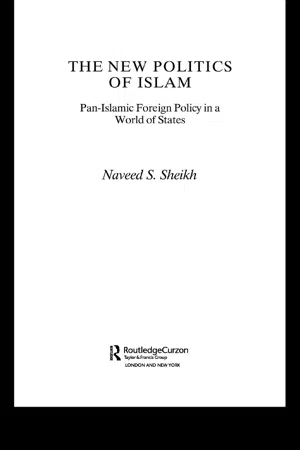
The New Politics of Islam
Pan-Islamic Foreign Policy in a World of States
- 224 pages
- English
- ePUB (mobile friendly)
- Available on iOS & Android
eBook - ePub
About this book
This is a timely study of the international relations of Islamic states, dealing both with the evolving theory of pan-Islamism from classical to post-caliphal times and the foreign-policy practice of contemporary states, especially Saudi Arabia, Iran and Pakistan, from the colonial period to the global aftermath of September 11. With a concise but analytic style, the book engages one-by-one with the questions of political theory, political geography and political sociology as they relate to international Islam. Its primary empirical investigation is centred on the Organization of the Islamic Conference (OIC), a powerful pan-Islamic regime, sometimes referred to as the 'Muslim United Nations'. In its theoretical deliberations on Islam and the postmodern condition, the book reconstructs contemporary understandings of how religious ideas and identities influence international politics in the Islamic world.
Information
1
(RE-)INTRODUCTORY REMARKS
PAN-ISLAM: WHENCE AND WHITHER?
As the outcome of a sustained intellectual engagement with Islam in world affairs, the present text is, unlike many sporadic cuts forced by the tragic events in and after September 2001, an attempt not only to undo the semantics of civilizational categories but to think about the thinking and ponder on the praxis of Islamic state actors. The ideational–material dialectic is, like the spirit–matter divide, an assumption that, in multiple ways, guides both the policy making of the practitioner and the policy analysis of the observer. The present study, too, is no objectivist “view from nowhere,” but if it makes its own assumptions explicit, by way of enunciating its research method and narrative, it is only because it seeks to challenge “conventional wisdom” (sometimes a euphemism for societal ignorance).
In seeking a holistic approach to Islam in contemporary foreign policy, I suggest, the analyst must keep in view at least three superstructures, all of which are potentially both subjective (cognitive) and intersubjective (socio-cultural). The first pertains to world order and the very constitutive premises of international relations and the state as its primary unit of analysis.1 Ideas such as political sovereignty, the typological equality of states, and the nominal inviolability of territorial borders, together with associated action programmes such as national interest and non-interference in domestic affairs, although not entirely endogenous to the intellectual history of pre-politicized Islam, provide one set of cognitive variables which are assumed to be causative in political decision-making and, thus, explanatory in political analysis.
A second superstructure is the exact inverse, viz. Islam’s distinctive political ontology with all of its self-styled iconoclasm and normativity (in contrast to the prevalent positivism in current international relations). From such a belief-system springs a certain teleology of political meaning and virtue, for in addition to organizing perception into a meaningful guide for behaviour, any belief-system has the function of establishing policy goals and ordering political preference.2 Indeed, a cogent belief-system may well affirm otherwise obscure political objectives and legitimate vehicles and visions of the exercise of power as an expression of, say, the ascent of religiosity (an anthropocentric narrative) or the hidden hand of God (a theocentric configuration).
Finally, the third superstructure entails an institutionalized fusion of these two realms of political cognition in the form of international organization, particularly the entity called the Organization of the Islamic Conference (OIC), which emerged at the historical moment when Islamic internationalism met the imperatives of a world order purely synonymous with the state-system. As analysts we, consequently, have three levels, and three logics, of investigation: A state-based world order with its immanent inner logic and operative principles, a pan-Islamic world order with transcendental heuristics, and the regime of the OIC at their interface. The present work deals with the antecedents, contours, and contradictions of this constellation. But before we seek to construct, de-construct, and reconstruct our understanding of Islam as an interstate resource, let us review the stakes in the debate.
SCHOLARSHIP & STATESMANSHIP: A MILITARY–ACADEMIC COMPLEX
The increased saliency of culture and religion within the disciplinary boundaries of International Relations (IR) is a product of transformations in both the material and ideational milieux, inside and outside the wondrous world of the academe. The metamorphosis in international political geography triggered by the demise of the Soviet Union and the adjacent rise of new dangers, largely as a policy of determined threat procurement from military and political quarters deprived of credible foes, has provided one causal influence to move beyond the bicentric strategic symmetry and thus turned the watchful eye, and much nuclear targeting, away from Moscow and toward a non-suspecting B-team (e.g. Beijing, Baghdad, and Belgrade) or other defiant genies in the big bottle called the international community.
Innovative interpretative and epistemic élites, particularly west of the Atlantic, have rationalized this convenient, albeit largely imaginary, horizontal proliferation of new threats by reference to the irrational, and therefore insistently parasuicidal, political or strategic assertion of those aggressive states—honorifically labelled “renegades” or “rogue states”—that by their very psychic, doctrinal or cultural makeup find themselves under the irresistible compulsion to transgress the codex of the established international order, citing questions of its validity or expediency. Thus came “Islam”—a somewhat fuzzy, but none the less feasible, new contender in that ordered cosmos of an international system exorcized of its Communist ghoul—to be a prominent feature in political statements, popular imagery, and academic textbooks in the less-than-wild West. This holds true, in particular, for the Far West (also known as North America) notwithstanding the fact that it has historically shared no geographical boundaries with that perilous phenomenon described as Islam.
But the mere availability of the starring role—as undisputed villain—is not enough to propel Islam to the centre-stage; historical narratives (i.e. the selective enumeration and current interpretation of events past) as well as at once trans-temporal axioms and belaboured mythology (as the set benevolence of “America” as polity and ideal and the corresponding malevolence of anti-American forces/ideas) are involved. So, too, is the tectonic shift in the paradigmatic and interparadigmatic assumptions of theoretical inquiries within the discipline of IR, which have, cumulatively, expanded the realm of legitimate, or only required, analysis.
Where IR-scholars and practitioners could earlier subscribe wholesale to the founding dicta, indeed guiding imperatives, of realpolitik so as to shape and sustain a Cartesian divide between the moral and the material (insofar as the latter itself contained an eternally self-validating inner logic), recent reappraisals remain ever more sceptical to the extent that many present-day analysts are professedly positivist-by-default or, more daringly, post-positivists.3 Any postulation to the effect that the sociological, anthropological, psychological, and theological arenas penetrate international politics can no longer be met with dismissal, disdain or uncontrolled laughter—at least not outside a shrinking circle of empiricists. Although culture and religion, as nebulous concepts, represent “everything that good, positivistically trained international relations specialists should hate,”4 the global resurgence of primordial idioms in the discursive space of dispersion has forced a reconceptualization of the ontological domain.
As such, Western IR-theory has come full circle: Its disengagement with matters of the Geist, the domain of the intangibles and therefore analytically untouchables, had prompted the development of a sterile, albeit self-proclaimedly rational, iconography of international affairs, thereby stripping the humanness (i.e. sentient, reflective, and emotive rudiments) from what became social and political animals. Epitomized in the embarrassingly unforetold collapse of Communism, the explanatory or indeed predictive value of such a mechanical mindset was exposed as entirely myopic, notwithstanding its indiscriminating import of natural science lenses and lexes. Predictably, therefore, the new political theology emerging from the pulpits of academic high priests (mostly professorial chairs) is, continuously, searching for a new divinity, a new scripture, a new sacrament, and a new law for the living. As ontological-epistemological orthodoxy gives way to an eclectic, and possibly celebrated, heterodoxy, religion re-enters the sphere of academic interest, beyond that of the just-rehearsed metaphor.
Given that the selfhood of the West to a large measure is based on civic theology—as “a secular church”—it should occasion little surprise that Otherness now, once again, is sought to be defined in religio-political terms.5 If truth be told, there is hardly a more pervasive political dogmatism in place on the face of our common globe than that springing from American political cosmology, a cosmology that stratifies states in a hierarchy, the horizontal rubrics of which range from the demons (revisionist states) to the divines (liberal-democratic allies and clients), as per their ideological proximity vis-à-vis the American ideal. And, as betrayed by the various manifestations of international conflict or cooperation in which the United States has embroiled itself, this “nation under God” will deal with a given state accordingly in matters of peace and war. At the same time, the “exceptionalist” ingredient in American political cosmology ascribes to Washington the status of the epicentre of the political cosmos—the United States is not only separate from but also superior to any other national or ideational allegiance, such segregation-cum-elevation being typified in the archetypal “City upon a Hill” metaphor. Closer to the divine ambit than any other state or institution (not excluding the United Nations), the United States is charged, by divine grace, with the ever-expanding mission of the political salvation of humankind, a mission only accomplished by political redemption in the form of the liturgical praise of and practical submission to Pax Americana (polity-wise or policy-wise) by states outside the Judaeo-Christian realm; or, if they should so prefer, damnation in the form of cultural retreat or military defeat. Recall Afghanistan, anno 2001.
But this work is about Islam; the point therefore comes to this: The prominence of Islam in contemporary IR-discourse, perhaps, says more about the Western side of the perceptual equation than the subject under scrutiny. According to Thierry Hentsch (1992), the cultural and religious Other has, as self-referential and therefore self-revealing myths and projections of Western insecurities about its own selfhood, always been an “immense repository of our own imagined world.”6 Little surprise, therefore, that in a bewildering variety of media—electronic, printed and floating in cyberspace that which is both—Western audiences are enlightened by Western pundits about the unholy onslaught of the Orient against a reified Western modernity, a modernity which paradoxically found its genesis in Europe’s encounter with, and enrichment from, the Muslim world.7 Indeed, while the medieval West had earlier fancied to refer euphemistically to the Saracens as “heathens,” it nevertheless did not shy away from emulating much of their science and philosophy, art and architecture, literature and symbolism, as well as some of their salient institutions (such as universities and public libraries) and practices (not least personal hygiene and, say, the cultivation of private gardens). Dante would subscribe to the architecture of the Islamic spiritual universe in The Divine Comedy, that most Christian of poems, and once a year Roger Bacon would don the Arab dress at Oxford when lecturing on Islamic illuminationist doctrines.8 In its multiple facets as faith and community, polity and society, civilization and philosophy, Islam provides us, as any enduring legacy, with a mixed archaeology.
At this juncture both classicist Hellenists and less-than-classic Foucauldians would surely insist that history remains a conveniently contingent science; as historiographers of all colours and stripes can vouch for, “doing history” is the preserve, and privilege, not of she who simply yields the pen (or the PC) but he who yields the power to define and disseminate the logos.9 An all-pervasive “anti- Muslimism”10 could thus take shape with the Renaissance, which deplored its own past as much as the Muslim present. With time, and the Age of (European) Enlightenment, emerged racialist pseudo-science, such as eugenicist explanations of (or justifications for) racial superiority and, by strategic extension, colonization and genocide. Thence also, within a situational ethic of imperial dominance, arose “Orientalism,” less as a paradigm of rigorous philological or anthropological scholarship than a contrived narrative of the supposed superiority of the Occidental Self over the Oriental Other.11
Empiricist epistemology, where truth (or simply good) is determined in the free interplay of opinion, was never part of the Orientalist agenda in any of its different morphological guises, whether auxiliary to projects such as “White Man’s Burden,” “Manifest Destiny,” or “mission civilisatrice.” Alien peoples— habitually conquered, subjugated, or otherwise pacified—were conceived from a distance and, often curiously, evaluated on the basis of presumed deficiencies according to distilled Western (or White) ideals, rarely to be understood empathetically on the basis of indigenous norms. Certainly, the cross-cultural encounter precipitated by the expansion of colonial holdings was bound to become an unequal dialectic, for the preponderant party heralded two, and only two, principles: (a) Might is right, (b) White is right.
Intellectualized, however, the Orientalist architecture continuously revolved around a binary polarity, an oppositional constellation in which one side’s instrumental rationality, enduring enlightenment, and perpetual progress was—and is—not only counterpoised to the other’s naturalized irrationality, inherent ignorance, and hence inescapable stagnation, but very much defined by its recourse to Otherness. The Other was not simply “Another” but the very “Alter.” Put differently, the Orient was not only creatively constructed as the alien Other—that is to say, the Orient was “orientalized” as Edward Said (1978, 1998) has noted—but the Occident itself was positioned, and privileged, by the deductive discourse about the Orient: By the orientalization of the Orient, the Occident itself was occidentalized. In cross-civilizational assessments of the fallen fortunes of the Muslims, the output differential came to be explained by the input differential, an analytical manoeuvre whereby Islam, as the independent variable, could conveniently be advanced as explanatory category and thus diagnosed as causal predicament.12 Although observers, particularly those with a disciplinary background in anthropology (albeit not simply those subscribing to ethnomethodology), insisted on the impossibility of identifying “Islam” as a variable, let alone independent variable, in social intercourse, Orientalist paradigms allowed a representation of normative belief-systems, if highly selective, to generate, and therefore explain, behaviour.13 While later intramural methods in the social sciences denied the pertinence of the Islamic referent altogether, Orientalism, in reifying (or mummifying) Islam, was responsible for the denial of cross-cultural constants and thus the loss of intersubjective insight. Both privileged the synchronic over the diachronic.
Whatever its temporal designation, we find in Orientalism an uncommon combination: A scholarly paradigm suitable for mass-consumption. The market forces, with and without marketing forces, together with the popular logistics of the supply-push and demand-pull assured its energization from the Reconquista and Inquisition to the age of globalized news cartels. Drawing on a-/historical and ethnocentric catalogues of stereotypes, symbols, foremeanings and fears, the grand narrative could follow a linear, and subsuming, dissemination through history. Sustained, as Norman Daniel (1993) has argued, by the twin dynamics of ignorance and religio-cultural antipathy, if not purposeful malice, anti-didactic “[n]onsense was accepted, and sound sense was distorted” in an elusive quest for the essence, indeed quintessence, of that enigmatic faith called Islam.14 Not that this was a distortion belonging to eras bygone: Unlike comparable religious rubrics, Islam, as that lone ideological contender to West-centric modernity, poses not as a protagonist committed to parochial idiosyncrasy but as a rival claim to universality. By assertory Islam, the West, pre- or post-modern, is displaced to the deuced periphery; the latter is thus denied its privileged position as universal epicentre and, by implication, negated as a norm for general emulation. (It should here be pertinent to recall why the West, albeit cosmologically its own causal centre, came to be relegated to the geographic designation of the “west”; namely the historical fact that Europe and later its cultural offspring i...
Table of contents
- COVER PAGE
- TITLE PAGE
- COPYRIGHT PAGE
- ACKNOWLEDGEMENTS
- FOREWORD
- 1. (RE-)INTRODUCTORY REMARKS: PAN-ISLAM: WHENCE AND WHITHER?
- 2. PAN-ISLAMIC PARADIGMS: ADJUSTING TO THE POST-CALIPHATIC WORLD ORDER
- 3. A GEOPOLITICAL GENEALOGY OF THE OIC: THE SECULAR RATIONALE
- 4. SELF-IDENTITY IN FOREIGN POLICY: BRINGING ISLAM BACK IN
- 5. SUMMARY AND CONCLUDING REFLECTIONS: A MIGHTY MYTH—RISE, DEMISE, AND RESURRECTION
- APPENDIX A: MEMBER STATES OF THE OIC TERRITORY, DEMOGRAPHY, AND ECONOMY
- APPENDIX B: THE INSTITUTIONAL STRUCTURE OF THE OIC: A COMPREHENSIVE LISTING
- APPENDIX C: TRIANGLE OF NEUTRALIZATION: A SCHEMATIC OVERVIEW
- NOTES AND REFERENCES
- SELECT BIBLIOGRAPHY
Trusted by 375,005 students
Access to over 1.5 million titles for a fair monthly price.
Study more efficiently using our study tools.
Frequently asked questions
Yes, you can cancel anytime from the Subscription tab in your account settings on the Perlego website. Your subscription will stay active until the end of your current billing period. Learn how to cancel your subscription
No, books cannot be downloaded as external files, such as PDFs, for use outside of Perlego. However, you can download books within the Perlego app for offline reading on mobile or tablet. Learn how to download books offline
We are an online textbook subscription service, where you can get access to an entire online library for less than the price of a single book per month. With over 1.5 million books across 990+ topics, we’ve got you covered! Learn about our mission
Look out for the read-aloud symbol on your next book to see if you can listen to it. The read-aloud tool reads text aloud for you, highlighting the text as it is being read. You can pause it, speed it up and slow it down. Learn more about Read Aloud
Yes! You can use the Perlego app on both iOS and Android devices to read anytime, anywhere — even offline. Perfect for commutes or when you’re on the go.
Please note we cannot support devices running on iOS 13 and Android 7 or earlier. Learn more about using the app
Please note we cannot support devices running on iOS 13 and Android 7 or earlier. Learn more about using the app
Yes, you can access The New Politics of Islam by Naveed S. Sheikh in PDF and/or ePUB format, as well as other popular books in Theology & Religion & Islamic Theology. We have over 1.5 million books available in our catalogue for you to explore.