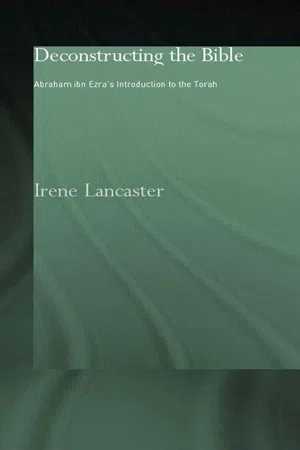
Deconstructing the Bible represents the first attempt by a single author to place the great Spanish Jewish Hebrew bible exegete, philosopher, poet, astronomer, astrologer and scientist Abraham ibn Ezra (1089-1164) in his complete contextual environment. It charts his unusual travels and discusses changes and contradictions in his hermeneutic approach, analysing his vision of the future for the Jewish people in the Christian north of Europe rather than in Muslim Spain. It also examines his influence on subsequent Jewish thought, as well as his place in the wider hermeneutic debate. The book contains a new translation of ibn Ezra's Introduction to the Torah, written in Lucca, northern Italy, together with a full commentary. It will be of interest to a wide variety of scholars, ranging from philosophers and theologians to linguists and students of hermeneutics.
- 256 pages
- English
- ePUB (mobile friendly)
- Available on iOS & Android
eBook - ePub
About this book
Information
1
THE BIOGRAPHY OF ABRAHAM IBN EZRA
Grow old along with me!
The best is yet to be,
The last of life, for which the first was made:
Our times are in His hand
Who saith “A whole I planned,
Youth shows but half; trust
God: see all nor be afraid”
The best is yet to be,
The last of life, for which the first was made:
Our times are in His hand
Who saith “A whole I planned,
Youth shows but half; trust
God: see all nor be afraid”
(Robert Browning, ‘Rabbi Ben Ezra’: I)
Abraham ibn Ezra is one of the most highly regarded, yet misunderstood, of biblical exegetes. In Jewish tradition his Commentary on the Torah is regarded as second only to Rashi’s1 in popularity, and yet he is often underestimated as a mere ‘grammarian’, or advocate of the ‘literal’ meaning of the text. This book aims to demonstrate that far from being a ‘literalist’, ibn Ezra was interested in ‘secret meanings’. He also espoused Aristotelianism, and was the first Jewish exegete to posit the conjunction of thinker, thinking and thought as the goal of man’s desire to know God.2 Most importantly, ibn Ezra’s curious mix of disparate approaches, which he termed ‘grammar’, is of relevance in modern hermeneutic debates. This biography presents an overview of ibn Ezra’s life, emphasising evidence linking his other writings to the Introduction.3 Brief accounts of the political situation of each place he visited are also included wherever possible.
Abraham ibn Ezra was born in 1089 in Tudela in the northern Spanish province of Navarra.4 His education was typical for a well-educated Spanish Jew of his time, being rounded and many-faceted. Ibn Ezra would have been immersed from an early age in the study of Jewish sources, including Torah, Hebrew poetry and linguistics, as well as Arabic poetry, linguistics, science and philosophy. It is important to note that ibn Ezra’s native language was Arabic, not Hebrew. In 1115, when ibn Ezra was twenty-six years old, Tudela was conquered by the Christians, which affected the status of its Jewish inhabitants.5
Very little is known of ibn Ezra’s life in Spain, except that he travelled extensively in both Muslim and Christian areas, including Toledo (which had become a Christian stronghold in 1086, three years before his birth), Cordoba and Lucena. He also visited north Africa, a major centre of Jewish studies at this time, passing through Granada. Ibn Ezra was very close to the great poet, Judah Halevi, who was also born in Tudela and who often shared his travels. Other friends included the philosopher, Joseph ibn Zaddik and the poet, Moses ibn Ezra (no relation). During his travels, ibn Ezra encountered many Jewish communities, some harbouring refugees from the fighting between Christians and Muslims.
Much of ibn Ezra’s poetic oeuvre was written during this early period, when his main domicile was the Iberian peninsula. Many poems were addressed to his benefactors in these communities, and often refer to the problems encountered by the Jews who found themselves in the midst of the two more powerful religions. It appears that ibn Ezra did not himself witness the Muslim Almohad invasion of the peninsula from North Africa, nor its effect on his older contemporaries, such as Moses ibn Ezra and Halevi. Nevertheless, he was fully aware of all the repercussions such tensions engendered.
In about 1140 we suddenly find ibn Ezra leaving Spain for Rome, and embarking on the ‘second period’ of his life.6 He travelled widely through Christian Europe, until the year of his death, 1164. Various reasons have been given for his departure, including the Almohad threat, famine, poverty, marital difficulties, illness and betrayal. There may also have been pressure on ibn Ezra to convert to Islam, which led to his emigration to a Christian country, despite his negative feelings towards Christianity. Another possible reason was the inner urge to educate the Jews of Ashkenazi Europe, whose literary and analytical traditions were different from those of Sephardi Spain and North Africa.7
Ibn Ezra in Rome
Ibn Ezra was fifty when he left the Spanish town of Lucena as a well-known poet and philosopher.8 From there he travelled to Rome ‘in a troubled spirit’,9 alone and impoverished. As well as his ‘strong pedagogical urge’, his fears regarding the impending decline of Spanish Jewry and his desire to safeguard its cultural knowledge led him ‘to take upon himself the role of planting her heritage on the living soil of the Jewish communities in Christian Europe.’10 There, economic necessity forced him to tutor the sons of his wealthy benefactors. He wrote mainly for these students.
Ibn Ezra arrived in Rome shortly after the struggle of Pope Innocent II, with the ‘antipope’, Anacletus II (1130–8), who had been of Jewish origin. When greeted by a Jewish deputation on his entry into Rome, between 1138–9, Innocent had praised Judaism’s ‘Holy Law’, but condemned the ‘religious practice and … faulty interpretation of the Jews,’ not realising, perhaps, the link in Judaism between textual interpretation, Law and religious practice. In addition, the ‘convocation of a great “ecumenical” council in 1139, the year after Anacletus’ death’, caused widespread consternation among the Jews of Europe. Although ‘no anti-Jewish canons were adopted’11 on this occasion, the atmosphere into which ibn Ezra immediately entered must have been extremely tense.
According to the famous Jewish traveller and fellow townsman of ibn Ezra, Benjamin of Tudela, Rome was the chief city of the ‘kingdom of Edom’, comprising about two hundred distinguished Jewish families, who did not even pay the usual special Jewish tax. Some of the Jews were actually in papal service. Two appeared to have had unlimited access to the papal household, including the contemporary head of the yeshivah (religious seminary).12
Despite earlier scholarly views to the contrary, Rome was a highly respected Talmudic centre.13 This fact is relevant to the debate surrounding ibn Ezra’s two Torah Introductions, written in Italy and northern France respectively. For instance, Nathan of Jehiel, who had been the head of the yeshivah before ibn Ezra’s arrival in Rome, had written a lexicon of the Talmud and midrashim,14 in which he had explained all the Talmudic terms, as well as their etymology. He had, in addition, been a fine linguist, having studied Aramaic, Latin, Greek, Arabic and Persian, as well as Hebrew.
Nathan had quoted from the Ge’onim15 and other earlier, as well as contemporary, authorities, utilising the learning of the three chief Torah centres of the day: Babylon (Iraq), Kairouan (North Africa) and Mainz (Germany). However, Nathan had been unaware of the pioneering work of Arabic-speaking Hebrew scholars, such as Judah ibn Hayyuj, relating to Hebrew grammar.16 It was, therefore, one of ibn Ezra’s goals to educate the Jews of Italy in this field. Roth states nevertheless that Nathan’s ‘great talmudic dictionary … bears testimony to the wide rabbinic learning and linguistic range of educated Roman Jewry at this time.’17
Levin describes the combination of wealth and yet foreboding that ibn Ezra encountered in the Jewish community of Rome, at a time when the Second Crusade was imminent. This feeling was aggravated by the sense of claustrophobia experienced in the narrow alleyways of the Jewish quarter of the town.18 Nevertheless, ibn Ezra stayed in Rome for five or six years, making contact with noble Jewish families, and writing poems in their honour. His style of poetry was very different from that of the Italian Jews, being replete with the idiom and scientific accuracy of the Spanish School. Another of ibn Ezra’s favourite devices was to pun on the name of the person to whom the poem was addressed, as in the case of Menahem,19 one of his patrons. This device was also used in the Introduction.
It was here in Rome that ibn Ezra wrote Moznaim,20 the first of several works on Hebrew grammar. He prefaced it with a detailed introduction, reviewing the work of previous grammarians.21 Bacher calls it ‘the oldest grammatical document in the history of grammar’.22 Levin refers to its scientific methodology and precision. The aim of this work was not novelty. As with ibn Ezra’s subsequent grammar books, it was rather a manual written ‘to give to Jews who do not understand Arabic the knowledge and understanding of the system of grammar established one hundred years previously by Judah ibn Hayyuj and his followers.…’23
In Rome, ibn Ezra translated three works on Arabic grammar by ibn Hayyuj and Judah ibn Gikatilla.24 He also composed the first of his Bible commentaries, Ecclesiastes, in which he immersed himself in textual exegesis, insisting on precise interpretations and uncompromising reliance on grammatical rules. His excellent memory assisted him in quoting from the relevant sources, as he had been unable to carry books with him from Spain. Ibn Ezra also introduced philosophical and scientific ideas into his biblical exegesis. He endeavoured to unite all the various disciplines, in order to justify his view of the Bible as a self-contained unit. This was the approach ibn Ezra was to adopt in most of his biblical commentaries, including that on the Torah.
The Commentary on Ecclesiastes is critical of the poetic style of the early Palestinian religious poet, Eleazar ben Kallir,25 who wielded great influence on the Italian school of Hebrew poetry.26 In ibn Ezra’s opinion, Kallir’s piyyutim (liturgical poetry) contained inappropriate linguistic forms, an insensitive use of Talmudic language and words of foreign origin. Ibn Ezra found Kallir ungrammatical in his application of biblical words and insensitive to the rhymes and sounds of the Hebrew letters. Above all, he condemned Kallir’s use of midrashic and aggadic idiom, which took the biblical sense beyond the pshat.27 In contrast, ibn Ezra praised the Babylonian Gaon, Sa’adiah, for omitting such perceived errors from his poetry.28
Ibn Ezra also broke new ground in declaring that no sage, however ancient in origin, and therefore worthy of reverence and respect, is immune from criticism and re-evaluation.29 Here ibn Ezra anticipates his stance in his Introduction to the Torah, where he states: ‘I shall be no respecter of persons when I explore the Torah text, but shall thoroughly, and to the best of my ability, seek the grammatical [form] of every word’.
Ibn Ezra also anticipates his Commentary on the Torah by announcing at the opening of his Commentary on Ecclesiastes that ‘a man cannot attain the rung of awe [of the Creator] until he ascends the ladder of wisdom and it is built and established on understanding.’30 Ibn Ezra regards the means as being as important as the end. Only by ‘ascending’ the ladder, does one begin to ‘build’ it. In other words, only by leading a committed life does ones own life begin to take shape in the way one would desire. In the Commentary on Ecclesiastes, ibn Ezra hints that one needs to be knowledgeable in order to gain true understanding. He also recommends brevity in biblical exegesis. Both these themes are developed in the Introduction to the Torah.
Ibn Ezra’s second biblical commentary was that on Job, which he introduced by reiterating his view that ‘the majority of the commentaries of the early writers on this book are not [written] according to grammatical criteria.31 Some, moreover, are [written] by the midrashic method’. Ibn Ezra’s own approach involves defining each word, including technical difficulties, according to pshat interpretations and the most up-to-date laws of grammar. Only then does he explain ‘the essence of the meaning.’32 Nevertheless, despite his resolve, ibn Ezra himself occasionally succumbs to more detailed, long-winded explanations, a trait he abhors in others.
According to Fleischer, ibn Ezra completed his literary achievement in Rome with his Commentary on the Five Megillot.33 The reaction of the Jewish scholars in Rome to the grammatical, yet philosophical and scientific, approach of ibn Ezra was one of astonishment. Ibn Ezra had introduced them to a totally novel approach, embracing many different disciplines under the title of ‘exegesis’, whilst demanding precision and self-discipline in poetry. In one of his own poems, ibn Ezra was to say generally of his stay in Italy that ‘in Edom there is no room for a sage who dwells in the land of Kedar’. His meaning is that the Jews of Christian Europe did not wish to accommodate the new ideas of the Muslim-influenced Jews from Spain.34
Ibn Ezra was aware of the general accusations of heresy aimed by Jews in Christian lands at the Spanish Jewish scholars. These must have increased his sense of geographical and cultural isolation and alienation. In addition he was totally dependant on his hosts for financial support. He had obviously reached an impasse in Rome and, immediately after completing the Commentary on the Five Megillot, he left to continue his life of perpetual travel. It may not be too far-fetched to suggest that ibn Ezra’s emphasis on ‘paths’ and ‘movement’ in the search for God, not to mention the ‘circle’ imagery of the Introductions, is a reflection of his own wanderings.
Ibn Ezra in Lucca
In 1145 ibn Ezra travelled north to Lucca, a six-day journey from Rome. It is possible that, in addition to the negative reasons for this move, ibn Ezra may, whilst still in Rome, have received an invitation from Jewish scholars residing in Lucca. Alternatively, he may just have thought that he might find much-needed financial and emotional support there.35
Before 1000 CE an important Jewish community had existed in Lucca.36 It is even possible that, as early as the ninth century, a Ta...
Table of contents
- Cover Page
- Title Page
- Copyright Page
- Acknowledgements
- A Note on Terminology
- Introduction
- 1 The Biography of Abraham Ibn Ezra
- 2 A History of the Scholarly Work on Ibn Ezra
- 3 Classical and Mediaeval Jewish Approaches to Text
- 4 Early Christian Hermeneutics
- 5 Muslim Hermeneutics
- 6 The Karaites
- 7 The Ge’onim
- 8 Introduction to the Torah: Translation and Commentary
- 9 Ibn Ezra’s Philosophical Grammar
- Notes
- Bibliography and Further Reading
Trusted by 375,005 students
Access to over 1.5 million titles for a fair monthly price.
Study more efficiently using our study tools.
Frequently asked questions
Yes, you can cancel anytime from the Subscription tab in your account settings on the Perlego website. Your subscription will stay active until the end of your current billing period. Learn how to cancel your subscription
No, books cannot be downloaded as external files, such as PDFs, for use outside of Perlego. However, you can download books within the Perlego app for offline reading on mobile or tablet. Learn how to download books offline
Perlego offers two plans: Essential and Complete
- Essential is ideal for learners and professionals who enjoy exploring a wide range of subjects. Access the Essential Library with 800,000+ trusted titles and best-sellers across business, personal growth, and the humanities. Includes unlimited reading time and Standard Read Aloud voice.
- Complete: Perfect for advanced learners and researchers needing full, unrestricted access. Unlock 1.5M+ books across hundreds of subjects, including academic and specialized titles. The Complete Plan also includes advanced features like Premium Read Aloud and Research Assistant.
We are an online textbook subscription service, where you can get access to an entire online library for less than the price of a single book per month. With over 1.5 million books across 990+ topics, we’ve got you covered! Learn about our mission
Look out for the read-aloud symbol on your next book to see if you can listen to it. The read-aloud tool reads text aloud for you, highlighting the text as it is being read. You can pause it, speed it up and slow it down. Learn more about Read Aloud
Yes! You can use the Perlego app on both iOS and Android devices to read anytime, anywhere — even offline. Perfect for commutes or when you’re on the go.
Please note we cannot support devices running on iOS 13 and Android 7 or earlier. Learn more about using the app
Please note we cannot support devices running on iOS 13 and Android 7 or earlier. Learn more about using the app
Yes, you can access Deconstructing the Bible by Irene Lancaster in PDF and/or ePUB format, as well as other popular books in Theology & Religion & Biblical Commentary. We have over 1.5 million books available in our catalogue for you to explore.