eBook - ePub
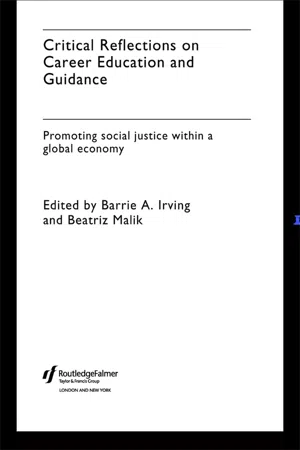
Critical Reflections on Career Education and Guidance
Promoting Social Justice within a Global Economy
- 216 pages
- English
- ePUB (mobile friendly)
- Available on iOS & Android
eBook - ePub
Critical Reflections on Career Education and Guidance
Promoting Social Justice within a Global Economy
About this book
First Published in 2004. The provision of effective career guidance has been presented as the answer to economic and social problems in young people, and has been seen by governments around the world as essential in ensuring economic competitiveness and prosperity. Policy discussions have centred on individuals' development of 'self-managed' careers within a global labour market, placing employability skills above all other concerns. This book goes beyond the rhetoric of careers guidance by exploring it from critical and radical standpoints. The contributors question the economic underpinning that has driven social inclusion agendas around the globe, arguing that career education and guidance needs to place greater emphasis on approaches that have a greater social awareness and within a global context. They discuss career guidance in consideration of a range of issues including social class, 'race' and gender and raise questions about the implications for policy and practice. Essential reading for students, researchers and academics and practitioners involved with careers education, this book will help the reader to improve their practice through a greater understanding of the theories and social and economic contexts involved
Information
Chapter 1
Introduction
Barrie A. Irving and Beatriz Malik
Critical reflections in context
Governments around the world appear to have been captured by narrow economic imperatives driven by the desire to win in the global competition for business, jobs and profit. It is argued that the gains made will ensure the economic health of successful nation states resulting in social cohesion, individual well-being and benefits for all. In response to demands from employers for a work-ready labour force the function of education is coming under ever-closer scrutiny to ensure that the ‘right’ attitudes, skills and behaviours are being inculcated in the young. Compulsory schooling is given the task of ensuring that the needs of an emerging high skills labour market will be met by pupils who understand the benefits of a ‘free market’ and the need to become lifelong learners. Further, young people and adults are being made aware of their responsibilities as productive citizens, yet also encouraged to recognise the potential prizes on offer to those individuals who make a ‘success’ of their lives. In recent years the provision of career education and guidance has been presented as a panacea for social exclusion, the key to individual aspiration, and an essential component in ensuring that labour demands are met.
Yet whilst the discourse of the market and triumphalist cry of capitalism currently rings loud, there is increasing unease about the ways in which globalisation is impacting on the lives of people in economically and politically powerful western nation states, and the relatively impoverished developing world. The emergence of a re-invigorated political ‘right’ in Europe and elsewhere, evidence of increasing social disadvantage and poverty, the hysteria associated with asylum seekers and refugees, concerns about increasing occurrences of racism, and negative portrayals of anti-capitalist and environmental protest, has led many to question the prevailing wisdom.
Think global: act local
In a rapidly changing labour market increased demands are being placed on employees to be flexible, continually enhance their employability skills, and be responsive to change (Rajan et al. 1997; Smith 2002). Teachers meanwhile are given the responsibility of ensuring their students are prepared for new challenges and opportunities by becoming lifelong learners (Irving 1999). Beneath the glowing picture of choice, opportunity, and economic rewards however lies a neo-liberal individualist conception, which belies the notion of social belonging or collective rights. Further, it is these aspects of life that have been increasingly undermined as the global capital message stakes its claim as the core ideology in many western states. The neo-liberal economic rationalist rhetoric, in which everything is subservient to the needs of the market, presents a restricted picture of how things could, and possibly should, be if the interests of justice and democracy are to be served.
Colley (2000) argues that the ongoing mantra concerning the benefits of globalisation is disingenuous at best as many workers in advanced western capitalist countries have experienced a decline in living standards, reduced employment rights, and a contraction in opportunity. She asserts that:
The tendency of globalization is not to create an economy requiring high skill levels and reward these with prosperity for all, but the opposite: greater inequalities in income, weakened trade union protection, casualised work with low skills and low pay.
(Colley 2000: 19)
If Colley is correct in her analysis, then there is a need to ask why there has been widespread acquiescence to such an individualistic and deterministic model. Whilst reality may take many forms, it appears clear that particular versions have greater power to influence public policy. At the current time, a managerialist form dominates, reinforced through government intervention (Offer in Gothard et al. 2001: 91) legitimated by the need to fundamentally change labour market practices in response to global competition (Bradley et al. 2000, cited by Offer in Gothard et al. 2001: 90).
Meanwhile the gap between the richest and poorest in society continues to grow as structural inequalities remain hidden from view. Individuals are increasingly held responsible for their futures, regardless of ‘race’, gender, social class or (dis)ability. An inverse approach to redistribution appears to be taking place in Britain today based on a meritocratic view of achievement and success. Talk of reducing the tax burden, removing restrictive labour practices, and enforcing participation in learning and work can be regarded as a means whereby greater economic rewards are given to those deemed to be ‘successful’ by taking away resources from those who have least (Darom 2000). Tomlinson (2001) identifies the emergence of a post-welfare society in which the work ethic and competition, whether in education or the labour market, dominates. In pursuit of economic efficiency, she argues, welfare benefits are being restructured or removed as they are perceived to be an economic drain on the nation’s wealth. This is reflected in Coffield’s observation in the United Kingdom.
The government’s stated aim of rebuilding the welfare state around work (DSS, 1998), by which is meant ‘paid employment’, has created a climate where learning is judged according to ‘rates of return’, and people are evaluated according to their employability and their capacity to deliver added value to the economy.
(Coffield 2000: 12)
Yet the restructuring of the welfare state, alongside the economic insecurities and uncertainties in this new order of globalised business, also has a cost reaching far beyond that of individual aspiration and opportunity. The impact on family, community and social cohesion is at stake as the pursuit of neo-liberal economic rationality overshadows any discussion of the collective good. Moreover, social worth is increasingly couched in the language of responsibility and economic participation, thereby marginalis-ing the contribution made by those engaged in ‘alternative work’ activities. It is interesting to note the changing language as we move from a discourse of citizens’ rights to that of responsibilities. Responsible citizenship is primarily evidenced through an individual’s engagement in the formal labour market, thereby avoiding the spectre of social exclusion. Tony Blair, British Prime Minister, notes in the foreword to a key report produced by the Social Exclusion Unit, ‘The best defence against social exclusion is having a job and the best way to get a job is to have a good education with the right training and experience’ (1999: 6).
This discourse also pervades the educational arena, where emphasis is placed on the individual, and on ‘self-determination’. A clear example of this is the importance of ‘personal effort’ and ‘rigour’ to attain school success which permeates throughout the recently enacted Spanish education law (LEY ORGÁNICA 2002). The ‘culture of effort’ is considered an essential quality assurance element in education, besides evaluation and adequate teacher training.
The implication is clear, the needs and desires of society as a whole are subservient to the economic goals of capital accumulation. Failure or reluctance to make an economic contribution is therefore construed as deviant or disruptive behaviour. Yet what does this say to those who are not actively engaged in paid labour due to family responsibilities, cultural/ religious beliefs, disability, age, or a decision to commit their life to socially useful work such as volunteering in the community or participation in protest movements? If the social conscience is to be recaptured, a restructuring of economic relations will be required to ensure a critical citizenship emerges that engages with individuals and members of diverse communities in a holistic way, recognising the value and worth of all, whilst also embracing the collective good.
Challenging career education and guidance
Clearly, career education and guidance is part of a wider political arena through which participants explore and examine multiple possibilities concerning their potential pathways through life. However, these pathways cannot be regarded as free, unfettered and equally available to all, as access to opportunity is subject to individual desires, social expectations and structural constraints. It is influenced by a range of particular discourses of power relations, and saturated by competing conceptions of social and economic reality. For some observers, the primary role of career education and guidance has been identified as a mechanism through which smooth transitions from education to work are facilitated, thereby enabling the labour market to function efficiently and effectively (Bridges 1998; Offer in Gothard et al. 2001: 83; Douglas 2004). In this scenario, career education and guidance adopts an instrumentalist role by ensuring that education and counselling provides ‘(R)ealistic, impartial information and advice – embedded in the realities of the labour market’ (Stokes 1994, cited in Colley 2000: 17, emphasis added).
Career educators and guidance counsellors ultimately become duty bound to mediate in the aspirations of their clients to ensure that the ‘right’ choices are made within the context and realities of an inequitable, yet ostensibly acceptable, economic world. The need to demonstrate the economic benefits accruing from career education and guidance in order to secure government funding and support (Bysshe et al. 2002) further entrenches the view that its primary goals should be narrowly related to labour market productivity and participation. The uncritical acceptance of such goals acts to move discussion away from a wider exploration of the concept of work in advanced capitalist countries, consideration of inequality and justice, and ways in which human value and worth are socially derived (Irving and Marris 2002). Perpetuating the view that individuals are solely responsible for their actions and situations helps to ‘(S)hift the political focus away from the structural problems of underemployment, poverty, homelessness, under-funded welfare services and a degenerating environment’ (Franklin 1998: 2).
Watts (1996) makes a profound, yet in many respects self-evident, statement in his identification of the political nature of career education and guidance. He writes that, ‘(w)ithin a society in which life chances are unequally distributed, it faces the issue of whether it serves to reinforce inequalities or to reduce them’ (p.351). Not only is the myth of the neutral state exposed but the concept of impartiality is also brought into question (Young 1990). As discussed earlier, career educators and counsellors must seriously question whether professional impartiality or neutrality is ever possible; to consider which realities are to be presented; and to decide whether their practice will work to reinforce or reduce inequality. Assisting in the development of employability skills, helping with job search activity and identifying opportunities in the labour market is only a partial aspect of career education and counselling, and is of most relevance to those clients seeking to secure employment. There is a wider role, however, concerning the provision of support and encouragement to those ‘Others’ who are not engaged in paid employment, or wish to transgress from the economic doctrines of the state. This is especially pertinent if career educators and guidance counsellors are to provide effective support to clients who may ‘have experiences of feeling lost, bewildered, confused, angry, stupid, rejected, misunderstood and redundant’ (West 2003: 22). Moreover, asking young people in particular to uncritically develop the skills to self-manage uncertain, insecure, yet potentially boundaryless careers in isolation of a social context or the development of a broad understanding of this concept, paradoxically may lead to a heightened sense of powerlessness, with their lives constructed in relation to the vagaries of economic toil. This is noticeable when we begin our examination of the prevailing dominant economic ideology from the position of the least advantaged. Presenting the perspectives of already powerful and privileged groups in normative and neutral ways can serve to silence dissenting voices, or demean the experiences of oppressed individuals and groups (Young 1990), doing little to enable them to recognise their individual and collective power to influence and enact change. This is of particular importance for those engaged in the practice of career education and guidance counselling. Exposing the value-laden ideologies of the global labour market to scrutiny serves to ensure that the recipients of career learning are given an opportunity to explore alternative visions and develop their own understanding of ‘career’ within a lived context.
Giroux (1992) emphasises the importance of an empowering approach within education, defining this term as the ability to think and act critically. When applied to career educators and guidance counsellors, it requires them to become transformative intellectuals, concerned not only with state sanctioned knowledge (Apple 2000) but also the promotion of alternative and critical perspectives. As Apple (2001) asserts, ‘the best way to understand what any set of institutions, policies, and practices does is to see it from the standpoint of those who have the least power’ (p.197). Agreeing with Giroux’s perspective on education, career educators and guidance counsellors must:
explore the complexity of culture within power relations that both enable and silence students from diverse traditions. They must also address issues of inequality as they are structured within racial, gender and class relations and recognize the limitations of the politics of separation in waging collective struggle against various relations of oppression in their complexity and interrelatedness.
(Giroux 1992: 246)
Whilst it is important to acknowledge that even the best intentioned career educator and guidance counsellor is likely to experience restrictions and limitations in pursuit of socially just outcomes from their work, this does not imply that there is no scope for action. As Beyer (2000) suggests, ‘If education is a social practice, and responsible for social continuity, then it must also be seen as having a critical perspective, one that is open to social change as well as continuity’ (p.37). Clearly, finding space to question dominant discourses is not always easy as it exposes professionals to reactionary claims that the presentation of alternative world-views is an act of naiveté based on simplistic assumptions, or prompted by self-interest (Young 1990). Yet failure to respond positively to this challenge leaves career education and guidance open to the charge that is has a strong tendency to act, albeit unintentionally perhaps, as a state agent.
Whilst much career theory has focused on the concept of self and opportunity, it is now timely to think more deeply about the need to embed a social justice philosophy that begins to ‘overcome the deficiencies associated with a sanitized, depoliticized and . . . neutralized perspective of social relations [and is] explicit about the sites of oppression . . . and their interlocking nature . . .’ (Irving et al. 2000: 176). A more holistic view of career education and guidance that not only works to improve the life of individuals, ...
Table of contents
- Cover Page
- Title Page
- Copyright Page
- Acknowledgements
- Contributors
- Foreword
- Chapter 1: Introduction
- Chapter 2: Social justice
- Chapter 3: Welfare to work
- Chapter 4: Liberté? Futilité?… Autonomé! Careers education as an emancipatory activity
- Chapter 5: Cultural diversity and guidance: myth or reality?
- Chapter 6: Career education for Muslim girls
- Chapter 7: (En)gendering socially just approaches to career guidance
- Chapter 8: Women, work and career development
- Chapter 9: The career education curriculum and students with disabilities
- Chapter 10: Social class, opportunity structures and career guidance
- Chapter 11: Working with youth at risk of exclusion
- Chapter 12: Social justice and equality of opportunity for Mexican young people
- Chapter 13: Beyond the toolbox
- Chapter 14: Challenging careers
Trusted by 375,005 students
Access to over 1.5 million titles for a fair monthly price.
Study more efficiently using our study tools.
Frequently asked questions
Yes, you can cancel anytime from the Subscription tab in your account settings on the Perlego website. Your subscription will stay active until the end of your current billing period. Learn how to cancel your subscription
No, books cannot be downloaded as external files, such as PDFs, for use outside of Perlego. However, you can download books within the Perlego app for offline reading on mobile or tablet. Learn how to download books offline
Perlego offers two plans: Essential and Complete
- Essential is ideal for learners and professionals who enjoy exploring a wide range of subjects. Access the Essential Library with 800,000+ trusted titles and best-sellers across business, personal growth, and the humanities. Includes unlimited reading time and Standard Read Aloud voice.
- Complete: Perfect for advanced learners and researchers needing full, unrestricted access. Unlock 1.5M+ books across hundreds of subjects, including academic and specialized titles. The Complete Plan also includes advanced features like Premium Read Aloud and Research Assistant.
We are an online textbook subscription service, where you can get access to an entire online library for less than the price of a single book per month. With over 1.5 million books across 990+ topics, we’ve got you covered! Learn about our mission
Look out for the read-aloud symbol on your next book to see if you can listen to it. The read-aloud tool reads text aloud for you, highlighting the text as it is being read. You can pause it, speed it up and slow it down. Learn more about Read Aloud
Yes! You can use the Perlego app on both iOS and Android devices to read anytime, anywhere — even offline. Perfect for commutes or when you’re on the go.
Please note we cannot support devices running on iOS 13 and Android 7 or earlier. Learn more about using the app
Please note we cannot support devices running on iOS 13 and Android 7 or earlier. Learn more about using the app
Yes, you can access Critical Reflections on Career Education and Guidance by Barrie A. Irving,Beatriz Malik in PDF and/or ePUB format, as well as other popular books in Education & Education General. We have over 1.5 million books available in our catalogue for you to explore.