eBook - ePub
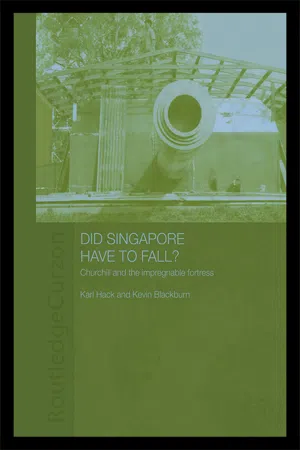
Did Singapore Have to Fall?
Churchill and the Impregnable Fortress
- 328 pages
- English
- ePUB (mobile friendly)
- Available on iOS & Android
eBook - ePub
About this book
This book provides a sophisticated summary of up-to-date knowledge on the Fall of Singapore, including the critical tensions between Churchill and local commanders. A focus on the role of Churchill, and on his understanding of the guns and Singapore's fortifications, makes the Fortress central to understanding why and how Singapore fell as it did. The book includes a range of quotations that give the flavour of the time and the essence of the debates. No other book allows the reader to get a clear overview of the base, the plans, the campaign, the guns and the remaining heritage, all in one place.
1
INTRODUCTION
British forces in Singapore surrendered on 15 February 1942. This was just seventy days after 8 December 1941, when Japanese troops first disembarked on the gentle tropical beaches of Singora and Patani in southern Thailand, and Kota Bharu in northeastern Malaya. Making full use of their aerial and armoured superiority—not to mention their infantry’s toughness and mobility—it had taken the Japanese just ten weeks to drive the British out of north Malaya, down its west coast (with minor thrusts in the east too), and across the causeway to their last stand in Singapore.
That the world’s biggest empire should be crushed so swiftly by an Asiatic foe it assumed to despise left a sense of shock, and of betrayed trust. Perhaps this is why Singapore’s fall continues to exercise fascination. It shattered mental images held for a century or more, and accelerated the end of empire.1 The 15 February was a day that would ‘live in infamy’.2
Hence the importance of the questions, did Singapore have to fall, and did it have to fall so soon and so ignominiously? Since 1942 there have been many suggestions as to how the island could have been saved, or defeat made less humiliating. If only there had been more guns, aircraft, tanks or men. If only Operation Matador had been launched in time to forestall the Japanese on the beaches of southern Thailand.3 If only Britain’s General-Officer-Commanding (Malaya), Lieutenant-General Arthur Percival, had not been fooled into thinking the Japanese would attack Singapore in its northeast rather than its northwest, or if Australian forces had not fallen apart in the last few days.
Even at the last gasp, with troops deserting, and aircraft departed to the Netherlands East Indies, some historians have spotted one last chance. What if a British counter-attack had been launched at the eleventh hour, on 15 February itself, when the Japanese were down to their last artillery shells and tanks?4 Perhaps then the remaining force of over 100,000 men need not have been defeated by a smaller Japanese Army.
So many ways have been suggested in which disaster could have been avoided, that it has become difficult to understand how Churchill and his commanders could have missed every one of them.
Yet blaming individuals can seem inadequate, given the scale of events from December 1941 to March 1942. The Americans lost the Philippines despite being involved in no other conflict. The Dutch collapse in the Netherlands East Indies came even more quickly. By the time Lieutenant-General Yamashita, commanding the Japanese Twenty-Fifth Army, secured Singapore on 15 February 1942, Japanese ships were rolling across the southern seas from Manila in the Philippines to Palembang in Sumatra, while Japan’s forces were soon to advance to Mandalay in Burma and to bomb Darwin in Australia. They even felt able to transfer some aircraft away from Malaya in early 1942, to the Borneo front. Finally, if Malaya did not have enough forces, Burma had fewer still: less troops; less aircraft and less guns. Hong Kong’s garrison of around 14,000 men and volunteers had just five aircraft.5 By May 1942 even India did not seem safe.
So the question remains: did Singapore have to fall at this time, and in this manner? Did Winston Churchill miss his chance to save Malaya in mid-1941, when there was still time to send vital tanks and aircraft? Or did the British Prime Minister do all he reasonably could, given the constraints of a global war? Was Singapore doomed not by individual mistakes, then, but by Britain’s relative decline, so that it became incapable of fighting Italy, Germany and Japan simultaneously? In short, was the Fall of Singapore avoidable, or inevitable?
The historiography on this question is so vast that, before an answer is even attempted, we need to outline the main pre-existing schools of thought. Only when a pattern is imposed on the innumerable books on this topic will we be able to start to piece the puzzle together again. Furthermore, the best place to begin this process is at the beginning, in 1942.
Several books by journalists appeared before the end of that fateful year. They gave us, amongst other things, the myth that the big coastal guns of Singapore faced uselessly out to sea. The journalists also excelled at giving the flavour of events they had witnessed. One of the best of these works was London Times correspondent Ian Morrison’s Malayan Postscript.6 Morrison covered most of the themes later authors would recycle in less exciting language, including the lacklustre performance of the civilian administration, and the need to build national armies, rather than relying on imperial mercenaries. Like many of his contemporaries, he was particularly struck by Britain’s reluctant, late and minimal recruitment of Asians, including local Chinese who had every reason to fear Japanese conquest.7
Later works tended to serve a positive function in debunking the early myths, but they also relegated the racial aspect to the background, in favour of studies of tactics and strategy. Two of the most important of these were by Major-General S.Woodburn Kirby.8 Kirby was chosen to write the official British military history: The War Against Japan, volume one of which was The Loss of Singapore (1957).9 Kirby was a natural choice, as he had experience of Singapore in the 1920s, and of India in the 1940s. He had even written a 1935 paper which foresaw Japanese landings on the coast of southeast Malaya, as a prelude to the main attack on Singapore. Yet despite all this he had remained untainted by direct involvement in the Malayan campaign.10 The resulting official history was an excellent example of the campaign study genre, but it was only in his later classic, Singapore: The Chain of Disaster (1971), that Kirby felt free to give full rein to his opinions.11
In this posthumous, 1971 work, Kirby’s perspective was reflected by the subtitle: The Chain of Disaster. This suggested a chain of responsibility, stretching all the way from 1921, through London’s decision not to send the necessary ships, tanks and aircraft, to the commanders in the field. Kirby’s books thus turned out to be detailed campaign histories which nevertheless looked beyond the campaign for the ultimate causes of defeat.12
While Kirby stressed that the fall of Singapore was due to the whole chain of decision-making, other historians have chosen to place Britain’s naval decisions to centre stage. For them, it was Britain’s failure to maintain a two-ocean navy after the beginning of the twentieth century which doomed Singapore. Rather than maintaining its naval dominance, Britain chose to build a naval base at Singapore to which they might despatch a fleet in an emergency. But the plan was fatally flawed. It assumed the Japanese would only attack Singapore in the most unlikely of scenarios, that is, when the Royal Navy was not already tied down in other conflicts.
Worse still, the one force which could have compensated for a relative decline in naval power was underplayed. The Royal Air Force tried to argue that its aircraft, and especially its torpedo bombers, should supplement or even displace ships and big coastal defence guns. But the older services refused to grant it more than a marginal role, until almost the very end, by when it was too late to assemble the necessary machines.
Strategic folly was compounded by parsimony. Whether because of a genuine lack of resources or simply a lack of will in the face of pressure for disarmament, economic problems at home, and rising domestic expenditure, not enough ships were built in the 1920s and 1930s.13 Hence when world war came in 1939 to 1940, the Royal Navy struggled to match even two adversaries: the Germans and the Italians. By 1941 it was hard pressed in the Atlantic and the Mediterranean, and no fleet could be sent to Singapore in time. This ‘naval school’, espoused by the likes of Neidpath and MacIntyre in the late 1970s to early 1980s, thus tended to stress Britain’s long-term decline and failures, rather than short-term decisions.14
The entrenched nature of Britain’s eastern dilemmas was also stressed by what might be called a ‘diplomatic’ school of historians. Books such as Ritchie Ovendale’s, ‘Appeasement’ and the English-Speaking World (1975) showed how British strategy was hamstrung by its global over-extension, Presented with an increasingly bellicose Germany and Italy in Europe in the 1930s, the Chiefs of Staff felt it expedient to appease in the distant Far East. To their minds, appeasing Japan was the easiest way of avoiding Britain having to face three strong enemies at once. Nor was appeasement driven only by the external threats. There were pressures internal to the Commonwealth as well. Export-orientedBritain might face economic defeat before actual war broke out, if it diverted too many of its industries into war production, to match too many adversaries, too soon.15 In addition, Australia and New Zealand, however supportive of a strong British presence in the Pacific, did not want to antagonise Japan. So there was an economic, political and military logic to appeasement, and to the strict diet of military provision this region was placed on.16 Until and unless concrete United States support was forthcoming, something not totally guaranteed until the attack against Pearl Harbor of December 1941, there were no obvious alternatives.17
These naval and diplomatic analyses would tend to exonerate both the commanders on the spot, and Churchill in London. Many other works also make light of Churchill’s responsibility for the disaster, not least his own superbly crafted history, called simply: The Second World War.
Volume 4 of this magisterial and elegantly written work, entitled The Hinge of Fate (1951), argues that Churchill had no choice but to concentrate resources in active theatres in the western and northern Africa in 1941, rather than risking dispersal to passive theatres such as Singapore. Raymond Callahan’s The Worst Disaster: The Fall of Singapore (1977) developed the classic statement of this grand strategy argument, stating that Churchill could fight one war in the west and hope to win it, or fight two, and risk losing on both fronts.18 Like the naval school, this grand strategy school takes a strategic approach. Unlike the naval school, it places the emphasis on decisions taken in the Second World War itself, rather than beforehand.
This exculpatory grand strategy school of thought even finds supporters in Singapore. Singapore-based Canadian historian Brian Farrell took this approach at a major conference held to mark the sixtieth anniversary of the Fall of Singapore (15 February 2002). This brought to Singapore many of the world’s experts on the campaign, with the resulting papers published as Sixty Years On: The Fall of Singapore Revisited (2002).19
Farrell’s previous work was on British grand strategy, so it is not surprising that he chose to place Churchill’s decisions in the context of a world crisis in 1941.20 According to this argument, Churchill gambled, and, in the ultimate sense, he won. It was not the British who made the critical strategic mistakes in 1941, but Hitler, who failed to deliver the knockout blow to the Soviet Union, and the Japanese.21
Since the Japanese knew from mid-1941 that any further expansion in the east was likely to mean war with the United States, they should have known that that would guarantee eventual defeat. Like Hitler, they gambled that one knock-out blow would bring their opponent to their knees, or at least to the negotiating table, and they lost. By comparison, Churchill knew his main need was to conserve forces and take the risks necessary to ensure survival, in the hope that the United States would eventually enter the war.
But the grand strategy, pro-Churchill lobby has not gone unchallenged. Its critics have ranged from vocal members of the House of Commons and House of Lords in 1941 and 1942 debates over the Malayan debacle, to Ong Chit Chung in Singapore itself. Together, these offer what might be called ‘a Churchill thesis’, that Churchill in particular took decisions which were not only fatal, but also avoidable.
The British parliamentary debates of 1941 to 1942 saw accusations that Churchill should and could have sent more reinforcements to Malaya, and that Britain could have produced more fighter aircraft and tanks and less labour-intensive bombers. In short, they included accusations that the seeds for what one Parliamentarian called the ‘Worst Disaster since Ethelred the Unready’ were sown in the corridors of Whitehall, if not on the playing fields of Harrow.22
At the opposite end of the twentieth century, and several thousand miles from Westminster, Ong Chit Chung also took on the role of prosecutor. Ong Chit Chung is a Singaporean historian and, at the time of writing, a member of Parliament and Chairman of the Singapore Parliamentary Committee on Defence and Foreign Affairs. His Operation Matador (1997) reminded us that the final defence plans for Malaya, in 1941, relied not on ships or coastal guns, but on an air and land defence of north Malaya and southern Thailand: plans which Churchill refused to back with the requisite tanks and aircraft.
Ong argued that Churchill was explicitly warned in early 1941 that a comparatively small number of modern machines could make a big difference in Malaya, but still chose to send large numbers of aircraft to the Middle East and the Soviet Union that year, and virtually none to Malaya.23 Ong’s main criticism appears to centre not on equipment sent to the Middle East, but on the despatch of more than 400 aircraft to Russia, where this material could only be a drop in a Soviet ocean. Another author has argued that ‘there would otherwise almost certainly have been Hurricane squadrons in Singapore by December’. Thus, from a Singaporean perspective, Singapore never did ‘fall’. It was surrendered by a British Empire that chose not to send the necessary resources, and whose commanders chose not to fight to the finish.24
Such postcolonial criticism has struck a chord not only in Singapore, where Ong’s Operation Matador has been discussed in the press and reprinted in Chinese, but in Australia too. Indeed, Australia even sent a special envoy to London in late 1941. This was Ear...
Table of contents
- Cover Page
- Title Page
- Copyright Page
- Plates
- Figures
- Maps
- Preface
- Abbreviations
- Battle Chronology
- 1 Introduction
- 2 Singapore In 1941
- 3 The Fatal Decisions
- 4 The Campaign
- 5 The Guns of Singapore
- 6 After the Battle
- 7 Conclusion
- Appendix A British Forces In December 1941, and Reinforcements
- Appendix B Japanese Forcesin December 1941
- Appendix C Organisation and Disposition of Malaya Command, 7 December 1941
- Appendix D Aircraft in the Far East and Their Disposition, 7 December 1941
- Appendix E War Diaries
- Appendix F Gun Statistics
- Appendix G the Fire Commands1
- Glossary
- Notes
- Bibliography
Trusted by 375,005 students
Access to over 1.5 million titles for a fair monthly price.
Study more efficiently using our study tools.
Frequently asked questions
Yes, you can cancel anytime from the Subscription tab in your account settings on the Perlego website. Your subscription will stay active until the end of your current billing period. Learn how to cancel your subscription
No, books cannot be downloaded as external files, such as PDFs, for use outside of Perlego. However, you can download books within the Perlego app for offline reading on mobile or tablet. Learn how to download books offline
Perlego offers two plans: Essential and Complete
- Essential is ideal for learners and professionals who enjoy exploring a wide range of subjects. Access the Essential Library with 800,000+ trusted titles and best-sellers across business, personal growth, and the humanities. Includes unlimited reading time and Standard Read Aloud voice.
- Complete: Perfect for advanced learners and researchers needing full, unrestricted access. Unlock 1.5M+ books across hundreds of subjects, including academic and specialized titles. The Complete Plan also includes advanced features like Premium Read Aloud and Research Assistant.
We are an online textbook subscription service, where you can get access to an entire online library for less than the price of a single book per month. With over 1.5 million books across 990+ topics, we’ve got you covered! Learn about our mission
Look out for the read-aloud symbol on your next book to see if you can listen to it. The read-aloud tool reads text aloud for you, highlighting the text as it is being read. You can pause it, speed it up and slow it down. Learn more about Read Aloud
Yes! You can use the Perlego app on both iOS and Android devices to read anytime, anywhere — even offline. Perfect for commutes or when you’re on the go.
Please note we cannot support devices running on iOS 13 and Android 7 or earlier. Learn more about using the app
Please note we cannot support devices running on iOS 13 and Android 7 or earlier. Learn more about using the app
Yes, you can access Did Singapore Have to Fall? by Kevin Blackburn,Karl Hack in PDF and/or ePUB format, as well as other popular books in History & Asian History. We have over 1.5 million books available in our catalogue for you to explore.