eBook - ePub
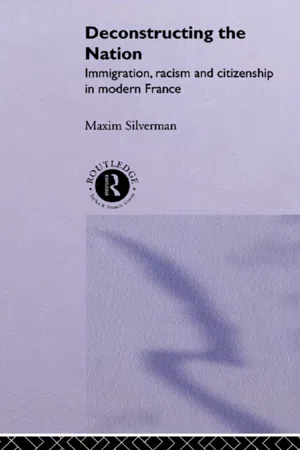
Deconstructing the Nation
Immigration, Racism and Citizenship in Modern France
- 216 pages
- English
- ePUB (mobile friendly)
- Available on iOS & Android
eBook - ePub
About this book
Deconstructing the Nation examines the connection between racism and the development of the nation-state in modern France. The author raises important questions about the nature of citizenship rights in modern French society and contributes to wider European debates on citizenship. By challenging the myths of the modern French nation Maxim Silverman opens up the debate on questions of immigration, racism, the nation and citizenship in France to non-French speaking readers. Until quite recently these matters have largely been ignored by researchers in Britain and the USA. However, European integration has made it essential to look beyond national frontiers. The major part of his analysis concerns the period from the end of the 1960s to the beginning of the 1990s. Yet contemporary developments are placed in a historical context: first through a consideration of the construction of the modern question of immigration since the second half of the nineteenth century, and second through a survey of political, economic and social developments since 1945. There are analyses of the major debates on nationality in 1987 and the headscarf' affair of 1989. Finally questions of immigration, racism and citizenship are considered within the framework of European integration.
Information
Chapter 1
Immigration and the nation-state
People like to say: revolution is beautiful, it is only the terror arising from it which is evil. But this is not true. The evil is already present in the beautiful, hell is already contained in the dream of paradise and if we wish to understand the essence of hell we must examine the essence of the paradise from which it originated.
(Kundera 1983:234)
THE QUESTION OF IMMIGRATION
Immigration is a fundamental feature of the formation of modern France. Of the major western countries only North America and Canada have experienced a more profound immigration than France. Three large waves of immigration have occurred over the last hundred years: the end of the nineteenth century saw an influx of Belgians and Italians, the 1920s saw the arrival of Poles, Czechs and Slavs, and the post-war period has seen an immigration from North and West Africa as well as a large Portuguese immigration in the 1960s. In the 1930s, the number of immigrants in France as a proportion of the total population was roughly the same as today—about 7.5 per cent of the total population. One in every four French nationals has a parent or grandparent who is/was not French.
Only recently have these facts been brought to light. Until the 1970s immigration had been a marginal interest for researchers. School history books did not teach the importance of immigration in the development of modern France (Gaspard and Servan-Schreiber 1985:185). Immigration was not deemed worthy of serious consideration, either in terms of its effect on society or as a phenomenon in its own right. Periodically, politicians and planners had debated questions of immigration (for example, at the end of the nineteenth century, during the 1930s and immediately after the Second World War). Yet these issues were confined, in the main, to articles and documents of a specialist nature, written either by demographers or economic planners. Only two major scientific studies of immigration had appeared before the 1960s (Mauco 1932; Girard and Stoetzel 1953). Historians had largely failed to reflect on these issues in their discussion of the modern history of France.
The contemporary interest in questions of immigration roughly corresponds to the change in immigration policy at the end of the 1960s. With the introduction of the first measures of immigration control in the modern period and moves towards a social policy of integration of immigrants came a wave 0f research projects on the question of immigration. If, formerly, immigration had been confined, in the main, to the specialised fields of demographic and technocratic planning, it was now at the intersection of a far more diverse disciplinary interest: that of sociology, geography, history, psychology, ethnology, economics, law and others. At the same time, immigration became the subject of a number of official reports which reflected the wider historical, social, psychological and ethnological approaches to immigration along with the economic and demographic perspectives. By the early 1980s most official publications on immigrants in France discussed—if only briefly—the history of immigration in France (see, for example, INSEE 1983:6–7; Secretariat d’Etat Chargé des Immigrés 1983:5), and had sections on aspects of culture and social problems.
The change from an economic to a social/cultural perspective on immigration parallels the change in focus from immigrants as a simple labour force (‘les travailleurs immigrés’ or ‘la maind’oeuvre étrangère’) to immigrants as social actors or victims, from the ‘first’ to ‘the second generation’ (‘la seconde génération’ or ‘les jeunes issus de l’immigration’), from immigrants as single men on temporary work and residence permits (‘une immigration temporaire’) to families settled in France (‘une immigration sédentarisée’). In the 1980s ‘les jeunes’ became the major symbol of the new focus on the ‘problems’ of installation and integration. Both official reports and research at large reflected (or constructed?) this new perspective on immigration. In the 1980s there were official studies on the problems of immigrant youth in French society (Marangé and Lebon 1982), delinquency and identity crises of immigrant youth (Malewska-Peyre 1982), immigrant youth in the schools (Berque 1985) and so on.
It is important to consider why the issue of immigration should have passed swiftly from the margins to the centre of political debate and theoretical and empirical research. The switch in focus and terminology outlined above is symptomatic of this shift. This will be considered further in later chapters. However, for the moment let us consider not why immigration has become politicised and analysed differently over the last twenty years but rather how immigration has been treated during this time of change.
I do not intend to survey the mass of recent research on immigration in France (for three extensive surveys of this nature, see Sayad 1984a; Clavairolle 1987; Dubet 1989a). However, it is useful to outline the broad framework within which the question of immigration has been approached in recent years. In the most recent of the surveys mentioned above entitled Immigrations: qu’en Savons-nous?, the sociologist François Dubet situates immigration at the centre of three major social processes: the first is integration, by which Dubet means the functional role played by immigrants in France (‘the place to which they are assigned, basically their “function” within a wider setting’); the second is assimilation, by which he means mechanisms of cultural identification (‘the cultural dimensions of the process of immigration and the cultural and social differences established between immigrant groups and those who welcome them’; the third is that of national identification, and questions of citizenship and political participation. Dubet suggests that these three processes—which he reduces schematically to economic, cultural and political/sociological processes—provide the major theoretical perspectives governing research on immigration in the social sciences (Dubet 1989a: 7).
One might argue with the terminology employed by Dubet (for example, the distinction he makes between integration and assimilation). Yet his survey is a good description of the conceptual framework within which immigration in France has become circumscribed. He points out that studies on immigration are invariably a mixture of these three approaches rather than confined to any one approach. As I noted in the introduction, there are considerable differences between the French and the British conceptual frameworks for the analysis of questions of immigration. Not only is there no substantial tradition of class-based analysis in France, but there is significantly a complete absence of the ‘race relations’ perspective developed in Britain (cf. Banton 1967; Rex 1983). These differences are largely determined by the respective national and colonial histories of the two countries.
The French conceptual framework (defining official approaches and sociological research) is heavily dependent on the distinction between French nationals and foreigners (rather than that between ‘ethnic minorities’ and the majority), and on questions of culture rather than the concept of ‘race’. Yet to suggest that all French research falls into the dualistic pattern of the ‘French/foreigners’ approach (often collapsed into a dichotomy between the French and ‘immigrants’) would be as erroneous as to suggest that all British research is of the problematic ‘race relations’ variety. Misunderstandings between the two countries are often a result of just such stereotyping. Recently in France, there have been as many critiques of the dualism of the ‘French/immigrants’ approach as there have of the ‘race relations’ approach in Britain. We will return to this issue later in this chapter.
However, in both countries dualism often has the tendency to slip back into the analysis, despite the conscious warnings against the resulting stereotyping and essentialising of communities. For example, in his comments on the work he is surveying, Dubet suggests that neither French society, on the one hand, nor immigrants, on the other, should be considered, respectively, as unified groups defined by clearly circumscribed and homogeneous cultures (Dubet 1989a: 48). Nor should immigrants be seen simply as passive victims of processes of economic, cultural and political exclusion for they are actively engaged as actors in the evolution and transformation of these processes (Dubet 1989a: 7). These are both important rectifications to some of those studies which situate the relationship between ‘host society’ and immigrants in simplistic dualistic terms of domination/subordination.
Yet this welcome call for a more nuanced approach to the question of immigration is at times contradicted by the type of dualism (even essentialism) that he is warning against. Dubet states:
It is important to say that immigrants are torn between two cultural and social worlds, that they wish (as is only normal) to enter into the new world without losing their identity, to transform themselves whilst remaining faithful to themselves.
(1989a: 59)
It is difficult to see what ‘their identity’ was before becoming split, or what is meant by ‘whilst remaining faithful to themselves’. These expressions reinforce the dualism of the two groups (‘two cultural and social worlds’) and seem to imply an essentialist concept of identity. There have been numerous analyses of the identity crises of children born in France of immigrant parents according to their position ‘between two cultures’ or ‘between two worlds’ (see for example UNESCO 1983), frequently presented in terms of a dichotomy between the ‘traditional’ culture of home and family and the ‘modern’ world of school and French social life.
Furthermore, although aware of the ethnocentric connotations of the concepts of assimilation and integration, Dubet seems to accept their analytical validity more or less unquestioningly. However, the dichotomy described above and many of the terms (like assimilation and integration) used to construct such dichotomies are not unproblematic. Immigration is not simply the point of intersection of two cultural communities but rather the point of intersection of fundamental aspects of the national/social (and international) complex of France today.
This not only implies questioning the dichotomy between the French and immigrants. It also means questioning other binary oppositions related to the whole debate which obscure the full complexity of social relations today. For example, when the question of immigration became a major political issue in the early 1980s, it was not infrequently framed in terms of a ‘for or against’ perspective, or, more generally, in terms of the polarised opposites of racism and anti-racism. A number of books demonstrated the importance of immigration in the development of the French economy, French society and the French nation (see Ben Jelloun 1984; Cordeiro 1984; Stasi 1984; Gaspard and Servan-Schreiber 1985). Others saw in the recent migration flows from North Africa a fundamental break with previous patterns of immigration to France (mainly European), in order to demonstrate the threat posed by immigration to the French economy, French society and the French nation (see Griotteray 1984; Le Gallou 1985). Analysis of immigration—and political and public opinion at large -appeared to become polarised between the ‘for’ and ‘against’ approaches, and ‘immigration’ became a party political football.
However, although the debate was constructed as a struggle between opposites, the two tendencies were more like doubles in which one was a mirror image of the other. So intolerance is opposed by tolerance, an exclusive community is opposed by an inclusive community, a false equality is opposed by a true equality, and so on. Racism became reduced to a question of intolerance (the remedy for which would therefore be more tolerance) or irrationality (the remedy for which would be more rationality) or exclusion based on origins (the remedy for which would be a greater degree of assimilation or integration) and so on.
Immigration can represent both the liberal republic and the threat to the liberal republic; it is the embodiment of France’s capacity for assimilation and proof of a break-down in assimilation; it is the embodiment of pluralism and proof of the impossibility of pluralism. It has become the ambivalent site of struggle over apparently polarised models of republican France. In the 1970s, there were major debates linking immigration with questions of modernisation of the economy and questions of social security. Immigration was represented as both the embodiment of modernisation and progress—without which the post-war economic reconstruction of France could not have taken place (Cordeiro 1984)—and the reason for the slow rate of modernisation, since North African immigrants were commonly associated with a backward, peasant and pre-industrial society; it was both of benefit to the social security system (Le Pors 1976) and a drain on it (Icart 1976). This ‘for’ and ‘against’ paradigm was already apparent at the beginning of the 1970s. As Pierre and Paulette Calame pointed out, ‘for some the foreign worker is a bottomless pit for social welfare, for others a source of perpetual benefit for France’ (1972:54). Immigrants were seen in purely functional terms: they made the economy and the welfare state work either more effectively or less effectively. Their status as a separate labour force or presence in the welfare system was accepted more or less without question. As the historian René Galissot has remarked, ‘even if the devalorisation of immigrants is challenged they are still considered in the same light; even when repatriation is opposed, immigration is still seen as a phenomenon that must be managed more efficiently’ (1985a:62).
‘Pro-immigrant’ anti-racism invariably followed the consensus agenda on immigration and merely took the opposite view. So, whether it was the economy or social security, the fertility of immigrant couples or the delinquency of immigrant youth, or the ‘problem’ of illegal immigration (‘immigration clandestine’), the terms of reference were the same; all that separated the two ‘sides’ was their ‘for’ or ‘against’ posture. Anti-racism became trapped in the argument around the legitimacy or illegitimacy of immigration (Sayad 1986). Pierre-André Taguieff has noted that ‘anti-racism has too often settled for a simple inversion: for the catastrophe vision of immigration it has simply substituted the vision of immigration as a “chance for France”’ (Taguieff 1989:98). The response to a pseudo-scientific demographic survey in 1985 published in Figaro-Magazine (October 26) entitled ‘Will we still be French in thirty years?’—which ‘proved’ that there would be nearly thirteen million non-European foreigners in France by the year 2015—closely followed the pattern outlined by Taguieff: the Minister for Social Affairs, Georgina Dufoix, published shortly afterwards a counterdossier criticising the scientific validity of these demographic projections yet implicitly accepted the logic of ‘the numbers game’ in the discussion of immigration.
Hence discussion of immigration was frequently trapped within the binary oppositions of inclusion and exclusion, assimilation (or integration) and repatriation, or entangled within the ambivalent concept of cultural difference. Anti-racism moved from the negative images of the 1970s (immigrant as victim) to the positive images of the early 1980s (immigrant as success or as social actor). Rarely were voices heard which challenged the dualist framing of the debate around immigration and attempted to situate immigration within the more complex totality of the modern national/social formation (however, see the excellent analyses of Abdelmalek Sayad).
Although still beset by some of the same problems of definition and approach, the question of immigration in the mid-1980s also became the site of a wide-ranging and passionate debate about the French nation-state, national identity and issues of citizenship. This body of research would fall under the third of Dubet’s categories, that of political and sociological processes. A number of the texts mentioned above also deal with aspects of these questions. Yet others extended the debate significantly to engage in a reappraisal of the history and structures of the French nation. If not entirely absent from the British debate on immigration and racism (see, for example, Gilroy 1987; Miles 1987a, 1987b), the ‘national question’ has nevertheless been only peripheral to these discussions. The recent work that has been done on the nation (see Nairn 1977; Anderson 1983; Gellner 1983; Samuel 1989; Hobsbawm 1990) has not, on the whole, emerged from considerations of immigration.
In France, on the other hand, the rediscovery of the importance of immigration in the making of modern France has highlighted aspects of republican France which have for long gone unquestioned. The historian Gérard Noiriel (1988a) maintains that it is precisely the model of the nation upon which republican France is founded that has led to the historical amnesia concerning the role of immigration in the development of French society. He suggests that the ideas of assimilation, uniformity and universality of the French model of the nation—‘la République une et indivisible’—have been crucial in masking ethnic, regional and other differences. The historiography of France has traditionally emphasised the homogeneity of the nation rather than its differences. This was very different to the national historiography of that other great country of immigration, the United States of America. The idea of the ‘melting pot’ acknowledges the importance of an amalgamation of different groups in the formation of the nation.
Recent studies of the nation and its historiography have been an important contextualisation of questions of immigration. By pointing up the centralising and assimilationist tendencies of the French nation-state, they have explained how the dichotomy between the French and immigrants came about: the juridical and political structures established during the nineteenth century institutionalised the distinction between the national and the nonnational and did not recognise any sub-divisions of these categories. Furthermore, this contextualisation of questions of immigration implies that immigration as such should not be the object of study but rather the French nation-state which has framed the question of immigration in a particular way (cf. Oriol et al. 1985). Noiriel (1988b: 6) puts it like this: ‘instead of seeing immigration as a phenomenon which is exterior to “our” history, we should see it as a problem which is an internal constitutive part of that history’.
It is not a question of providing an ‘alternative’ history of France alongside a ‘traditional’ history; it is more a question of reevaluating national history from within, that is, questioning the assumptions and determinations upon which national historiography is founded. This approach questions the ‘commonsense’ notion of the unity and homogeneity of the nation and of what Raphael Samuel has termed, in relation to Britain, the notion of ‘continuous national history’ (Samuel 1989). ‘France’ and ‘immigration’, ‘the French’ and ‘immigrants’ are not opposites but part of a more complex whole.
However, the reappraisal of the formation of the nation and national historiography is itself not unproblematic. Here too myth is not absent (though could it be otherwise since historiography and myth are partners in the construction of the past?). In a number of works on the nation written in the 1980s the homogenising and unifying force of that brand of revolutionary French republicanism known as Jacobinism is stripped away to reveal a plural and diverse France underneath. In his ambitious but unfinished history of France, Fernand Braudel devotes a long section to the diversity of France (1986:27–107). He quotes Yves Florenne (p. 30) who challenges the famous Jacobin slogan ‘la France une et indivisible’ by suggesting that France is ‘one and divisible’ (Le Monde,9 April 1981).1 Hervé le Bras and Emmanuel Todd (1981) also talk of the diversity of France which has survived the unifying process of industrialisation (p. 7). Bruno Etienne (1989) highlights the pluralism of France in order to challenge the concept of a monolithic French history, culture and identity.
The other side to this approach is that which sees Jacobinism as destructive of all differences in its construction of a unified and centralised nation-state (Weber 1976; Coulon 1979). In a sense, these approaches are two sides of the same coin. They are both critiques of the centralising ethos of Jacobinism from a more pluralist perspective. These studies have all challenged the myth of the historical unity of the French nation-state. Yet this type of historiography of the nation tends to be based on a dichotomy between a centralising and assimilationist Jacobinism, on the one hand, and the existence of minorities, on the other, as if these are separate and autonomous entities. In other words, analysis of the nation of this sort often objectifies the state and minorities and posits an opposition...
Table of contents
- Cover Page
- Title Page
- Copyright Page
- Acknowledgements
- Introduction
- Chapter 1
- Chapter 2
- Chapter 3
- Chapter 4
- Chapter 5
- Chapter 6
- Notes
- Bibliography
Trusted by 375,005 students
Access to over 1.5 million titles for a fair monthly price.
Study more efficiently using our study tools.
Frequently asked questions
Yes, you can cancel anytime from the Subscription tab in your account settings on the Perlego website. Your subscription will stay active until the end of your current billing period. Learn how to cancel your subscription
No, books cannot be downloaded as external files, such as PDFs, for use outside of Perlego. However, you can download books within the Perlego app for offline reading on mobile or tablet. Learn how to download books offline
Perlego offers two plans: Essential and Complete
- Essential is ideal for learners and professionals who enjoy exploring a wide range of subjects. Access the Essential Library with 800,000+ trusted titles and best-sellers across business, personal growth, and the humanities. Includes unlimited reading time and Standard Read Aloud voice.
- Complete: Perfect for advanced learners and researchers needing full, unrestricted access. Unlock 1.5M+ books across hundreds of subjects, including academic and specialized titles. The Complete Plan also includes advanced features like Premium Read Aloud and Research Assistant.
We are an online textbook subscription service, where you can get access to an entire online library for less than the price of a single book per month. With over 1.5 million books across 990+ topics, we’ve got you covered! Learn about our mission
Look out for the read-aloud symbol on your next book to see if you can listen to it. The read-aloud tool reads text aloud for you, highlighting the text as it is being read. You can pause it, speed it up and slow it down. Learn more about Read Aloud
Yes! You can use the Perlego app on both iOS and Android devices to read anytime, anywhere — even offline. Perfect for commutes or when you’re on the go.
Please note we cannot support devices running on iOS 13 and Android 7 or earlier. Learn more about using the app
Please note we cannot support devices running on iOS 13 and Android 7 or earlier. Learn more about using the app
Yes, you can access Deconstructing the Nation by Maxim Silverman in PDF and/or ePUB format, as well as other popular books in Social Sciences & Sociology. We have over 1.5 million books available in our catalogue for you to explore.