First published in 1992. Although there is a vast amount of secondary literature on the Philosophical Investigations, very little exists which considers the exegesis of this important text. The apparently disjointed structure of the book has often been taken as a licence for interpreting passages out of context. This collection shows how important it is to consider the arguments which specify or authorise particular readings of certain passages.
The essays are by distinguished Wittgenstein scholars. All approach the Investigations with the conviction that prior to pronouncements of the relevance or tenability of certain remarks one must always carefully consider Wittgenstein's text itself and locate the puzzling passages in their (immediate or original) contexts. Diverse exegetical approaches are represented; while some believe that the Investigations can be read as an independent text, others find it essential to look at the context of a particular remark, or of variations on it, in Wittgenstein's other texts. A lively debate emerges as authors differ in their assessment of the philosophical value of their material; some try to show that careful interpretations reveal valuable insights into prima facie untenable passages, others conclude that certain remarks fail to resolve the issues they address.
This is the first strictly exegetical collection of papers on the Investigations. It is a major contribution to the study of not only this work, but of Wittgenstein's thought and an important strand of twentieth century philosophy.
eBook - ePub
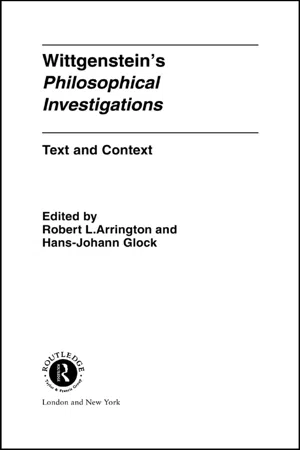
Wittgenstein's Philosophical Investigations
Text and Context
- 256 pages
- English
- ePUB (mobile friendly)
- Available on iOS & Android
eBook - ePub
Wittgenstein's Philosophical Investigations
Text and Context
About this book
Information
Chapter 1
‘Bring me a slab!’: meaning, speakers, and practices Merrill Ring
My text will be those three paragraphs—§19(b), §20(a) and §20(b)—of the Philosophical Investigations1 in which Wittgenstein investigates the relationship between the expressions ‘Slab!’ and ‘Bring me a slab!’
The material in those paragraphs seems to be interpolated into that location in the Investigations. Where in his texts to place the discussion of that topic was a continuing problem for Wittgenstein. He first inserted it in the Brown Book as a very long parenthetical note immediately following §1. In his attempt to revise that dictated work for publication, the discussion remained in its original place, as a very early disruption of the central flow of thought.2 When a few months later, he gave the revision up as a bad job and began writing the first version of the Investigations, these paragraphs (with changes of detail) became §§17, 18, and 19 of the new work3 and then evolved into their final location as Investigations §19(b) and §20(a and b). Despite the relocation, the material still seems to me interpolated into the main text. I have not found any way of making a significant connection between it and the preceding §19(a) or the following §21. All in all, Wittgenstein seems to have been struck with the importance of the topic and largely pleased with his handling of it, and so worked to include it in what he hoped to make public of his investigations. None the less, it seems, he could never find a natural home for it in his texts.
I shall attempt to provide for this material a thorough philosophical commentary, although, as it will work out, §20(a) will elude my grasp. Since the paragraphs in question constitute the longest unit of thought in Part I of the Investigations, resulting commentary will be lengthy. My aim is that of a cartographer of territory already generally known: to produce a detailed map, to give philosophers looking into Wittgenstein a useful, detailed account of one district of the country of the Investigations. It will turn out that the sections to be described do contain an investigation important both philosophically and to the understanding of Wittgenstein. Still, my aim here will not be to use Wittgenstein to attack a philosophical issue, but to try to understand what he is up to.4
It is appropriate to mention at the outset what one of my findings will be. I will argue that while there are some highly important lessons Wittgenstein wants to get across in these paragraphs, confusions, often organizational but at least once intellectual, prevent him from achieving a perspicuous presentation.
I
But what about this: is the call ‘Slab!’ in example (2) a sentence or a word?—If a word, surely it has not the same meaning as the like-sounding word of our ordinary language, for in §2 it is a call. But if a sentence, it is surely not the elliptical sentence: ‘Slab!’ of our language.—As far as the first question goes you can call ‘Slab!’ a word and also a sentence; perhaps it could be appropriately called a ‘degenerate sentence’ (as one speaks of a degenerate hyperbola); in fact it is our ‘elliptical’ sentence.
(PI §196)
Wittgenstein begins with a question about example (2), the language-game of §2 of the Investigations. It is a question as to the status of its elements: are they words or sentences? However, anyone who attempts to use that question and the notions of word and sentence as guides to the subject matter of §19(b) and §20 will become thoroughly lost.
There are two very good reasons why it would have been appropriate for Wittgenstein to investigate the status in example (2) of ‘Slab!’, etc. First, such a problem is suggested by a part of the Augustinian picture of language which Wittgenstein has, to this point in the text, ignored. That picture was fully specified in §1 of the Philosophical Investigations as the idea that words are names of objects and that sentences are combinations of words. In inventing a language in which the sentences are not combinations of words, Wittgenstein undermined that second conjunct of the picture. Here he calls attention to that undermining. One must also see the question in a second context. The topic will have been raised not just in criticism of the Augustinian picture generally but also in criticism of its specific deployment in the Tractatus. There he had held that propositions are combinations of words: ‘An elementary proposition consists of names. It is a nexus, a concatenation of names’ (TLP 4.22).
Although both those concerns are pertinent, we must not think that they provide the key to §19(b) and §20. To see that, consider his answer to the question ‘Is “Slab!” in example (2) a sentence or a word?’ He gives an ‘Either or both’ answer, although expressing a preference for calling it a limiting case of a sentence. Contrast what he does here with the tactics employed in the Brown Book:
Let us now look at the different kinds of signs which we have introduced. First let us distinguish between sentences and words. A sentence I will call every complete sign in a language-game, its constituent signs are words. (This is a merely rough and general remark about the way I will use the words ‘proposition’ and ‘word’.)
(BB p. 82)
In that rough definition, completeness is the key notion. A consequence is that a sentence may consist of a single word when that word functions as a complete sign. In answer to his question about the status of ‘Slab!’, Wittgenstein does not explicitly offer that definition. But it surely is behind his answer that ‘Slab!’ in example
(2) is not only a word but also a sentence, that is, a complete sign.
If we assume that Wittgenstein’s fundamental concern in §19(b)-20 is in criticizing an aspect of the Augustinian picture which he had himself earlier accepted, we shall be disappointed. His response to the question about the status of ‘Slab!’ in example (2) runs neither long nor deep. The answer is given quickly and the machinery used in the Brown Book is not even presented. Nor is what he produces a deep analysis or a deep criticism: what he says merely shows the view to be mistaken.
The suspicion must be that the real issue in §19(b) is something different from what he implies it to be. That suspicion is borne out by the fact that he begins his answer by saying ‘As far as the first question goes…’. There is, then, some second question which he had in mind. Unhappily, he does not explicitly ask that other. It is not, however, difficult to infer. The interlocutor’s second and third sentences imply a question. Generally formulated, the implied question is: ‘Does “Slab!” in example (2) mean the same as the corresponding expression in our language?’
Wittgenstein’s interlocutor gives a ‘No’ answer to that implicit question. That is, it is denied that there is sameness of meaning no matter which reply is given to the explicit question. If ‘Slab!’ in example (2) is a word, then it does not mean the same as our word ‘slab’; but if it is a sentence, that sentence does not mean the same as our sentence ‘Slab!’
Consider first the claim that the word ‘slab’ in example (2) does not have the same meaning as our word ‘slab’. In the Brown Book this is the explicit and primary issue: ‘Note: Objection: The word “Brick” in language 1) has not the meaning which it has in our language’ (BB p. 77). That assumes that ‘Slab!’ in example (2) is a word. In adapting this material for the Investigations, it looks as if Wittgenstein noticed the assumption and responded by tacking on an opening discussion of whether ‘Slab!’ is a word or a sentence. A better response, of course, would have been a more complete restructuring.
Wittgenstein also added to the original Brown Book material the reason for denying that, if ‘Slab’ in example (2) is a word, it means the same as our word: ‘for in (2) it is a call.’
In the Brown Book Wittgenstein responded to that ‘No’ answer concerning the sameness of meaning of the word ‘slab’ in the two languages. ‘This is true if it means that in our language there are usages of the word “brick” different from our usages of this word in 1). But don’t we sometimes use the word “brick” in just this way?’ (BB pp. 77–8). That is, he agrees that the word has not the same meaning in the two languages, but his agreement is conditional. They do not mean the same if the point of saying this is to note that we use the word ‘slab’ in ways other than they do. For them it is only a call. We can use it as a call and also in other ways. Hence, it would be misleading to say, as the imagined answer does, that the two expressions do not have the same meaning; but it would be equally misleading to claim that they just do mean the same.
While that reply is given in the Brown Book, it is not to be found in the Investigations. In fact Wittgenstein says nothing in the later work about the interlocutor’s explicitly made argument that the two words do not have the same meaning. One might explain this by saying that he came to agree with the claim that the two expressions do not mean the same. While that would certainly explain his silence, such a move is not plausible. The reply given in the Brown Book is so characteristic of Wittgenstein. It is much more plausible to explain the omission of a reply by saying that Wittgenstein, in the Investigations, came to be uninterested in the issue that he had used in the Brown Book to structure the discussion. Perhaps that is because he has already said that the best answer to the question about the status of ‘Slab!’ in example (2) is that it is a degenerate sentence. That may deflect him from the issue as to whether the two expressions mean the same if ‘Slab!’ in example (2) is a word. This, however, is only a guess. The central point is that we have not yet identified a topic which Wittgenstein pursues in §19(b).
Turn now to the second of the interlocutor’s claims: that if ‘Slab!’ in example (2) is a sentence, then it does not mean the same as the sentence ‘Slab!’ in our language. First, my account of the claim needs some defence, since I put it as a claim about meaning, although that is not the terminology in the text. But what would it mean to say, as does Wittgenstein speaking as critic, that their ‘Slab!’ and our ‘Slab!’ are the same? The issue must be whether the two mean the same. That reading is supported by the fact that when Wittgenstein introduced the parallel issue about the words ‘slab’, he explicitly put it in terms of whether they meant the same. The interlocutor clearly seems to be raising the same concern about the calls or sentences in the two languages.
Hence the implicit question, the one Wittgenstein had in mind but did not make explicit, is ‘Does the call “Slab!” in example
(2) mean the same as our call “Slab”?’ Wittgenstein, again, imagines a ‘No’ answer. He does not immediately cite, as he did in the concern about the words ‘slab’, a reason for that denial, although the word ‘elliptical’ does, of course, provide some indication of such a reason.
Unlike his procedure with respect to the claim that the words ‘slab’ do not mean the same, Wittgenstein does reply to the parallel claim about the sentences or calls. And he objects to the interlocutor’s denial of sameness of meaning: ‘in fact it is our “elliptical” sentence.’ That is, his claim is that the interlocutor is wrong; the two calls or sentences do mean the same.
All that Wittgenstein does, however, is to assert the contradictory of the interlocutor’s answer. No argument is given for or against either answer. The upshot is that his response is left in an unsatisfactory state. I take the absence of any substantial discussion as a sign that we have not yet reached a topic which can be represented as the subject matter of §19(b). This issue of sameness of meaning will not entirely vanish, however, but the role it plays is not that of the chief subject-matter of §19(b) and its sequels.
But that is surely only a shortened form of the sentence ‘Bring me a slab’, and there is no such sentence in example (2).
With the above lines, we have reached the point at which the central issue of §19(b) begins to emerge. Here Wittgenstein has the interlocutor state the reasons for his claim that ‘Slab!’ does not mean the same in the two languages. The reasoning can be set out as follows.
P1 Our (call/sentence) ‘Slab!’ is a shortened form of our (call/sentence) ‘Bring me a slab!’
P2 In example (2) there is no such sentence as ‘Bring me a slab!’
C1 Hence their ‘Slab!’ cannot be a shortened form of ‘Bring me a slab!’
C2 Hence their call cannot mean the same as ours.
Wittgenstein has already rejected the ultimate conclusion: he said their call means the same as ours. However, P2 is true given the description of example (2), and C1 follows from P2. Moreover, Wittgenstein will not deny P1: he will readily allow that our ‘Slab!’ is short for ‘Bring me a slab!’ What, then, is wrong with the argument?
There is a suppressed premise which is necessary for the conclusion to follow. P1, P2, and C1 talk about whether expressions are elliptical or not. They do not mention meaning at all. Yet the final conclusion says something about meaning. There must be an assumption which connects up what an expression means and whether or not it is elliptical. What must be assumed to make the argument work is something on the order of:
P3 An elliptical form of words cannot mean precisely the same as its non-elliptical counterpart.
With that premise the interlocutor’s claim does follow: ‘Slab!’ in example (2), which is not elliptical, cannot mean the same as our ‘Slab!’, which is elliptical.
Perhaps surprisingly, it is the thesis expressed by that missing premise which is the long-awaited key to interpreting §19(b) and what follows. Before going on to consider the substance of the matter, it is necessary to consider a feature of the thesis which has a bearing upon our attempts to understand how the discussion proceeds.
The assumption ‘An unshortened expression and a shorthand version of it cannot mean the same’ is perfectly general. It can have application to expressions which lie wholly within our language as well as to expressions in two languages (as was the case in the above argument). It is that generality, that possibility of applying the assumption to the relation between two expressions within our language, which guides the remainder of Wittgenstein’s discussion in the rest of §19 and until the very last words of §20.
For the fact of the matter is that after this point nothing more is said about the relation between our language and example (2). Example (2) drops out of the discussion entirely. Wittgenstein does not even attempt to show why the two calls ‘Slab!’ mean the same, although he has asserted that they do. His reasons for that assertion can be constructed out of what he goes on to say, but he is not at all concerned to do that himself. His interest shifts fully to the relation between our expression ‘Slab!’ and our ‘Bring me a slab!’.
Looking back, it might be said that Wittgenstein could have saved himself and his readers a great deal of trouble had he begun §19(b) straightforwardly by having the interlocutor say, ‘Our call “Bring me a slab!” cannot mean the same as our “Slab!” because the second is elliptical for the other.’ For such is the real starting point of his investigation in these connected sections. Yet that brisk way of dealing with the textual difficulties has its shortcomings. It simply does not take into account the structure of the Investigations as Wittgenstein conceived it. The Augustinian picture and example (2) were organizationally in the saddle. To accommodate an issue that has nothing significant to do with example (2) to the main structure of the text, he prefaced the discussion with some connecting tissue which is misleading as to the nature of the problem at hand. The Brown Book strategy for getting the material into the text—its insertion as a purely interpolated comment—is less misleading than the solution adopted in the Investigations.
II
Section 19(b) is not importantly concerned with the contrast between words and sentences or with a contrast between example (2) and our language. To put it baldly, if we ignore the context and take substance only into account, §19(b) should have begun with the interlocutor saying, ‘“Bring me a slab!” cannot mean the same as “Slab!”’. Wittgenstein would then have asked, ‘Why do you say that?’ Behind the response, ‘Because “Slab!” is elliptical’, would be lurking the assumption about the relationship in meaning of elliptical and non-elliptical expressions. And those claims, despite all the misguided stage-setting, do constitute the problem that Wittgenstein investigates in §19(b) and §20.
If the discussion had so begun, it would ...
Table of contents
- Cover Page
- Title Page
- Copyright Page
- Notes on contributors
- Abbreviations
- Introduction
- Chapter 1: ‘Bring me a slab!’: meaning, speakers, and practices Merrill Ring
- Chapter 2: Philosophical Investigations section 122: neglected aspects
- Chapter 3: Philosophical Investigations section 128: ‘theses in philosophy’ and undogmatic procedure 1
- Chapter 4: ‘Tormenting questions’ in Philosophical Investigations section 133
- Chapter 5: Common behaviour of many a kind: Philosophical Investigations section 206
- Chapter 6: Private language: Philosophical Investigations section 258 and environs *
- Chapter 7: Adelheid and the Bishop—what’s the game?
- Chapter 8: The visual room *
- Chapter 9: Making contact in language: the harmony between thought and reality 1
- Chapter 10: ‘Das Wollen ist auch nur eine Erfahrung’
- Chapter 11: Wittgenstein on believing in Philosophical Investigations part II, chapter 10
Trusted by 375,005 students
Access to over 1.5 million titles for a fair monthly price.
Study more efficiently using our study tools.
Frequently asked questions
Yes, you can cancel anytime from the Subscription tab in your account settings on the Perlego website. Your subscription will stay active until the end of your current billing period. Learn how to cancel your subscription
No, books cannot be downloaded as external files, such as PDFs, for use outside of Perlego. However, you can download books within the Perlego app for offline reading on mobile or tablet. Learn how to download books offline
Perlego offers two plans: Essential and Complete
- Essential is ideal for learners and professionals who enjoy exploring a wide range of subjects. Access the Essential Library with 800,000+ trusted titles and best-sellers across business, personal growth, and the humanities. Includes unlimited reading time and Standard Read Aloud voice.
- Complete: Perfect for advanced learners and researchers needing full, unrestricted access. Unlock 1.5M+ books across hundreds of subjects, including academic and specialized titles. The Complete Plan also includes advanced features like Premium Read Aloud and Research Assistant.
We are an online textbook subscription service, where you can get access to an entire online library for less than the price of a single book per month. With over 1.5 million books across 990+ topics, we’ve got you covered! Learn about our mission
Look out for the read-aloud symbol on your next book to see if you can listen to it. The read-aloud tool reads text aloud for you, highlighting the text as it is being read. You can pause it, speed it up and slow it down. Learn more about Read Aloud
Yes! You can use the Perlego app on both iOS and Android devices to read anytime, anywhere — even offline. Perfect for commutes or when you’re on the go.
Please note we cannot support devices running on iOS 13 and Android 7 or earlier. Learn more about using the app
Please note we cannot support devices running on iOS 13 and Android 7 or earlier. Learn more about using the app
Yes, you can access Wittgenstein's Philosophical Investigations by Robert Arrington, Hans-Johann Glock, Robert Arrington,Hans-Johann Glock in PDF and/or ePUB format, as well as other popular books in Philosophy & Philosophy History & Theory. We have over 1.5 million books available in our catalogue for you to explore.